


Quality assurance pharma jobs protect medicines through strong systems, disciplined records, and risk controls. Moreover, these roles connect GMP compliance with daily decisions across pharmaceutical operations. Therefore, QA professionals influence product quality long before patients receive finished medicines. On September 3, 2026, LinkedIn showed 4,853 Quality Assurance Pharma results.
This guide explains roles, qualifications, salaries, career growth, and application strategies. Additionally, it connects each topic with GMP, QMS, CAPA, and quality risk management. Use the Pharma Jobs page to compare current pharmaceutical career opportunities.
Table of Contents
What Are Quality Assurance Pharma Jobs?
Quality assurance pharma jobs manage systems that keep pharmaceutical work controlled and compliant. Therefore, QA teams focus on prevention instead of relying only on final testing. They create procedures, review records, investigate events, and control important changes. Moreover, they support batch record review, audit readiness, and inspection readiness. FDA guidance links modern quality systems with 21 CFR Parts 210 and 211.
Meanwhile, ICH Q10 describes a lifecycle pharmaceutical quality system model. That model includes CAPA, change management, monitoring, and management review. Therefore, strong QA professionals understand systems, evidence, risk, and accountability. They also protect data integrity through clear records and controlled documentation. Consequently, pharmaceutical QA jobs demand both technical knowledge and careful judgment.
Key Responsibilities in Pharmaceutical Quality Assurance
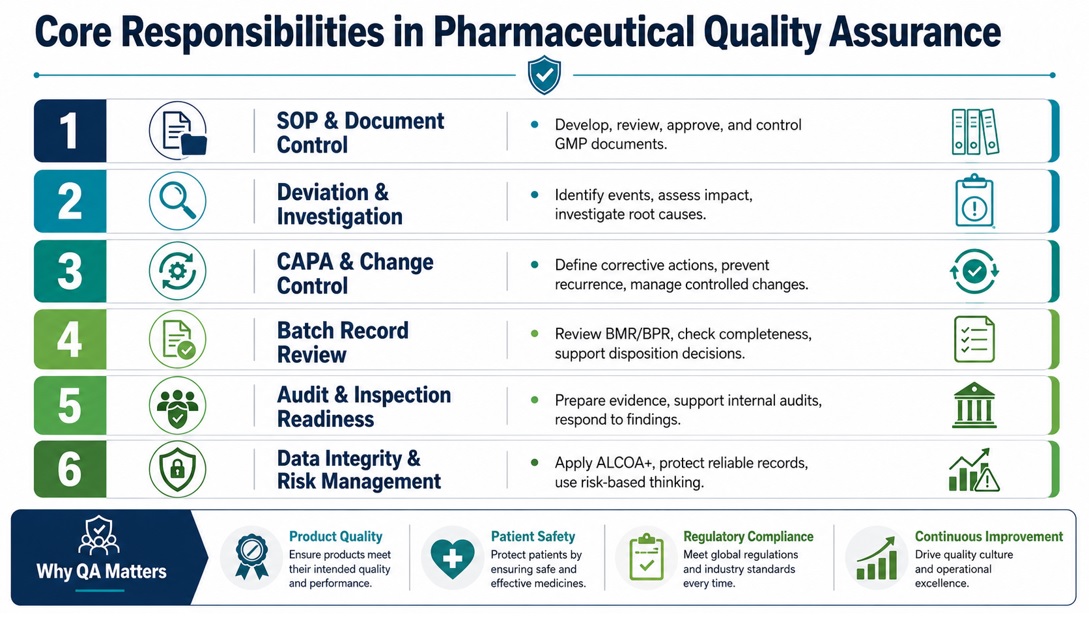
First, candidates should understand the daily responsibilities behind pharmaceutical quality assurance jobs. These responsibilities vary by product, site, company, and seniority. However, several activities appear repeatedly across current pharma QA jobs.
- Control SOP documentation, training records, forms, and other approved quality documents.
- Support deviation investigation, root cause analysis, CAPA, and effectiveness checks.
- Review batch records, laboratory documentation, and supporting quality evidence.
- Assess change control requests and identify potential quality or compliance impacts.
Most Common Pharmaceutical Quality Assurance Jobs
Pharmaceutical quality assurance jobs cover several responsibility levels and technical specialties. Therefore, job titles alone rarely explain the complete scope. One company may use QA Officer for investigation-focused responsibilities. Another company may assign similar work to a QA Specialist.
Quality systems teams may focus on governance, metrics, and inspection readiness. Managers usually oversee people, major decisions, and QMS effectiveness.
Key commun QA jobs include:
Number 1 Quality Assurance Associate Jobs
Number 2 Specialist and QA Officer Roles
Number 3 Quality Systems and Compliance Jobs
Number 4 Quality Assurance Manager Jobs
Pharmaceutical Quality Assurance Jobs
| Role | Typical scope | Core skills | Related search term |
|---|---|---|---|
|
QA Associate |
Documentation support, training, batch review, deviation support |
GMP, SOPs, document control, attention to detail |
pharmaceutical quality assurance associate jobs |
|
QA Specialist / Officer |
Investigations, CAPA, change control, audit support |
QMS, RCA, risk assessment, batch record review |
pharma quality assurance specialist jobs |
|
Quality Systems / Compliance |
QMS governance, metrics, audits, inspection readiness |
CAPA effectiveness, trending, document governance, QRM |
quality systems jobs |
|
QA Manager |
Team leadership, escalations, strategy, major investigations |
Leadership, inspection readiness, QMS oversight, risk decisions |
pharmaceutical quality assurance manager jobs |
Number 1 Quality Assurance Associate Jobs
Quality Assurance Associate jobs often provide an accessible entry pathway. These roles usually emphasize controlled execution, accurate records, and procedural discipline. Associates may support SOP updates, document control, and training administration. They may also support deviations, batch review, and inspection preparation. Therefore, attention to detail strongly affects performance at this level. Many employers also value clear writing and reliable follow-through. ZipRecruiter reported a $60,925 average U.S. salary in August 2026.
Number 2 QA Specialist and QA Officer Roles
QA Specialist and QA Officer roles require more independent quality judgment. These professionals often lead investigations and coordinate cross-functional quality actions. They may manage CAPA records, change control, and batch record review. Moreover, specialists frequently support audits, inspections, and quality risk assessments. Therefore, employers expect stronger QMS understanding at this career stage.
Candidates should explain how they assess impact before choosing corrective actions. They should also show how they verify CAPA effectiveness after implementation. ZipRecruiter reported a $71,279 U.S. average during August 2026.
Number 3 Quality Systems and Compliance Jobs
Quality Systems and Compliance jobs focus on overall QMS performance. These roles often manage document governance, training systems, and quality metrics. They also monitor CAPA effectiveness, recurring deviations, and inspection readiness. Teams may lead internal audits and management review activities.
ICH Q10 identifies several core elements within an effective pharmaceutical quality system. These elements include CAPA, change management, monitoring, and management review. Therefore, quality systems professionals need strong trend analysis and governance skills. They should also understand risk-based prioritization and cross-functional escalation.
Number 4 Management Review
Quality Assurance Manager jobs combine technical leadership with organizational accountability. Managers oversee teams, serious investigations, escalations, and quality system performance. They often review major deviations, CAPA plans, and inspection commitments. Moreover, managers set priorities when several quality risks compete for resources.
Salary.com reported a $129,997 U.S. average in August 2026. The reported middle range reached $116,736 through $142,174 annually.
What Qualifications Do You Need for Pharmaceutical QA Jobs?
Employers usually expect a life-science foundation and evidence from regulated environments. However, exact education requirements vary across pharmaceutical quality assurance jobs. Many employers consider pharmacy, chemistry, biology, biotechnology, engineering, or related degrees. Advanced degrees can help, although many operational roles prioritize relevant experience. Therefore, candidates should focus on job-specific evidence rather than degree titles alone. Practical GMP training also strengthens entry-level and career-transition applications.
- Show GMP or cGMP training that matches pharmaceutical manufacturing expectations.
- Highlight QMS experience involving deviations, CAPA, change control, or document control.
- Describe batch record review, SOP documentation, and regulated record responsibilities.
Typical QA Salary by Experience Level
salary data helps candidates compare responsibility levels and market expectations. However, salary sources use different methods, titles, and datasets. Therefore, readers should compare several benchmarks before negotiating compensation. ZipRecruiter reported $60,925 for Pharmaceutical Quality Assurance Associates during August 2026. It reported $71,279 for Pharmaceutical Quality Assurance Specialists during August 2026.
QA Salary by Role
| Role | 2026 U.S. benchmark | Interpretation |
|---|---|---|
|
Pharmaceutical QA Associate |
$60,925 average |
Entry-level and early-career benchmark |
|
Pharmaceutical QA Specialist |
$71,279 average |
Experienced individual-contributor benchmark |
|
Pharmaceutical QA Manager |
$129,997 average |
Leadership benchmark; scope varies widely |
Career Path from QA Associate to QA Manager
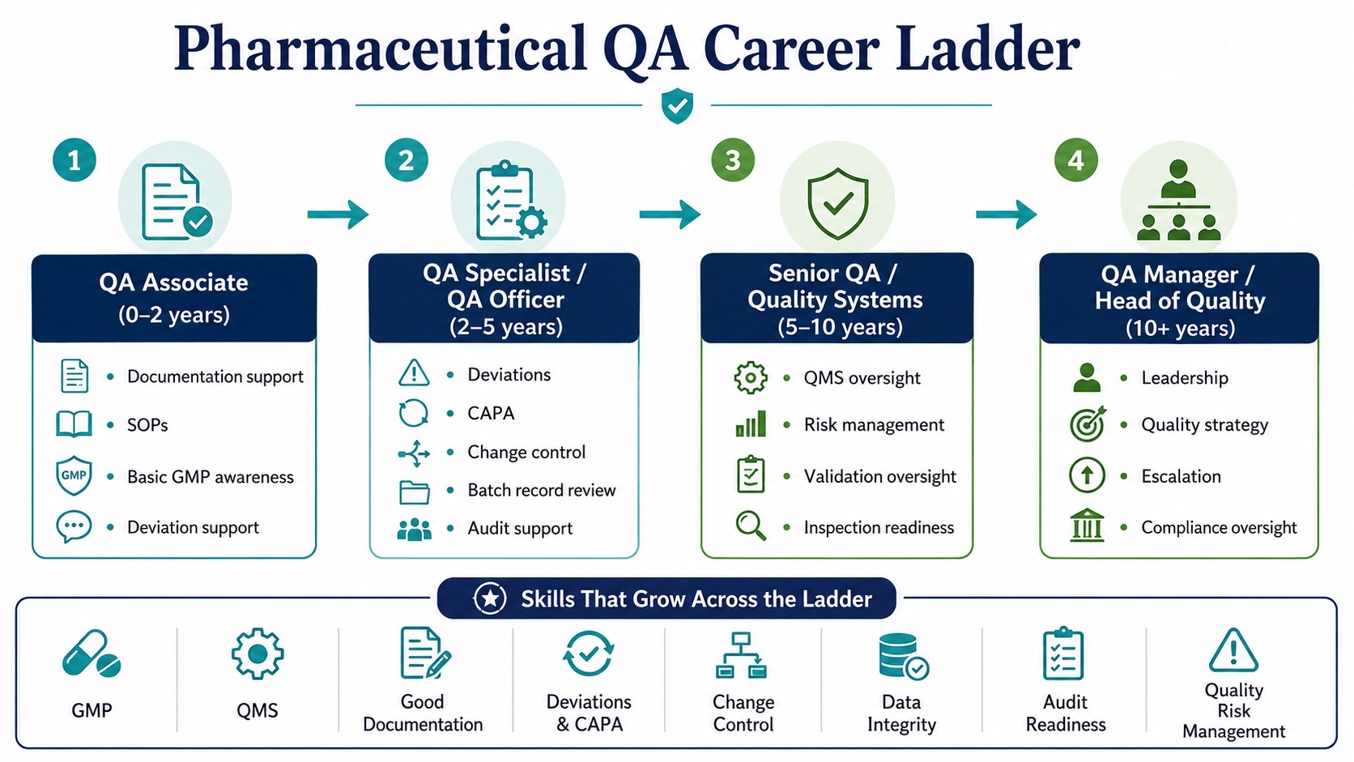
QA career growth usually follows increasing responsibility and broader decision authority. A common pathway starts with QA Associate responsibilities. Next, professionals often move into QA Specialist or QA Officer roles. Then, experienced staff may lead quality systems, investigations, or compliance programs.
How to Find and Apply for Quality Assurance Pharma Jobs in 2026
Finding quality assurance pharma jobs in 2026 requires focused search methods. Therefore, candidates should avoid using one broad keyword repeatedly. Use several related keywords that match your preferred responsibility level. Search pharmaceutical quality assurance jobs when you want broader industry results. Search pharmaceutical quality assurance associate jobs for entry-level opportunities.
Final Word
Quality assurance pharma jobs offer several routes into regulated pharmaceutical careers. Demand also remains visible in the market: on September 3, 2026, LinkedIn showed 4,853 Quality Assurance Pharma job results. However, success requires more than understanding GMP terminology. Strong professionals combine QMS knowledge with disciplined documentation and practical judgment. They also manage deviations, CAPA, change control, audits, and quality risks. Moreover, their decisions can directly influence product quality and patient safety.
Candidates should build evidence around real responsibilities and measurable outcomes. Career growth usually follows deeper technical ownership and broader leadership responsibility. Salary data also reflects this progression: the article reports an average U.S. salary of $129,997 for Pharmaceutical QA Managers in August 2026. Finally, use current job data and credible regulatory sources during career planning. Then, update your resume and target roles that match your strongest evidence.
FAQs
A science-related degree often helps, but employers also value regulated experience. Pharmacy, chemistry, biology, biotechnology, and engineering backgrounds appear frequently.
Yes, many candidates enter QA through associate, technician, or document-control positions. Manufacturing and QC experience can also create strong transfer pathways.
Current U.S. averages vary strongly by responsibility level. Associates average about $60,925 annually. Specialists average about $71,279, while Managers average about $129,997

Ershad Moradi
Ershad Moradi, a Content Marketing Specialist at Zamann Pharma Support, brings 6 years of experience in the pharmaceutical industry. Specializing in pharmaceutical and medical technologies, Ershad is currently focused on expanding his knowledge in marketing and improving communication in the field. Outside of work, Ershad enjoys reading and attending industry related networks to stay up-to-date on the latest advancements. With a passion for continuous learning and growth, Ershad is always looking for new opportunities to enhance his skills and contribute to pharmaceutical industry. Connect with Ershad on Facebook for more information.

GMP Audit Checklist 2026: The Essential Guide for Risk-Based Audits
Master your GMP Audit Checklist with a practical, risk-based approach to pharmaceutical self-inspections. Explore five essential audit steps, FDA’s six-system model, GMP documentation and evidence sampling, audit findings, CAPA tracking, and effectiveness verification to strengthen compliance and inspection readiness.
Orphan Drug Designation in 2026: FDA and EMA Eligibility Criteria
Discover how orphan drug designation works in 2026. Compare FDA and EMA eligibility criteria, rare disease prevalence thresholds, scientific evidence requirements, and regulatory incentives. Learn what pharmaceutical sponsors need to prepare for successful regulatory submissions

CEP certificate in pharma: What QA Must Verify in 2026
Learn how QA teams verify EDQM certificates, assess API suppliers, and prepare for GMP inspections. This guide explains CEP 2.0 updates, impurity controls, and essential records that help maintain regulatory compliance and inspection readiness across pharmaceutical manufacturing operations.