


Quality assurance pharma jobs protect medicines through strong systems, disciplined records, and risk controls. Moreover, these roles connect GMP compliance with daily decisions across pharmaceutical operations. Therefore, QA professionals influence product quality long before patients receive finished medicines. On September 3, 2026, LinkedIn showed 4,853 Quality Assurance Pharma results.
This guide explains roles, qualifications, salaries, career growth, and application strategies. Additionally, it connects each topic with GMP, QMS, CAPA, and quality risk management. Use the Pharma Jobs page to compare current pharmaceutical career opportunities.
Table of Contents
What Is a Biopharma Job?
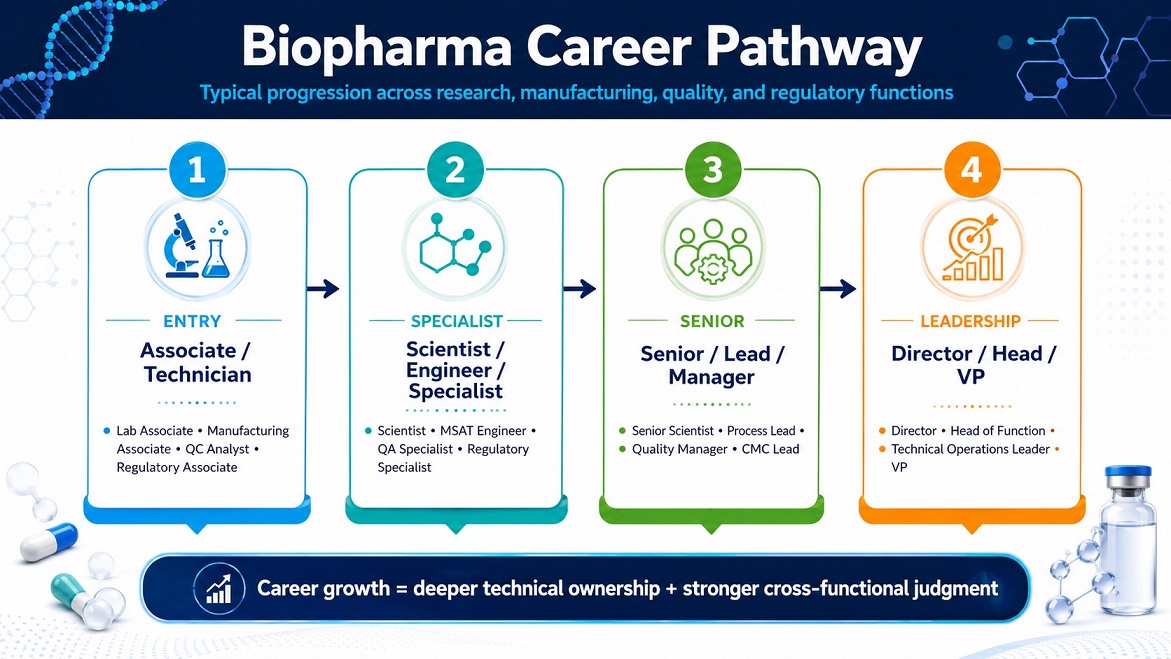
A biopharma job combines life science with pharmaceutical development or manufacturing. Teams transform biological knowledge into controlled, reproducible, and compliant products. Work may involve discovery, cell culture, purification, quality, CMC, or clinical development.
Some roles support commercial supply, pharmacovigilance, or regulatory submissions. Therefore, the sector needs scientists and operational specialists. Employers also value documentation, collaboration, and regulated decision-making.
What Types of Jobs Are Available in Biopharma?
Biopharma careers span the complete product lifecycle. Roles differ by product, company size, and development stage.
Different types of jobs available in biopharma are
Type 1 Research and Development Jobs
Type 2 Biopharma Manufacturing and Bioprocessing Jobs
Type 3 Quality Assurance and Quality Control Jobs
Type 4 Regulatory Affairs and CMC Jobs
Type 5 Clinical Research, Pharmacovigilance, and Medical Affairs Jobs
Type 6 Supply Chain and Commercial Biopharma Jobs
The table below summarizes common pathways.
Common pathways available in biopharma
| Role Area | Typical Level | Core Responsibilities | Required Skills |
|---|---|---|---|
|
Research and Development |
Associate to scientist |
Experiments, assays, development |
Biology, analytics, statistics |
|
Manufacturing and MSAT |
Associate to engineer |
Production, scale-up, troubleshooting |
GMP, bioprocessing, investigations |
|
Quality |
Analyst to manager |
Testing, review, compliance |
QC, QA, data integrity |
|
Regulatory and CMC |
Associate to director |
Submissions, strategy, change assessment |
CMC, writing, regulations |
Type 1 Research and Development Jobs
R&D teams investigate targets, mechanisms, formulations, assays, and product characteristics. Scientists may work with proteins, cells, vectors, or analytical methods. Employers expect experimental design and clear technical documentation. Moreover, data interpretation strongly influences development decisions.
Type 2 Biopharma Manufacturing and Bioprocessing Jobs
Manufacturing teams convert processes into reliable clinical or commercial production. Areas include upstream, downstream, aseptic operations, and fill-finish. Associates execute procedures and record critical activities. MSAT teams connect process knowledge, technology transfer, and performance.
Type 3 Quality Assurance and Quality Control Jobs
QC teams test materials, intermediates, environments, and finished products. QA teams govern systems that ensure compliant execution. Their work includes deviations, CAPA, change control, and batch review. Additionally, quality staff support audits and inspection readiness.
Type 4 Regulatory Affairs and CMC Jobs
Regulatory teams translate development evidence into submission strategies. CMC specialists organize manufacturing, controls, specifications, and lifecycle changes. They coordinate with development, quality, and manufacturing. Therefore, technical writing and change assessment are important.
Type 5 Clinical Research, Pharmacovigilance, and Medical Affairs Jobs
Clinical teams manage trials across development phases. Pharmacovigilance teams assess safety information and emerging risks. Medical affairs teams communicate scientific evidence. These roles need strong judgment, communication, and cross-functional collaboration.
Type 6 Supply Chain and Commercial Biopharma Jobs
Supply teams manage materials, capacity, inventory, and cold-chain requirements. Commercial teams support launches, market access, and customer strategy. These roles combine business skills with product understanding. Consequently, science knowledge can strengthen decisions outside laboratories.
What Skills Are Needed for Biopharma Jobs?
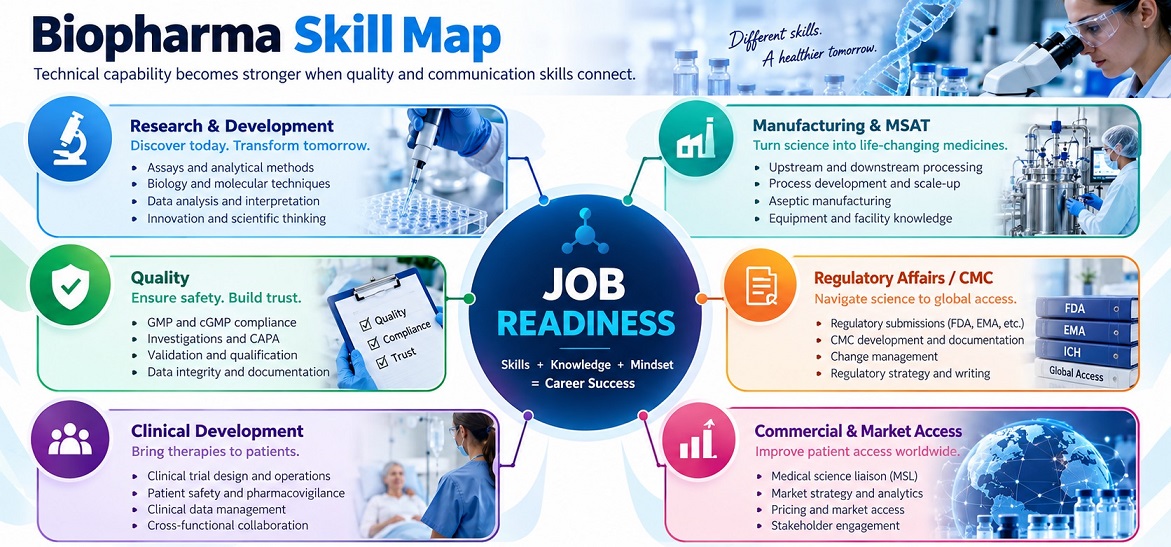
Employers value technical depth and disciplined execution. They also need cross-functional communication. Build evidence for these core capabilities:
- Apply GMP or GxP principles during daily work.
- Document activities clearly and protect data integrity.
- Investigate deviations using structured root-cause methods.
- Understand upstream, downstream, analytical, or aseptic processes.
- Communicate technical risks to different stakeholders.
- Use statistics, digital systems, and controlled data effectively.
Biopharma Jobs by Work Type
Work location depends heavily on the role. Laboratory and manufacturing jobs usually require physical presence. Meanwhile, writing and coordination roles may offer flexibility.
On-Site Laboratory and Manufacturing Roles
Cell culture, purification, microbiology, QC, and aseptic production require specialized facilities. Employees must follow gowning, safety, and controlled procedures. Manufacturing schedules may include shifts or weekends. Therefore, assess operational expectations before applying.
Remote and Hybrid Biopharma Jobs
Remote options appear more often in regulatory, medical writing, data, and project roles. Some clinical and pharmacovigilance tasks can support hybrid work. However, remote availability varies by employer. Strong digital collaboration skills improve competitiveness.
Biopharma Job Salary and Career Growth
Biopharma salaries vary across functions and experience levels. Geography and specialized responsibility also change compensation. Current benchmarks show differences across major career tracks. The figures below represent U.S. averages or medians. They do not guarantee individual offers.
Biopharma Job Salary Comparision
| Role | Experience Signal | Current Salary Benchmark |
|---|---|---|
|
Biomanufacturing Associate |
Early to mid |
$67,637 average |
|
Pharmaceutical QA Specialist |
Mid |
$99,040 average |
|
Regulatory Affairs Specialist |
Mid to senior |
$129,597 average |
|
Medical Scientist |
Advanced scientific |
$103,410 median |
Medical scientist employment should grow 13% through 2035. Biological technician employment should grow 7% during that period. These projections exceed overall U.S. occupational growth. Therefore, scientific demand supports several biopharma pathways.
Where to Search for Biopharma Jobs
Use multiple channels because employers distribute openings differently. Combine broad boards with specialist sources:
- Search LinkedIn using exact role titles and technical keywords.
- Review BioSpace for specialized life-science opportunities.
- Check company career pages for direct postings.
- Use Indeed for broader geographic coverage.
- Follow recruiters focused on biotechnology and pharmaceutical hiring.
- Track CDMO, biotech, and established manufacturer career pages.
Search terms should reflect your technical strengths. For example, combine “MSAT” with bioprocessing or technology transfer. Use “QA” with deviations, validation, or batch release.
How to Prepare for Biopharma Interviews
Interviewers often test technical knowledge and practical judgment. Prepare examples involving problems, decisions, and cross-functional communication. Explain how you protected quality while meeting operational goals.
Use concise STAR examples for behavioral questions. Also review the employer’s platform, pipeline, and manufacturing model. Finally, prepare questions about team priorities.
Final Word
A biopharma career requires more than scientific knowledge. Employers need regulated execution, collaboration, and continuous learning. Strong professionals connect technical decisions with product quality and patient outcomes. Therefore, build experience that proves responsibility and reliable judgment.
Current career data also shows strong variation across biopharma functions. The article reports an average U.S. salary of about $67,637 for Biomanufacturing Associates, while Regulatory Affairs Specialists average around $129,597. These figures highlight how specialization, experience, and regulatory responsibility can significantly influence earning potential.
Keep learning about new modalities, regulations, and digital tools. A focused search can turn specialized skills into meaningful career opportunities.
FAQs
Manufacturing associates, laboratory technicians, QC analysts, and clinical coordinators offer common entry routes. Availability depends on regional employers and product pipelines. Contract roles can also provide practical experience.
Not every entry role requires previous GMP employment. However, basic GMP knowledge improves interview readiness. Candidates should understand controlled documentation and data integrity.
Current U.S. averages vary strongly by responsibility level. Associates average about $60,925 annually. Specialists average about $71,279, while Managers average about $129,997

Ershad Moradi
Ershad Moradi, a Content Marketing Specialist at Zamann Pharma Support, brings 6 years of experience in the pharmaceutical industry. Specializing in pharmaceutical and medical technologies, Ershad is currently focused on expanding his knowledge in marketing and improving communication in the field. Outside of work, Ershad enjoys reading and attending industry related networks to stay up-to-date on the latest advancements. With a passion for continuous learning and growth, Ershad is always looking for new opportunities to enhance his skills and contribute to pharmaceutical industry. Connect with Ershad on Facebook for more information.

GMP Audit Checklist 2026: The Essential Guide for Risk-Based Audits
Master your GMP Audit Checklist with a practical, risk-based approach to pharmaceutical self-inspections. Explore five essential audit steps, FDA’s six-system model, GMP documentation and evidence sampling, audit findings, CAPA tracking, and effectiveness verification to strengthen compliance and inspection readiness.
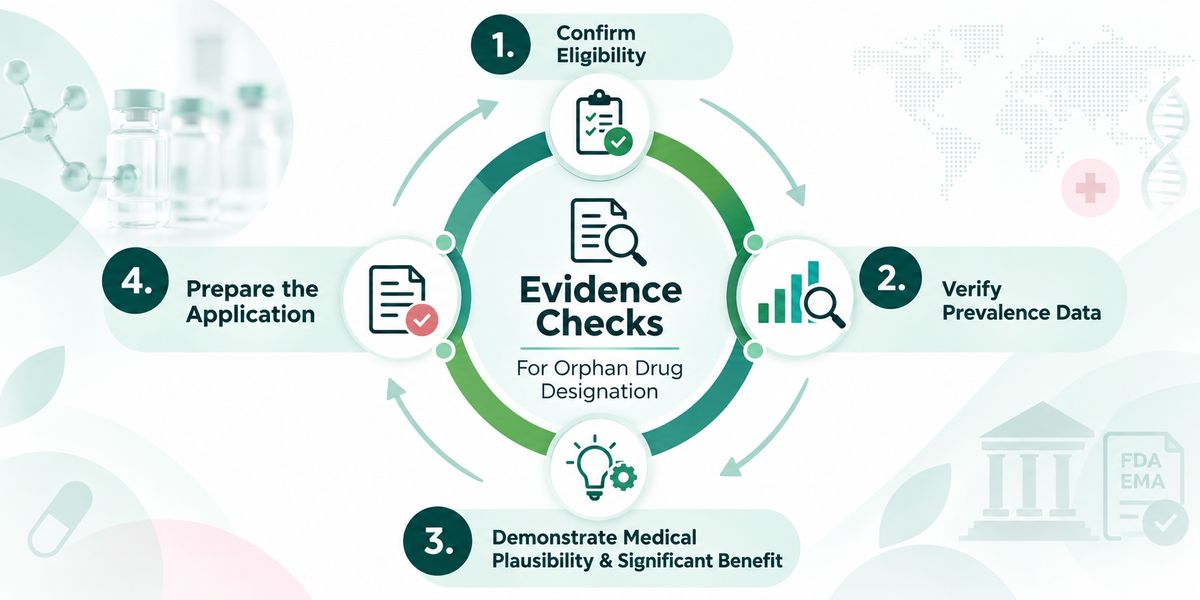
Orphan Drug Designation in 2026: FDA and EMA Eligibility Criteria
Discover how orphan drug designation works in 2026. Compare FDA and EMA eligibility criteria, rare disease prevalence thresholds, scientific evidence requirements, and regulatory incentives. Learn what pharmaceutical sponsors need to prepare for successful regulatory submissions

CEP certificate in pharma: What QA Must Verify in 2026
Learn how QA teams verify EDQM certificates, assess API suppliers, and prepare for GMP inspections. This guide explains CEP 2.0 updates, impurity controls, and essential records that help maintain regulatory compliance and inspection readiness across pharmaceutical manufacturing operations.