


Rising demand across Pharma Jobs makes mastering pharmacovigilance interview questions essential. Safety workloads remain high: in 2025, EudraVigilance collected and managed about 1.77 million individual case safety reports (ICSRs). This guide covers the most common questions in the article itself, and the full set of 60 questions with answers is available as a free PDF at the end.
Use this guide to sharpen ICSR processing, MedDRA coding, and GVP/ICH fundamentals so you stand out.
Table of Contents
Common Pharmacovigilance Interview Questions with Answers
Pharmacovigilance interviews often probe judgment and compliance readiness. Expect questions on ICSR handling, MedDRA coding, causality methods, signal escalation, and documentation quality. Employers test how you think under pressure. They also value clarity and timelines. Below, we group common questions and answers into three practical categories.
- General / HR PV Interview Questions
- Technical PV Interview Questions
- Scenario-Based PV Interview Questions
General / HR PV Interview Questions
Before technical drills, PV interviews start with general questions to assess fit, motivation, and communication. Keep answers structured, concise, and tied to patient safety, compliance, and teamwork.
Q: Tell me about yourself.
A: Clinical pharmacy graduate with PV internship. I handled ICSRs, coded MedDRA, and wrote narratives. I value data, teamwork, and timelines, and aim to improve safety outcomes.
Q: Why pharmacovigilance?
A: Because PV protects patients and uses my analytical strengths. I enjoy causality assessment, trend detection, and communication. Change demands continuous learning, energizing me to maintain compliance.
Q: Your strengths and weaknesses?
A: Strengths: structured thinking, ALCOA+ documentation, and stakeholder communication. Weakness: over-detailing narratives. I mitigate by timeboxing, using checklists, and seeking early feedback to balance precision with speed.
Q: How do you handle tight timelines and pressure?
A: I prioritize by risk and due date, break tasks into blocks, and communicate early. I track timelines with dashboards, request clarifications, and escalate before deadlines slip.
Technical PV Interview Questions
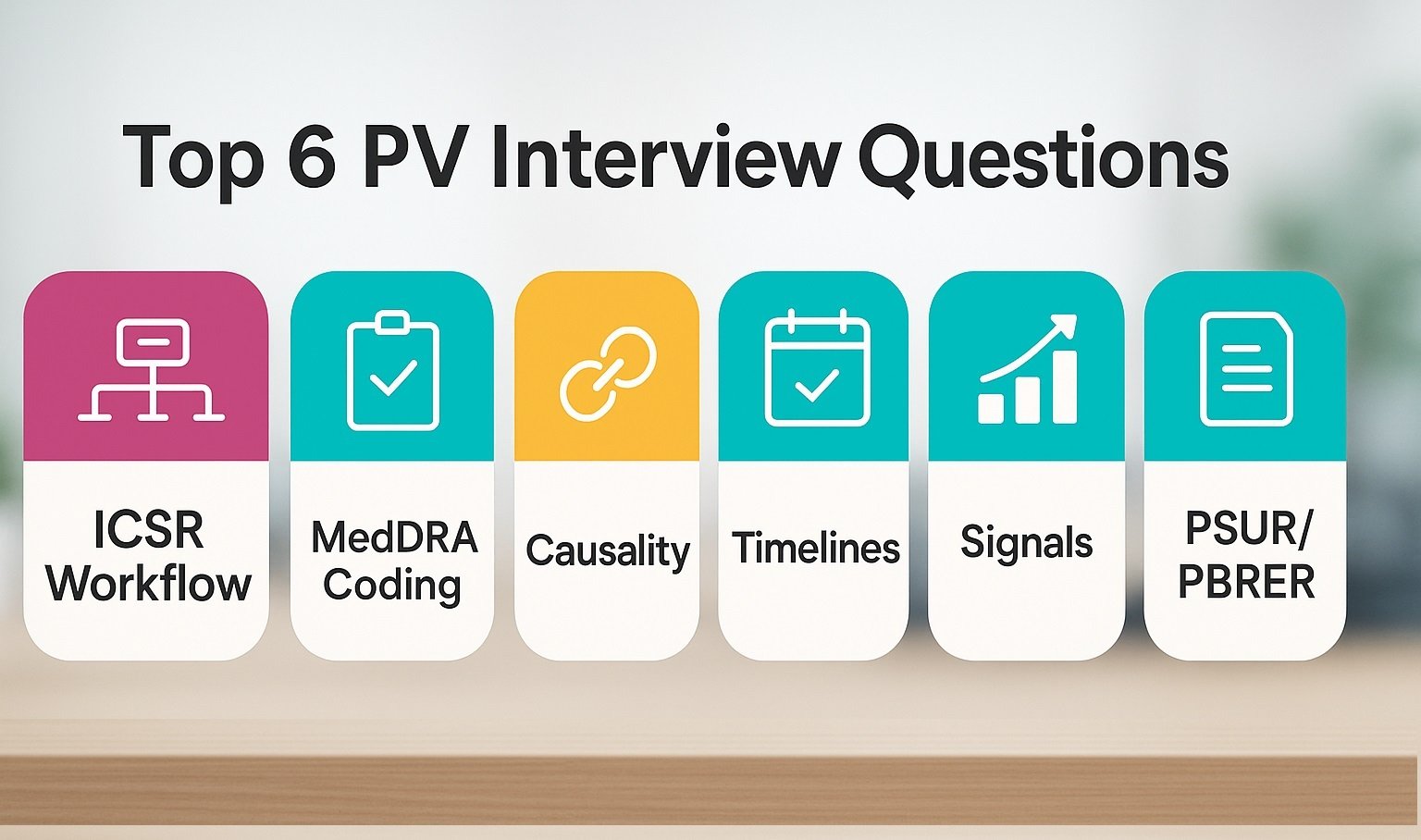
Q: Here’s a concise, interview-ready set of technical PV Q&As covering case processing, MedDRA coding, signal detection, and PSURs/PBRER.
Q: Walk me through ICSR processing.
A: Intake → triage → duplicate check → MedDRA coding → seriousness/expectedness/causality → narrative → follow-up plan → QC → regulatory submission (E2B(R3)) → closure with audit trail.
Q: How do you assess seriousness and expectedness?
A: Apply ICH E2A seriousness criteria. Check expectedness against RSI/label (SmPC/USPI). Document rationale and impact on reporting timelines and aggregate commitments.
Q: Explain your causality approach.
A: Use WHO-UMC or Naranjo. Evaluate temporality, dechallenge/rechallenge, biological plausibility, alternative causes, and dose-response. Record reasoning transparently in the case narrative.
Q: How do you code with MedDRA?
A: Code to the most accurate LLT reflecting verbatim meaning. Confirm hierarchy to PT/SOC. Manage version control, recoding rules, and justify any clinical coding decisions.
Q: When would you use SMQs?
A:For case finding and evaluation. Start narrow for specificity, broaden if needed. Review false positives, clinical context, and signal impact on risk profile.
Reporting Timeline and Signal Questions
Q: What are the EU timelines for reporting post-marketing ICSRs?
A: Marketing authorisation holders must submit serious suspected adverse reactions that occur in the EU or in third countries to EudraVigilance within 15 days. Non-serious reactions that occur in the EEA must be submitted within 90 days. Since December 2025, EMA has also sent monthly compliance notifications on these timelines, so late cases are visible to the organisation.
Q: How do SUSAR timelines differ between the EU and the US?
A: In the EU, sponsors report fatal or life-threatening SUSARs to EudraVigilance within 7 days and other SUSARs within 15 days. If the 7-day report is incomplete, a completed report follows within an additional 8 days. In the US, 21 CFR 312.32 requires sponsors to notify FDA of any unexpected fatal or life-threatening suspected adverse reaction within 7 calendar days, and other IND safety reports within 15 calendar days.
Q: What if a SUSAR first looks non-fatal but later turns out to be fatal or life-threatening?
A: Under the EU Clinical Trials Regulation, the sponsor must then report it as soon as possible and in any event within 7 days of becoming aware that the reaction is fatal or life-threatening. If the initial report is incomplete, a completed report follows within an additional 8 days. Interviewers use this question to check that you track the reporting clock from the moment the seriousness changes, not from the first receipt.
Q: When does the reporting clock start?
A: Day 0 is the date the organisation first receives the minimum information for a valid case: an identifiable patient, an identifiable reporter, a suspect product and an adverse reaction. For follow-up information, the date of the most recent information becomes the new reference date.
Q: What is a safety signal, and what happens next?
A: A signal is information on one or more observed adverse reactions potentially caused by a medicine that warrants further investigation. In the EU, validated signals that the rapporteur or lead Member State confirms go to PRAC for prioritisation and assessment. In 2025, 43% of the signals PRAC assessed led to a recommendation to update the product information, while 20% needed only routine safety monitoring.
Scenario-Based PV Interview Questions
Scenario 1 — Blinded trial SUSAR
Short description: Life-threatening anaphylaxis hours post-dose in a blinded Phase III trial; likely SUSAR requiring rapid unblinding control and 7-day reporting.
Model answer: Secure patient safety; alert PI/medical monitor; confirm minimum criteria; check RSI; assess causality; start 7-day clock; request controlled unblinding; code MedDRA; write ALCOA+ narrative; submit E2B(R3); notify IRB/IEC; set targeted follow-ups; keep full audit trail.
Scenario 2 — Late case with duplicate risk
Short description: Serious unexpected case due tomorrow; outcome unknown; two sources may describe the same patient/event.
Model answer: Submit expedited initial with minimum criteria and note gaps; investigate and merge duplicates per SOP; prioritize follow-ups (diagnosis, outcome, labs, exposure); update timelines; escalate early if risk persists; record deviation; implement CAPA to prevent recurrence.
Tips to Succeed in a Pharmacovigilance Interview
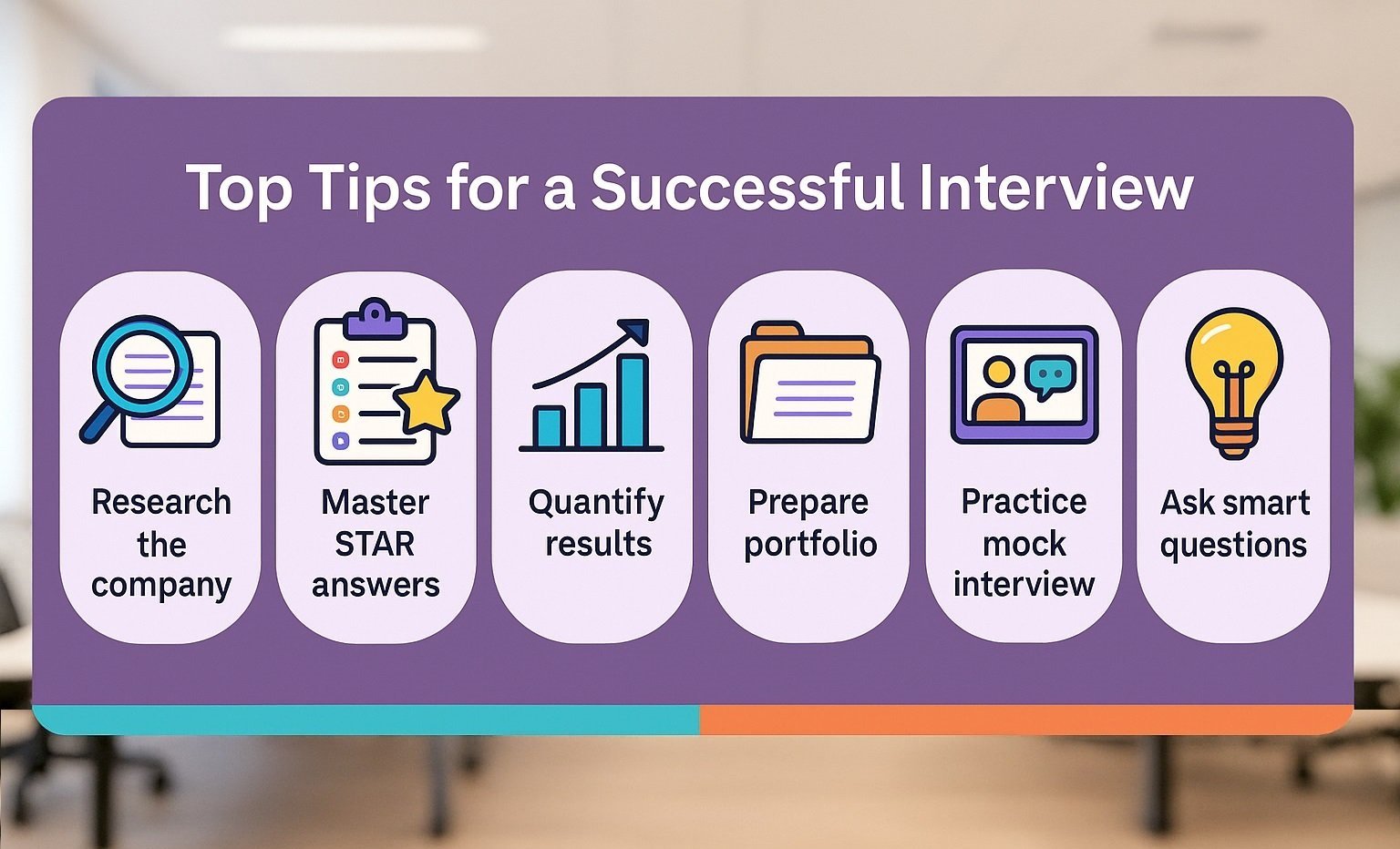
Pharma Career Coaching for pharmacovigilance interview questions—get 1:1 prep that’s fast, practical, and inspection-ready. We drill real ICSR cases, tighten your narratives, and sharpen answers hiring managers expect. Book your session:
DS Associate, Safety Scientist, or QPPV scenarios with scored feedback.
Intake → closure: triage, duplicates, MedDRA, narrative, timelines, QC.
Choose precise LLTs/PTs, manage versioning, explain rationale clearly.
Apply WHO-UMC/Naranjo and ICH criteria under time pressure.
SMQs, trend review, benefit-risk messaging, and PSUR/PBRER essentials.
Turn projects into concise, quantified wins.
Pharmacovigilance Terms to Know in Job Interview
AE (Adverse Event): Any untoward medical occurrence after product use, not necessarily caused by it.
SAE (Serious Adverse Event): AE causing death, life-threat, hospitalization, disability, congenital anomaly, or other significant medical event.
ADR (Adverse Drug Reaction): AE with a suspected causal link to the product.
ICSR (Individual Case Safety Report): A single patient safety report submitted to regulators.
Minimum Criteria: Identifiable patient, reporter, suspect product, and event—starts the reporting clock.
CIOMS: Council standardizing safety report forms (e.g., CIOMS I).
E2B(R3): ICH electronic ICSR transmission standard (XML).
SUSAR: Serious, unexpected, suspected adverse reaction; requires expedited reporting.
GVP: EU Good Pharmacovigilance Practices guideline series.
ICH: International Council for Harmonisation; sets PV/clinical standards.
How to Prepare for a Pharmacovigilance Interview
Reading interview questions is not enough. You should practise explaining each answer in clear, professional language. Use the downloadable PDF to review key pharmacovigilance topics, test your knowledge, and identify weak areas before the interview.
- Practise answering each question aloud.
- Add examples from your education or work.
- Review ICSR, MedDRA, signal detection, and reporting timelines.
- Prepare short answers for technical and behavioural questions.
- Note any topic that requires further study.
Download the Top 60 Pharmacovigilance Interview Questions and Answers
Use this professional PDF as a structured interview preparation guide. It covers common technical questions, regulatory concepts, case-processing topics, and practical interview scenarios. The file can help entry-level candidates and experienced professionals organise their preparation and improve answer quality.
- Review questions by topic instead of randomly.
- Use the answers as guidance, not memorised scripts.
- Personalise each answer with practical examples.
- Practise with a colleague or interview partner.
- Complete a final review one day before the interview.
Test Your PV Knowledge Before the Interview
Final words
Pharma jobs keep evolving, so mastering pharmacovigilance interview questions matters more than ever. Interviewers increasingly test whether you know reporting timelines, signal management and recent regulatory changes, not just definitions. If you are also weighing offers, the pharmacovigilance salary guide shows how pay changes by role and region. coring sustained safety workloads.
This guide covered HR, technical, and scenario questions, plus ICSR, MedDRA, GVP/ICH, and a mini glossary.
FAQs
1️⃣ What do PV interviewers look for?
Sound judgment under pressure, compliance mindset, and clear communication. Prove ICSR fluency, MedDRA accuracy, GVP/ICH awareness, ALCOA+ documentation, timeline discipline, and teamwork with medical, QA, and data functions.
2️⃣ How should I prepare quickly?
Build STAR stories, prepare two practice narratives written from fictional or published cases, and run a timed mock interview. Never share real case data from a current or former employer.
3️⃣ How do I structure strong answers?
Use STAR: Situation, Task, Action, Result. State your decision, the guideline behind it, and the impact (errors reduced, timelines met). Keep it concise, patient-safety first, and inspection-ready.
Refrences
Ershad Moradi, a Content Marketing Specialist at Zamann Pharma Support, brings 6 years of experience in the pharmaceutical industry. Specializing in pharmaceutical and medical technologies, Ershad is currently focused on expanding his knowledge in marketing and improving communication in the field. Outside of work, Ershad enjoys reading and attending industry related networks to stay up-to-date on the latest advancements. With a passion for continuous learning and growth, Ershad is always looking for new opportunities to enhance his skills and contribute to pharmaceutical industry. Connect with Ershad on Facebook for more information.

Protocol Deviations in Clinical Trials: Build an Audit-Ready Record
Protocol deviations can threaten participant protection and trial reliability. This practical guide explains risk-based classification, documentation, escalation, CAPA, and preventive oversight.
eCTD Publishing Software: The Right Features for Submission Success
Discover how eCTD publishing software organizes regulatory dossiers, validates electronic submissions, manages document lifecycles, and supports FDA and EMA workflows.

Pharmaceutical Analytical Testing Services: Essential Quality Insights
A practical guide to pharmaceutical analytical testing services: assay, impurities, dissolution, stability, microbial testing, validation and outsourced-laboratory oversight.