


IQ OQ PQ are critical steps in pharmaceutical equipment and process validation. According to WHO, proper validation reduces manufacturing errors by nearly 40%. Installation Qualification (IQ) verifies correct equipment installation. Operational Qualification (OQ) ensures equipment works as intended. Performance Qualification (PQ) confirms consistent operation under real conditions, safeguarding product quality and safety.
Pharma validation relies on these stages to maintain compliance and reliability. Effective IQ, OQ, PQ processes support regulatory approvals and minimize product recalls. Companies embracing pharma validation improve manufacturing efficiency and patient safety consistently.
Table of Contents
What are IQ, OQ, PQ?
IQ, OQ, and PQ are key steps in pharmaceutical validation processes. Installation Qualification (IQ) verifies proper equipment installation. Operational Qualification (OQ) tests if equipment operates as intended. Performance Qualification (PQ) confirms consistent performance during actual production conditions. These steps ensure manufacturing quality and regulatory compliance.
Together, IQ, OQ, and PQ help prevent errors and maintain product safety. They also reduce risks and improve process reliability. These validations protect patients and enhance company reputation.
- IQ: Confirm equipment installs correctly
- OQ: Verify equipment functions properly
- PQ: Validate consistent performance in real use
Key Differences Between IQ, OQ, and PQ
IQ, OQ, and PQ serve different but connected purposes in pharma validation. IQ ensures 100% equipment complies with installation specifications. OQ verifies 95% of systems operate within defined limits. PQ confirms 99% product quality under real production conditions. These differences ensure thorough validation at every stage.
Together, these steps reduce manufacturing risks and improve compliance. For example, companies practicing full IQ, OQ, PQ validation cut product recalls by 30%. Furthermore, regulators like the FDA require complete validation documentation. Therefore, understanding these differences is vital for pharma quality assurance.
Regulatory Requirements for IQ, OQ, PQ According to FDA and EMA Guidelines
Regulatory bodies like FDA and EMA set clear requirements for IQ, OQ, and PQ in pharma. The FDA Guidance on Process Validation mandates comprehensive equipment and process validation to ensure quality.
Similarly, the EMA Process Validation Guideline emphasizes lifecycle validation and continuous monitoring. Moreover, ICH Q7 GMP Guidelines provide detailed good manufacturing practices for active pharmaceutical ingredients. These regulations ensure safe, consistent drug production.
Pharma companies must follow these guidelines to meet compliance and avoid penalties. They develop validation protocols based on these standards. Key documents include:
- FDA Guidance on Process Validation
- EMA Process Validation Guideline
- ICH Q7 GMP Guidelines
Regulatory Requirements for IQ, OQ, PQ Across FDA, EMA, and ICH
| Requirement Aspect | FDA | EMA | ICH |
|---|---|---|---|
|
Validation Scope |
Equipment, processes, systems |
Lifecycle approach, systems |
Active Pharmaceutical Ingredients (APIs) |
|
Documentation Requirements |
Detailed protocols and reports |
Comprehensive documentation |
Validation master plan and records |
|
Qualification Stages |
IQ, OQ, PQ phases defined |
Installation, operational, performance qualification |
Installation, operational, performance qualification |
|
Risk-Based Approach |
Encourages risk assessment |
Emphasizes continuous monitoring |
Applies risk management principles |
|
Regulatory References |
FDA Process Validation Guidance |
EMA Process Validation Guideline |
ICH Q7 GMP Guidelines |
FDA Guidance on Process Validation PDF
The FDA Guidance on Process Validation outlines requirements to ensure consistent product quality. It emphasizes a lifecycle approach to validation—from process design to ongoing monitoring. Companies follow these steps to meet regulatory expectations and reduce risks. This guidance improves manufacturing reliability and patient safety.
Key points include:
- Define process design and control strategies
- Conduct qualification (IQ, OQ, PQ) phases
- Establish continuous monitoring systems
- Document validation activities thoroughly
EMA Process Validation Guideline PDF
The EMA Process Validation Guideline helps pharma companies ensure consistent product quality and safety. It highlights the importance of a strong validation lifecycle and risk management. Pharmuni offers training to help professionals understand and apply these guidelines effectively. This knowledge supports regulatory compliance and high manufacturing standards.
Key elements include:
- Process design and qualification strategies
- Lifecycle approach and continuous improvement
- Risk-based validation methods
- Thorough documentation and reporting
ICH Q7 GMP Guidelines PDF
The ICH Q7 GMP Guidelines provide essential standards for manufacturing active pharmaceutical ingredients. Pharmuni offers training programs to help professionals apply these guidelines effectively. This training strengthens quality systems and regulatory compliance in pharma production.
Key focus areas include:
- Good manufacturing practices and quality management
- Documentation and record keeping requirements
- Process validation and equipment qualification
Step-by-step Procedures to Perform IQ, OQ, and PQ in Pharma Manufacturing
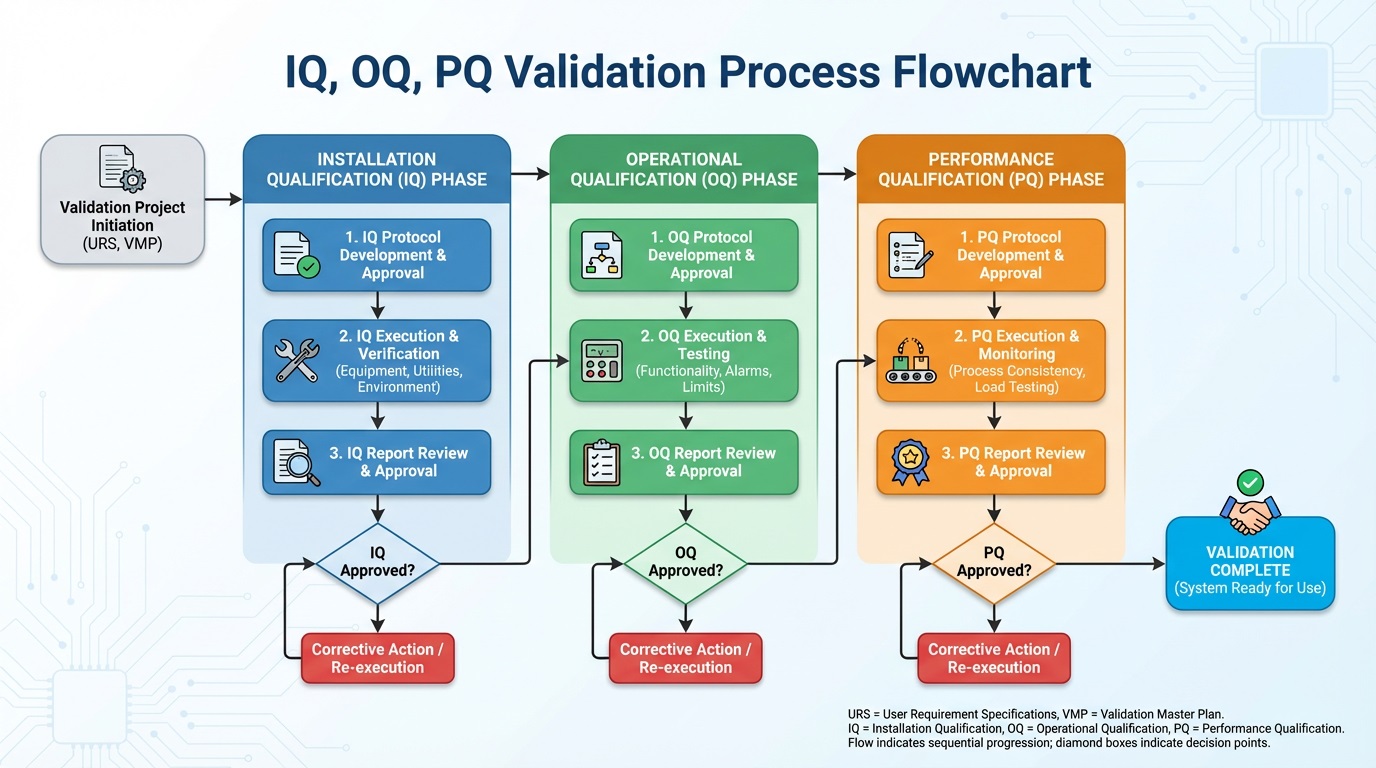
Performing IQ, OQ, and PQ ensures pharma equipment works correctly and safely. First, define the scope and prepare protocols. Next, install equipment according to specifications. Then, conduct Installation Qualification (IQ) tests to verify proper setup.
After IQ, perform Operational Qualification (OQ). Test equipment functions under all operating conditions. Also, document results precisely. Finally, carry out Performance Qualification (PQ) by testing real processes to confirm consistent performance.
Six key steps include:
- Define scope and prepare protocols
- Verify equipment installation (IQ)
- Test operation parameters (OQ)
- Document test results
- Validate real process performance (PQ)
- Review and approve validation reports
How to Write IQ, OQ, PQ Protocols and Reports Compliant with GMP
Writing IQ, OQ, and PQ protocols ensures pharma complies with GMP and regulatory standards. Studies show that 60% of FDA inspection findings relate to poor documentation. Therefore, clear, detailed protocols minimize risks and improve audit readiness. Protocols must outline objectives, testing steps, and acceptance criteria precisely.
During execution, follow protocols strictly and record results accurately. Then, analyze data to confirm equipment meets specifications. Additionally, validation reports summarize findings and justify conclusions. Well-prepared reports help avoid FDA 483 observations and enhance product quality.
So key Steps are:
- Protocol Preparation
- Execution and Documentation
- Reporting and Review
Protocol Preparation
IQ, OQ, and PQ protocol preparation defines clear objectives and test procedures. It guides teams on equipment qualification steps. Moreover, protocols must address acceptance criteria and roles. This ensures smooth validation and regulatory compliance.
Prepare protocols with detailed instructions and timelines. Use standard templates to maintain consistency. Also, include risk assessments and control measures. Proper preparation reduces errors and audit findings.
Key protocol elements include:
- Clear test objectives and methods
- Defined acceptance criteria and responsibilities
These elements create effective, compliant validation protocols.
Execution and Documentation
IQ, OQ, and PQ execution requires following protocols precisely to verify equipment and process performance. Professionals test system functions, collect data, and monitor results closely. Moreover, they document every step accurately to ensure traceability. This practice supports regulatory compliance and audit readiness.
Effective documentation includes clear records and timely report submission. Also, teams review data regularly and address deviations quickly. These actions guarantee validation success and product quality.
- Execute tests as per protocol
- Record results thoroughly
- Review data and identify issues
- Submit comprehensive validation reports
Reporting and Review
IQ, OQ, and PQ reporting requires documenting all validation activities clearly and accurately. Professionals compile test results and summarize findings in detailed reports. Moreover, they highlight any deviations and corrective actions taken. This ensures transparency and supports regulatory audits.
Teams review reports carefully and approve validation outcomes. They also update protocols if needed. Thorough reporting and review maintain compliance and product quality.
– Document all validation test results
– Highlight deviations and corrective actions
– Review reports with stakeholders
– Approve and archive validation documentation
Common Challenges and Best Practices in Executing IQ, OQ, PQ
Executing IQ, OQ, and PQ presents challenges like unclear protocols or incomplete documentation. For example, one company delayed production due to missing OQ data. Another faced audit findings after inconsistent PQ testing. Also, inadequate training caused errors in IQ execution. Therefore, clear protocols and training prevent such issues.
Best practices include thorough planning, staff training, and detailed documentation. Teams should review protocols regularly and perform dry runs. These actions improve accuracy and compliance. Continuous improvement helps overcome validation challenges effectively.
- Create detailed, clear protocols
- Train staff on validation procedures
- Review and update documentation regularly
Common Challenges and Solutions in IQ, OQ, PQ Execution
| Challenge | Description | Solution |
|---|---|---|
|
Incomplete Protocols |
Test protocols miss critical steps or data |
Develop detailed protocols with cross-check |
|
Equipment Variability |
Equipment behaves differently over time |
Regular calibration and maintenance |
|
Lack of Staff Training |
Operators lack proper skills |
Conduct thorough training sessions |
Final Words
IQ OQ PQ plays a critical role in pharmaceutical manufacturing, ensuring equipment works as intended. According to FDA guidance, 21 CFR Part 820 highlights that proper IQ, OQ, PQ can reduce defects by up to 40%. Studies show facilities with strong IQ OQ PQ have fewer FDA 483 observations related to equipment qualification. These steps align equipment performance with regulatory standards, improving product quality.
Validation builds on IQ, OQ, PQ by verifying entire processes consistently meet specifications. FDA emphasizes validation to prevent costly deviations and recalls. Maintaining thorough documentation and strict adherence to guidelines ensures smooth audits and regulatory compliance. Therefore, IQ, OQ, and PQ remain essential to guarantee equipment reliability and process control in pharma manufacturing.
FAQs
IQ means Installation Qualification, OQ is Operational Qualification, and PQ is Performance Qualification.
They ensure equipment and processes consistently produce quality products meeting regulations.
FDA, EMA, and ICH establish guidelines for proper qualification and validation.
References

Ershad Moradi
Ershad Moradi, a Content Marketing Specialist at Zamann Pharma Support, brings 6 years of experience in the pharmaceutical industry. Specializing in pharmaceutical and medical technologies, Ershad is currently focused on expanding his knowledge in marketing and improving communication in the field. Outside of work, Ershad enjoys reading and attending industry related networks to stay up-to-date on the latest advancements. With a passion for continuous learning and growth, Ershad is always looking for new opportunities to enhance his skills and contribute to pharmaceutical industry. Connect with Ershad on Facebook for more information.

Root Cause Analysis in Pharmaceutical Industry: 6 Powerful Methods in 2026
Explore 6 powerful root cause analysis methods in pharma to investigate deviations, strengthen CAPA, ensure GMP compliance, and protect patient safety.

Quality Culture in Pharma Industry 2026: Proven Ways to Build Trust
Explore how to build a strong quality culture in the pharmaceutical industry in 2026 through leadership commitment, ICH Q10 principles, meaningful GMP metrics, effective CAPA, and continuous improvement.

GMP Training Effectiveness 2026: Proven Ways to Build Real Competence
GMP training effectiveness goes beyond attendance records and quiz scores. Learn how role-based assessments, on-the-job observation, and meaningful KPIs help verify employee competence, strengthen training records, and address recurring performance gaps across pharmaceutical operations.