


Patient Safety Importance means preventing avoidable harm from care and medicines, and it remains critical in 2024. WHO’s Global Patient Safety Action Plan 2021–2030 urges safer medication use and stronger learning systems. WHO also estimates medication errors cost about US$42 billion yearly, showing the scale of risk.
Pharmacovigilance tracks adverse reactions and manages benefits versus risks using WHO PIDM and VigiBase reports. Please include recent updates from FDA 21 CFR Parts 210–211 and ICH E6(R3). Share the latest WHO 2023–2024 harm statistics available.
Table of Contents
What is Patient Safety Importance?
Patient safety importance means preventing harm during care and medicine use. It protects patients, builds trust, and improves treatment results. Therefore, healthcare teams follow clear steps to reduce risks every day.
- Confirm patient identity before tests, drugs, or procedures.
- Check allergies, doses, and interactions before you give medicines.
- Report errors and near misses, then fix the root causes.
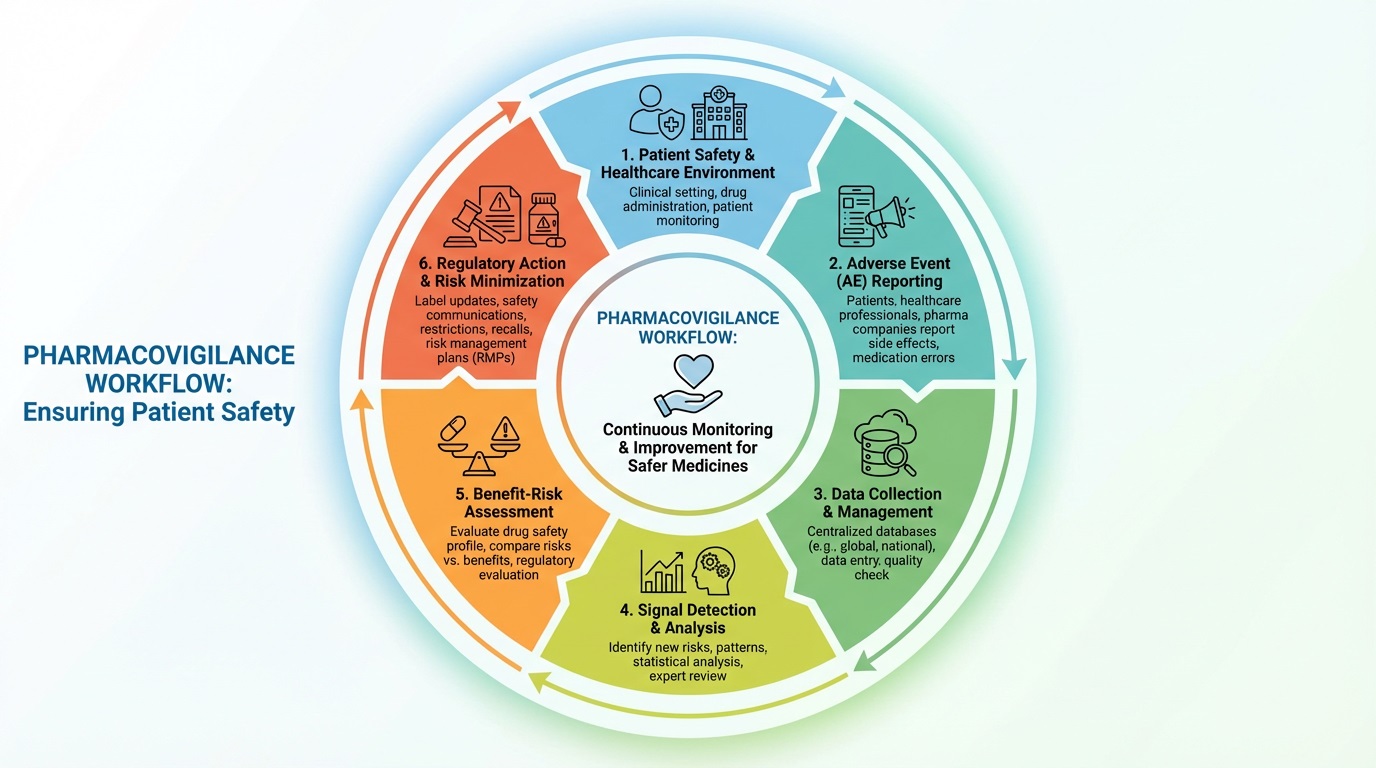
Role of Pharmacovigilance in Patient Safety
Pharmacovigilance protects patients by tracking medicine side effects and risks. Teams collect reports and spot safety signals early to prevent harm. So, pharmacovigilance teams act fast and share clear safety actions.
- Record adverse reactions with timing, dose, and patient details.
- Analyze trends and update warnings, labels, and risk plans.
- Educate clinicians and patients to report symptoms and follow guidance.
Top Challenges in Standardizing Patient Safety
Standardizing patient safety faces many system and people challenges. Organizations use different definitions, tools, and reporting rules across sites.
Leaders must align processes and support consistent daily practice.
Key Challenges are
- Challenge 1: Variation in Regulatory Requirements Across Regions
- Challenge 2: Inconsistent Terminology and Data Reporting
- Challenge 3: Integration of Diverse Data Sources
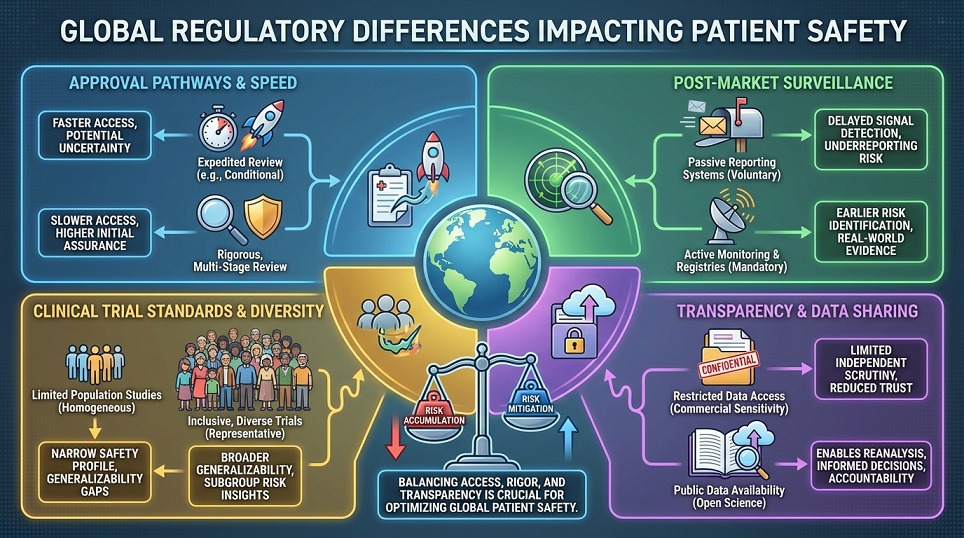
Challenge 1: Variation in Regulatory Requirements Across Regions
Regulatory requirements vary across regions, so companies adjust safety and quality plans. The FDA, EMA, and PMDA use different formats, timelines, and submission portals. Therefore, global teams track local laws and keep documents consistent.
Fact: the EU uses EudraVigilance, while the US uses FAERS for ADR reports.
Companies also manage different label rules, inspections, and language needs.
Challenge 2: Inconsistent Terminology and Data Reporting
Inconsistent terminology harms safety tracking and delays correct decisions. Pharma groups use different codes, abbreviations, and case definitions across systems. Therefore, organizations must standardize terms and enforce strong reporting rules.
– Use MedDRA terms for adverse events and reactions.
– Apply one case form and one seriousness definition.
– Train staff to enter complete fields and correct dates.
– Audit data regularly and fix errors quickly.
Challenge 3: Integration of Diverse Data Sources
Teams collect safety data from trials, EHRs, and spontaneous reports. Different formats and missing fields slow signal review and trend detection. Therefore, organizations must connect systems and set clear data standards.
- Map fields across sources and use one patient identifier strategy.
- Clean data with validation rules, then flag outliers fast.
- Use common vocabularies, such as MedDRA and WHODrug.
Track data lineage to support audits and reliable decisions.
Patient Safety: Related Guidelines
FDA CFR Title 21 Parts 210 and 211 guide drug manufacturing quality and patient safety. They require strong GMP controls, validated processes, and clear documentation practices.
Therefore, ICH E6(R3) guides clinical trials and protects participants through quality management. 21 CFR Parts 210 and 211 set minimum current GMP requirements. Teams use risk-based oversight, train staff, and keep accurate records for inspections.
FDA CFR Title 21 Parts 210 & 211
FDA CFR Title 21 Parts 210 and 211 set current GMP rules for drug manufacturing. They require strong controls, clean facilities, and accurate batch records. Therefore, teams follow these rules to protect patients and product quality.
ICH E6(R3)
ICH E6(R3) guides Good Clinical Practice for modern clinical trials. It stresses quality by design, risk focus, and reliable trial data. So, sponsors and sites protect participants through strong oversight.
Comparison of FDA CFR Title 21 Parts 210 & 211 vs. ICH E6(R3) Guidelines on Patient Safety
| Aspect | FDA CFR Title 21 Parts 210 & 211 (cGMP) | ICH E6(R3) (GCP) | Patient safety focus |
|---|---|---|---|
|
Scope |
Drug manufacturing and quality systems |
Clinical trial design and conduct |
Prevents quality defects reaching patients |
|
Main goal |
Ensure consistent identity, strength, purity, quality |
Protect participants and ensure credible data |
Reduces harm from poor processes and poor trial control |
|
Key controls |
Validation, sanitation, change control, documentation |
Risk-based quality management, oversight, data integrity |
Detects risks early and controls them |
|
Who must comply |
Manufacturers and quality units |
Sponsors, CROs, investigators, sites |
Defines responsibilities for safety decisions |
Mechanisms for detecting, assessing, and preventing adverse drug reactions (ADRs) to enhance patient safety
Teams detect ADRs through active monitoring in clinics and electronic health records. They use spontaneous reports to catch rare events quickly. Therefore, safety teams compare trends and trigger early signal alerts.
Key prevention steps include:
- Assess causality, severity, and expectedness using standard tools.
- Update labels, add warnings, and educate prescribers and patients.
- Apply risk minimization, dose adjustments, and follow-up monitoring plans.
Final words
Patient Safety Importance drives safer care and safer medicines across health systems. WHO reports 1 in 10 patients suffers harm in care, and medication errors cost about US$42 billion yearly (WHO, 2017).
Pharmacovigilance detects, evaluates, and prevents ADRs using reports, EHR signals, and targeted studies. It supports rapid label updates and risk plans, while WHO programs promote global reporting. We need ongoing pharma and healthcare collaboration, robust guidelines, and innovation to advance patient safety effectively. Can you share authoritative pharma references or recent case studies?
FAQs
Patient safety matters because it reduces avoidable harm from care and medicines. More than 3 million deaths each year are linked to unsafe care.
Pharmacovigilance improves patient safety by collecting adverse reaction reports, detecting safety signals, and supporting label updates and risk minimization. In practice, it helps teams move from isolated case reports to structured benefit–risk decisions across the product lifecycle.
FDA 21 CFR Parts 210 and 211 set minimum current GMP requirements for drug manufacturing. They require suitable facilities and controls, written production and process procedures, sanitation, documentation, and quality oversight so drug products meet safety, identity, strength, quality, and purity requirements.
References

Ershad Moradi
Ershad Moradi, a Content Marketing Specialist at Zamann Pharma Support, brings 6 years of experience in the pharmaceutical industry. Specializing in pharmaceutical and medical technologies, Ershad is currently focused on expanding his knowledge in marketing and improving communication in the field. Outside of work, Ershad enjoys reading and attending industry related networks to stay up-to-date on the latest advancements. With a passion for continuous learning and growth, Ershad is always looking for new opportunities to enhance his skills and contribute to pharmaceutical industry. Connect with Ershad on Facebook for more information.

Root Cause Analysis in Pharmaceutical Industry: 6 Powerful Methods in 2026
Explore 6 powerful root cause analysis methods in pharma to investigate deviations, strengthen CAPA, ensure GMP compliance, and protect patient safety.

Quality Culture in Pharma Industry 2026: Proven Ways to Build Trust
Explore how to build a strong quality culture in the pharmaceutical industry in 2026 through leadership commitment, ICH Q10 principles, meaningful GMP metrics, effective CAPA, and continuous improvement.

GMP Training Effectiveness 2026: Proven Ways to Build Real Competence
GMP training effectiveness goes beyond attendance records and quiz scores. Learn how role-based assessments, on-the-job observation, and meaningful KPIs help verify employee competence, strengthen training records, and address recurring performance gaps across pharmaceutical operations.