


Risk Management Plan in Pharmacovigilance guides safety actions to protect patient safety importance. Regulators expect clear risks, minimization measures, and benefit–risk review at launch and postmarketing. As monitoring grows complex with real‑world data and polypharmacy, an RMP sets priorities and accountability.
Pharmacovigilance uses reports, EHR signals, and studies to test RMP assumptions and update labels. WHO estimates 1 in 10 patients experiences harm, and medication errors cost US$42 billion yearly (WHO, 2017). Effective risk management reduces avoidable admissions and improves outcomes through shared healthcare–industry governance.
Table of Contents
What is Risk Management Plan in Pharmacovigilance?
A Risk Management Plan in pharmacovigilance explains key risks and safety actions. It supports patient safety and meets regulator expectations after drug approval. Therefore, teams review the plan often and update it with new evidence.
An RMP usually includes:
- Identify important risks, missing information, and target populations.
- Plan routine measures, like labeling, plus extra risk minimization.
- Describe safety studies, signal tracking, and success metrics.
How to Create an Effective Risk Management Plan for Drugs?
Define important risks and describe who faces them. Set clear safety goals and assign owners for each action. Finaly, review new safety data regularly and update the plan fast.
- List missing information and plan targeted data collection.
- Choose routine controls, like labeling, and extra measures, like training.
- Plan signal detection, case review, and periodic benefit–risk checks.
- Track metrics, audit results, and patient outcomes to prove effectiveness.
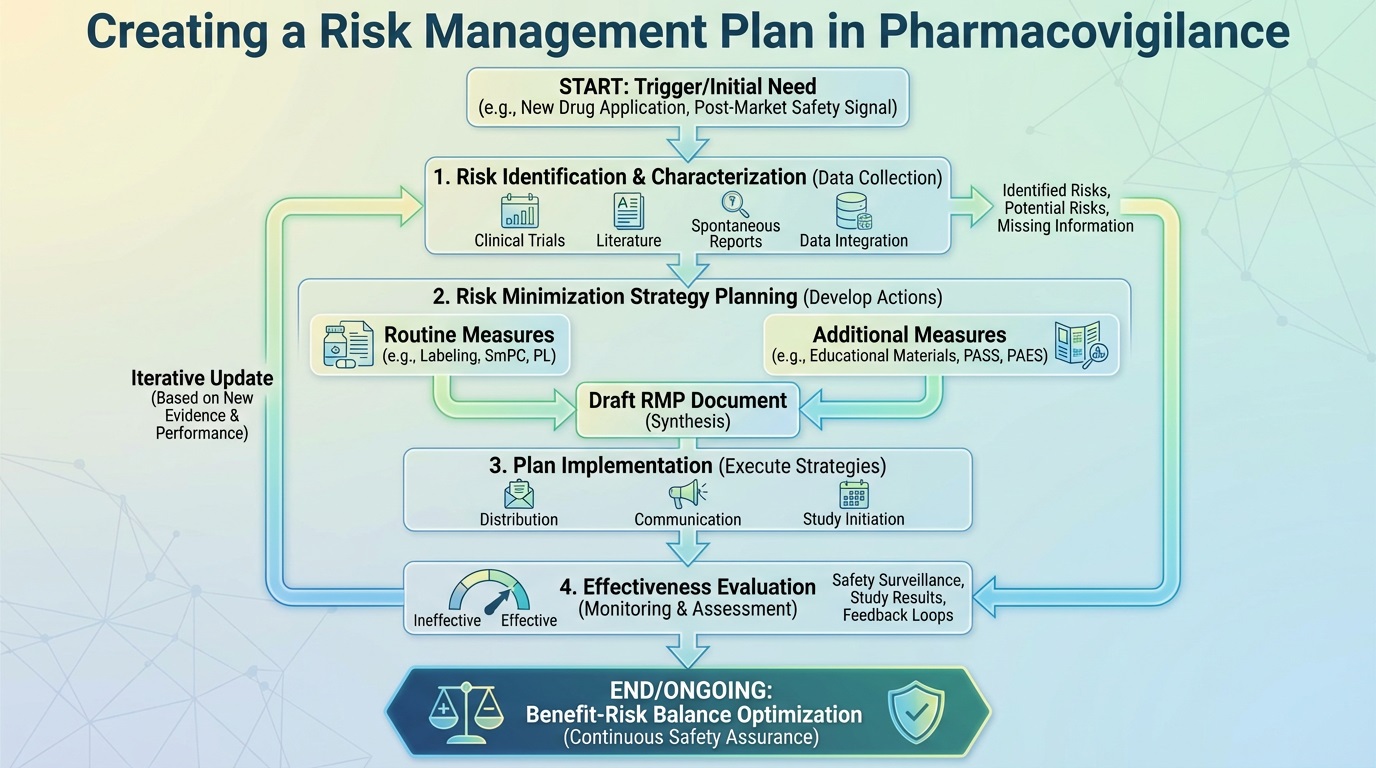
Main Components of a Risk Management Plan in Pharmacovigilance
A Risk Management Plan guides teams to manage drug risks across real-world use. It supports safe use and helps teams act fast on new safety signals. Therefore, teams update the plan as evidence grows.
- Safety Specification: Define known risks, potential risks, and missing safety data.
- Pharmacovigilance Plan: Monitor reports, detect signals, and assess benefit–risk.
- Risk Minimization Measures: Educate users, adjust labeling, and control access.
- Post-authorization Safety Studies (PASS): Run studies to confirm risks and measure actions.
Main Components of an RMP with Descriptions and Examples
| Main RMP Component | Description | Example |
|---|---|---|
|
Safety Specification |
Identifies known risks, potential risks, and missing safety information. |
Notes hepatotoxicity risk and limited data in pregnancy. |
|
Pharmacovigilance Plan |
Defines how you monitor safety and evaluate new signals. |
Reviews ICSRs weekly and runs quarterly signal detection. |
|
Risk Minimization Measures |
Lists actions that reduce or prevent harm in real-world use. |
Adds contraindications, provides prescriber training, uses controlled access. |
|
Typical Online GMP Training Provider |
Single online GMP course with certificate |
Individuals or small teams needing basic training |
|
Post-authorization Safety Studies (PASS) |
Plans studies to confirm risks and measure minimization effectiveness. |
Runs a registry to track serious bleeding rates after launch. |
Safety Specification
Safety specification lists known risks, potential risks, and missing safety data. Teams use it to focus safety work on the biggest concerns.
Fact: Most safety data comes from trials with limited patient numbers.
Teams update the safety specification when new reports appear. They add new risks, refine risk groups, and note key knowledge gaps.
Pharmacovigilance Plan
A pharmacovigilance plan guides teams after a drug launches quickly. Teams monitor reports from patients, doctors, and databases in real time. They detect signals and track trends in adverse events using clear thresholds.
They assess benefit–risk whenever new evidence appears and set review timelines, define case follow-up, and document decisions.
Risk Minimization Measures
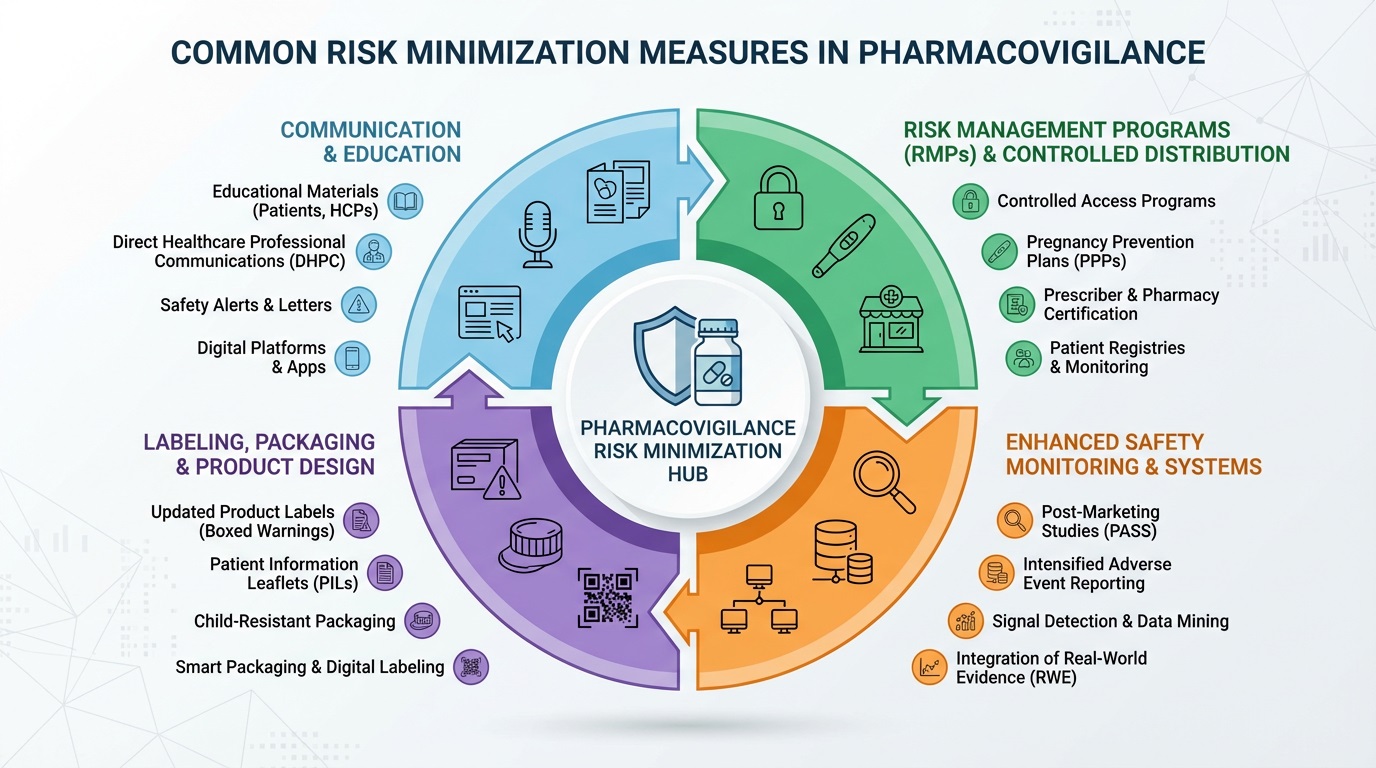
Risk minimization measures reduce harm and support safe drug use. Teams add clear warnings, dose limits, and contraindications on labels. Clinicians follow checklists and counseling steps during each prescription.
Companies track outcomes and improve measures when problems continue. Patients receive guides that explain risks and safe behaviors. Pharmacists verify key labs and drug interactions before dispensing.
Post-authorization Safety Studies (PASS)
PASS studies collect real-world safety data after a drug reaches patients. Researchers follow large groups to measure risks and identify predictors. Hospitals record outcomes, exposures, and key medical history in registries.
Therefore, sponsors analyze results and refine the benefit–risk profile. Regulators review findings and request label changes or new controls.
Examples of Risk Management Plans in Pharmacovigilance
Examples of risk management plans show how teams control known and potential risks. They define key risks, set goals, and select monitoring and minimization tools. So, teams review data often and adjust actions as evidence changes.
- RMP for a New Anticoagulant Drug: track bleeding, manage doses, teach warning signs.
- RMP for a Monoclonal Antibody in Autoimmune Disease: watch infections, guide screening, plan registries.
Example 1: RMP for a New Anticoagulant Drug
An RMP for a new anticoagulant focuses on preventing serious bleeding. Teams identify high-risk patients and set clear monitoring goals. Clinicians follow dose rules and check kidney function before prescribing.
Therefore, teams track outcomes and update actions when safety signals rise.
Key risks include:
- major bleeding
- drug interactions with antiplatelets.
Teams add patient cards and teach fast steps for bleeding symptoms.
Example 2: RMP for a Monoclonal Antibody in Autoimmune Disease
An RMP for a monoclonal antibody targets infection and immune-related risks. Teams identify vulnerable patients and set clear safety goals. Clinicians screen patients before treatment and review prior therapies.
Key concerns include:
- Serious infections
- TB reactivation
Other concerns include:
- Malignancy risk
- Infusion reactions
How to Monitor and Update a Risk Management Plan Post-Approval?
First, collect real‑world reports and registry data. Review cases weekly and track trends. Next, detect signals and check benefit–risk. Therefore, update labels, tools, and training quickly.
Finally, document changes and set new milestones.
Use triggers:
- New risk
- Higher rates
- Missing data often.
Final Words
Risk Management Plan in Pharmacovigilance aligns safety activities with U.S. requirements like FDA REMS under FD&C Act 505-1 and postmarketing reporting in 21 CFR 314.80. It helps teams define risks, target high‑risk groups, and set measurable controls, so patients receive effective therapy with fewer preventable harms.
Pharmacovigilance then monitors real‑world outcomes using sources such as FAERS and FDA safety communications. Teams reassess benefit–risk, update labeling, and refine minimization measures to preserve efficacy over time. Please share any authoritative references you want cited, for example EMA RMP guidance, FDA guidance documents, or FDA communications and publications.
FAQs
It includes a safety specification, a pharmacovigilance plan, risk minimization measures, and PASS plans.
They update it after new signals, new risks, higher event rates, or major label changes.
They track process metrics (training, compliance) and outcome metrics (event rates, hospitalizations).
References

Ershad Moradi
Ershad Moradi, a Content Marketing Specialist at Zamann Pharma Support, brings 6 years of experience in the pharmaceutical industry. Specializing in pharmaceutical and medical technologies, Ershad is currently focused on expanding his knowledge in marketing and improving communication in the field. Outside of work, Ershad enjoys reading and attending industry related networks to stay up-to-date on the latest advancements. With a passion for continuous learning and growth, Ershad is always looking for new opportunities to enhance his skills and contribute to pharmaceutical industry. Connect with Ershad on Facebook for more information.

Root Cause Analysis in Pharmaceutical Industry: 6 Powerful Methods in 2026
Explore 6 powerful root cause analysis methods in pharma to investigate deviations, strengthen CAPA, ensure GMP compliance, and protect patient safety.

Quality Culture in Pharma Industry 2026: Proven Ways to Build Trust
Explore how to build a strong quality culture in the pharmaceutical industry in 2026 through leadership commitment, ICH Q10 principles, meaningful GMP metrics, effective CAPA, and continuous improvement.

GMP Training Effectiveness 2026: Proven Ways to Build Real Competence
GMP training effectiveness goes beyond attendance records and quiz scores. Learn how role-based assessments, on-the-job observation, and meaningful KPIs help verify employee competence, strengthen training records, and address recurring performance gaps across pharmaceutical operations.