
ANDA Application in 2026: FDA Requirements, Submission Process and GMP Inspection Readiness

FDA’s FY2025 GDUFA framework sets a 10-month review goal for standard original submissions, while a facility-not-ready case with a reset can face a 30-month goal. However, a strong ANDA application depends on more than submitting the right documents. Teams must align CMC data, bioequivalence evidence, manufacturing controls, and inspection readiness. Therefore, understanding how pharma regulation connects submission quality with facility readiness can help prevent avoidable delays in the generic drug approval process.

Table of Contents

What Is an ANDA Application?

An ANDA application is the FDA submission used to seek approval for a generic drug. Unlike a full new drug application, it usually does not require new clinical studies to prove safety and effectiveness. Instead, the applicant must show that the generic product matches the reference listed drug in key areas, including strength, dosage form, quality, and bioequivalence. Therefore, the review focuses heavily on pharmaceutical equivalence, manufacturing controls, and evidence that the proposed product can perform like the approved brand-name drug.

Why Submission Readiness Matters for Generic Drug Approval?

Submission readiness helps generic drugs move through FDA review with fewer delays. Complete CMC data, strong bioequivalence evidence, and inspection-ready facilities reduce regulatory gaps and support a smoother approval process.

4 Areas That Can Decide Whether an ANDA Moves Forward

FDA review depends on more than whether an application is complete on paper. The agency also looks at the quality of the technical package, the strength of the bioequivalence evidence, and the readiness of the manufacturing site. Therefore, weaknesses in any of these areas can create delays, additional questions, or review setbacks.

The four areas below show where regulatory teams should focus before submission and during FDA review:

Can FDA Accept the Application for Review? (Available PDF)

Does the CMC Package Match the Proposed Commercial Product? (Available PDF)

Is the Bioequivalence Strategy Strong Enough? (Available PDF)

Is the Manufacturing Site Truly Inspection-Ready? (Available PDF)

Can FDA Accept the Application for Review? (Available PDF)

FDA checks whether an ANDA is substantially complete before starting full technical review. Major deficiencies or multiple minor gaps can lead to a refuse-to-receive decision.

Download the FDA Refuse-to-Receive Guidance Here

Does the CMC Package Match the Proposed Commercial Product? (Available PDF)

The CMC package should align product, process, methods, specifications, and facility data. Gaps can trigger FDA questions and delay review.

Download Good ANDA Submission Practices Guidance for Industry Here

Is the Bioequivalence Strategy Strong Enough? (Available PDF)

Bioequivalence studies must show that the generic product performs comparably to the reference listed drug. FDA also evaluates study design, analytical methods, pharmacokinetic data, and product-specific requirements.

Download the FDA Bioequivalence Guidance Here

Is the Manufacturing Site Truly Inspection-Ready? (Available PDF)

Manufacturing facilities should comply with CGMP and be ready to perform the operations described in the ANDA. Poor facility readiness can affect inspection scheduling, review progress, and the final approval timeline.

Download the FDA Facility Readiness Guidance Here

What Happens After FDA Accepts an ANDA for Review?

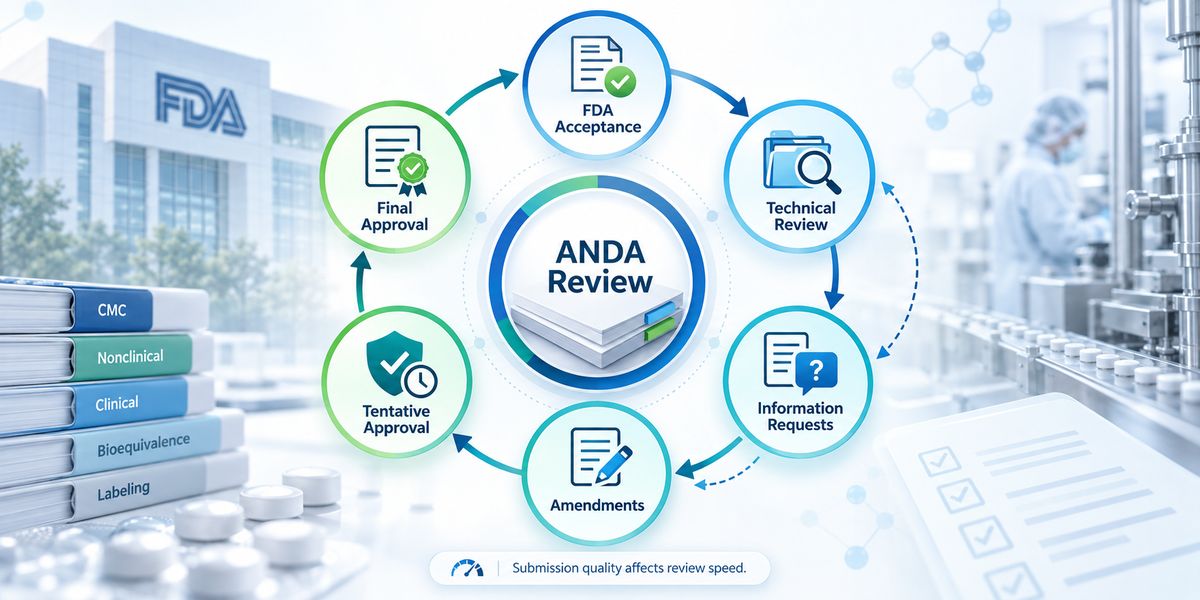
Once FDA accepts an ANDA, the application moves into substantive review. FDA assesses product quality, bioequivalence, labeling, manufacturing information, and other technical data. During this process, reviewers may issue information requests or require amendments. However, unresolved deficiencies can lead to a complete response action. If requirements are met but approval is blocked by patent or exclusivity issues, FDA may grant tentative approval before final approval becomes possible.


 This infographic shows the key stages of the ANDA approval process, from FDA filing review to tentative or final approval, helping teams understand where regulatory delays can occur.

ANDA approval from FDA acceptance to final generic drug approval

Where Can an ANDA Lose Time Before Approval?

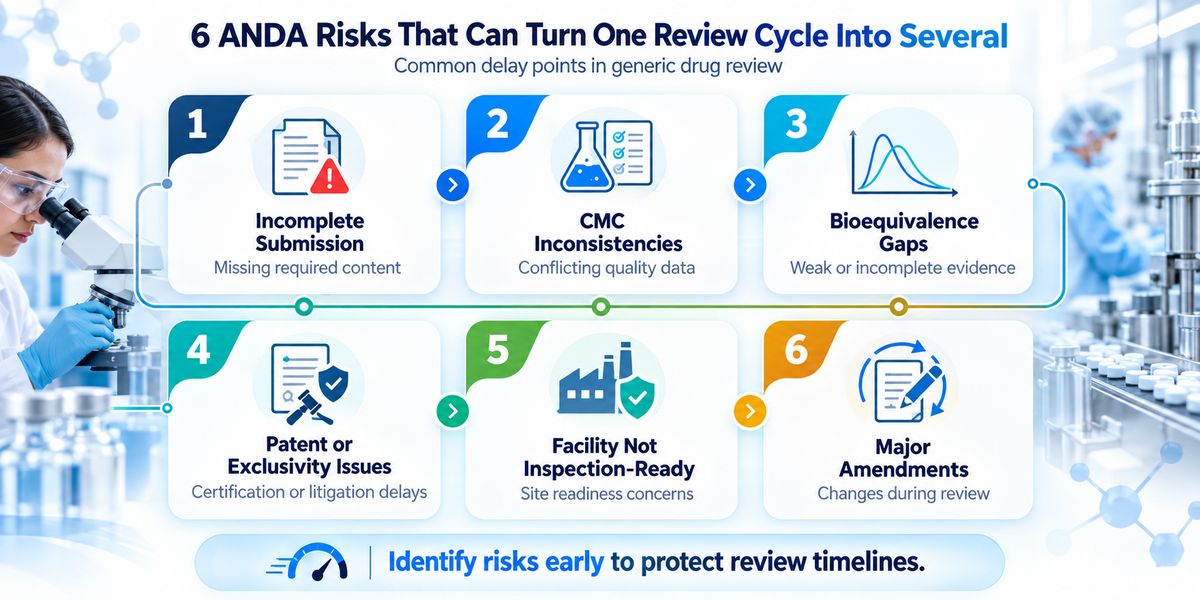
An ANDA can lose time when problems appear after FDA review has already started. Incomplete submissions, CMC inconsistencies, weak bioequivalence evidence, and facility issues can trigger additional questions or review cycles. Moreover, patent litigation and major amendments can affect when FDA can complete or act on an application. Therefore, teams should identify these risks before submission and keep technical, regulatory, and manufacturing information aligned throughout review.


 The table below shows six common ANDA delay risks, how they affect FDA review, and what teams can do to reduce them.

Risk Area How It Can Delay the ANDA Practical Control
Incomplete initial submission
Missing or inadequate information can prevent substantive review or lead to additional FDA requests.
Check the complete ANDA content and filing requirements before submission.
CMC inconsistencies
Differences between specifications, manufacturing processes, facilities, or supporting data can create product-quality deficiencies.
Reconcile CMC data across modules, sites, methods, and supporting documents before filing.
Bioequivalence gaps
Weak study design, incomplete data, or unsuitable analysis can require clarification or additional evidence.
Follow applicable FDA bioequivalence guidance and product-specific recommendations.
Patent and exclusivity issues
A Paragraph IV challenge can trigger litigation, and a timely patent lawsuit can generally create a 30-month stay of approval.
Review Orange Book patents and certification requirements early in development.
Six ANDA submission risks that can increase FDA review cycles and delay generic drug approval.

Final Word

Inspection pressure is not easing. FDA conducted 972 drug quality assurance inspections in FY2024, 27% more than in FY2023, showing increased manufacturing oversight.  Therefore, an ANDA application should not be treated as a dossier-only exercise; the submitted data must match a site that can demonstrate control in practice. Ultimately, teams that connect submission quality with daily GMP readiness are better positioned to avoid preventable inspection and approval delays.

FAQs

1️⃣ What can cause FDA to refuse to receive an ANDA?


FDA may refuse an ANDA if it is not substantially complete or contains major deficiencies. Common problems include missing required data, inadequate CMC information, or unsupported specifications.

2️⃣ Can a manufacturing site delay ANDA approval if the dossier is complete?


Yes. FDA can delay approval when a listed facility is not inspection-ready, has unresolved CGMP concerns, or cannot support the manufacturing operations described in the application.

3️⃣ Does Paragraph IV certification always delay generic drug approval by 30 months?


No. A 30-month stay generally applies only if the patent owner or NDA holder files a patent infringement lawsuit within 45 days of receiving the Paragraph IV notice.

Picture of Mahtab Shardi

Mahtab Shardi

Mahtab is a pharmaceutical professional with a Master’s degree in Physical Chemistry and over five years of experience in laboratory and QC roles. Mahtab contributes reliable, well-structured pharmaceutical content to Pharmuni, helping turn complex scientific topics into clear, practical insights for industry professionals and students.

Share