


Pharma equipment qualification proves that equipment suits its intended pharmaceutical use. It connects engineering evidence with GMP expectations, product quality, and patient protection. More than 70% of GMP inspection findings relate to weaknesses in quality systems, documentation, or process control. Many teams confuse qualification with simple equipment testing. However, qualification creates
controlled evidence across the equipment lifecycle.
The broader pharma qualification framework covers facilities, utilities, systems, and processes. Equipment qualification focuses on machines, instruments, and supporting equipment. Regulatory expectations increasingly emphasize lifecycle and risk-based control. EU GMP Annex 15 provides an important qualification framework. ICH Q9(R1) reinforces proportionate quality risk management. PIC/S and WHO guidance also support structured qualification planning. This guide explains practical machine qualification in pharma.
Table of Contents
What Is Pharma Equipment Qualification?
Pharma equipment qualification documents equipment suitability and consistent performance. The process starts before installation and continues during routine operation. Teams define requirements, assess risks, test equipment, and approve evidence.
Qualification normally precedes process validation. Therefore, qualified equipment provides a reliable foundation for validated manufacturing processes. It also supports cleaning validation, analytical work, and controlled production.
Machine qualification in pharma should match intended use and equipment criticality. A simple balance needs different controls than an aseptic filling line. Risk determines the required effort, testing depth, and documentation.
Why Equipment Qualification Matters
Qualified equipment reduces uncertainty during manufacturing and quality operations. It also provides evidence during regulatory inspections. More importantly, qualification protects product quality when equipment performance affects critical outcomes.
Strong equipment qualification can:
- Confirm equipment suitability for intended pharmaceutical operations.
- Reduce failures affecting critical quality attributes or process parameters.
- Support reliable cleaning, maintenance, calibration, and operation.
- Improve inspection readiness through traceable qualification evidence.
- Strengthen change control and deviation investigations.
Business Need for Pharma Equipment Qualification
| Business Need | Qualification Contribution | Quality Impact |
|---|---|---|
|
Product quality |
Confirms controlled equipment performance |
Reduces variability |
|
Patient safety |
Controls equipment-related product risks |
Supports safe medicines |
|
Compliance |
Provides documented GMP evidence |
Strengthens inspection readiness |
|
Reliability |
Tests functions and operating ranges |
Reduces unexpected failures |
Steps of Pharma Equipment Qualification: From Requirements to GMP Compliance
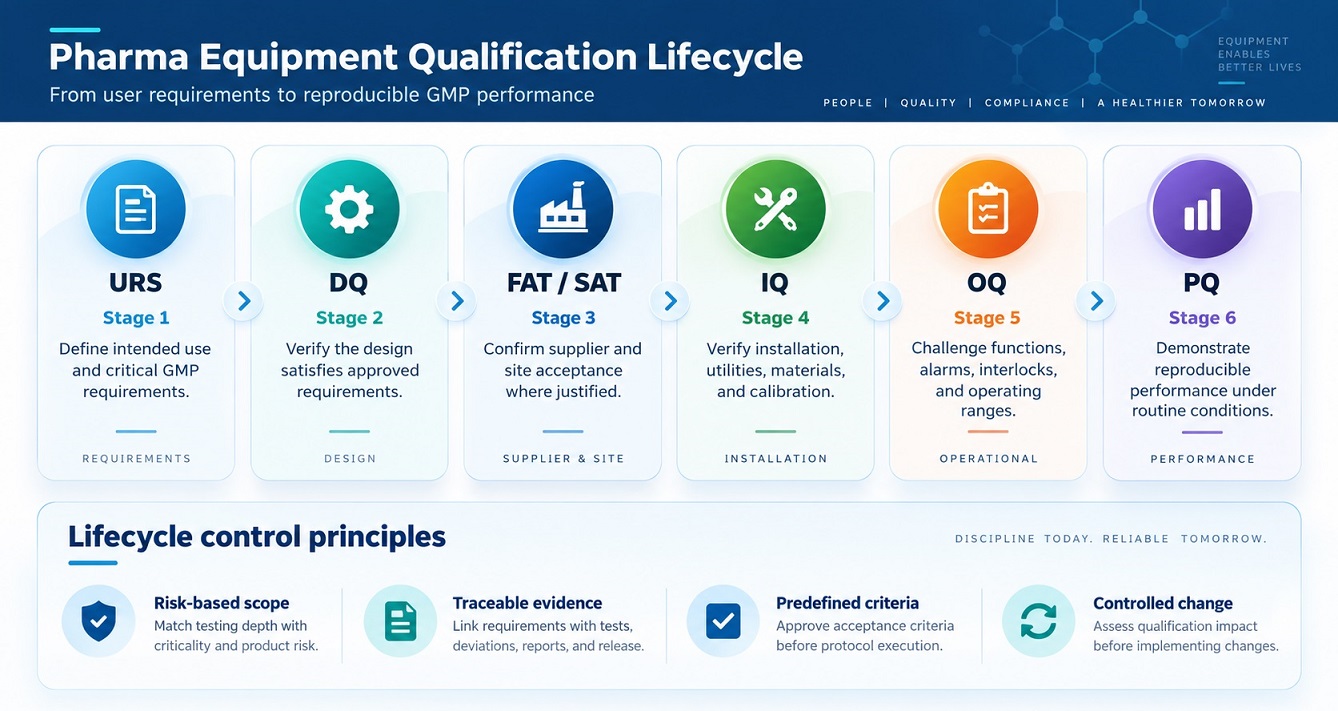
Pharma equipment qualification follows a systematic approach to ensure equipment meets its intended use and GMP requirements. Each step builds documented evidence, from defining user needs and assessing risks to verifying design, installation, operation, and performance. A structured qualification process helps pharmaceutical companies maintain control, support inspections, reduce quality risks, and ensure reliable manufacturing operations throughout the equipment lifecycle.
Pharma equipment qualification follows a structured lifecycle to prove that equipment is suitable, reliable, and compliant with GMP expectations. The main steps include:
Step 1 — Define Equipment Requirements and Perform Risk Assessment
Step 2 — Complete Design Qualification (DQ)
Step 3 — Execute Installation Qualification (IQ)
Step 4 — Execute Operational Qualification (OQ)
Step 5 — Demonstrate Performance Qualification (PQ)
Step 1 — Define Requirements and Risk
Start with a clear User Requirements Specification, or URS. The URS should describe intended use, capacity, controls, utilities, safety, and GMP needs. Requirements should remain testable and traceable.
Next, assess product and process risks. Consider equipment criticality, failure modes, detectability, and existing controls. ICH Q9(R1) supports risk-based effort and documentation. Therefore, high-risk functions usually need stronger qualification evidence.
Supplier selection should consider technical capability and GMP suitability. Vendor documents can support planning. However, the manufacturer retains final responsibility.
Step 2 — Complete Design Qualification
Design Qualification, or DQ, verifies that the proposed design meets approved requirements. Teams review specifications before installation whenever practical. This stage prevents costly gaps from reaching the factory floor.
DQ can examine materials, instrumentation, software, cleaning access, and utilities. Traceability should connect critical requirements with design evidence.
Factory Acceptance Testing may support this stage. FAT can identify problems before equipment shipment. However, FAT does not automatically replace later site qualification.
Step 3 — Execute Installation Qualification
Installation Qualification, or IQ, verifies correct installation against approved specifications. Teams confirm equipment identity, components, utilities, drawings, and documentation. They also verify calibration status and required materials.
IQ evidence commonly checks:
- Equipment model, serial numbers, and approved configuration.
- Utilities, connections, environmental conditions, and installation location.
- Product-contact materials and construction specifications.
- Instrument calibration and identification status.
Step 4 — Execute Operational Qualification
Operational Qualification, or OQ, challenges equipment functions across approved operating ranges. OQ demonstrates that equipment operates as intended under controlled conditions.
Tests should cover critical controls, alarms, interlocks, sequences, and operating limits. Teams should challenge normal and defined worst-case conditions where appropriate. Acceptance criteria must receive approval before execution.
Deviations need documented assessment before final approval. Teams should explain impact, root cause, correction, and residual risk. Passing results should never hide unresolved execution problems.
OQ can establish acceptable operating ranges for routine procedures and later validation.
Equipment Qualification Stages and Evidence
| Qualification Stage | Main Question | Typical Evidence |
|---|---|---|
|
DQ |
Does the design meet approved requirements? |
Specifications, drawings, risk reviews |
|
IQ |
Was the equipment installed correctly? |
Installation checks, calibration, certificates |
|
OQ |
Does the equipment operate correctly? |
Functional challenges, alarms, ranges |
|
PQ |
Does performance remain reproducible? |
Routine-condition runs and performance data |
Step 5 — Demonstrate Performance Qualification
Performance Qualification, or PQ, demonstrates reproducible performance under routine operating conditions. PQ uses approved procedures, trained operators, and representative operating conditions.
Teams should define meaningful performance criteria before execution. PQ should reflect intended use and critical interactions.
Equipment PQ should demonstrate equipment capability. Process validation demonstrates process consistency and product control. Some activities may overlap, but the validation strategy should explain them clearly.
Qualification Documentation and Traceability
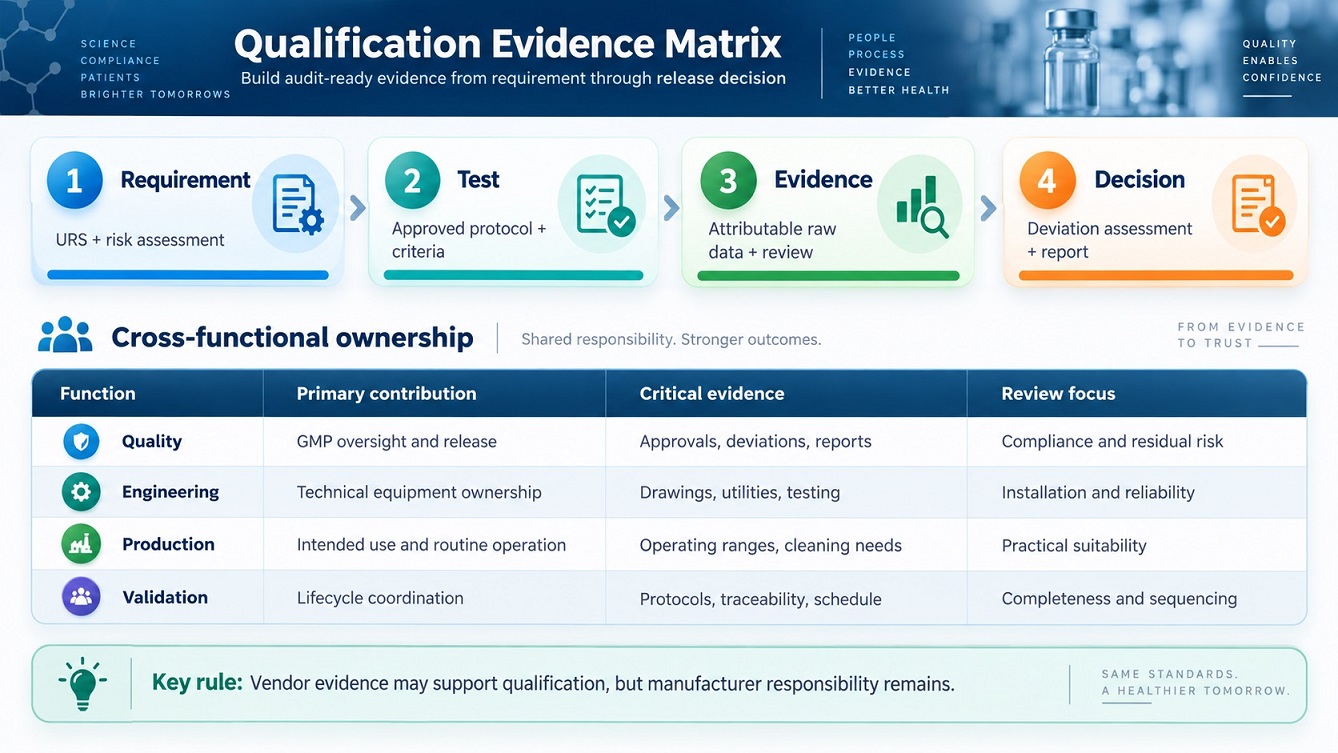
Good qualification documentation makes conclusions defensible. Protocols should define scope, responsibilities, tests, and acceptance criteria. Reports should summarize results and unresolved risks.
Core documentation usually includes:
- An approved validation master plan or equivalent qualification strategy.
- URS documents and requirement traceability.
- Risk assessments supporting qualification scope and testing depth.
- Approved DQ, IQ, OQ, and PQ protocols.
- Executed records with attributable and contemporaneous data.
- Deviation assessments, final reports, approvals, and release decisions.
ALCOA+ principles should guide data recording and review. Version control prevents obsolete requirements entering qualification packages.
Maintaining the Qualified State
Qualification does not end after PQ approval. Equipment changes, maintenance, failures, and performance trends can alter the qualified state. Therefore, lifecycle controls must continue after initial release.
Change control should evaluate qualification impact before implementation. Significant modifications may require targeted or broader requalification. Relocation can also affect utilities, installation, or operating performance.
Periodic review should consider equipment history, accumulated changes, and performance trends. Requalification decisions should remain risk-based and documented.
Best Practices for Audit-Ready Qualification
Audit-ready programs combine technical rigor with clear governance. Teams should avoid excessive testing without scientific purpose. They should also avoid weak testing that ignores critical functions.
Effective practices include:
- Define testable requirements before equipment purchase or modification.
- Use risk assessments to justify qualification depth.
- Maintain traceability between requirements, tests, deviations, and conclusions.
- Separate supplier evidence from manufacturer approval responsibilities.
- Integrate calibration, maintenance, change control, and deviation systems.
- Train reviewers to assess data quality, not only completed checkboxes.
Quality and engineering should collaborate from project initiation. Production should confirm practical operating requirements.
Common Qualification Mistakes
Generic protocols can miss critical equipment-specific risks. Unreviewed vendor documents create another weakness. Successful testing alone also cannot complete qualification.
Teams need approved evidence, resolved deviations, and defensible conclusions. Cumulative changes can also weaken the qualified baseline.
Final Word
Business development pharma jobs combine science, strategy, finance, and relationship management. They influence which medicines companies develop, license, partner on, or acquire. Demand also remains visible across the U.S. market. In September 2026, LinkedIn showed 13,000+ related U.S. openings. Current listings include associate, manager, director, alliance, and corporate development positions.
Successful professionals understand both opportunity and risk. They assess science, development pathways, market potential, economics, partnerships, and strategic fit. Due diligence and valuation become increasingly important at senior levels.
U.S. pharmaceutical business development salaries averaged about $59,559 in September 2026. However, compensation rises substantially for specialized leadership positions. Location, experience, transaction responsibility, bonuses, and equity also affect total compensation.
FAQs
Qualification usually applies to equipment, utilities, premises, and supporting systems. Validation usually demonstrates controlled processes, methods, or systems. Qualification often provides the foundation for later validation work.
Requalification may follow significant changes, relocation, repeated failures, or concerning trends. Periodic review may also identify requalification needs. The scope should match risk and documented impact.
Vendor testing can support qualification when justified and reviewed. However, it does not remove manufacturer responsibility. Site conditions and GMP requirements may still require additional qualification testing.

Ershad Moradi
Ershad Moradi, a Content Marketing Specialist at Zamann Pharma Support, brings 6 years of experience in the pharmaceutical industry. Specializing in pharmaceutical and medical technologies, Ershad is currently focused on expanding his knowledge in marketing and improving communication in the field. Outside of work, Ershad enjoys reading and attending industry related networks to stay up-to-date on the latest advancements. With a passion for continuous learning and growth, Ershad is always looking for new opportunities to enhance his skills and contribute to pharmaceutical industry. Connect with Ershad on Facebook for more information.

GMP Audit Checklist 2026: The Essential Guide for Risk-Based Audits
Master your GMP Audit Checklist with a practical, risk-based approach to pharmaceutical self-inspections. Explore five essential audit steps, FDA’s six-system model, GMP documentation and evidence sampling, audit findings, CAPA tracking, and effectiveness verification to strengthen compliance and inspection readiness.
Orphan Drug Designation in 2026: FDA and EMA Eligibility Criteria
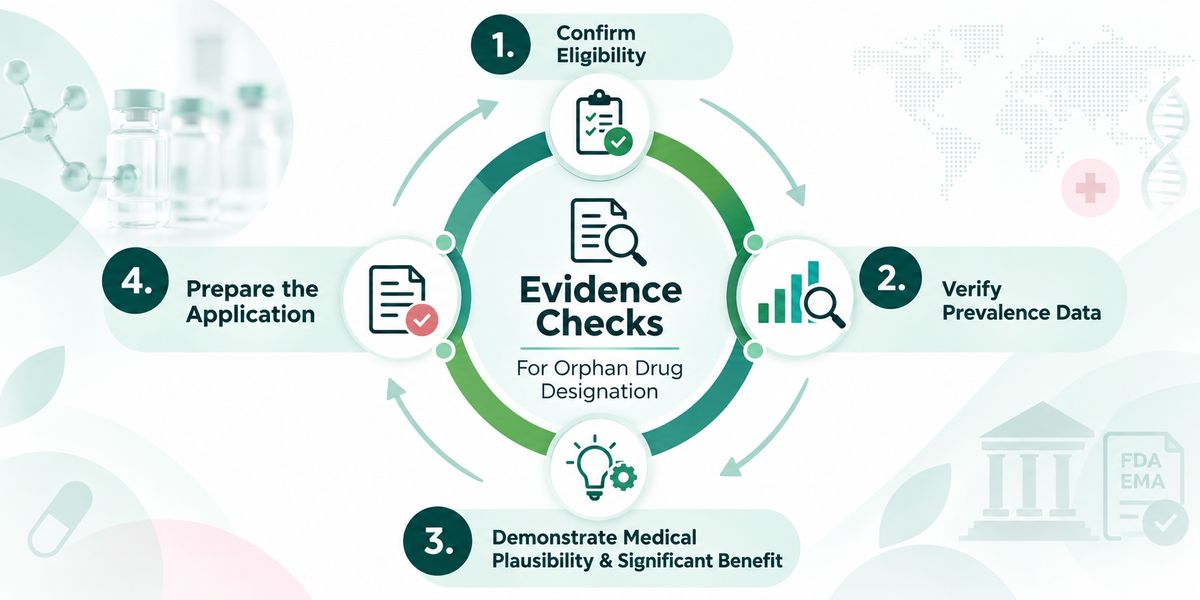
Discover how orphan drug designation works in 2026. Compare FDA and EMA eligibility criteria, rare disease prevalence thresholds, scientific evidence requirements, and regulatory incentives. Learn what pharmaceutical sponsors need to prepare for successful regulatory submissions

CEP certificate in pharma: What QA Must Verify in 2026
Learn how QA teams verify EDQM certificates, assess API suppliers, and prepare for GMP inspections. This guide explains CEP 2.0 updates, impurity controls, and essential records that help maintain regulatory compliance and inspection readiness across pharmaceutical manufacturing operations.