


Pharmaceutical quality assurance interview questions test practical judgment, not memorized definitions. Employers want evidence that candidates can protect product quality and patient safety. They also expect strong GMP and pharmaceutical quality system knowledge. Current hiring demand remains visible across major job boards. LinkedIn showed 5,000+ “Quality Assurance Pharma” U.S. roles in September 2026. It also showed 1,000+ “Pharmaceutical Quality Assurance” roles during the same check.
These figures are live search snapshots, not official labor statistics. Therefore, candidates should prepare for technical, behavioral, and scenario-based questions. This guide explains what employers test and how strong answers should sound. You can also explore current Pharma Jobs while preparing your applications.
Table of Contents
What Are Pharmaceutical Quality Assurance Interview Questions?
Pharmaceutical quality assurance interview questions assess how candidates apply quality principles in regulated work. They cover GMP, QMS, documentation, investigations, risk, audits, and batch oversight. Strong answers connect rules with controlled decisions. Moreover, interviewers often test independence, escalation, and evidence-based judgment. They want candidates who protect patients while supporting reliable pharmaceutical operations.
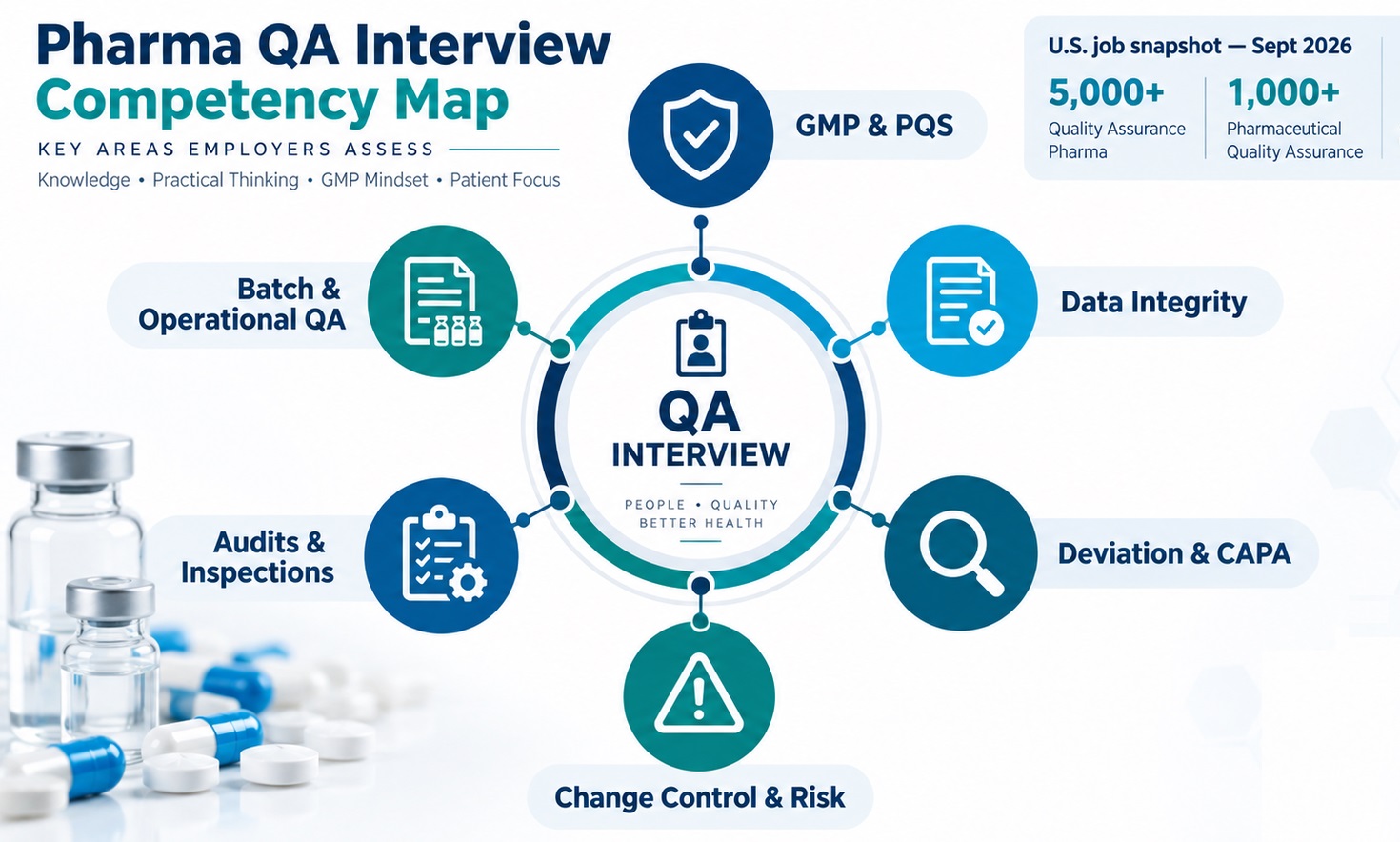
What Do Employers Test in a Pharmaceutical QA Interview?
Employers usually test six connected competency areas. These areas reflect everyday responsibilities inside pharmaceutical quality functions. They also show whether candidates understand quality beyond terminology. Interviewers often move from definitions into realistic situations. Therefore, candidates should explain what they would review, decide, document, and escalate.
Employers assess these four focus areas to understand how candidates apply pharmaceutical quality principles in real QA situations.
Interview Focus Area 1 — Building GMP and QMS Understanding
Interview Focus Area 2 — Demonstrating Data Integrity Awareness
Interview Focus Area 3 — Solving Quality Problems Through CAPA and Risk Tools
Interview Focus Area 4 — Showing Audit and Inspection Readiness
High-Yield Pharma QA Interview Categories
| Category | Example questions | What the interviewer is assessing |
|---|---|---|
|
QA fundamentals |
What is QA? How is QA different from QC? What is the quality unit’s role? |
QA purpose, governance, independence, and patient focus |
|
GMP & QMS |
What is cGMP? What are key pharmaceutical quality system elements? |
Connecting GMP requirements with a functioning quality system |
|
Documentation & data integrity |
How do you correct GMP records? What does ALCOA+ mean? |
Documentation discipline, traceability, reliability, and escalation |
|
Deviation & CAPA |
How do you investigate deviations? How do you verify CAPA effectiveness? |
Containment, impact assessment, RCA quality, and recurrence prevention |
|
Change control & risk |
How do you assess process or equipment changes? |
Impact analysis, risk management, review, approval, and implementation control |
Interview Focus Area 1 — Building GMP and QMS Understanding
GMP questions test whether candidates understand controlled pharmaceutical manufacturing. Good answers connect procedures, training, records, equipment, and oversight. ICH Q10 also frames quality as a lifecycle management system. Therefore, avoid treating GMP as a checklist alone. Explain how the quality unit supports consistent processes and reliable product release.
Interview Focus Area 2 — Demonstrating Data Integrity Awareness
Documentation questions often reveal a candidate’s real GMP discipline. Interviewers may ask about record corrections, audit trails, or missing entries. Strong answers emphasize contemporaneous records, traceability, and justified corrections. They should also protect original information. Moreover, candidates should escalate suspicious or unreliable data instead of normalizing it.
Interview Focus Area 3 — Solving Quality Problems Through CAPA and Risk Tools
Deviation and CAPA questions test investigation quality and decision discipline. Start with containment and immediate product protection. Next, assess scope, impact, and available evidence. Then investigate root causes without forcing a preferred conclusion. CAPA should address verified causes and systemic weaknesses. Finally, verify effectiveness using defined evidence before closure.
Interview Focus Area 4 — Showing Audit and Inspection Readiness
Inspection questions test calm communication and evidence retrieval. Candidates should describe accurate, factual, and concise responses. They should never guess when records require confirmation. Batch review questions also test release discipline. Reviewers should check completeness, deviations, laboratory results, changes, and required approvals before supporting disposition.
Most Common Pharmaceutical Quality Assurance Interview Questions
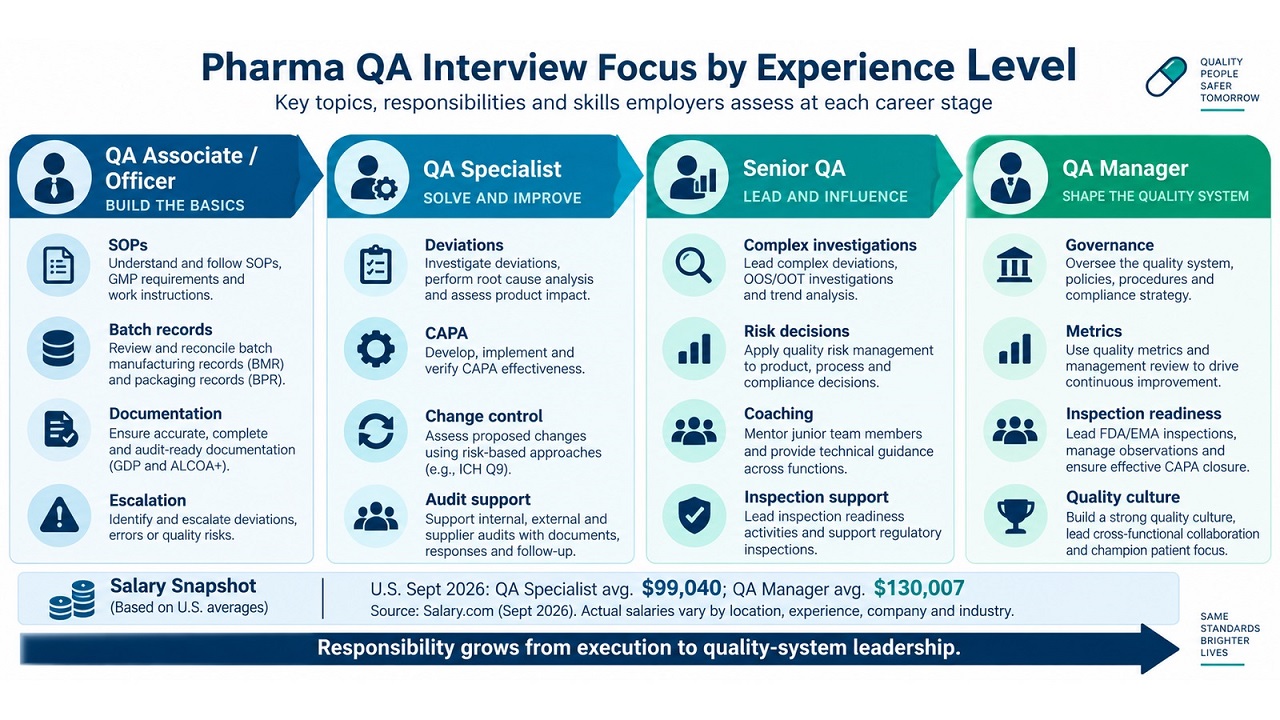
Most pharma QA interviews combine direct questions with short scenarios. Prepare concise definitions, then practice applying them. A strong answer usually explains the risk first. Next, it describes immediate control actions. Then, it explains investigation, documentation, and final quality decisions. This sequence keeps answers practical and patient-focused.
• Explain QA versus QC using responsibility, independence, and product oversight.
• Describe cGMP as controlled, current, documented pharmaceutical manufacturing practices.
• Explain ALCOA+ through reliable, traceable, complete, and protected records.
• Describe deviation handling from containment through investigation and documented closure.
• Explain CAPA selection using verified causes, risk, and recurrence prevention.
• Describe inspection responses using facts, records, ownership, and timely follow-up.
Scenario Answer Direction by QA Topic
| Scenario | Answer sequence | Strong-answer principle |
|---|---|---|
|
Deviation |
Contain → assess → investigate → CAPA → effectiveness |
Protect product before seeking root cause. |
|
Data integrity |
Preserve record → verify facts → escalate → investigate |
Never overwrite or normalize unreliable data. |
|
Change control |
Define change → assess impact → approve → implement → verify |
Evaluate quality, validation, training, and regulatory impact. |
|
OOS |
Secure data → laboratory assessment → full investigation → disposition |
Avoid unsupported retesting or automatic invalidation. |
Pharmaceutical QA Interview Questions for Freshers
Freshers rarely need years of QA experience for every entry role. However, they must show strong learning discipline and GMP awareness. Interviewers may use basic questions to test foundations. They also look for transferable evidence from laboratories, internships, manufacturing, research, or university projects. Therefore, connect your experience with controlled work habits.
Basic QA, GMP, SOP, and GDP Questions
Basic questions often cover QA purpose, GMP, SOPs, and Good Documentation Practices. Candidates should know why written procedures matter. They should also understand controlled records and training requirements. When explaining SOPs, focus on consistency and approved methods. When explaining GDP, focus on traceability, accuracy, and complete records.
- Review basic GMP terms before practicing complex scenario questions.
- Prepare one controlled-work example from study, laboratory, or internship experience.
- Describe mistakes honestly and explain corrective actions you personally completed.
- Use SOP language carefully and avoid claiming authority you never held.
- Connect documentation habits with traceability, compliance, and patient protection.
- Practice concise answers that explain actions, evidence, and escalation points.
How Freshers Should Answer Without Direct QA Experience
Do not pretend to have direct experience you lack. Instead, explain the closest relevant example honestly. Describe the controlled task, your responsibility, and the evidence you used. Then explain how the same thinking transfers into QA. For scenarios, state what you would verify before acting. This approach shows integrity and structured thinking.
Pharmaceutical QA Interview Questions by Experience Level
Interview depth grows as QA responsibility increases. Associate roles emphasize execution and accurate records. Specialist roles add investigations, risk decisions, and cross-functional influence. Manager roles test governance, priorities, escalation, and quality culture. Salary also rises with responsibility, location, and industry complexity.
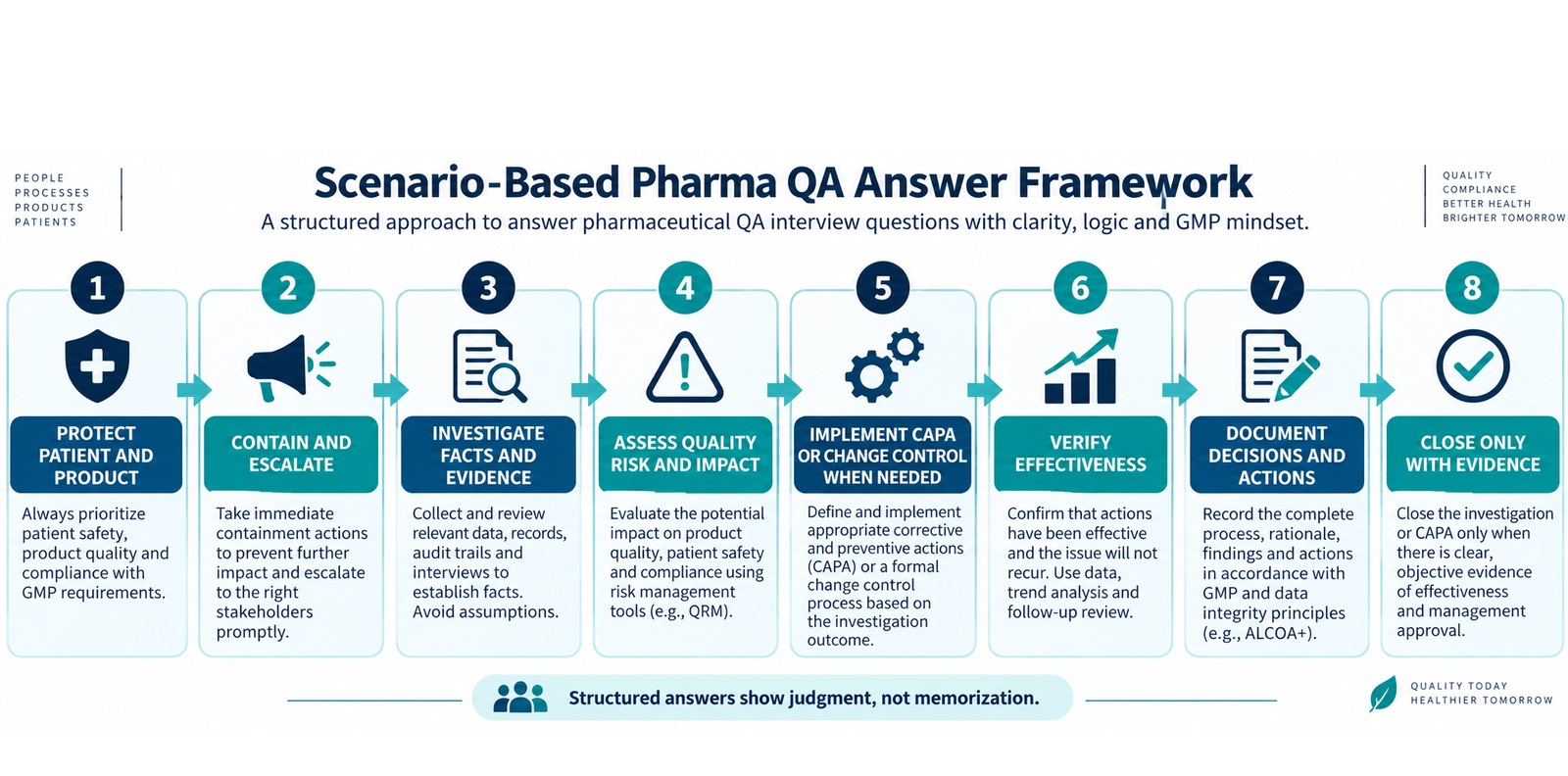
- Associate: emphasize execution, record accuracy, SOPs, and timely escalation.
- Specialist: emphasize investigations, risk decisions, CAPA, and cross-functional influence.
- Senior specialist: emphasize complex cases, coaching, and inspection support.
- Manager: emphasize governance, prioritization, metrics, and quality independence.
- Director: emphasize system performance, culture, resources, and regulatory strategy.
QA Associate and QA Officer Interview Questions
QA associate and officer interviews often focus on daily execution. Expect document review, line clearance, batch records, SOP compliance, deviations, and escalation. Interviewers want reliable attention to detail. They also want candidates who know their authority limits. Good answers show disciplined work and timely communication.
QA Specialist and Senior QA Interview Questions
Specialist and senior interviews demand stronger technical ownership. Expect deeper CAPA, deviation, change control, risk, and audit questions. Candidates may need to defend investigation decisions. They should explain evidence, alternatives, and residual risk. Senior answers should also show coaching and cross-functional influence.
QA Manager and Quality Leadership Interview Questions
Manager interviews examine system performance and leadership judgment. Questions may cover quality metrics, recurring deviations, inspection readiness, resources, and difficult decisions. Strong candidates prioritize risks instead of reacting equally to everything. They also explain escalation pathways and management oversight. Leadership answers should protect independence while enabling operations.
Final Word
Pharmaceutical QA interviews reward structured thinking and quality judgment. Strong candidates connect GMP requirements with practical decisions. Current QA hiring trends show 5,000+ pharma QA jobs, highlighting demand for GMP, CAPA, and data integrity skills.
They protect patients, product quality, and reliable operations. Therefore, practice scenarios instead of memorizing definitions alone. Build examples around documentation, investigations, risk assessment, and escalation. Finally, demonstrate how your responsibility grows with stronger quality-system knowledge.
FAQs
Yes. Many entry roles accept science, pharmacy, engineering, or related backgrounds. Employers still expect GMP knowledge and disciplined documentation habits. Practical examples from laboratories, internships, or manufacturing can strengthen your answers.
Prepare GMP, QMS, deviations, CAPA, data integrity, change control, and batch review. Also practice inspection and behavioral questions. Focus on decision logic instead of memorizing long definitions.
Use a risk-based sequence. Protect product and patients first. Then contain, escalate, investigate, assess impact, implement actions, and verify effectiveness. Finish with complete documentation and evidence-based closure.
References

Ershad Moradi
Ershad Moradi, a Content Marketing Specialist at Zamann Pharma Support, brings 6 years of experience in the pharmaceutical industry. Specializing in pharmaceutical and medical technologies, Ershad is currently focused on expanding his knowledge in marketing and improving communication in the field. Outside of work, Ershad enjoys reading and attending industry related networks to stay up-to-date on the latest advancements. With a passion for continuous learning and growth, Ershad is always looking for new opportunities to enhance his skills and contribute to pharmaceutical industry. Connect with Ershad on Facebook for more information.

GMP Audit Checklist 2026: The Essential Guide for Risk-Based Audits
Master your GMP Audit Checklist with a practical, risk-based approach to pharmaceutical self-inspections. Explore five essential audit steps, FDA’s six-system model, GMP documentation and evidence sampling, audit findings, CAPA tracking, and effectiveness verification to strengthen compliance and inspection readiness.
Orphan Drug Designation in 2026: FDA and EMA Eligibility Criteria
Discover how orphan drug designation works in 2026. Compare FDA and EMA eligibility criteria, rare disease prevalence thresholds, scientific evidence requirements, and regulatory incentives. Learn what pharmaceutical sponsors need to prepare for successful regulatory submissions

CEP certificate in pharma: What QA Must Verify in 2026
Learn how QA teams verify EDQM certificates, assess API suppliers, and prepare for GMP inspections. This guide explains CEP 2.0 updates, impurity controls, and essential records that help maintain regulatory compliance and inspection readiness across pharmaceutical manufacturing operations.