


Pharma Quality Management Softwares in 2026: GMP eQMS and FDA Compliance Tools

Regulatory agencies issue more than 3,500 FDA Form 483 observations each year across pharmaceutical manufacturing facilities, highlighting persistent GMP compliance gaps and recurring quality system weaknesses. As a result, companies now invest heavily in digital systems that control deviations, CAPA workflows, and audit readiness in real time. In this environment, pharma quality management softwares have become a core backbone of compliance strategy, because they unify documentation, track deviations, and strengthen inspection preparedness under strict GMP expectations. Moreover, modern pharma quality management practices rely on eQMS platforms to reduce human error and improve traceability across the entire product lifecycle. Therefore, pharmaceutical companies increasingly adopt integrated systems to stay aligned with FDA and EU GMP requirements while ensuring faster, more reliable quality decision-making.

Table of Contents

What Is Pharma Quality Management Softwares in GMP Context?

Pharma quality management softwares provide a GMP-controlled digital system that unifies documentation, deviations, CAPA, audits, and validation processes in one platform. Moreover, pharmaceutical quality management system software improves compliance by standardizing workflows and ensuring full traceability. In addition, eQMS software pharma industry tools manage deviations and CAPA actions in real time, while audit management software GMP strengthens inspection readiness. Therefore, GMP documentation control software supports data integrity compliance pharma requirements across the entire quality lifecycle.

Why Pharmaceutical QMS Softwares Is Critical for GMP and Inspection Readiness?

Pharmaceutical QMS software is essential for GMP compliance because it centralizes quality processes and keeps systems inspection-ready. Moreover, it improves CAPA management by tracking corrective and preventive actions in real time. In addition, deviation management system pharma tools quickly capture issues and support fast resolution. Likewise, audit management software GMP strengthens inspection readiness, while data integrity compliance pharma ensures accurate and reliable records across the quality system.

Pharmaceutical Quality Management Systems in GMP Environments

Pharmaceutical quality management system software in GMP environments helps companies build a controlled, compliant, and inspection-ready quality framework. Moreover, it integrates all critical quality processes into a unified digital system to reduce risks and strengthen regulatory performance.

In this section, we focus on the core eQMS software pharma industry modules that drive GMP compliance and inspection readiness in pharmaceutical operations.

  • CAPA Management in Pharmaceutical QMS Software (e.g., MasterControl, Veeva Vault QMS)
  • Deviation Tracking and Investigation Systems (e.g., ETQ Reliance, Sparta TrackWise)
  • Audit Management and Inspection Readiness Tools (e.g., Veeva Vault Quality, Qualio)
  • Document Control and GMP Compliance Systems (e.g., MasterControl, Greenlight Guru)

CAPA Management in Pharmaceutical QMS Softwares (e.g., MasterControl, Veeva Vault QMS)

CAPA systems help identify, investigate, and resolve quality issues to prevent recurrence. Tools like MasterControl and Veeva Vault QMS ensure compliant workflows and traceability.

Deviation Tracking and Investigation Systems (e.g., ETQ Reliance, Sparta TrackWise)

These systems record deviations from approved processes and support structured root cause analysis. Platforms like ETQ Reliance and TrackWise ensure timely, compliant investigations.

Audit Management and Inspection Readiness Tools (e.g., Veeva Vault Quality, Qualio)

Audit tools manage planning, execution, and tracking of audits to ensure regulatory compliance. Veeva Vault Quality and Qualio improve readiness by centralizing audit data.

Document Control and GMP Compliance Systems (e.g., MasterControl, Greenlight Guru)

Document control systems manage creation, approval, and versioning of GMP documents. Solutions like MasterControl ensure compliance and data integrity.

Comparison of Pharmaceutical QMS Software Modules and Compliance Impact

In modern Pharmaceutical Quality Management Systems (QMS), each module plays a direct role in reducing GMP compliance risks and inspection findings. Therefore, integration between CAPA, Deviation, Audit, and Document Control systems strengthens overall quality control and minimizes operational errors. In addition, when these modules work together in a unified eQMS platform, pharmaceutical companies achieve faster GMP compliance and significantly reduce FDA and EMA inspection findings. As a result, QMS software acts not only as a management tool but also as a critical compliance safeguard.

The table below shows how each QMS module directly impacts GMP inspection findings and compliance performance:

QMS Module CAPA Management Module Deviation Management System Audit Management System Document Control System
Core Function
Root cause correction and preventive action
Deviation logging and investigation
Audit planning and tracking
SOP and document version control
Main GMP Risk Reduced
Recurring quality failures
Uninvestigated process deviations
Missing audit evidence and gaps
Outdated or uncontrolled documents
Common GMP Finding
Ineffective CAPA closure
Weak deviation investigation process
Poor audit trail and readiness gaps
Use of obsolete SOPs
Compliance Impact
Ensures effective corrective actions
Improves traceability and investigations
Strengthens inspection readiness
Maintains data integrity and control
Inspection Benefit
Reduces repeat deviations
Improves root cause accuracy
Faster and cleaner audit response
Prevents documentation errors

Download GMP Inspection Findings and Quality Management System Compliance Guide (CAPA, Deviation, Audit & Document Control) Here

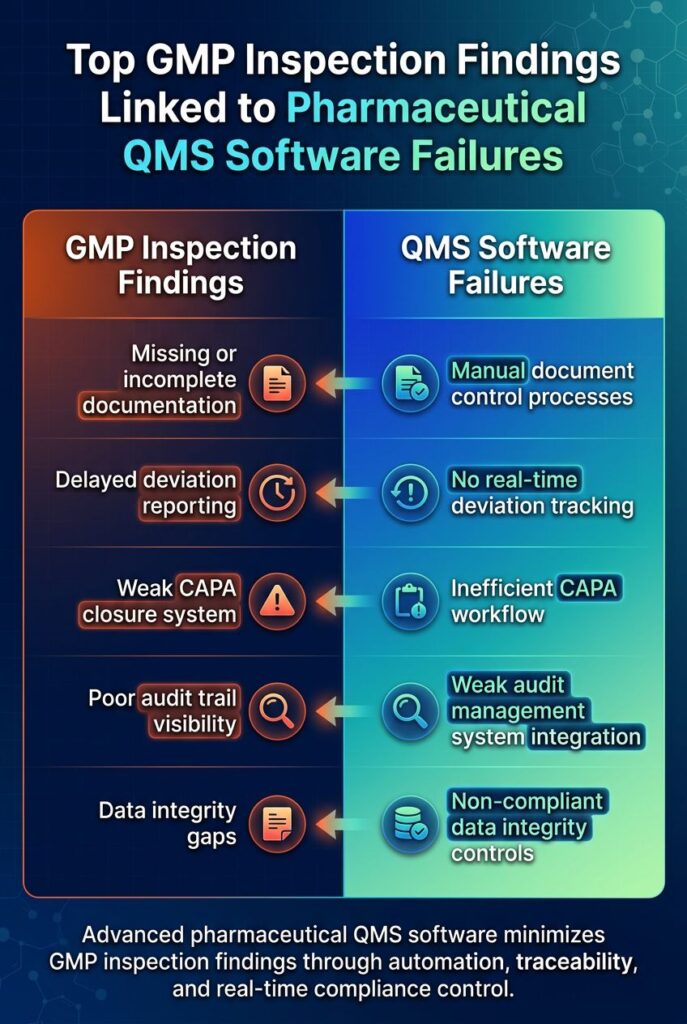
This infographic highlights the most common GMP inspection findings and how failures in pharmaceutical QMS software directly contribute to compliance gaps and audit risks.

Common GMP findings caused by pharmaceutical QMS software gaps, including weak document control, delayed deviations, and ineffective CAPA management.

How Integrated eQMS Platforms Improve GMP Inspection Readiness

Integrated eQMS platforms improve GMP inspection readiness by connecting all quality processes into one controlled system. First, they link CAPA, deviations, audits, and document control in real time, so teams track every action without delay. Moreover, they reduce manual errors and improve data accuracy across pharmaceutical operations. As a result, QA teams gain full visibility over compliance activities and respond faster during inspections. In addition, these systems strengthen traceability and ensure consistent documentation updates. Therefore, pharmaceutical companies maintain continuous GMP readiness and improve overall regulatory performance.
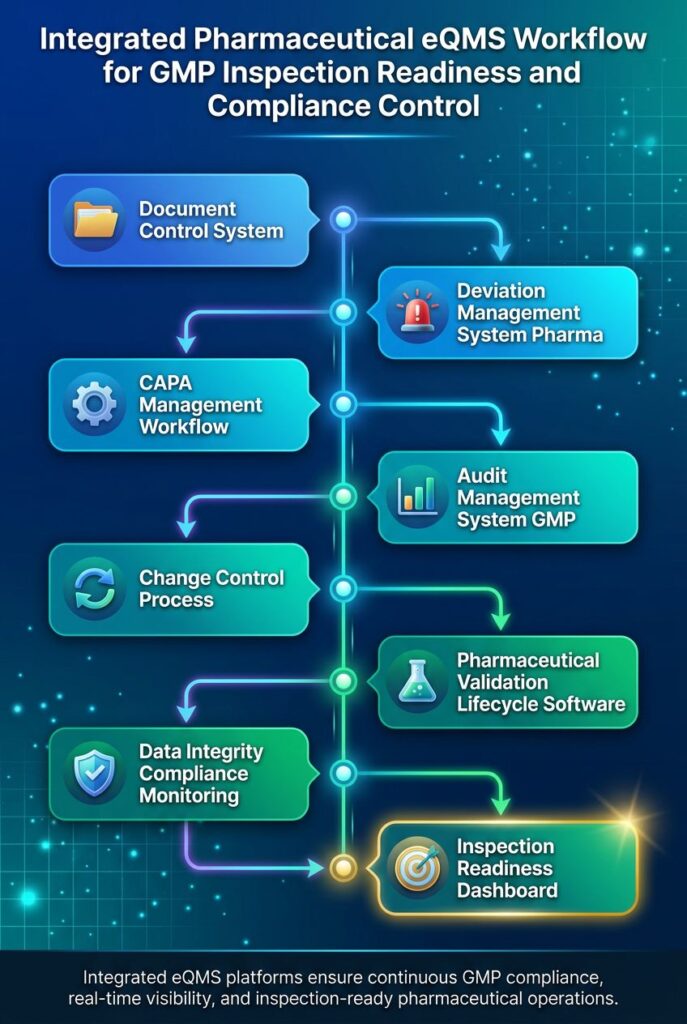
This infographic illustrates how an integrated pharmaceutical eQMS connects CAPA, deviations, audits, and document control into a unified workflow to ensure continuous GMP inspection readiness.

Pharmaceutical integrated eQMS workflow showing CAPA, deviations, audits, and document control connected in a single GMP compliance system for inspection readiness
An integrated eQMS workflow streamlines CAPA, deviation management, audit processes, and document control to strengthen GMP compliance and improve inspection readiness across pharmaceutical operations.

Final words

Integrated eQMS platforms connect CAPA, deviations, audits, and document control in one unified system, so pharmaceutical companies improve control and speed up GMP inspection readiness. Moreover, this integration reduces compliance gaps and strengthens real-time traceability across quality processes.

Industry inspection data shows a strong trend: EU/EEA GMP authorities issue over 1,600 compliance certificates annually, yet still record around 10 formal non-compliance findings each cycle. This gap highlights that inspection pressure remains constant even with advanced systems.

Therefore, companies increasingly rely on pharmaceutical QMS softwares to stay inspection-ready, reduce risks, and maintain continuous GMP compliance.

FAQ

1️⃣How does an integrated quality system reduce inspection findings in regulated manufacturing environments?

It reduces findings by connecting deviations, CAPA, audits, and documents in one workflow. As a result, teams close gaps faster and maintain full traceability during inspections.

2️⃣Why do inspectors focus so heavily on CAPA and deviation tracking during audits?

Because these two areas show how quickly a company identifies, investigates, and fixes quality risks. Therefore, weak CAPA or delayed deviation handling often leads to major compliance observations.

3️⃣What is the biggest advantage of using digital quality platforms instead of manual compliance systems?

Digital systems improve speed and data accuracy across quality operations. Moreover, they ensure real-time visibility, which helps teams stay continuously inspection-ready instead of reacting only before audits.

Picture of Mahtab Shardi
Mahtab Shardi

Mahtab is a pharmaceutical professional with a Master’s degree in Physical Chemistry and over five years of experience in laboratory and QC roles. Mahtab contributes reliable, well-structured pharmaceutical content to Pharmuni, helping turn complex scientific topics into clear, practical insights for industry professionals and students.

Share