


How often do system validation gaps trigger audit findings in pharma? Many inspection trend analyses suggest that over 30% of system-related findings link to weak validation, poor documentation, or missing data integrity controls. Regulators now look far beyond paper SOPs and focus directly on how you manage your computerized systems. In this guide, you learn how CSV vs Annex 11 compare, where they overlap, and how to apply them in real projects without drowning in paperwork.
Computerized System Validation (CSV) and EU GMP Annex 11 both sit at the heart of this scrutiny. Together they shape how you validate software, protect electronic records, and demonstrate control of your digital GMP environment. When you link them correctly to Good Manufacturing Practices (GMP), you reduce risk, avoid avoidable 483s, and protect patients.
Table of Contents
CSV vs Annex 11: What Each Framework Covers
When people say “CSV and Annex 11,” they often mix two different types of guidance.
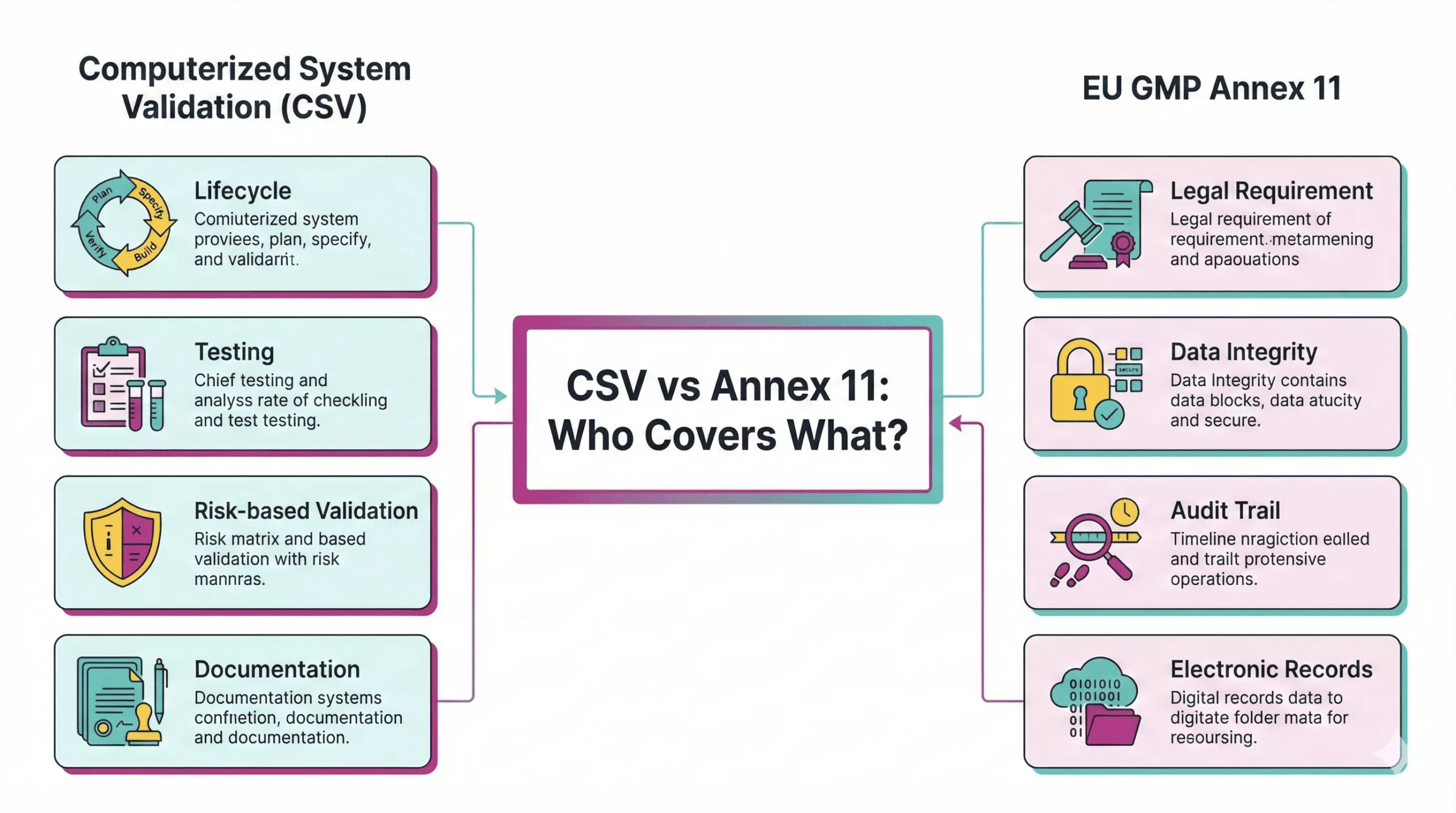
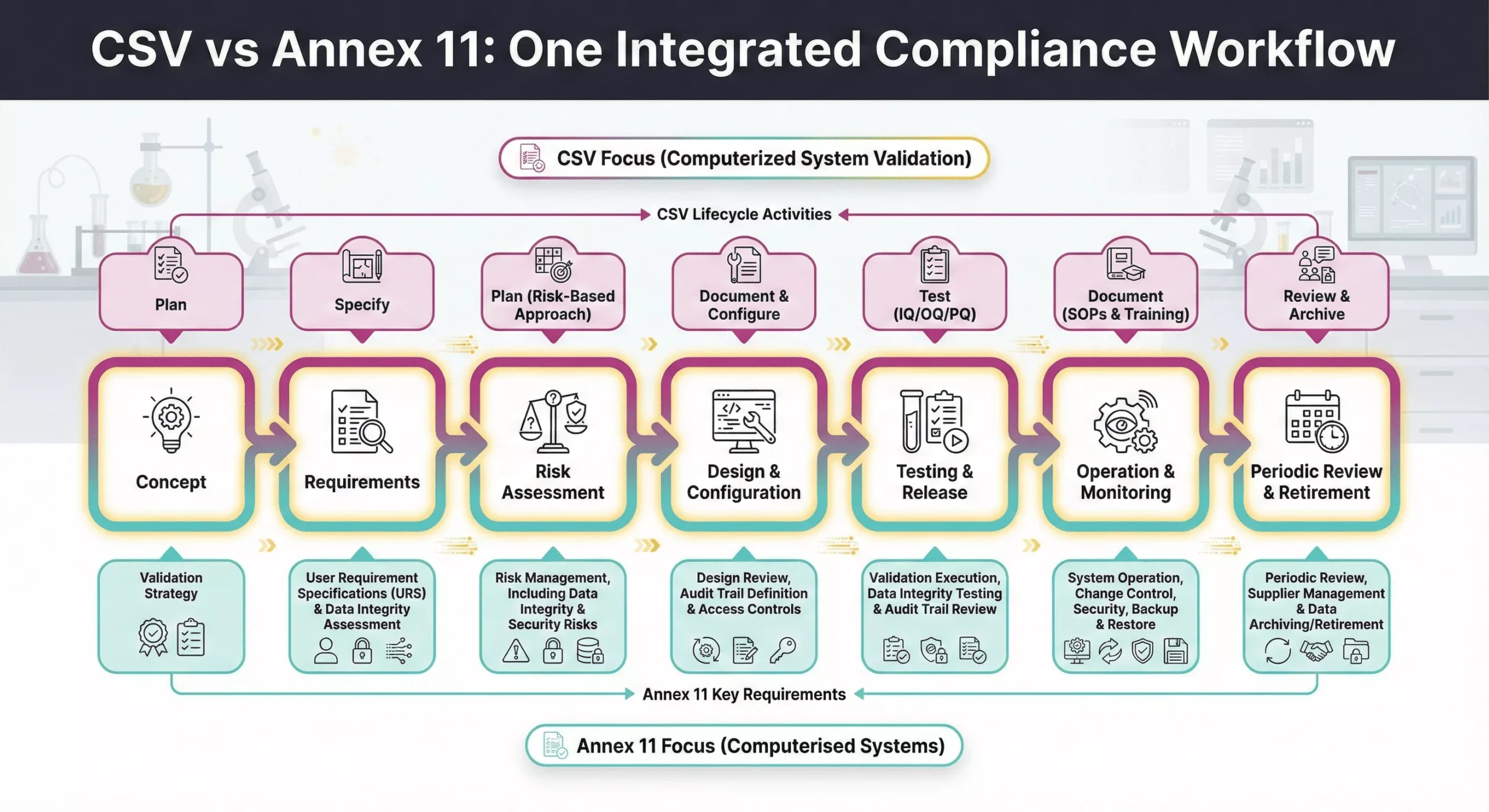
CSV describes a validation approach. You usually build it on GAMP 5 and related regulatory expectations. The focus sits on the full lifecycle of a computerized system, from concept to retirement. CSV tells you how to plan, specify, test, document, and maintain systems in a risk-based way.
Annex 11, in contrast, is a legal requirement inside the EU GMP Guide. It defines what GMP-regulated companies must ensure when they use computerized systems for production, quality control, and related GMP activities. It covers topics like validation, access control, electronic signatures, and audit trails.
Therefore:
- CSV gives you how to validate.
- Annex 11 defines what you must achieve to stay compliant in the EU.
- Both target the same objective: reliable, controlled computerized systems that protect product quality and data integrity.
Core Principles: How Both Approach System Compliance
Both frameworks share a common aim: keep systems fit for intended use, under control, and aligned with GMP.
CSV, especially when guided by GAMP 5, promotes a risk-based validation approach. You scale effort based on system impact on patient safety, product quality, and data integrity. You document logic, but you avoid “test everything” overkill.
Annex 11 sets concrete compliance requirements for GMP-regulated computerized systems. It expects validated applications, qualified infrastructure, clear roles, and documented procedures across the full lifecycle.
You can summaries the core principles like this:
- Fitness for intended use: Validate according to risk and business process impact.
- Lifecycle thinking: Plan, specify, test, release, maintain, and retire systems with control.
- Data integrity by design: Build ALCOA+ (Attributable, Legible, Contemporaneous, Original, Accurate, Complete, Consistent, Enduring, Available) into system setup and use.
- Shared responsibility: Split duties between business, QA, IT, and suppliers, then record them clearly.
Documentation Expectations in CSV vs Annex 11
Validation documentation often feels heavy. However, CSV and Annex 11 do not demand two separate mountains of paper. You can structure one set of documents that satisfy both.
| Document Area | CSV Focus (GAMP-style) | Annex 11 Focus | Typical Owner |
|---|---|---|---|
|
Validation Plan |
Define scope, roles, risk strategy, deliverables |
Show system lifecycle and control strategy |
QA + Business Process |
|
Requirements (URS/FRS) |
Capture intended use and functional needs |
Ensure requirements support GMP and data integrity |
Business + QA + IT |
|
Risk Assessment |
Classify risks, set testing depth |
Demonstrate quality risk management application |
QA + Validation Lead |
|
Test Protocols & Reports |
Prove functions work as intended |
Provide evidence system runs under control |
Validation / CSV Team |
|
SOPs & Work Instructions |
Standardize daily operation and maintenance |
Ensure controlled use and security of systems |
Business + QA |
|
Periodic Review / Requal. |
Confirm system remains compliant over time |
Show ongoing lifecycle oversight |
QA + System Owner |
Regulators care less about format and more about clarity, traceability, and consistency.
Risk and Impact Assessment: CSV Requirements vs Annex 11 Expectations
When you compare CSV and Annex 11 for risk, you see strong alignment.
CSV, guided by GAMP 5, asks you to classify systems and functions based on risk, then tailor validation depth to that risk. Annex 11 explicitly mentions risk management and expects you to apply quality risk principles across the lifecycle, from supplier selection to change control.
For practical work:
- Map business processes and GMP impact first.
- Rate each function for patient safety, product quality, and data integrity.
- Decide where to apply detailed testing, independent review, or enhanced monitoring.
- Document the logic in a simple, auditable way.
This shared risk view helps you justify why some functions receive heavier validation than others.
Data Integrity Controls in CSV vs Annex 11
Data integrity now dominates warning letters and inspection reports. Many FDA and EU observations highlight missing audit trails, uncontrolled access, or incomplete electronic records.
Both frameworks demand strong controls, yet they describe them differently. CSV integrates data integrity into requirements, design, and testing. Annex 11 spells out mandatory expectations for electronic records and signatures.
| Area | CSV Typical Practice | Annex 11 Requirement Highlights |
|---|---|---|
|
Audit Trails |
Specify, configure, and test audit trail behavior |
Require audit trails for GMP-critical data changes |
|
Access & Security |
Define roles, test permissions, and segregation |
Enforce unique IDs, secure access, and oversight |
|
Electronic Records |
Validate creation, storage, retrieval, and backup |
Ensure records remain complete, accurate, and available |
|
Electronic Signatures |
Test signature controls were used |
Align with EU signature rules and identity checks |
|
Record Review |
Build audit trail review into procedures |
Require routine review before batch or data release |
Therefore, a good CSV strategy will prove that Annex 11 data integrity expectations work in practice.
Technical and Procedural Controls: Where CSV and Annex 11 Align or Differ
Technical controls and procedures keep systems safe long after go-live. Here, Computer System Validation vs Annex 11 sits very close together.
You can think in two buckets:
Where they align
- Emphasis on controlled configuration and change management.
- Need for backup, restore, and disaster recovery tests.
- Requirement for training and documented procedures.
Where they differ
- CSV focuses more on test depth, specification detail, and lifecycle deliverables.
- Annex 11 sets explicit regulatory rules for hosting, outsourcing, and supplier oversight in the EU.
In practice, one integrated set of technical and procedural controls usually satisfies both.
Practical Comparison: When to Apply CSV, Annex 11, or Both
Real projects rarely choose CSV vs Annex 11 as an either/or. Most GMP systems in Europe must meet both.
You apply CSV whenever a system supports GxP processes, regardless of region. You apply Annex 11 when that system falls under EU GMP scope. Global companies often design a “highest common denominator” approach: one standard that passes EU, US, and other authority expectations at once.
A simple use-case table helps:
| Scenario / Use Case | Primary Driver | Apply CSV? | Apply Annex 11? |
|---|---|---|---|
|
GMP MES in an EU-licensed plant |
EU GMP, batch records, EBR |
Yes |
Yes |
|
Laboratory LIMS used for QC testing in EU and US |
GMP, data integrity, global QC |
Yes |
Yes (EU batches) |
|
Stability study database used only in US sites |
FDA, data integrity guidance |
Yes |
No (unless EU use) |
|
HR or payroll system with no GMP impact |
Corporate only |
No (or minimal risk note) |
No |
|
Cloud-based QMS used for deviations and CAPAs worldwide |
GxP workflow, records, audit trail |
Yes |
Yes for EU products |
Therefore, start every project with two questions:
- Does this system touch GxP data or GMP decisions?
- Does any EU GMP site use it for regulated activities?
If you answer “yes” to either, you move straight into CSV planning. If you answer “yes” to both, you also map Annex 11 clauses explicitly.
Practical Go-Live Checklist for GxP Computerized Systems
Before a computerized system goes live, teams should confirm that validation evidence, controls, and responsibilities are complete. A structured checklist helps QA, IT, and system owners identify gaps early, reduce compliance risk, and release the system with clear, documented confidence across the complete GxP system lifecycle.
- Confirm the system’s GxP impact
- Approve the User Requirements Specification
- Complete the risk assessment
- Execute and document required testing
- Verify user roles and access controls
- Review audit-trail functionality
- Assess and approve the supplier
- Obtain formal release approval
Download the CSV vs Annex 11 Go-Live Checklist
This practical PowerPoint helps QA, IT, validation teams, and system owners review critical controls before system release. It converts CSV and Annex 11 expectations into clear actions, supporting consistent decisions, stronger documentation, and better inspection readiness throughout the computerized system lifecycle.
- Assess GxP impact
- Review URS completeness
- Confirm risk-based testing
- Verify access and audit trails
- Evaluate supplier controls
- Document final release approval
Review Every Critical Control Before Release
Final words
Inspection of data and industry analysts suggest that almost 40% of system-related audit findings connect to weak validation, inconsistent documentation, or poor data integrity controls. Data gaps, missing audit trail review, and unclear system ownership often sit at the center of those findings.
When you truly understand CSV vs Annex 11, you design systems differently. You ask better questions during vendor selection. You write sharper user requirements. You scale validation effort using risk, not habit. You also prove data integrity instead of assuming it.
FAQ
You apply CSV to every GxP-relevant computerized system across all regions. You apply Annex 11 whenever the same system supports EU GMP activities, such as batch release or QC testing.
Inspectors often ask for your validation package, risk assessments, and SOPs first. They then map those documents against Annex 11 clauses, data integrity expectations, and your own procedures.
Frequent gaps include unclear system ownership, limited audit trail review, weak user access control, and missing periodic review of validated systems.
GAMP 5 does not replace Annex 11. Instead it gives a practical, risk-based method to implement CSV that supports Annex 11 requirements.
References

Stephanie Männicke
Digital Marketing Especialist at Zamann Pharma Support, brings 8 years of experience in Corporate and Digital Communication. Specializing in Digital Marketing and Content Creation, Stephanie is currently focused on creating strategic content for Pharmuni's networks, especially content on topics such as recruitment, onboarding and employer branding. Outside of work, Stephanie is a mum, a crocheter and a movie fan. An avid reader and in search of expanding her knowledge, Stephanie is always looking for ways to innovate communication in the digital environment and connect people in a genuine way.

Deviation vs Nonconformance 2026: 5 Critical GMP Mistakes to Avoid
Explore 5 critical differences between deviation and nonconformance in pharma, including GMP investigations, OOS, risk assessment, and CAPA.

Root Cause Analysis in Pharmaceutical Industry: 6 Powerful Methods in 2026
Explore 6 powerful root cause analysis methods in pharma to investigate deviations, strengthen CAPA, ensure GMP compliance, and protect patient safety.

Quality Culture in Pharma Industry 2026: Proven Ways to Build Trust
Explore how to build a strong quality culture in the pharmaceutical industry in 2026 through leadership commitment, ICH Q10 principles, meaningful GMP metrics, effective CAPA,