


ICH Guidelines are global standards that harmonize pharmaceutical quality with data and facts. Built for worldwide collaboration, they help teams design, test, and document products consistently. By aligning expectations across regions, ICH Guidelines support regulatory approvals and enable streamlined drug development cycles. Their structured approach reduces uncertainty by specifying what evidence is needed and how it should be generated and reviewed.
Within ICH Q7–Q10, key pharma processes are defined with clear validation and risk management expectations. These modules guide manufacturing controls, quality systems, and ongoing lifecycle oversight across pharma regulation frameworks. When sponsors follow ICH Q7–Q10 principles, dossiers become easier to evaluate, helping regulators reach decisions faster.
Table of Contents
What are ICH Guidelines?
ICH Guidelines are global standards for pharmaceutical development and quality. They help companies plan studies and produce medicines consistently. Regulators use them to review evidence clearly. They support faster approvals and safer products worldwide.
- ICH sets clear expectations for documentation and testing.
- Teams follow ICH to control quality systems and processes.
- ICH guides validation activities and verifies performance.
- ICH requires risk management for better decision making.
- ICH supports consistent submissions across regions.
Different ICH Guidelines with different categories
| Category | Example ICH Guidelines | Main Focus |
|---|---|---|
|
Q: Pharmaceutical Quality |
Q7, Q8, Q9, Q10 |
GMP for APIs, development, risk management, quality system |
|
Q: Stability & Impurities |
Q1A, Q1B, Q3A, Q3C |
Stability testing, photostability, impurity control, residual solvents |
|
Q: Analytical Testing & Specifications |
Q2(R1), Q4B, Q5C, Q6A |
Analytical validation and biotech testing/suitability |
|
S: Nonclinical Safety |
S1, S2(R1), S3A, S4 |
Safety pharmacology, genotoxicity, carcinogenicity, study duration |
|
E: Clinical & Statistics |
E3, E6(R2), E9(R1), E14 |
Clinical study reports, GCP, statistics, QT/QTc |
How do they impact pharmaceutical development?
ICH guidelines shape how drug makers plan, test, and document products. They create consistent quality standards across countries. Developers follow timelines, protocols, and reporting formats. These steps reduce confusion and speed review. As a result, teams spend less time reworking studies.
ICH guidelines also strengthen safety and effectiveness evidence. They guide dose selection, stability testing, and clinical data quality. Teams manage risks early and monitor study conduct. Clear rules help regulators trust submissions faster.
- Teams improve data accuracy and traceability.
- Companies design studies with consistent endpoints.
- Regulators review applications with fewer questions.
Detailed Overview of ICH Q7 GMP Guidelines for Active Pharmaceutical Ingredients
ICH Q7 GMP guides active pharmaceutical ingredient manufacturers on quality and control. It focuses on facilities, equipment, documentation, and process monitoring. In addition, it covers material handling, production steps, and lab testing. Teams also manage deviations and change controls to keep quality stable. These rules help reduce mix-ups and contamination risks.
- Teams validate processes before routine production
- They test starting materials and control suppliers tightly
- They maintain batch records and full documentation trails
- They control contamination through clean operations and storage rules
- They review complaints, returns, and out-of-spec results regularly
Understanding ICH Q8, Q9, and Q10 for Pharmaceutical Development, Quality Risk Management, and Quality Systems
ICH Q8 guides pharmaceutical development and helps teams define quality targets for products. It describes how teams link product design to clinical performance and manufacturing results. Next, it supports consistent critical quality attributes during scale-up.
ICH Q9 helps teams manage risks using structured processes and clear decision rules. Then, teams reduce harm and improve compliance by prioritizing real risks. Finally, ICH Q10 connects development, risk control, and improvement into one quality system
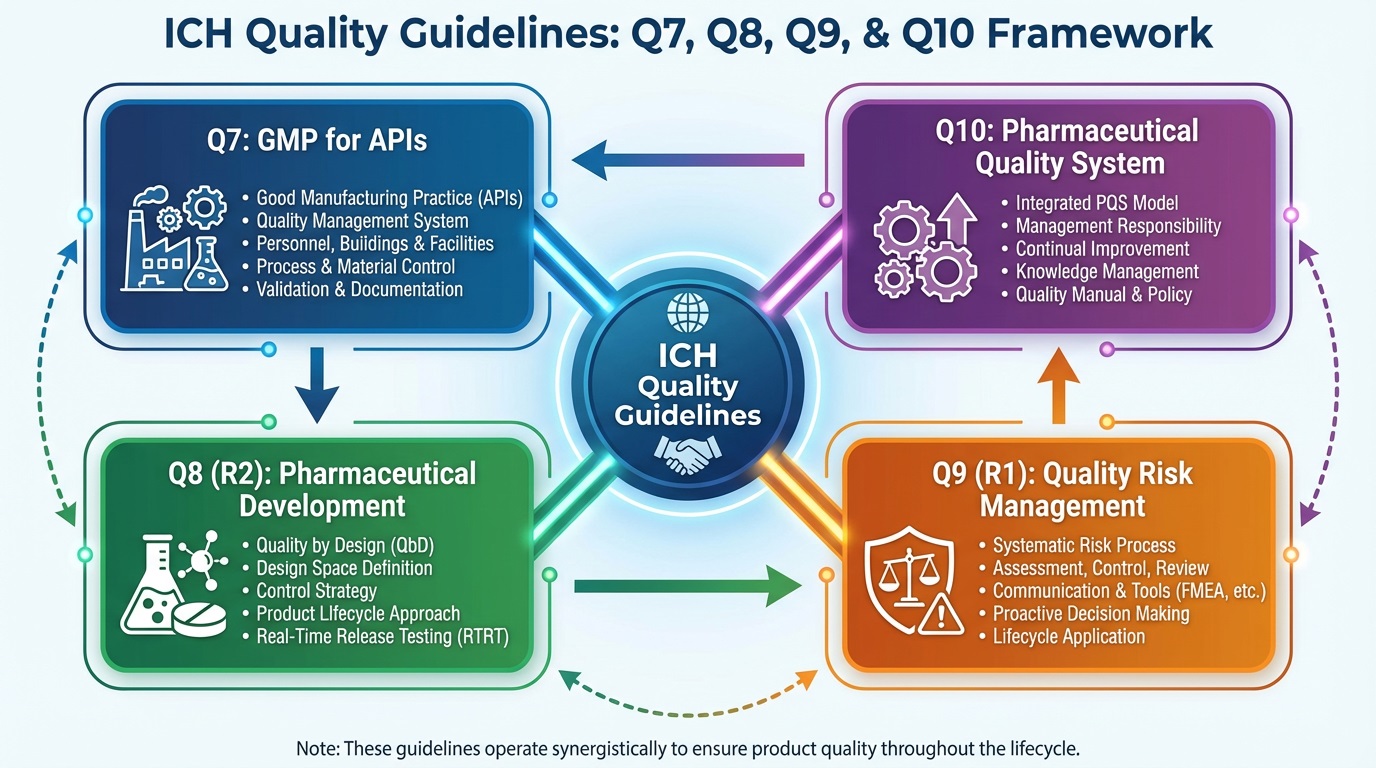
ICH Q8: Pharmaceutical Development
ICH Q8 guides pharmaceutical development by promoting quality by design principles. It helps companies link product formulation to manufacturing processes clearly. Also, it encourages innovation while maintaining regulatory compliance. This guideline improves product consistency and reduces development time. Teams use ICH Q8 to optimize processes and ensure drug safety.
ICH Q9: Quality Risk Management
ICH Q9 helps teams manage quality risks in drug products. Teams identify risks, assess impact, and choose suitable controls. Therefore, teams prevent problems and protect patient safety.
Next, teams monitor risk over time and update decisions with new data. Then, teams document key reasons and actions for transparency. In addition, teams use risk thinking during changes, deviations, and investigations.
ICH Q10: Pharmaceutical Quality System
ICH Q10 guides quality systems for pharmaceutical products. Teams connect development, manufacturing, and continuous improvement. Therefore, teams manage quality as an everyday responsibility.
Next, teams set quality objectives and roles for key processes. Then, teams measure performance using audits and reviews. In addition, teams handle changes and CAPA with clear steps. Finally, teams improve product quality over time with new learning.
How to Implement ICH Guidelines in Pharma Manufacturing and Quality Control
ICH guidelines help teams plan, document, and control production and testing. Therefore, teams follow clear procedures and strong batch records.
Example 1: Teams validate processes and equipment before routine manufacture.
Example 2: Teams use risk tools to set sampling plans for QC tests.
ICH Guidelines on Process Validation and Lifecycle Management
ICH guidelines emphasize a lifecycle approach to process validation. This approach integrates design, qualification, and continuous monitoring phases. Also, it improves product quality and regulatory compliance. Companies adopting this method reduce risks and enhance efficiency.
Furthermore, ICH promotes risk-based validation strategies. They focus resources on critical process areas. Additionally, continuous process verification detects deviations early for timely corrections. Key principles include:
- Promote a lifecycle approach
- Apply risk-based validation strategies
- Encourage continuous process verification
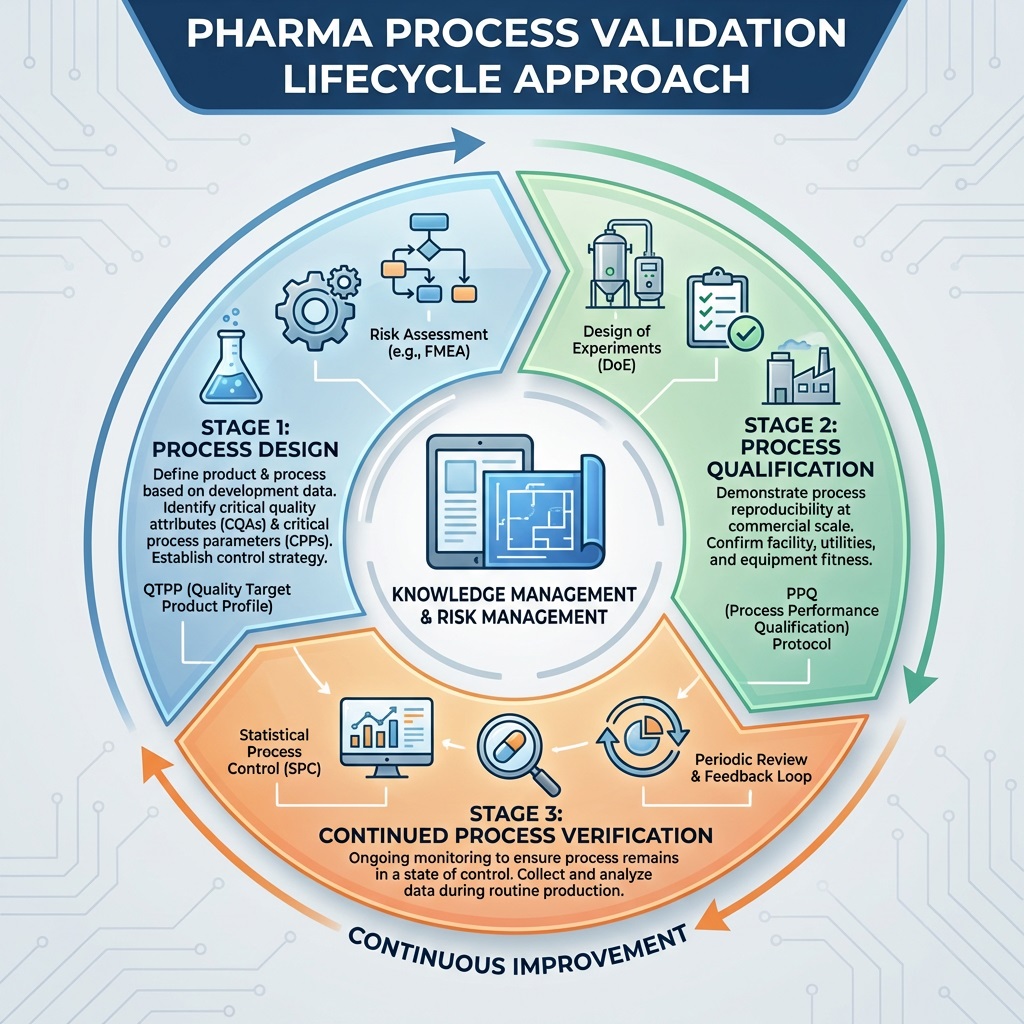
Promote a Lifecycle Approach
ICH guidelines promote a lifecycle approach to process validation, integrating design, qualification, and continuous monitoring. This approach improves product quality and regulatory compliance. Also, it supports data-driven decision-making and risk management. Companies using lifecycle validation reduce defects and enhance process control. Moreover, regulators expect lifecycle data to ensure consistent manufacturing.
Key data elements include:
- Process design and development data
- Installation and operational qualification results
- Performance qualification data under real conditions
- Ongoing process monitoring data
- Risk assessments and mitigation plans
- Validation change control and reviews
Promote a Lifecycle Approach
ICH guidelines promote a lifecycle approach to process validation, integrating design, qualification, and continuous monitoring. This approach improves product quality and regulatory compliance. Also, it supports data-driven decision-making and risk management. Companies using lifecycle validation reduce defects and enhance process control. Moreover, regulators expect lifecycle data to ensure consistent manufacturing.
Key data elements include:
- Process design and development data
- Installation and operational qualification results
- Performance qualification data under real conditions
- Ongoing process monitoring data
- Risk assessments and mitigation plans
- Validation change control and reviews
Risk-based Validation Strategies
ICH guidelines encourage risk-based validation strategies to focus efforts on critical process areas. This approach helps reduce validation costs and improves efficiency while ensuring product quality and safety. Also, it supports better resource allocation and regulatory compliance.
Top risk-based strategies include:
- Prioritizing validation based on potential impact
- Using risk assessments to guide testing intensity
- Continuously monitoring processes for early issue detection
Risk-Based Validation Strategies vs Traditional Validation Approaches
| Factor | Risk-Based Validation Strategies | Traditional Validation Approaches |
|---|---|---|
|
Main focus |
Target critical process steps and critical quality attributes |
Validate many steps broadly, with less prioritization |
|
Scope |
Validate based on risk ranking and impact |
Validate most parameters and areas similarly |
|
Testing intensity |
Run more testing where failure risk stays highest |
Use similar testing effort across the whole process |
|
Sampling plan |
Choose sampling levels based on risk and data history |
Use fixed sampling plans regardless of risk |
Encourage Continuous Process Verification
ICH guidelines encourage continuous process verification to maintain consistent product quality throughout manufacturing. This approach monitors processes in real time and identifies deviations quickly. Also, it promotes data analysis to support ongoing improvements. Continuous verification helps companies stay compliant and reduce risks.
Key actions include:
- Collect real-time process data
- Analyze trends for potential issues
- Implement corrective actions promptly
- Review verification results regularly
Role of ICH Guidelines in Global Harmonization of Pharma Regulations
ICH guidelines play a key role in harmonizing pharmaceutical regulations globally. They create common standards that help pharmaceutical companies comply with multiple regulatory bodies. This reduces duplication and speeds up drug approvals. Also, harmonization improves patient safety and ensures consistent product quality worldwide.
For example:
- ICH Q7 aligns GMP standards for active ingredient production across regions.
- ICH Q10 standardizes quality system practices internationally.
Final Words
ICH guidelines play a critical role in ensuring pharmaceutical product quality and regulatory compliance worldwide. According to ICH, implementing these guidelines reduces regulatory delays by up to 40% and improves manufacturing consistency. Their comprehensive framework covers product development, risk management, and quality systems, helping companies meet global standards effectively. Continuous education and adaptation to evolving ICH guidelines remain essential as the pharma industry advances.
Professionals should stay updated and share authoritative references, regulatory changes, or relevant case studies. This collaboration enriches the community’s knowledge, fosters best practices, and drives innovation in pharmaceutical quality management.
FAQs
ICH Guidelines harmonize global pharmaceutical standards for quality, safety, and efficacy.
They streamline development, improve data consistency, and speed regulatory approvals.
They address GMP for APIs, pharmaceutical development, quality risk management, and quality systems.
References

Ershad Moradi
Ershad Moradi, a Content Marketing Specialist at Zamann Pharma Support, brings 6 years of experience in the pharmaceutical industry. Specializing in pharmaceutical and medical technologies, Ershad is currently focused on expanding his knowledge in marketing and improving communication in the field. Outside of work, Ershad enjoys reading and attending industry related networks to stay up-to-date on the latest advancements. With a passion for continuous learning and growth, Ershad is always looking for new opportunities to enhance his skills and contribute to pharmaceutical industry. Connect with Ershad on Facebook for more information.

Udemy vs Pharmuni in 2026: One Course Fast or a Full Pharma Career Path?
Udemy makes it easy to buy a specific self-paced course from a huge marketplace. Pharmuni takes a different approach, connecting pharma learning with assessments, Career Paths, competency visibility, CV tools, and job matching.

COURSERA VS PHARMUNI in 2026: Global Learning Scale or a Pharma Career System?
Coursera offers global provider choice and multidisciplinary learning. Pharmuni focuses on pharma-specific assessments, Career Paths, job skills, CV tools, and job matching.

PharmaState Academy vs Pharmuni in 2026: More Courses, More Direction, or Both?
PharmaState Academy offers broad, often low-cost pharma learning across QA/QC, manufacturing, regulatory, sales and marketing. Pharmuni adds role-based assessments, Career Paths, competency benchmarking, CV tools and job matching. Here is where each platform fits best.