


Media Fill is an aseptic process simulation that checks whether a sterile filling process can prevent microbial contamination. It uses sterile growth medium instead of real product, so teams test the process, equipment, environment, and operators without risking patients. WHO TRS 1044 Annex 2, published in 2022, revised the 2011 sterile-products GMP guidance and aligned with EU and PIC/S expectations.
In pharma quality assurance, media fill (MF) data supports batch confidence, operator qualification, environmental monitoring review, deviation control, CAPA decisions, and audit readiness for inspections globally.
Table of Contents
What is Media Fill in Pharma?
MF test checks an aseptic filling process with sterile nutrient media instead of drug product. It tests the process, people, equipment, cleanroom, and interventions. EU GMP Annex 1 calls it APS, or aseptic process simulation. It also sets “zero growth” as the target.
Example: a sterile vial filling line runs media instead of medicine. The team then incubates every unit and checks microbial growth. Media Fill helps QA confirm process control before patients receive sterile products.
- Tests aseptic filling practice
- Uses sterile nutrient media
- Checks contamination control
- Supports GMP inspection readiness
Why is Media Fill Important in Sterile Manufacturing?
MF helps teams find contamination risks before commercial production. It challenges operators, line setup, interventions, and cleanroom behavior. Also, FDA guidance supports CGMP controls for sterile drugs under 21 CFR Parts 210 and 211.
Sterile products can harm patients when contamination reaches the batch. Therefore, QA teams use Media Fill to strengthen sterility assurance, deviation control, CAPA decisions, and operator qualification.
Key Steps of Media Fill Test
A MF test follows a planned, documented, and controlled process. Teams must define batch size, line speed, worst-case conditions, interventions, incubation checks, and acceptance criteria. EU GMP Annex 1 says typical APS runs fill 5,000 to 10,000 units.
The main steps include:
Step 1: Prepare the MF test Protocol
Step 2: Set Up the Aseptic Filling Line
Step 3: Run the MF simulation
Step 4: Incubate and Inspect Filled Units
Step 5: Review Results and Approve the Report
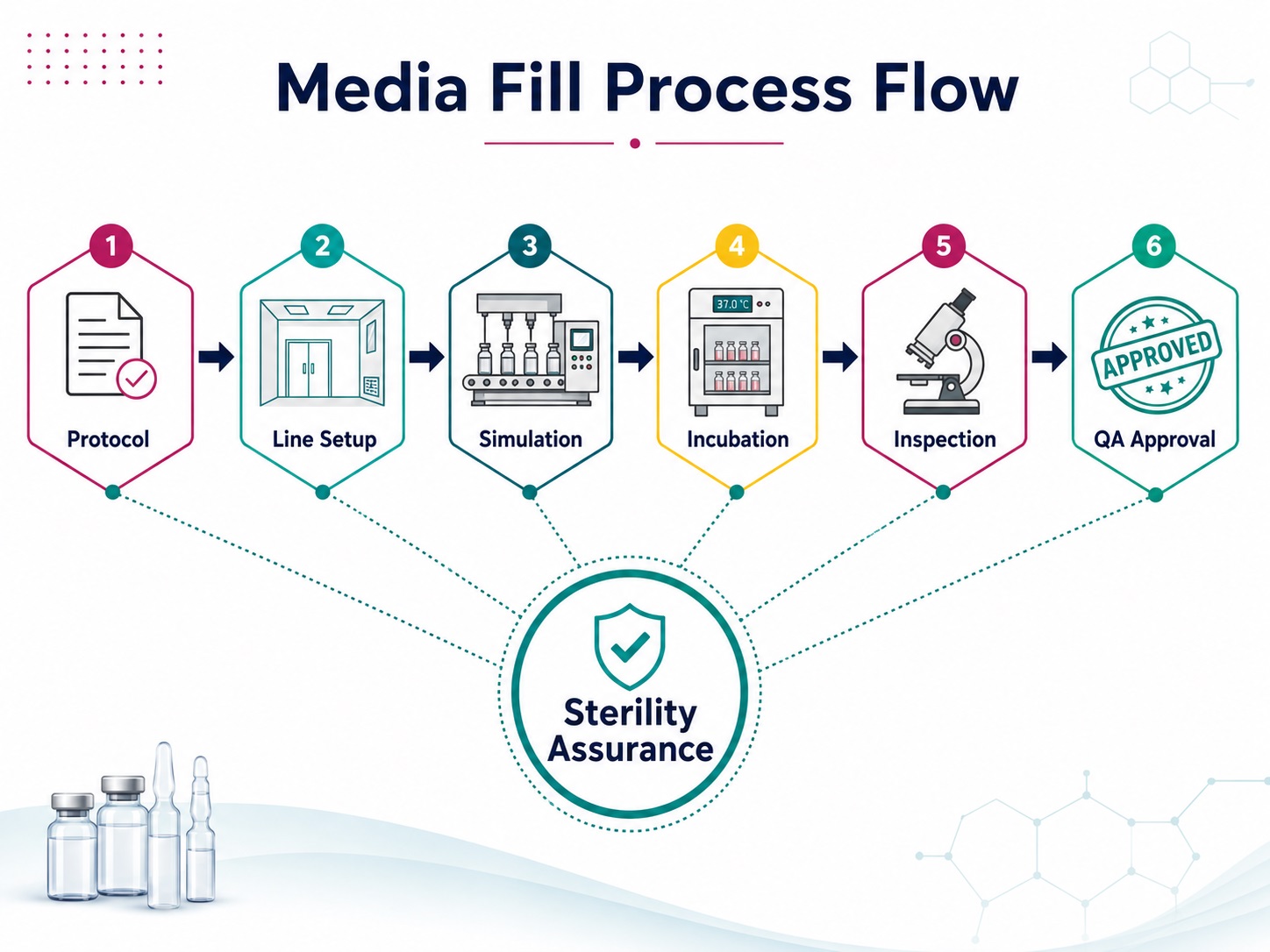
Step 1 Prepare the MF Test Protocol
Define scope, batch size, line speed, operators, interventions, incubation conditions, and acceptance criteria. Include worst-case situations. Also, assign responsibilities to QA, production, microbiology, validation, and engineering teams before execution starts.
Step 2 Set Up the Aseptic Filling Line
Prepare sterile components, growth medium, equipment, and cleanroom conditions. Check cleaning records, sterilization records, and line clearance. Then, confirm gowning qualification, environmental monitoring points, and required materials before starting the simulation.
Step 3 Run the MF Test Simulation
Run the process with sterile growth medium instead of drug product. Include routine and worst-case interventions. Example: simulate a stopper jam correction during filling. Record operator actions, line stops, restarts, and monitoring results.
Step 4 Incubate and Inspect Filled Units
Incubate all filled units under approved conditions. Inspect units for turbidity, microbial growth, leakage, or damage. Record each observation clearly. Then, isolate suspect units and identify microorganisms when contamination appears.
Step 5 Review Results and Approve the Report
Review filled units, contamination results, interventions, deviations, monitoring data, and growth promotion results. QA compares evidence with acceptance criteria. Finally, approve the report only when the study meets protocol and GMP expectations.
What is the Difference between MF and Aseptic Process Simulation?
MF describes the practical test using sterile growth medium. Aseptic Process Simulation, or APS, describes the same concept in regulatory language. EU GMP Annex 1 states that APS uses sterile nutrient media or a surrogate in place of product.
In simple terms, MF test is the common industry name. APS is the formal technical term. Both terms focus on aseptic process performance, not drug quality testing.
Acceptance Criteria for MF test
Acceptance criteria define whether the run passes or fails. EU GMP Annex 1 sets the target as zero growth. Any contaminated unit means a failed APS and requires investigation, corrective measures, and repeat successful simulations.
Teams should also review environmental monitoring, personnel monitoring, interventions, incubation results, and unit reconciliation. Therefore, QA must approve the final report only after complete evidence review.
Acceptance Criteria Table for MF
| Area | Expected Result | Required Action |
|---|---|---|
|
Filled units |
Zero microbial growth |
Investigate any contamination |
|
Growth medium |
Supports microbial growth |
Repeat invalid test |
|
Interventions |
Complete records |
Investigate missing data |
|
Environmental monitoring |
Meets limits |
Review trends |
Frequency Requirements for Media Fill in Pharma
Media Fill frequency depends on process risk, filling line, shifts, operators, and changes. EU GMP Annex 1 expects periodic APS twice yearly, about every six months, for each aseptic process, filling line, and shift.
Each operator should join at least one successful APS annually. Teams also repeat Media Fill after major changes, long inactivity, new equipment, new containers, or failed simulations.
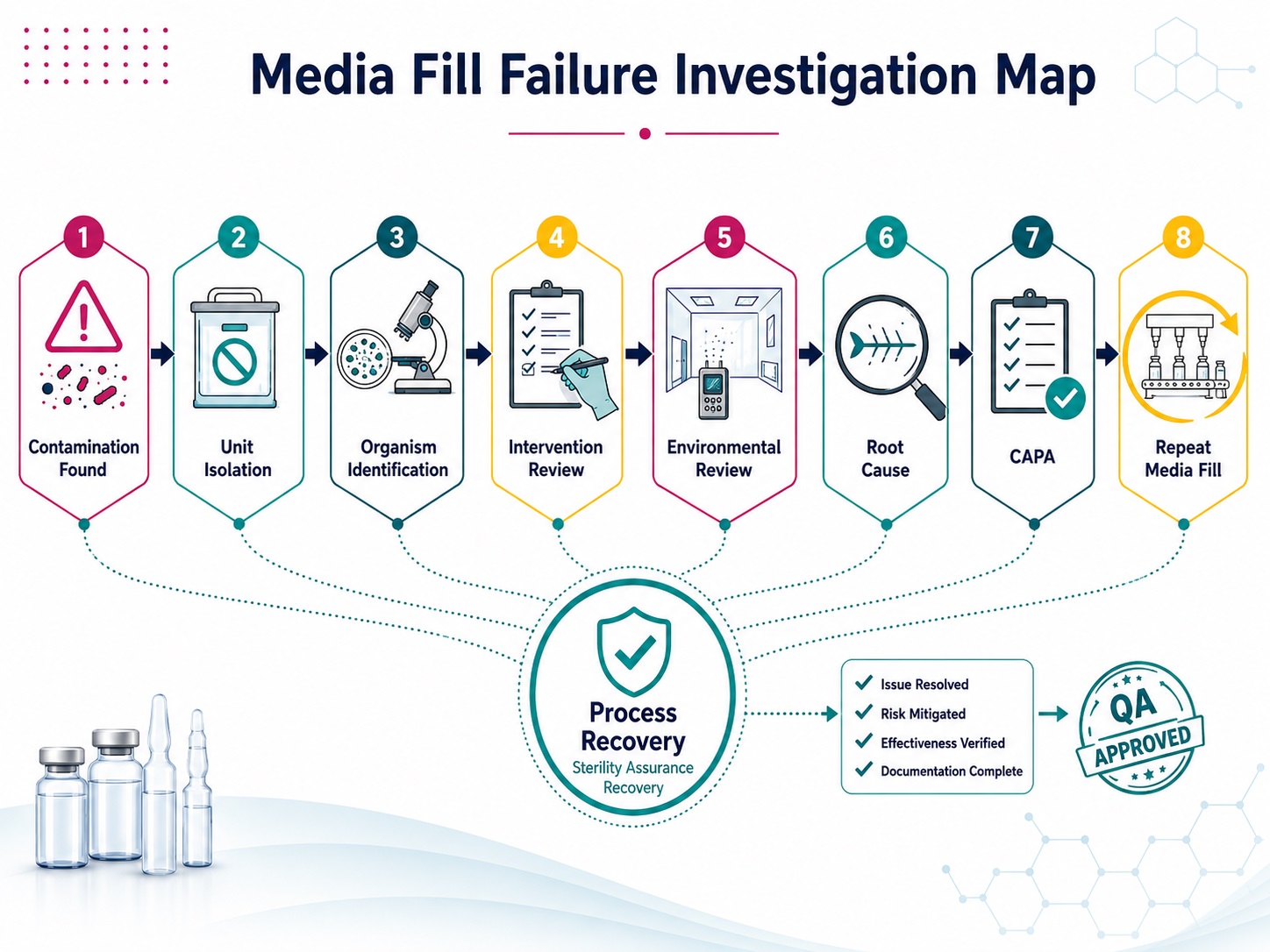
Tips for Failure Investigation for MF test
A Media Fill failure needs fast action, strong records, and clear root cause analysis. EU GMP Annex 1 expects a minimum of three successful consecutive repeat APS runs after failure. It also requires record review since the last successful APS.
Example: one contaminated unit appears after a corrective intervention. QA reviews the operator action, organism identity, EM data, and cleaning records. Then, the team defines CAPA before production resumes.
- Identify contaminated units quickly
- Review interventions and operators
- Check EM and cleaning records
- Define CAPA before approval
Final Words
MF protects sterility assurance, GMP compliance, and patient safety. It does more than validate one filling activity. It tests people, process, equipment, cleanroom behavior, and interventions.
Therefore, teams should align each MF study with EU GMP Annex 1, FDA guidance, WHO GMP, and internal SOPs. WHO TRS 1044 Annex 2 revised the 2011 WHO sterile GMP text with EU and PIC/S collaboration.
FAQs
Media Fill tests the aseptic filling process with sterile growth medium. It checks the process, equipment, cleanroom, operators, and interventions. It does not test the drug product.
Media Fill helps teams detect contamination risks before real production. It supports sterility assurance, GMP compliance, operator qualification, and patient safety.
The expected result is no microbial growth in filled units. Any contamination needs investigation, root cause analysis, CAPA, and QA review.
References

Ershad Moradi
Ershad Moradi, a Content Marketing Specialist at Zamann Pharma Support, brings 6 years of experience in the pharmaceutical industry. Specializing in pharmaceutical and medical technologies, Ershad is currently focused on expanding his knowledge in marketing and improving communication in the field. Outside of work, Ershad enjoys reading and attending industry related networks to stay up-to-date on the latest advancements. With a passion for continuous learning and growth, Ershad is always looking for new opportunities to enhance his skills and contribute to pharmaceutical industry. Connect with Ershad on Facebook for more information.

Deviation vs Nonconformance 2026: 5 Critical GMP Mistakes to Avoid
Explore 5 critical differences between deviation and nonconformance in pharma, including GMP investigations, OOS, risk assessment, and CAPA.

Root Cause Analysis in Pharmaceutical Industry: 6 Powerful Methods in 2026
Explore 6 powerful root cause analysis methods in pharma to investigate deviations, strengthen CAPA, ensure GMP compliance, and protect patient safety.

Quality Culture in Pharma Industry 2026: Proven Ways to Build Trust
Explore how to build a strong quality culture in the pharmaceutical industry in 2026 through leadership commitment, ICH Q10 principles, meaningful GMP metrics, effective CAPA, and continuous improvement.