


Calibration in pharma industry keeps instruments accurate, reliable, and GMP-ready. FDA 21 CFR 211.68 requires routine calibration, inspection, or checks under a written program, with records maintained. Therefore, teams control small measurement errors before they affect batch quality, lab results, and patient safety.
Pharma Validation also depends on calibrated tools, because wrong readings can mislead qualification or process decisions. WHO TRS 1052 Annex 4 says laboratories need suitable equipment for tests and calibrations. It also notes 10–15% yearly equipment expenditure for maintenance. So, calibration supports traceability, confidence, and audit readiness.
Table of Contents
What is Calibration in Pharma iIndustry?
Calibration in pharma industry checks whether instruments give accurate and reliable results.[object Object] Teams compare instrument readings with approved reference standards. Therefore, calibration helps protect batch quality, lab data, and patient safety.
It also supports GMP compliance during audits and inspections. Accurate instruments help teams make correct production, testing, and release decisions.
Confirms instrument accuracy
Supports reliable test results
Reduces batch quality risks
Strengthens GMP audit readiness
Calibration vs. Qualification vs. Verification in Pharma
Calibration compares instrument readings with a traceable reference standard. Teams use it to confirm accuracy during routine GMP work. Qualification proves equipment can perform its intended process role.
Verification confirms that a system, method, or result meets defined requirements. Therefore, these three activities support reliable data and stronger pharma decisions.
Calibration: checks measurement accuracy
Qualification: proves equipment fitness
Verification: confirms requirement match
GMP value: reduces quality risks
Key Steps in Calibration
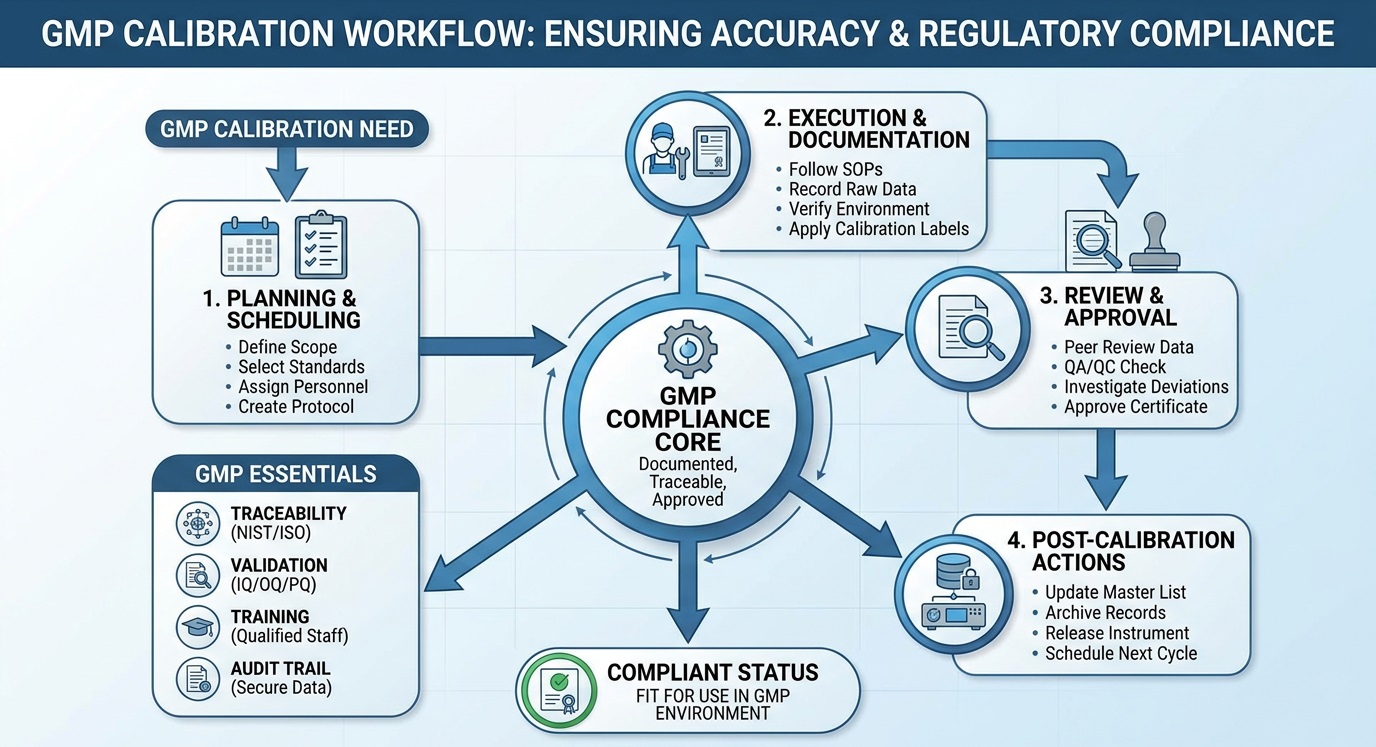
Key steps in calibration help pharma teams control instruments with clear rules. First, create a calibration SOP with roles, methods, limits, and records. Then, build a master calibration list for all GMP-critical equipment.
Prepare calibration certificates after each approved calibration activity. Also, maintain calibration logs to track dates, results, and corrective actions.
Step 1: Create a Calibration SOP.
Step 2: Build a Master Calibration List.
Step 3: Prepare Calibration Certificates.
Step 4: Maintain Calibration Logs.
Step 1: Create a Calibration SOP
Create a calibration SOP to guide every calibration activity. Define who performs, reviews, and approves each task.
Also, include clear rules for limits, records, and follow-up actions. Therefore, teams can keep instruments accurate and audit-ready.
Purpose: Explains why calibration matters.
Scope: Lists covered instruments.
Responsibilities: Defines team roles.
Procedure: Shows required steps.
Acceptance Criteria: Sets pass or fail limits.
Records: Controls logs and certificates.
Step 2: Build a Master Calibration List
Build a master calibration list to track every GMP-critical instrument. Include equipment names, IDs, locations, owners, and calibration dates.
Also, update the list after changes, repairs, or new equipment. Therefore, teams can prevent missed calibrations and audit gaps.
Instrument ID: Shows unique equipment identity.
Location: Shows where teams use it.
Owner: Names the responsible person.
Frequency: Sets calibration timing.
Due Date: Shows next calibration deadline.
Status: Confirms valid or expired calibration.
Step 3: Prepare Calibration Certificates
Prepare calibration certificates after each completed calibration activity. Include results, standards used, dates, and approval details.
Also, review each certificate before record filing. Therefore, teams can prove instrument accuracy during audits.
Instrument Details: Identifies the calibrated equipment.
Calibration Results: Shows actual readings and deviations.
Reference Standards: Confirms traceable standards used.
Acceptance Criteria: Shows pass or fail limits.
Technician Details: Names the person who performed calibration.
Approval: Confirms QA or supervisor review.
Step 4: Maintain Calibration Logs
Maintain calibration logs to track every completed and planned calibration. Record dates, results, instrument IDs, and responsible staff.
Also, update logs after each calibration, repair, or missed due date. Therefore, teams can spot gaps early.
- Instrument ID: Links the log to equipment.
- Calibration Date: Shows when work happened.
- Due Date: Shows the next deadline.
- Result: Confirms pass or fail status.
- Action Taken: Records fixes or follow-up.
- Reviewer: Confirms document check.
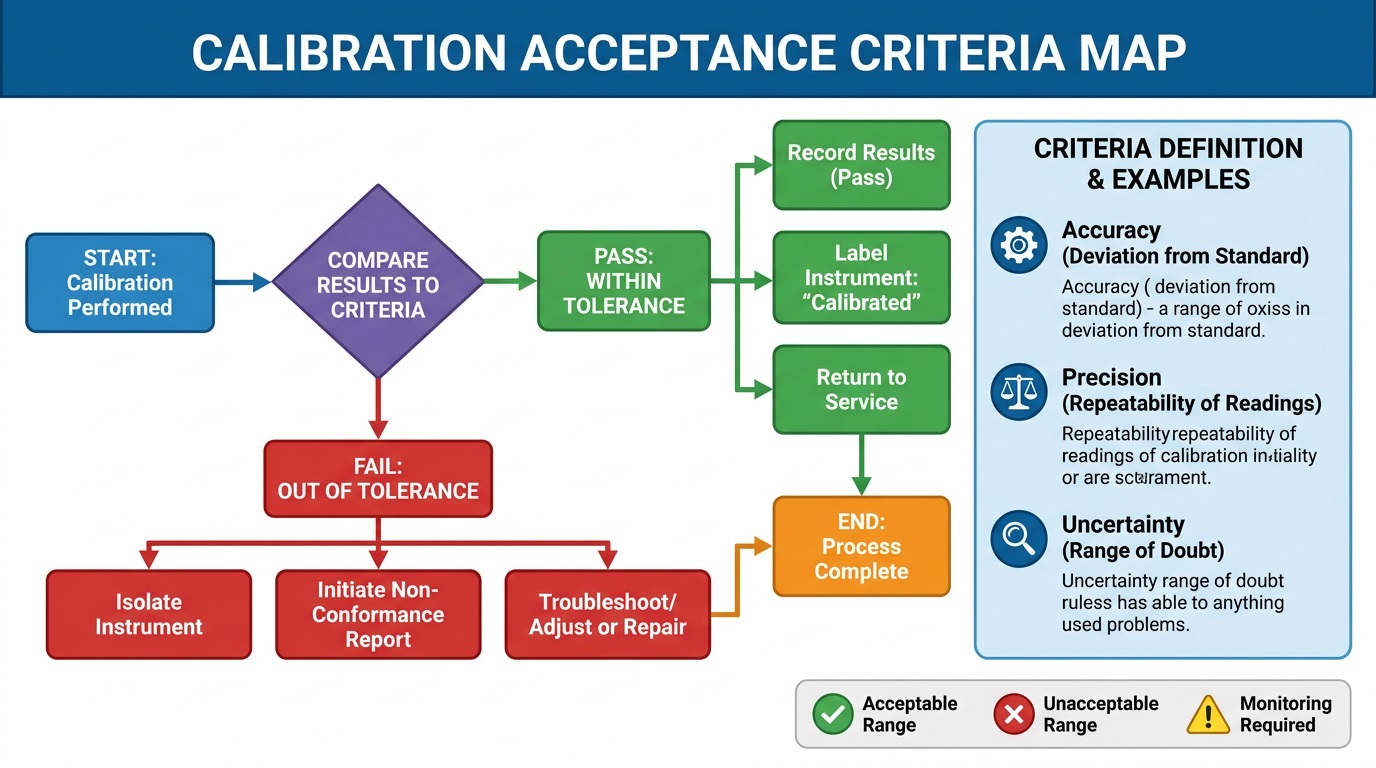
Key Components of Calibration Acceptance Criteria
Calibration acceptance criteria define clear pass or fail limits for instruments. Teams set limits using product risk, process needs, and manufacturer specifications.
Also, teams include measurement uncertainty, operating range, and traceability. Therefore, they can judge results consistently and protect GMP decisions.
Common Instruments Calibration in Pharma Industry
Common instruments calibration in pharma industry covers tools that affect quality decisions. Teams calibrate balances, thermometers, humidity sensors, pH meters, and pressure gauges. These tools support production, storage, testing, and release.
Also, teams calibrate analytical instruments like HPLC, UV spectrophotometers, and conductivity meters. Therefore, accurate instruments help protect data, batches, and patients.
Common Instruments and Calibration Frequency
| Common Instrument | Typical Calibration Frequency | Notes |
|---|---|---|
|
Balance |
Daily check + 6–12 months full calibration |
Use traceable weights |
|
Temperature Sensor |
6–12 months |
Increase frequency for critical storage areas |
|
Humidity Sensor |
6–12 months |
Check stability rooms and warehouses carefully. |
|
pH Meter |
Before use + scheduled calibration |
Use certified buffer solutions |
|
Pressure Gauge |
6–12 months |
Critical for cleanrooms and process systems. |
|
HPLC |
6–12 months |
Follow system suitability and qualification plans. |
Calibration of Temperature
Temperature calibration confirms that sensors give accurate readings. Teams use traceable standards and fixed test points.
WHO expects suitable equipment controls in quality laboratories. Therefore, teams protect storage, production, and testing conditions.
Select reference standard
Define test points
Compare sensor readings
Record deviations
Approve calibration results
Calibration of Humidity
Humidity calibration confirms that sensors measure moisture levels correctly.
Key Steps are
Select traceable humidity standard
Define low and high test points
Compare sensor readings
Record deviation values
Review and approve results
Balance Calibration in Pharma Industry
Balance calibration in pharma industry confirms accurate weighing results. Teams check balances with traceable reference weights. FDA 21 CFR 211.68 requires routine calibration under a written program.
Clean and level the balance
Select traceable test weights
Check zero and repeatability
Compare readings with limits
Record and approve results
Define Acceptance Criteria and Handle Out-Of-Tolerance Results in Calibration
Define acceptance criteria before each calibration activity. Teams set tolerance limits, test points, and pass or fail rules.
Also, teams investigate out-of-tolerance results immediately. Therefore, they can protect affected batches, records, and GMP decisions.
Tolerance Limits: Set allowed measurement differences.
Test Points: Check critical operating ranges.
Measurement Uncertainty: Include possible reading variation.
Pass/Fail Rules: Define clear result decisions.
OOT Action: Investigate impact and start CAPA.
Final Words
Calibration in pharma industry is not only a technical task. It protects GMP compliance, product quality, and patient safety. ISO 9001:2015 clause 7.1.5 expects valid measuring resources for reliable results. Therefore, every team needs clear SOPs, trained staff, approved certificates, and traceable standards.
A strong calibration system also needs correct frequency and fast action for out-of-tolerance results. ISO/IEC 17025:2017 clause 7.6 requires laboratories to evaluate measurement uncertainty. So, teams improve accuracy, reduce quality risks, and stay audit-ready.
FAQs
Calibration in pharma industry means comparing an instrument’s reading with a trusted reference standard. It helps teams confirm accuracy, reduce measurement errors, and protect GMP decisions.
GMP requires records because teams must prove that instruments work correctly. FDA 21 CFR 211.68 requires routine calibration, inspection, or checks under a written program, with written records maintained.
Common instruments include balances, thermometers, humidity sensors, pH meters, pressure gauges, HPLC systems, UV spectrophotometers, and conductivity meters.
Refrences

Ershad Moradi
Ershad Moradi, a Content Marketing Specialist at Zamann Pharma Support, brings 6 years of experience in the pharmaceutical industry. Specializing in pharmaceutical and medical technologies, Ershad is currently focused on expanding his knowledge in marketing and improving communication in the field. Outside of work, Ershad enjoys reading and attending industry related networks to stay up-to-date on the latest advancements. With a passion for continuous learning and growth, Ershad is always looking for new opportunities to enhance his skills and contribute to pharmaceutical industry. Connect with Ershad on Facebook for more information.

Deviation vs Nonconformance 2026: 5 Critical GMP Mistakes to Avoid
Explore 5 critical differences between deviation and nonconformance in pharma, including GMP investigations, OOS, risk assessment, and CAPA.

Root Cause Analysis in Pharmaceutical Industry: 6 Powerful Methods in 2026
Explore 6 powerful root cause analysis methods in pharma to investigate deviations, strengthen CAPA, ensure GMP compliance, and protect patient safety.

Quality Culture in Pharma Industry 2026: Proven Ways to Build Trust
Explore how to build a strong quality culture in the pharmaceutical industry in 2026 through leadership commitment, ICH Q10 principles, meaningful GMP metrics, effective CAPA, and continuous improvement.