


A Regulatory Specialist is a pharma professional who guides products through regulatory requirements. They help companies meet FDA, EMA, ICH, and local authority expectations. They also support CTD submissions, eCTD sequences, product information, compliance tracking, and lifecycle maintenance. The CTD uses 5 modules, so specialists must organize quality, safety, and efficacy evidence clearly.
In pharma regulation, WHO stresses strong national regulatory systems for safe, effective, quality medical products. Its Global Benchmarking Tool evaluates regulatory systems across 9 functions and 4 maturity levels. Therefore, the role needs technical accuracy, current guideline awareness, and strong submission control.
Table of Contents
What is a Regulatory Specialist?
A Regulatory Specialist helps pharma companies follow health authority rules. They support drug approval, product updates, and compliance work.
They also prepare documents for FDA, EMA, ICH, and local authorities. Therefore, they help protect patients and market access.
- Manage regulatory submissions
- Review product information
- Track guideline updates
- Support lifecycle changes
- Maintain compliance records
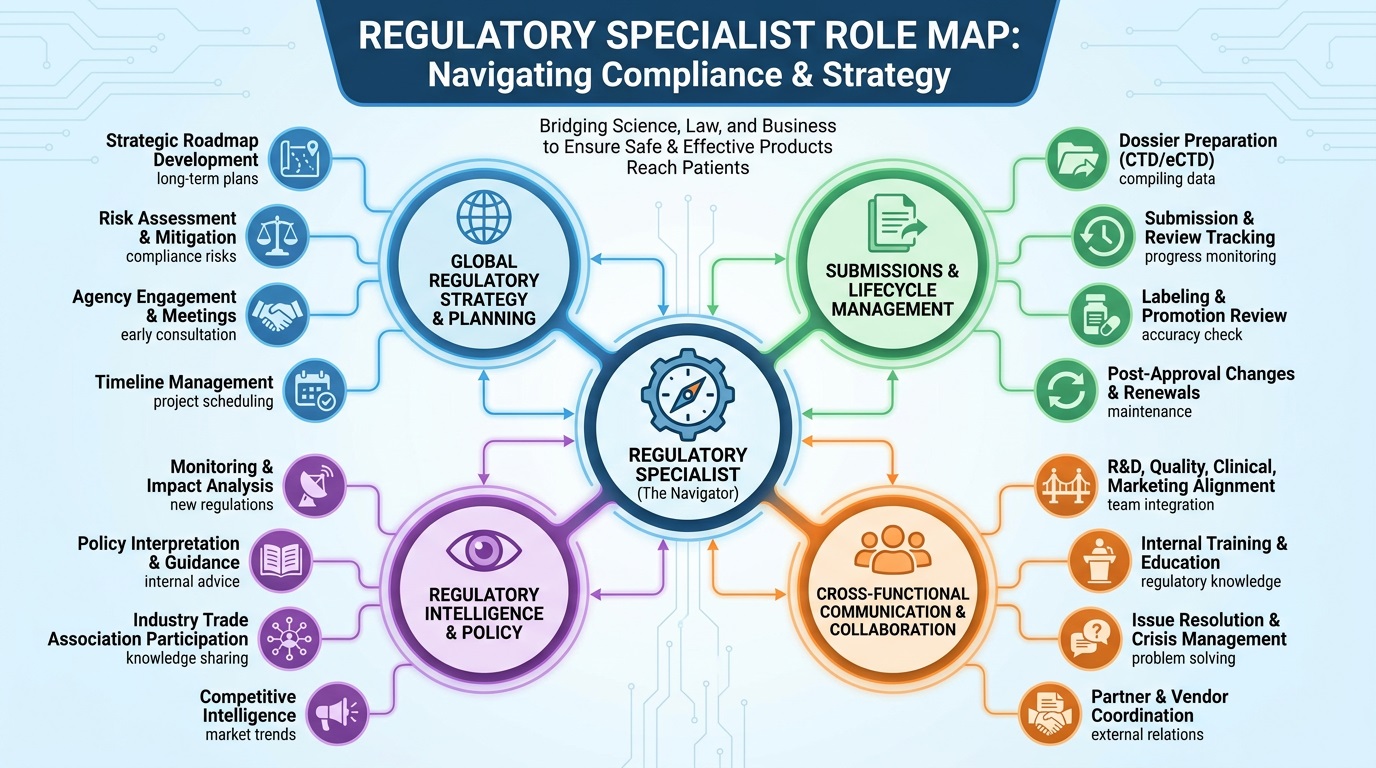
Regulatory Specialist job description
A Regulatory Specialist manages pharma documents and supports product approval. They prepare submissions, review labels, and track compliance tasks.
They also connect regulatory teams with QA, PV, manufacturing, and marketing. Therefore, they help teams follow current rules.
- Prepare CTD and eCTD files
- Review SmPC, PIL, and labels
- Track regulatory deadlines
- Support product changes
Regulatory Specialist Skills
| Regulatory Specialist Skill | Why It Matters | Example Task |
|---|---|---|
|
Regulatory guideline knowledge |
Helps the specialist follow FDA, EMA, ICH, and local rules |
Check submission requirements before filing |
|
CTD and eCTD understanding |
Supports correct dossier structure and electronic submissions |
Organize documents into CTD Modules 1–5 |
|
Technical writing |
Creates clear and accurate regulatory documents |
Write submission summaries and response letters |
|
Document control |
Keeps files accurate, approved, and audit-ready |
Track versions, approvals, and final documents |
|
Attention to detail |
Reduces errors in submissions and product information |
Check dosage, strength, labels, and claims |
Regulatory Specialist Key Responsibilities
Regulatory Specialists manage key tasks that keep pharma products compliant. They prepare submissions and check product information for accuracy.
Therefore, they help teams meet authority rules and protect market access.
- Number 1: Prepare CTD, eCTD, NDA, MAA, and variation submissions.
- Number 2: Review SmPC, PIL, labels, and claims.
- Number 3: Monitor FDA, EMA, ICH, and local updates.
- Number 4: Support renewals, changes, and lifecycle records daily, carefully.
Number 1 : Prepare Regulatory Submissions
Regulatory Specialists prepare submissions using ICH M4 CTD structure. They organize Module 1 to Module 5 documents for authority review.
They also follow FDA eCTD guidance and EMA eSubmission rules. Therefore, they check formats, sequence numbers, validation errors, and final files before submission.
Number 2 : Review Product Information
Regulatory Specialists review product information using SmPC guidance and EMA QRD templates. They check SmPC, PIL, labelling, dosage, warnings, and claims.
They also follow FDA labelling resources for prescription drugs. Therefore, they keep safety, efficacy, and approved product details consistent.
Number 3 : Monitor Regulatory Compliance
Regulatory Specialists monitor regulatory compliance by tracking FDA, EMA, ICH, and local updates. They check deadlines, authority requests, commitments, and dossier changes.
Therefore, they help teams avoid missed actions and compliance risks.
- Track guideline updates
- Review authority deadlines
- Monitor variation status
- Update compliance records
Number 4 : Support Product Lifecycle Management
Regulatory Specialists support product lifecycle management after product approval. They manage renewals, variations, safety updates, and dossier changes.
Therefore, they help products stay compliant during every market stage.
- Track post-approval changes
- Support renewal submissions
- Update product information
- Maintain regulatory history records
Regulatory Specialist Salary
A Regulatory Specialist salary depends on country, experience, and company size. In Germany, PayScale reports an average near €52,128 in 2026.
Therefore, specialists can grow earnings by gaining submission experience.
- Learn CTD/eCTD
- Build FDA and EMA knowledge
- Manage variations
- Improve technical writing
Regulatory Specialist Salary Based on Job Title
| Job Title | Experience Level | Estimated Salary Range |
|---|---|---|
|
Regulatory Affairs Assistant |
Entry level |
€35,000–€45,000 |
|
Regulatory Affairs Associate |
Junior |
€28,000–€55,000 |
|
Regulatory Affairs Specialist |
Mid-level |
€35,000–€91,000 |
|
Senior Regulatory Affairs Specialist |
Senior |
€54,000–€95,000 |
|
Regulatory Affairs Manager |
Management |
€45,000–€88,000 |
How to Become a Regulatory Affairs Specialist
To become a Regulatory Affairs Specialist, build science knowledge and regulatory writing skills. Study pharmacy, life sciences, chemistry, or biotechnology.
Then, add certifications and practical guideline training.
- Earn a pharma-related degree
- Study FDA, EMA, ICH, and WHO guidelines
- Learn CTD and eCTD basics
- Practice submissions, labelling, and variations
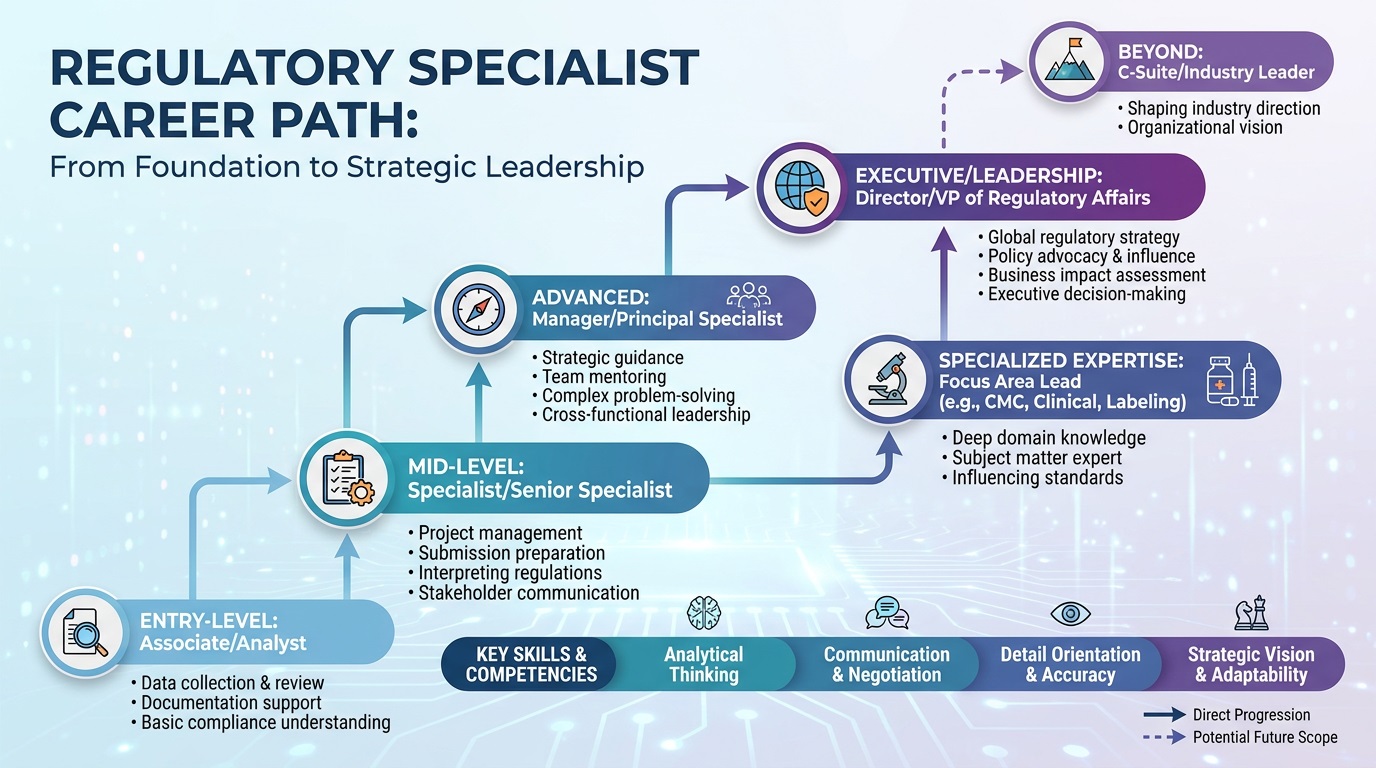
Which Education and Certifications Help Regulatory Specialists?
Regulatory Specialists often study pharmacy, life sciences, chemistry, biotechnology, or medical sciences. These degrees build strong knowledge of drug development, quality, safety, and compliance.
They can also add regulatory training and certifications. For example, RAPS offers RAC credentials for drugs and devices, while TOPRA offers regulatory affairs training and MSc options.
- Degree in pharmacy or life sciences
- Training in CTD and eCTD submissions
- RAC-Drugs or RAC-Devices certification
- TOPRA regulatory affairs courses
- GMP, GCP, and pharmacovigilance training
- Technical writing and documentation training
Which Pharma Guidelines Should Regulatory Specialists Know?
Regulatory Specialists should know guidelines that control submissions, product quality, labelling, and lifecycle changes. They should review official FDA, EMA, ICH, WHO, and EU sources often.
Therefore, they can prepare accurate dossiers and avoid compliance gaps.
- ICH M4 CTD: Use for CTD Modules 1–5 and dossier structure.
- ICH M4Q: Use for Module 3 Quality and CMC documentation.
- FDA eCTD Guidance: Use for electronic submissions to CDER and CBER.
- FDA eCTD Resources: Use for technical specifications and validation rules.
- EMA eSubmission Guidance: Use for EU electronic submission requirements.
- EudraLex Volume 2: Use for EU procedures, renewals, variations, SmPC, and package leaflets.
Technical Checklist for Regulatory Specialists
Regulatory Specialists use technical checklists to control submissions, labels, and lifecycle records. They should follow ICH CTD, FDA eCTD, EMA eSubmission, and EudraLex Volume 2 guidance.
Therefore, they can reduce errors and improve review readiness.
- Check CTD Modules 1–5
- Validate eCTD sequence numbers
- Review SmPC, PIL, and labels
- Track variations and renewals
- Confirm CMC document updates
- Review authority response deadlines
- Keep approved dossier versions
- Archive submission confirmations
- Monitor FDA, EMA, ICH updates
- Maintain inspection-ready records
Final Words
A Regulatory Specialist protects compliance, patient safety, and market access. This role helps pharma companies meet authority expectations and keep products legally available.
However, the job goes beyond administrative document handling. It requires technical judgment, strong documentation habits, guideline awareness, and clear cross-functional communication.
Regulatory Specialists must understand FDA, EMA, ICH, WHO, and local requirements. They also need to work closely with QA, PV, CMC, manufacturing, and marketing teams.
Finally, pharma regulations change often. If you are a pharma expert, please share useful guidelines, PDF references, checklists, salary data, or real examples to support future learners.
FAQs
A Regulatory Specialist prepares submissions, reviews product information, tracks compliance, and supports product lifecycle changes. They help companies meet FDA, EMA, ICH, WHO, and local authority rules.
A Regulatory Specialist needs technical writing, CTD/eCTD knowledge, guideline awareness, document control, and attention to detail. They also need strong communication skills because they work with QA, PV, CMC, manufacturing, and marketing teams.
They should know ICH CTD guidelines, FDA eCTD requirements, EMA procedural guidance, EudraLex Volume 2, EU GMP, and WHO regulatory system guidance. These sources guide submissions, product information, variations, renewals, and compliance work.
References

Ershad Moradi
Ershad Moradi, a Content Marketing Specialist at Zamann Pharma Support, brings 6 years of experience in the pharmaceutical industry. Specializing in pharmaceutical and medical technologies, Ershad is currently focused on expanding his knowledge in marketing and improving communication in the field. Outside of work, Ershad enjoys reading and attending industry related networks to stay up-to-date on the latest advancements. With a passion for continuous learning and growth, Ershad is always looking for new opportunities to enhance his skills and contribute to pharmaceutical industry. Connect with Ershad on Facebook for more information.

Deviation vs Nonconformance 2026: 5 Critical GMP Mistakes to Avoid
Explore 5 critical differences between deviation and nonconformance in pharma, including GMP investigations, OOS, risk assessment, and CAPA.

Root Cause Analysis in Pharmaceutical Industry: 6 Powerful Methods in 2026
Explore 6 powerful root cause analysis methods in pharma to investigate deviations, strengthen CAPA, ensure GMP compliance, and protect patient safety.

Quality Culture in Pharma Industry 2026: Proven Ways to Build Trust
Explore how to build a strong quality culture in the pharmaceutical industry in 2026 through leadership commitment, ICH Q10 principles, meaningful GMP metrics, effective CAPA, and continuous improvement.