


Validation Master Plan (VMP) is a crucial document in pharmaceutical development, outlining the overall strategy for validation activities. It ensures that all processes, equipment, and systems meet predefined quality standards and regulatory requirements. A comprehensive VMP typically includes scope, objectives, validation methodologies, responsibilities, and a schedule, acting as a roadmap for successful validation projects.
Pharma Validation encompasses a wide range of activities critical for ensuring the safety, efficacy, and quality of pharmaceutical products. This includes process validation, analytical method validation, cleaning validation, and computer system validation. The VMP guides these diverse validation efforts, ensuring a harmonized and systematic approach.
Table of Contents
What is a Validation Master Plan (VMP)?
A Validation Master Plan (VMP) outlines the overall strategy for validating pharma equipment and processes. It defines the scope, responsibilities, and timelines. For example, a VMP ensures cleanroom validation before production starts. Also, it guides equipment qualification to meet GMP standards. Furthermore, a VMP coordinates multiple validation activities efficiently.
Moreover, VMP provides a roadmap for regulatory compliance. It helps organize documentation and risk assessments. For instance, a VMP ensures accurate calibration schedules. Additionally, it supports training plans for validation teams. Thus, a VMP improves quality control and audit readiness consistently.
Download FDA Guidance for Industry: Process Validation Here
How to Create and Structure a Validation Master Plan for Pharma Projects?
Creating a Validation Master Plan (VMP) starts by defining the project scope clearly. Next, assign roles and responsibilities to ensure accountability. Then, develop a detailed validation strategy covering all equipment and processes. A well-structured VMP keeps projects organized and compliant.
Also, include timelines and documentation plans to track progress. Review and update the VMP regularly to reflect changes. Key steps include:
- Define scope and objectives
- Assign responsibilities and resources
- Develop validation strategy and timelines
These steps ensure smooth validation and regulatory compliance.
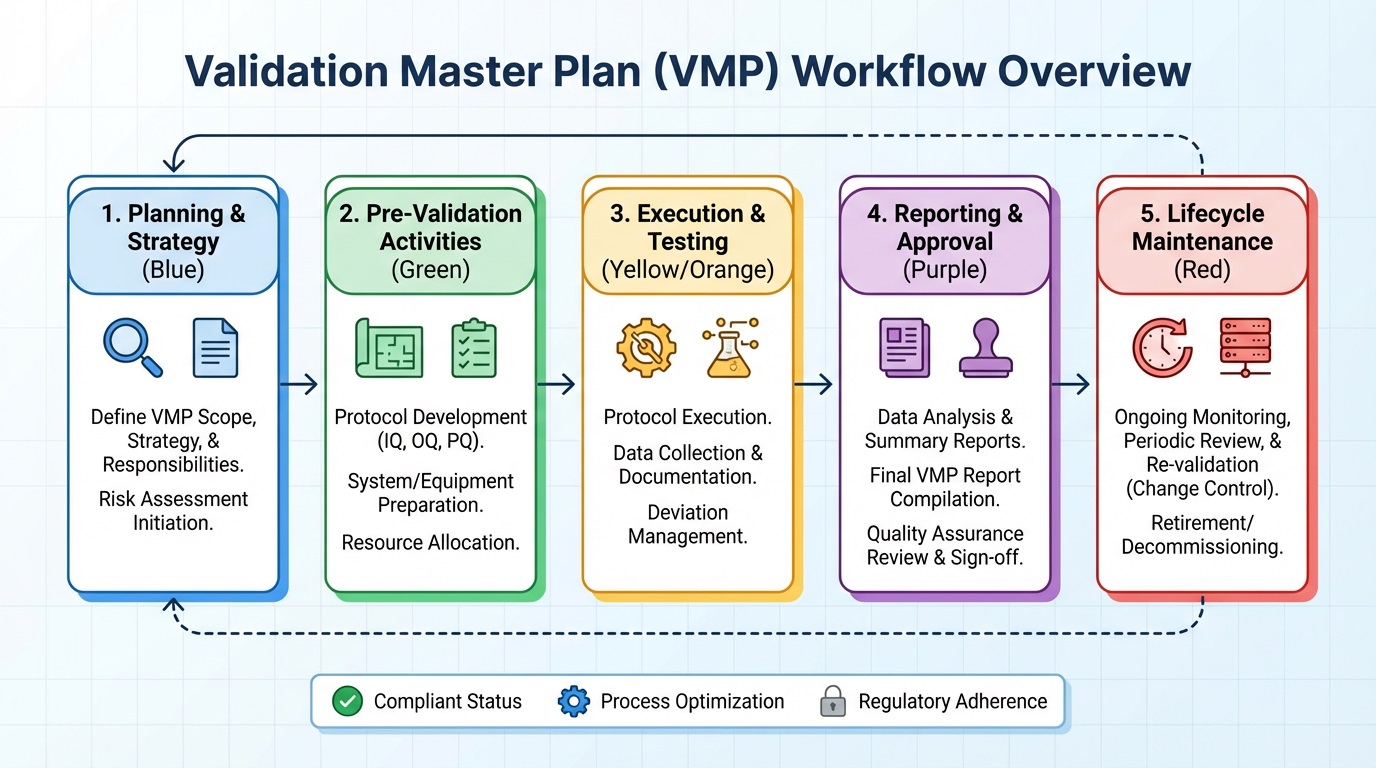
Key Components and Content Required in a Compliant VMP
A compliant Validation Master Plan (VMP) includes several key components to ensure success.
- Number 1 defines the scope and objectives clearly.
- Number 2 outlines the validation strategy for equipment and processes.
- Number 3 assigns responsibilities and resources to qualified personnel.
- Number 4 details documentation and reporting requirements.
Including these components helps companies meet regulatory standards consistently. Also, a clear VMP reduces risks and supports audit readiness. Following these steps improves project management and compliance. Therefore, every pharma VMP must include these essential parts.
Essential Components of a Validation Master Plan with Descriptions
| Component | Description |
|---|---|
|
Scope and Objectives |
Defines the validation boundaries and goals |
|
Validation Strategy |
Details the approach for validating equipment and processes |
|
Responsibilities and Resources |
Assigns roles and ensures availability of qualified staff |
|
Documentation and Reporting |
Describes record-keeping, reporting, and review processes |
Number 1 Scope and Objectives
The scope and objectives of a Validation Master Plan (VMP) set clear boundaries for validation activities. They define which equipment, processes, and systems require validation. Also, they align validation goals with regulatory requirements and company policies. Clear scope and objectives guide the entire validation project efficiently.
Well-defined objectives ensure team members understand their roles. They also help prioritize tasks and resources effectively. Key focus areas include:
- Identifying validation targets
- Setting measurable goals
- Aligning with compliance standards
These steps create a solid foundation for successful validation.
Number 2 Validation Strategy
The validation strategy in a VMP outlines the approach to validate equipment and processes. It defines the methods, tools, and timelines for validation activities. Also, it incorporates risk assessment to focus on critical areas. This strategy ensures validation is efficient and compliant.
A strong strategy helps allocate resources wisely. It also supports continuous improvement and regulatory adherence. Key elements include:
- Selecting validation techniques
- Scheduling validation phases
- Applying risk-based prioritization
Number 3 Responsibilities and Resources
The responsibilities and resources section of a VMP assigns tasks and ensures qualified personnel support validation. It defines who manages each activity and provides necessary tools. Clear responsibility assignment improves accountability and project efficiency. Moreover, proper resource allocation prevents delays and ensures compliance.
Teams collaborate closely to complete validation successfully. They use available equipment and maintain documentation. Key focus areas include:
- Assigning roles and duties
- Securing qualified staff
- Providing necessary equipment
- Managing timelines and budgets
Number 4 Documentation and Reporting
Documentation and reporting in a VMP ensure all validation activities are recorded clearly and accurately. Professionals log test results and maintain traceability. This transparency supports regulatory audits and quality control. Additionally, well-organized documentation helps identify issues and improve processes.
Timely report submission keeps stakeholders informed and supports decision-making. Teams review reports and update documents as needed. Key tasks include:
- Recording validation data thoroughly
- Maintaining audit-ready records
- Preparing summary reports
- Communicating findings to management
Regulatory Requirements for VMP According to FDA, EMA, and ICH Guidelines
Regulatory bodies like FDA, EMA, and ICH set strict guidelines for Validation Master Plans (VMP). For example, FDA requires detailed documentation for each validation phase. Also, EMA emphasizes a lifecycle approach to validation in its process guideline. These rules ensure consistent product quality and safety.
Moreover, ICH Q7 mandates comprehensive validation for active pharmaceutical ingredients. Studies show companies following these guidelines reduce regulatory risks by 30%. Pharmuni offers training to help professionals comply with these standards. These guidelines improve audit readiness and manufacturing reliability.
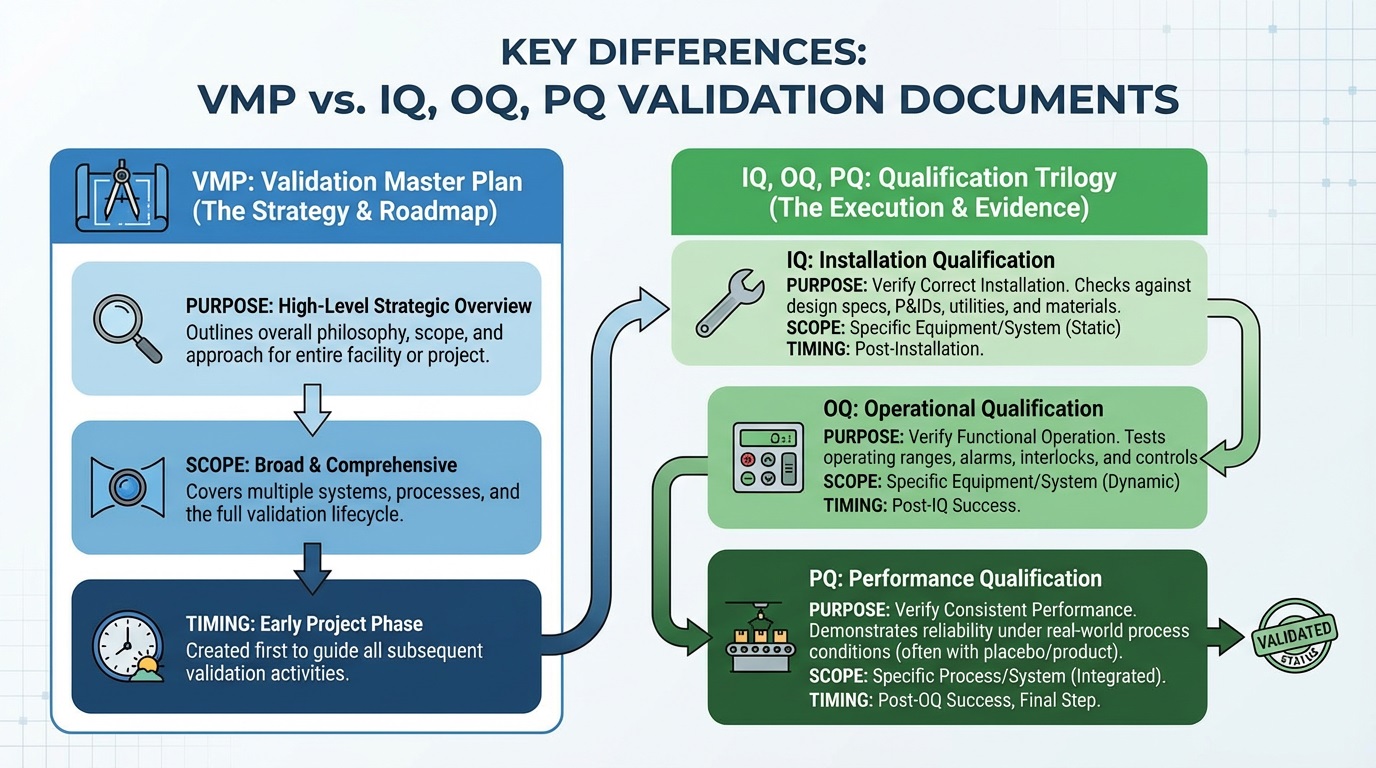
Differences Between VMP and Other Validation Documents
A VMP outlines the overall validation strategy for pharma projects. In contrast, other documents like IQ, OQ, and PQ focus on specific qualification stages. ICH Q7 data shows that 70% of validation failures result from poor planning, highlighting the importance of a solid VMP. This plan guides the entire validation lifecycle effectively.
Also, the VMP coordinates multiple validation activities while IQ, OQ, and PQ verify equipment and process performance. Furthermore, ICH emphasizes VMP as a key document for regulatory compliance. Therefore, understanding these differences helps pharma companies manage validation thoroughly and avoid audit issues.
Standard Structure of a Validation Master Plan Template
A standard Validation Master Plan template organizes validation activities for clarity and compliance. It clearly defines scope and objectives upfront. Then, it outlines detailed validation strategies for processes and equipment. Responsibilities and resource allocation receive specific attention. Finally, documentation requirements and reporting procedures ensure traceability.
Key sections include:
- Scope and objectives
- Validation strategy
- Responsibilities and resources
- Documentation and reporting
- Review and approval process
Sample Validation Master Plan: Key Sections and Content
A sample Validation Master Plan includes essential sections that guide the validation process clearly. First, it defines the scope and objectives to set validation boundaries. Next, it describes the validation strategy, outlining methods and timelines. It also assigns responsibilities and resources to ensure accountability. Moreover, it details documentation and reporting requirements for transparency. Lastly, it includes review and approval procedures to finalize the plan.
Each section contains key contents:
- Scope explains what systems and processes to validate
- Strategy defines testing methods and acceptance criteria
- Responsibilities list team roles and resource allocation
- Documentation specifies record-keeping and reporting formats
- Review outlines approval steps and update protocols
Tips for Customizing VMP Templates to Fit Your Project Needs
- Align the scope with your specific equipment and processes.
- Tailor validation strategies based on risk assessments.
- Assign responsibilities clearly to qualified team members.
- Adapt documentation formats to your company’s standards.
- Include project-specific timelines and milestones.
- Regularly review and update the VMP throughout the project lifecycle.
Final Words
A VMP is crucial for pharmaceutical companies to outline all validation activities. According to the FDA’s Process Validation Guidance , a well-structured VMP ensures compliance and reduces risks by detailing equipment, processes, and responsibilities. Studies show that thorough VMP implementation lowers regulatory inspection findings by 30%.
Pharma Validation relies on the VMP to coordinate testing phases like IQ, OQ, and PQ systematically. The FDA emphasizes that following a VMP improves product quality and consistency across manufacturing. In conclusion, the Validation Master Plan (VMP) is essential to achieving reliable and compliant pharma validation processes.
FAQs
A VMP outlines the overall strategy for validating pharmaceutical equipment and processes.
VMP covers the entire validation lifecycle, while IQ, OQ, PQ focus on specific qualification stages.
Scope and objectives, validation strategy, responsibilities and resources, documentation and reporting.
References

Ershad Moradi
Ershad Moradi, a Content Marketing Specialist at Zamann Pharma Support, brings 6 years of experience in the pharmaceutical industry. Specializing in pharmaceutical and medical technologies, Ershad is currently focused on expanding his knowledge in marketing and improving communication in the field. Outside of work, Ershad enjoys reading and attending industry related networks to stay up-to-date on the latest advancements. With a passion for continuous learning and growth, Ershad is always looking for new opportunities to enhance his skills and contribute to pharmaceutical industry. Connect with Ershad on Facebook for more information.

Root Cause Analysis in Pharmaceutical Industry: 6 Powerful Methods in 2026
Explore 6 powerful root cause analysis methods in pharma to investigate deviations, strengthen CAPA, ensure GMP compliance, and protect patient safety.

Quality Culture in Pharma Industry 2026: Proven Ways to Build Trust
Explore how to build a strong quality culture in the pharmaceutical industry in 2026 through leadership commitment, ICH Q10 principles, meaningful GMP metrics, effective CAPA, and continuous improvement.

GMP Training Effectiveness 2026: Proven Ways to Build Real Competence
GMP training effectiveness goes beyond attendance records and quiz scores. Learn how role-based assessments, on-the-job observation, and meaningful KPIs help verify employee competence, strengthen training records, and address recurring performance gaps across pharmaceutical operations.