


Quality Variations in Pharmaceutical Manufacturing 2026: Critical Guide to Avoid Costly Compliance Failures

quality variations are approved or proposed changes to a pharmaceutical product, process, site, specification, analytical method, packaging, or stability commitment. FDA places post-approval CMC changes into three reporting categories: major, moderate, and minor, under 21 CFR 314.70. Therefore, teams must assess quality, safety, and effectiveness before implementation.

WHO Annex 10 guides authorities on pharmaceutical product variation procedures, while WHO biological guidance uses risk analysis for approved biological changes. Strong pharma regulation helps teams classify changes, prepare evidence, and protect patients. Always request current WHO PDFs, FDA examples, timelines, and audit data.

Table of Contents

What Are Quality Variations in Pharma?

Quality variations are planned changes to approved pharma product details. They may affect sites, methods, specifications, packaging, or stability data. Therefore, QA and RA teams must assess every change carefully.

ICH Q12 supports structured lifecycle management for post-approval CMC changes. FDA guidance also explains reporting categories for approved NDA and ANDA changes. Define the approved product baseline.

  • Identify the exact quality change.
  • Assess patient and compliance risk.
  • Choose the correct variation route.

Types of Variations in Pharma: Type IA, Type IB, and Type II

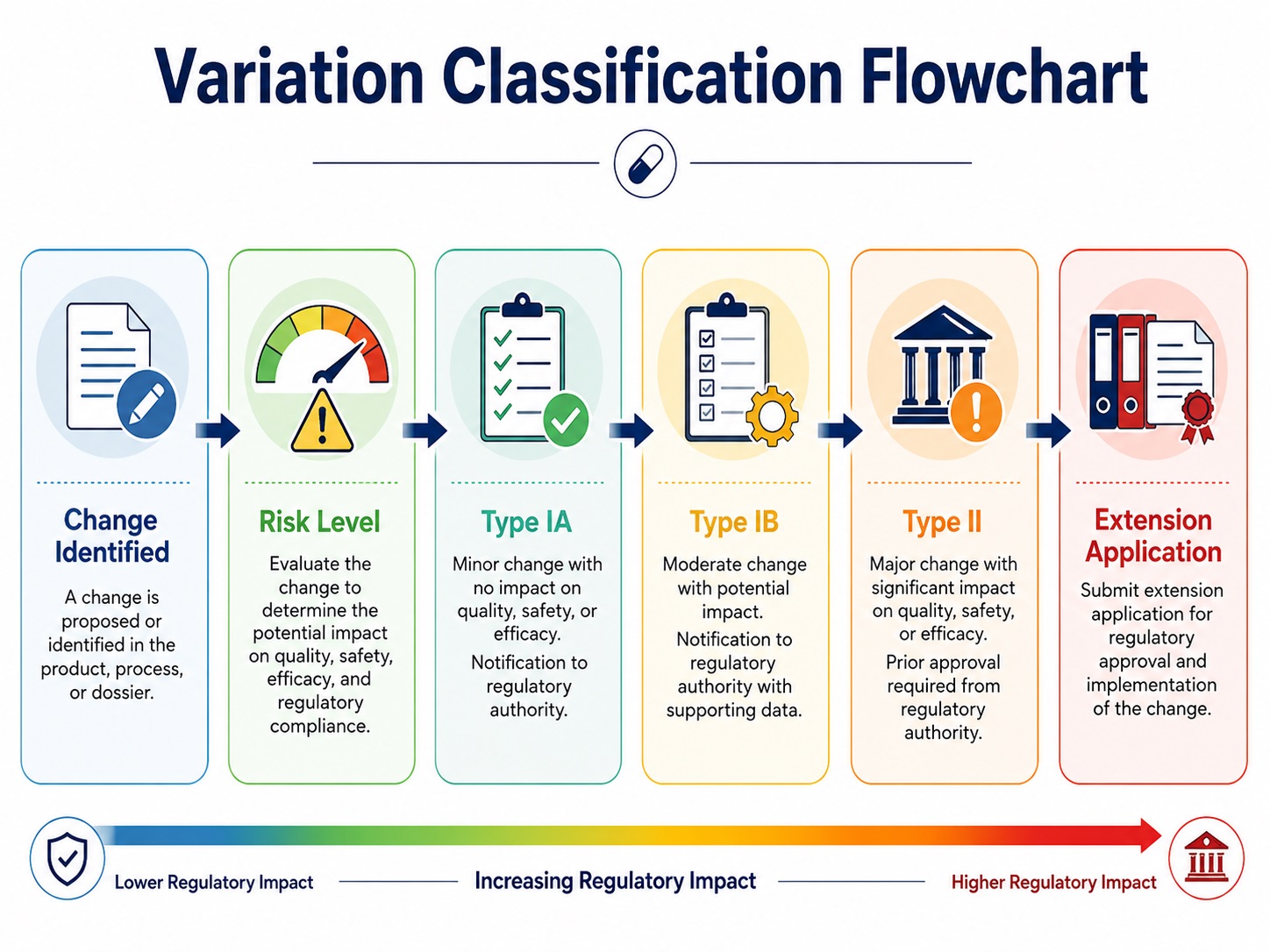
EU variation systems group changes by risk and regulatory impact. Type IA covers minor changes. Type IB covers minor changes needing authority notification. Type II covers major changes with higher impact. However, teams must confirm the correct category before implementation. EMA provides separate guidance for Type IA, Type IB, and Type II variations.

Variation Classification Flowchart

Type IA Variations in Pharma

Type IA variations usually cover low-risk changes. Teams often notify authorities after implementation, depending on rules. However, QA must still record evidence, justification, and approval. These changes still need clear traceability.

Type IB Variations in Pharma

Type IB variations cover changes that need authority notification before acceptance. RA teams must prepare justification, forms, and supporting data. Then, QA tracks implementation after regulatory acceptance. This route needs strong timing control.

Type II Variations in Pharma

Type II variations cover major quality changes. These changes may affect quality, safety, or efficacy. Teams usually need deeper technical data. Therefore, RA, QA, QC, production, and validation must align early.

Extension Applications and Major Quality Changes

Extension applications cover major changes beyond normal variation scope. Examples include major strength, route, or formulation changes. Teams must review dossier impact carefully. Then, they must prepare a complete regulatory package.

Stability Data Requirements for Variations

Stability data helps prove that a change does not harm product quality. Teams should review long-term, accelerated, and commitment data. They must also check shelf life, storage conditions, and packaging impact.

EMA provides stability guidance for variation applications. It explains how stability data supports Type IA, Type IB, and Type II variations.

Variation Impact Assessment and Documentation Checklist

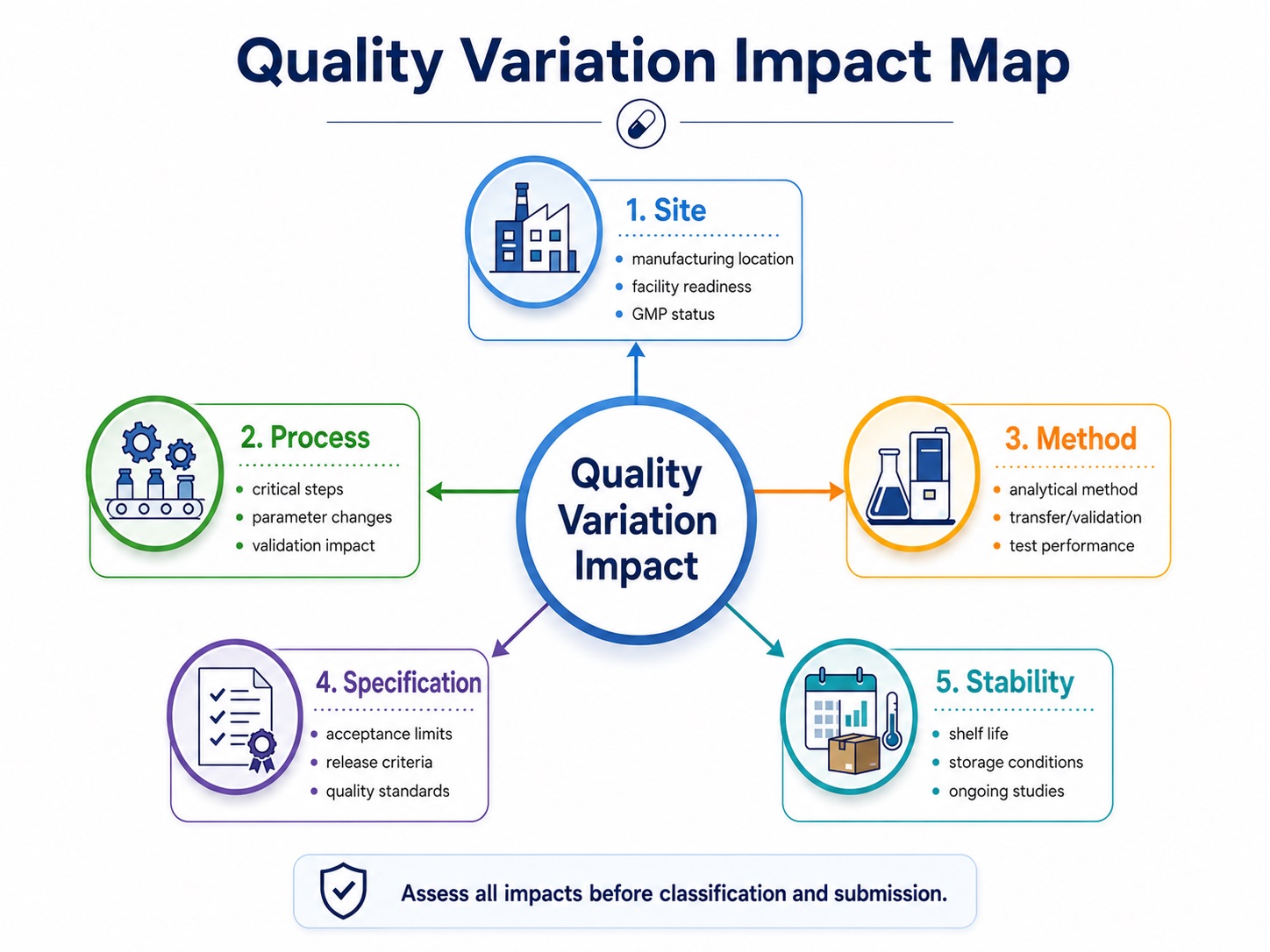
A variation impact assessment connects science, GMP, and regulatory strategy. Teams must check site, process, method, specification, stability, and dossier impact. Then, they must decide the right submission path.

ICH Q9(R1) supports quality risk management across manufacturing, distribution, inspection, and submission activities. This makes risk review essential for quality variations.

Quality Variation Impact Map

Change Control vs Variation in Pharma

Change control starts inside the company. Variation starts when the approved regulatory file needs update. However, both processes must work together. QA controls the GMP change. RA controls the authority submission.

Mention these topics as supporting bullets:

  • Major variation examples.
  • Minor variation examples.

Major Variation Examples in Pharma

Major variations may include new manufacturing sites, major process changes, or specification changes. They may also include new sterilization methods. These changes need strong data, risk assessment, and regulatory review.

Minor Variation Examples in Pharma

Minor variations may include low-risk administrative updates or small technical changes. Teams still need records, approvals, and traceability. Minor does not mean careless. QA must protect compliance every time.

Technical Checklists for Quality Variations

Technical checklists help teams avoid missing critical variation evidence. They also improve communication between QA, RA, QC, production, and validation. Therefore, companies should use one standard checklist for every quality variation.

A strong checklist should connect change control, variation classification, risk assessment, and documentation. It should also track stability data, validation impact, and regulatory submission status.

  • Confirm affected product and market.
  • Review dossier sections and approved commitments.
  • Check validation, stability, and method impact.
  • Record approvals, timelines, and final implementation.
Technical Checklist for Quality Variation Documentation
Checklist Area What to Check
Change description
Explain the change clearly
Regulatory category
Select Type IA, Type IB, Type II, or extension
Risk assessment
Assess quality, safety, and compliance impact
Stability data
Check shelf life and storage impact
Validation impact
Review process, cleaning, and method validation

Final Words

Quality variations are not simple paperwork. They protect product quality, regulatory compliance, and patient safety. Therefore, every pharma company needs a strong process for change control, variation classification, and risk assessment.

Pharma teams should also collect strong references. Also share real audit findings, variation timelines, and practical checklists

FAQs

1️⃣ What are quality variations in pharma?

Quality variations are changes to approved product quality details.

2️⃣ Why do companies classify variations?

They classify variations to choose the correct regulatory pathway.

3️⃣ Do minor variations still need documentation?

Yes. Every variation needs clear evidence and traceability.

References

Picture of Ershad Moradi

Ershad Moradi

Ershad Moradi, a Content Marketing Specialist at Zamann Pharma Support, brings 6 years of experience in the pharmaceutical industry. Specializing in pharmaceutical and medical technologies, Ershad is currently focused on expanding his knowledge in marketing and improving communication in the field. Outside of work, Ershad enjoys reading and attending industry related networks to stay up-to-date on the latest advancements. With a passion for continuous learning and growth, Ershad is always looking for new opportunities to enhance his skills and contribute to pharmaceutical industry. Connect with Ershad on Facebook for more information.

QMS in Pharmaceutical Manufacturing

QMS in Pharmaceutical Manufacturing 2026: Unlock Quality & Compliance Success

A robust Quality Management System (QMS) forms the backbone of pharmaceutical manufacturing. It ensures adherence to GMP and global standards, mitigates risks, controls processes, and drives continuous improvement. By maintaining accurate documentation and training staff, QMS helps pharma companies achieve regulatory compliance and deliver safe, high-quality products consistently.

Read More »

Share