


CSV documentation is essential for pharma computerized system validation and regulatory compliance. Since 2010, global regulators like FDA, EMA, and industry standards such as GAMP 5 have emphasized thorough documentation. Accurate CSV records support system integrity, traceability, and data reliability. Proper documentation enables companies to meet rigorous audit and inspection standards, minimizing compliance risks.
Pharma quality assurance relies heavily on precise CSV documentation to ensure patient safety. Studies show that incomplete records contribute to 25% of regulatory inspection observations. Therefore, maintaining detailed and accurate CSV documentation strengthens quality systems and helps achieve sustained compliance across pharmaceutical operations.
Table of Contents
What is CSV Documentation?
CSV documentation records the validation of computerized systems in pharmaceuticals. It ensures systems work correctly and meet regulatory standards. Proper CSV documentation supports data integrity and audit readiness. Also, it helps identify and mitigate risks in software use.
According to FDA guidance, CSV documentation includes validation plans, test cases, and reports. EMA and GAMP 5 also define documentation requirements. These clear guidelines help companies comply with regulations and maintain quality assurance.
How to Prepare Compliant CSV Documentation
Prepare compliant CSV documentation by following structured validation processes and regulatory guidelines. Start with clear objectives and detailed plans. Also, document testing thoroughly and maintain accurate records. Proper preparation aids audits and ensures system reliability. Regular reviews keep documents up to date.
Key steps include:
- Define user requirements clearly
- Develop functional specifications
- Create validation master plans
- Execute testing protocols
- Document test results comprehensively
- Review and approve all records
Key Components and Structure of CSV Document
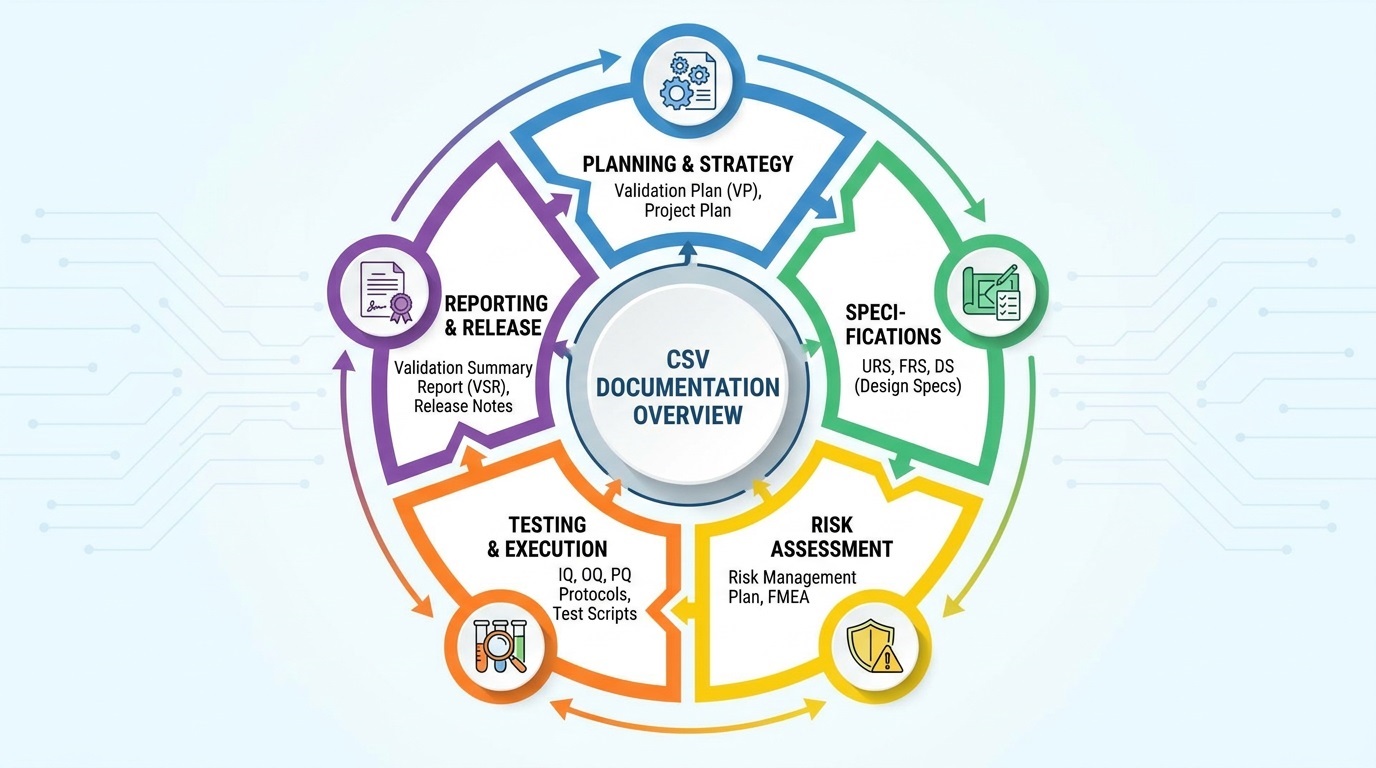
Key components of CSV documentation define system requirements and validation strategies clearly. User Requirements Specification (URS) describes what the system must do. Functional Specification (FS) details how the system meets these needs. Validation Master Plan (VMP) outlines overall validation activities and timelines.
Together, these documents ensure thorough planning and execution. They support regulatory compliance and audit readiness.
Key components include:
– User Requirements Specification (URS)
– Functional Specification (FS)
– Validation Master Plan (VMP) / Validation Plan
User Requirements Specification (URS)
User Requirements Specification (URS) defines what the computerized system must accomplish. It includes functional needs, performance criteria, and user expectations. Clear URS helps guide development and validation efforts. Also, it ensures all stakeholders agree on system goals and requirements.
Key URS elements include:
– Functional requirements
– Performance specifications
– User interface expectations
Functional Specification (FS)
Functional Specification (FS) describes how the system meets the user requirements. It details software functions, workflows, and interfaces. Clear FS guides development teams and supports validation activities. Also, it helps identify necessary tests and acceptance criteria.
Key FS components include:
- Software functions and features
- Data processing workflows
- User interface and system interactions
Validation Master Plan (VMP) / Validation Plan
The Validation Master Plan (VMP) outlines the overall validation strategy for computerized systems. It defines scope, responsibilities, timelines, and documentation requirements. Clear VMP ensures organized validation and regulatory compliance. Also, it coordinates all validation activities for efficiency.
Key VMP components include:
- Validation objectives and scope
- Roles and responsibilities
- Validation schedule and documentation
| Document Type | Key Contents | Purpose |
|---|---|---|
|
User Requirements Specification (URS) |
Functional needs, performance criteria, user expectations |
Define what the system must do |
|
Functional Specification (FS) |
Software functions, workflows, user interfaces |
Explain how the system meets requirements |
|
Validation Master Plan (VMP) / Validation Plan |
Scope, roles, timelines, documentation requirements |
Outline overall validation strategy |
How to Conduct Risk Assessments for CSV Document?
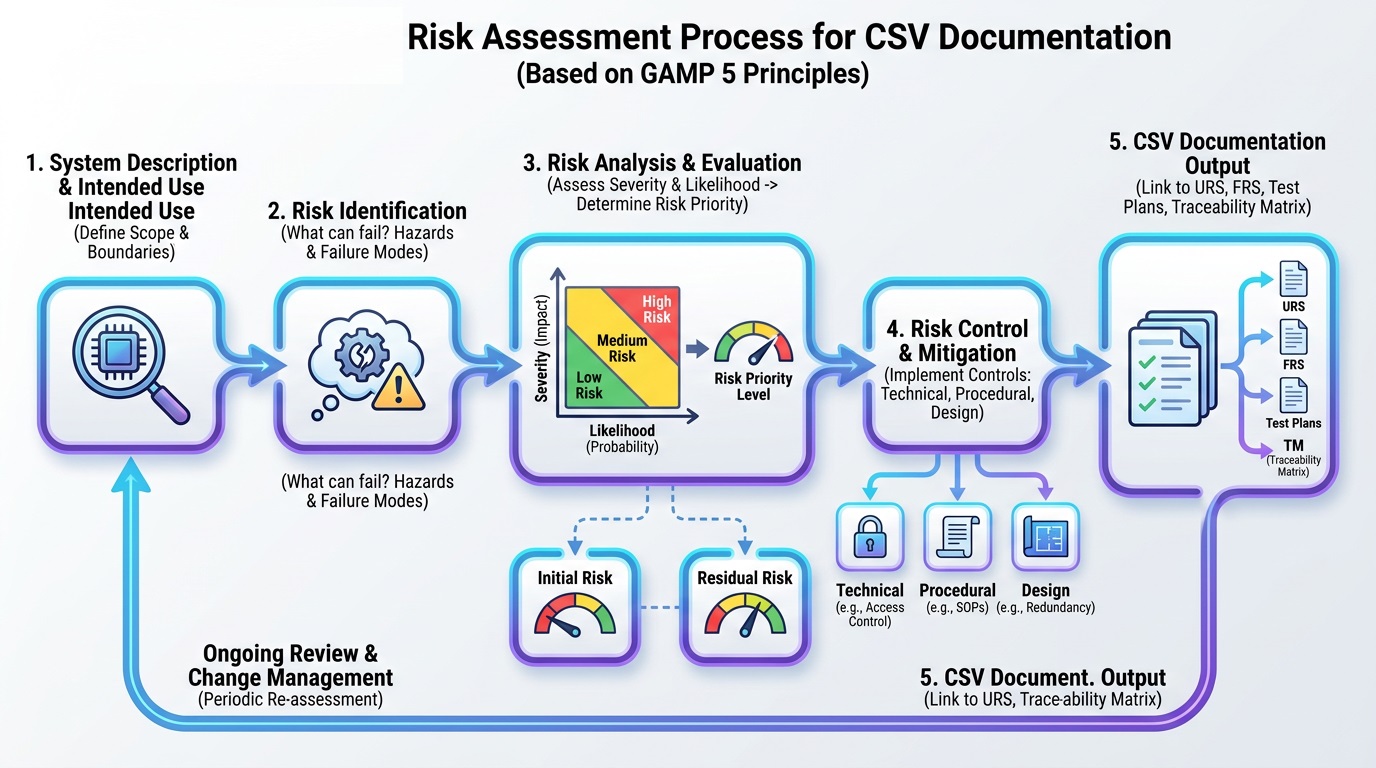
Conduct risk assessments for CSV documents by identifying potential system failures and their impact. Evaluate risks based on likelihood and severity. Prioritize high-risk areas for detailed validation. Also, involve cross-functional teams to ensure comprehensive analysis. Document all findings and mitigation actions clearly. Regularly review risks as systems evolve. Proper risk management supports compliance and data integrity.
Key risks include:
- Software defects
- Data loss or corruption
- Unauthorized access
- Incomplete requirements
- Poor change control
- Insufficient testing
- Lack of traceability
Audit Trail and Record-Keeping Requirements
Audit trails in CSV track all system changes to ensure data integrity and traceability. They help detect unauthorized activities and support regulatory audits. Proper record-keeping maintains compliance with FDA, EMA, and GAMP 5 standards. Also, it aids investigation and quality assurance.
Examples include:
- Logging user access and actions
- Recording data creation and modifications
- Maintaining secure, unalterable electronic records
Common Challenges and Solutions in Managing CSV Document
Managing CSV documents faces challenges like incomplete records and poor version control. Teams struggle with maintaining traceability and handling frequent changes. Also, inconsistent documentation leads to audit failures. Addressing these issues improves compliance and system reliability. Effective solutions include clear processes and thorough training.
Common challenges and solutions:
- Incomplete documentation → Implement detailed checklists
- Poor version control → Use electronic document management
- Lack of traceability → Maintain traceability matrices
- Insufficient Risk Assessment → Establish Risk Assessment procedures
Challenge 1: Incomplete Documentation
Incomplete documentation in CSV leads to gaps in system validation and audit failures. It causes confusion and delays regulatory approvals. Companies must ensure all required documents are complete and accurate. Also, review documents regularly to prevent missing information.
Key actions include:
- Create detailed document checklists
- Perform thorough document reviews
- Train teams on documentation standards
Challenge 2: Poor Version Control
Poor version control causes confusion and errors in CSV documentation. It leads to using outdated or incorrect documents during validation processes. Companies must implement effective version control systems to track changes and maintain accuracy. Also, clear labeling helps teams identify the latest document versions.
Examples include:
- Overwriting current documents without backups
- Missing document revision history
- Using inconsistent file naming conventions
- Failing to restrict editing access
Challenge 3: Lack of Traceability
Lack of traceability in CSV documents causes 30% of regulatory inspection issues. It hampers tracking of requirements through validation phases, increasing risk of errors. Companies need detailed traceability matrices to link requirements, tests, and results. Regular audits help ensure traceability remains accurate and complete.
Proper traceability improves document transparency and accountability. Also, it supports quicker issue resolution during audits. Implementing automated tools reduces manual errors and strengthens compliance. Consequently, firms achieve higher regulatory confidence and better-quality assurance.
Challenge 4: Insufficient Risk Assessment
Insufficient risk assessment causes up to 25% of CSV non-compliance findings during audits. It leads to overlooked system vulnerabilities and inadequate testing. Companies should perform thorough risk analyses to prioritize validation efforts and mitigate failures. Regular updates keep risk assessments aligned with system changes.
Effective risk management improves system reliability and regulatory compliance. Also, it helps allocate resources efficiently and prevent costly errors. Using risk-based approaches enhances validation focus and audit readiness. Therefore, detailed risk assessments are critical in CSV documentation.
Final Words
Medical device regulatory submissions depend heavily on thorough CSV documentation to ensure data integrity and system reliability. According to ICH guidelines, well-maintained CSV records reduce regulatory inspection findings by up to 30%. Accurate documentation supports validation, traceability, and audit readiness, all critical for successful submissions. Pharma companies must continuously update their CSV documentation to reflect system changes and regulatory requirements.
Furthermore, ongoing staff training ensures that teams understand documentation standards and compliance expectations. ICH emphasizes continuous learning to adapt to evolving regulations. Regular updates and training foster quality assurance and mitigate risks, supporting sustained regulatory compliance and product safety.
FAQs
CSV documentation records system validation activities to ensure computer systems comply with regulations.
It supports data integrity, traceability, audit readiness, and reduces regulatory inspection findings by up to 30%.
User Requirements Specification (URS), Functional Specification (FS), and Validation Master Plan (VMP) are essential components.
References

Ershad Moradi
Ershad Moradi, a Content Marketing Specialist at Zamann Pharma Support, brings 6 years of experience in the pharmaceutical industry. Specializing in pharmaceutical and medical technologies, Ershad is currently focused on expanding his knowledge in marketing and improving communication in the field. Outside of work, Ershad enjoys reading and attending industry related networks to stay up-to-date on the latest advancements. With a passion for continuous learning and growth, Ershad is always looking for new opportunities to enhance his skills and contribute to pharmaceutical industry. Connect with Ershad on Facebook for more information.

Root Cause Analysis in Pharmaceutical Industry: 6 Powerful Methods in 2026
Explore 6 powerful root cause analysis methods in pharma to investigate deviations, strengthen CAPA, ensure GMP compliance, and protect patient safety.

Quality Culture in Pharma Industry 2026: Proven Ways to Build Trust
Explore how to build a strong quality culture in the pharmaceutical industry in 2026 through leadership commitment, ICH Q10 principles, meaningful GMP metrics, effective CAPA, and continuous improvement.

GMP Training Effectiveness 2026: Proven Ways to Build Real Competence
GMP training effectiveness goes beyond attendance records and quiz scores. Learn how role-based assessments, on-the-job observation, and meaningful KPIs help verify employee competence, strengthen training records, and address recurring performance gaps across pharmaceutical operations.