


GAMP 5 2026: Ultimate Guide to Pharma Computerized System Validation

GAMP 5 is the industry standard for computerized system validation in pharma. It guides risk-based validation, so teams focus effort on patient safety, product quality, and data integrity. WHO TRS 1019, Annex 3, Appendix 5 covers computerized system validation, while WHO TRS 1033, Annex 4 strengthens data integrity expectations.

Pharma Validation uses GAMP 5 across the lifecycle, from planning to retirement. It supports risk management, supplier control, testing, change control, and records. Therefore, teams can meet FDA, EMA, and WHO expectations with stronger compliance evidence.

Table of Contents

What is GAMP 5?

GAMP 5 gives pharma teams a practical guide for computerized system validation. It helps teams prove systems work as intended and support GxP compliance. ISPE calls it a good-practice framework for fit-for-use systems.

Key points:

  • Use risk-based validation.
  • Protect data integrity.
  • Manage systems across the lifecycle.

Therefore, GAMP 5 helps teams plan, test, release, and maintain systems. WHO treats validation as an essential GMP quality system element.

How Does GAMP 5 Guide Computerized System Validation (CSV)?

GAMP 5 guides CSV through a risk-based lifecycle process. Teams define user needs, assess risks, and test critical functions.

  • Focus on data integrity.
  • Protect patient safety.
  • Test what matters most.

Therefore, teams avoid overtesting and focus on real compliance risks. GAMP 5 also supports planning, release, change control, and retirement.

  • Document decisions clearly.
  • Review systems regularly.

Main Principles and Risk-Based Approach of GAMP 5 Explained

GAMP 5 helps teams validate systems with clear priorities. It focuses effort on risks that affect patients, quality, and data.

  • Number 1: Risk-Based Validation
  • Number 2: System Categorization

Therefore, teams test critical functions first and avoid unnecessary work. They also manage systems from design to retirement.

  • Number 3: Lifecycle Approach
  • Number 4: Scalable Documentation
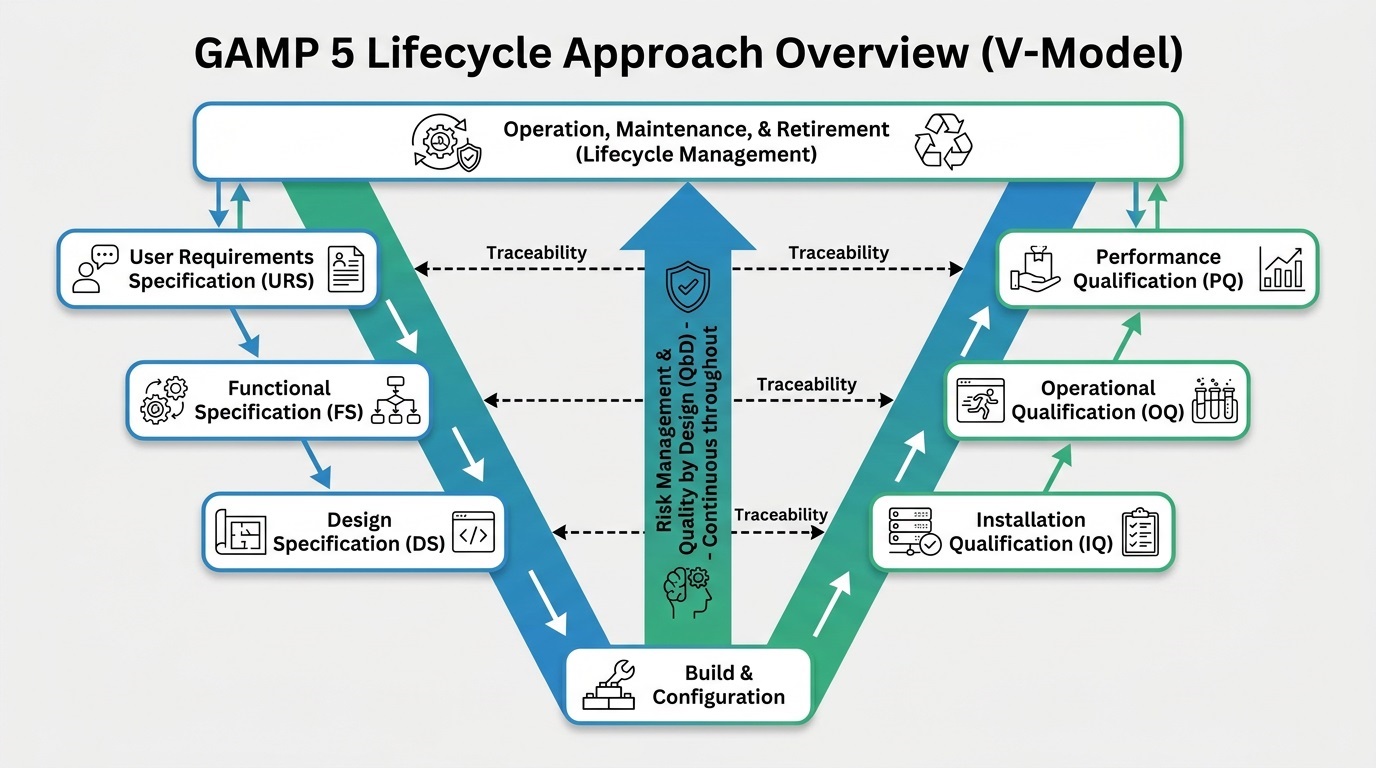
GAMP 5 Lifecycle Approach Overview

Number 1: Risk-Based Validation

Risk-based validation helps teams focus testing on high-risk system functions. FDA’s 2025 CSA guidance supports this approach for production and quality software.

Fact 1: teams apply more rigor where software affects quality.

WHO TRS 1019 calls validation essential to GMP and GCP. Therefore, teams protect data, patients, and product quality.

Fact 2: validation supports the pharmaceutical quality system

Number 2: System Categorization

System categorization in GAMP 5 classifies software by complexity and intended use.

  • Fact 1: Teams use Categories 1, 3, 4, and 5.
  • Category 2 no longer applies.

Therefore, teams scale validation to actual risk, not templates.

  • Fact 2: ISPE says Categories 3–5 work as a continuum.
  • Teams should apply critical thinking.

Number 3: Lifecycle Approach

GAMP 5 applies validation across the full computerized system lifecycle.
Fact 1: ISPE published the 404-page second edition in July 2022.

Therefore, teams plan, specify, test, operate, and retire systems with control.
Fact 2: WHO says validation should cover the lifecycle of systems.

Number 4: Scalable Documentation

Scalable documentation in GAMP 5 means teams create evidence according to system risk. ISPE’s 404-page edition supports fit-for-use systems.

Therefore, teams keep low-risk records lean and document critical functions deeply. WHO expects procedures for operation, maintenance, change, and incidents.

How to Implement GAMP 5 Compliance in Pharmaceutical Manufacturing?

Implement GAMP 5 compliance by defining system purpose, risks, and user requirements. Then, validate critical functions first.

  • Map system processes.
  • Assess data integrity risks.
  • Define validation scope.

Therefore, teams control computerized systems across manufacturing. Keep records clear and update them during changes.

  • Test key functions.
  • Train users.
  • Review performance regularly.

Key Documentation and Checklist Requirements Under GAMP 5

Teams document GAMP 5 evidence to prove system control and compliance.

  • User requirements
  • Risk assessment
  • Validation plan
  • Test scripts
  • Traceability matrix

Therefore, teams should keep records clear, current, and audit-ready.

  • Change control logs
  • Training records
  • SOPs
  • Deviation reports
  • Periodic review checklist
Document Purpose Key Content
URS
Defines what users need from the system.
Intended use, user needs, GxP requirements, data integrity needs.
Risk Plan
Identifies and controls system risks.
Critical functions, patient safety risks, product quality risks, data risks.
Validation Plan
Explains how the system will be validated.
Scope, roles, testing strategy, acceptance criteria, timelines.

User Requirements Specification (URS)

URS defines what users need from a system before design starts. It helps teams align expectations and avoid costly rework.

  • Intended use
  • User roles
  • Critical functions
  • Data integrity needs
  • Acceptance criteria

Therefore, teams use URS to guide design, testing, and validation evidence.

Risk Assessment and Risk Management Plan

A validation plan explains how teams validate a computerized system. Test scripts show how teams verify key functions.

  • Scope
  • Roles
  • Risk focus
  • Test steps
  • Expected results

Therefore, teams use both documents to prove system control. Clear scripts also help testers record results, deviations, and evidence.

Validation Plan and Test Scripts

A validation plan defines the system scope, roles, and testing strategy. Test scripts guide testers through expected steps.

  • Scope
  • Roles
  • Risks
  • Test steps
  • Expected results

Therefore, teams test critical functions and record clear evidence. They also capture deviations, fixes, approvals, and final acceptance.

Differences Between GAMP 4 and GAMP 5 Guidelines

GAMP 4 used a more document-heavy validation model. It focused strongly on system categories, supplier assessment, and scripted evidence.

GAMP 5 shifts teams toward risk-based validation and lifecycle control. Therefore, teams use critical thinking, scalable documentation, and stronger data integrity practices. This approach reduces unnecessary testing and improves compliance focus.

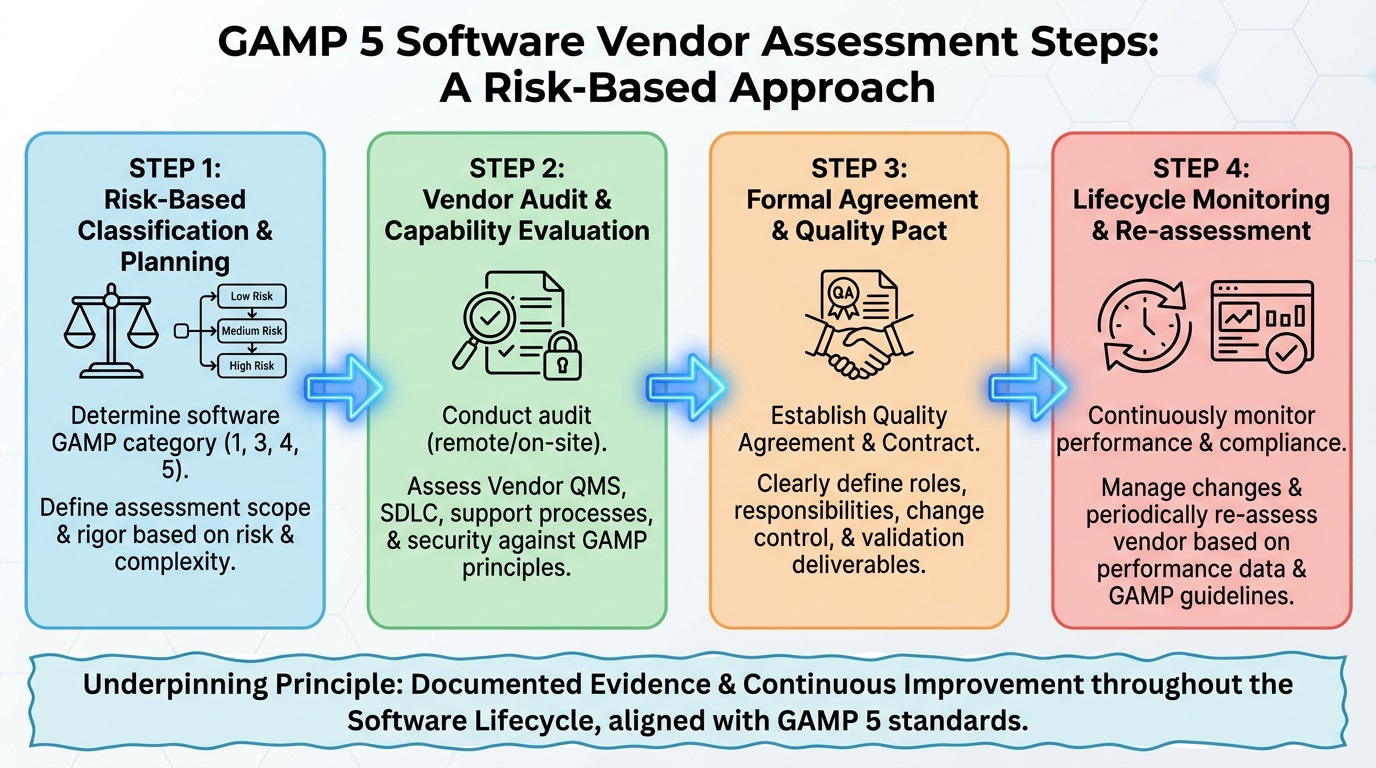
How to Apply GAMP 5 for Software Vendor Assessments?

Teams apply GAMP 5 by checking vendor quality, experience, and software risk.

  • Quality system

  • GxP experience

  • Support process

  • Security controls

  • Change control

  • Audit history

Therefore, teams choose vendors that support validation and compliance. They also review documents, test evidence, and service agreements before system approval.

Steps for Software Vendor Assessment Following GAMP 5

Final Words

GAMP 5 helps pharma teams maintain computerized system quality and compliance. WHO TRS 1019 Annex 3 includes Appendix 5 on computerized system validation. It also defines validation as part of the pharmaceutical quality system. Teams should update URS, risks, tests, deviations, and change records regularly. 

Pharma Validation needs continual training, clear ownership, and routine document review. WHO TRS 1033 Annex 4 supports data integrity for product quality, safety, and efficacy. Therefore, share pharma references, regulatory updates, or validation case studies to strengthen industry learning today. 

FAQs

1️⃣ What is GAMP 5 in pharma validation?

GAMP 5 is a risk-based guide for validating GxP computerized systems. It helps pharma teams prove that systems work correctly, protect data integrity, and support regulatory compliance.

2️⃣ Why does GAMP 5 matter for data integrity?

GAMP 5 helps teams control electronic records, user access, audit trails, testing, and changes. Therefore, it reduces data errors and supports reliable GMP decisions.

3️⃣ How does GAMP 5 support risk-based validation?

GAMP 5 helps teams focus testing on critical system functions. Teams apply more effort where risks affect patient safety, product quality, or data integrity.

Picture of Ershad Moradi

Ershad Moradi

Ershad Moradi, a Content Marketing Specialist at Zamann Pharma Support, brings 6 years of experience in the pharmaceutical industry. Specializing in pharmaceutical and medical technologies, Ershad is currently focused on expanding his knowledge in marketing and improving communication in the field. Outside of work, Ershad enjoys reading and attending industry related networks to stay up-to-date on the latest advancements. With a passion for continuous learning and growth, Ershad is always looking for new opportunities to enhance his skills and contribute to pharmaceutical industry. Connect with Ershad on Facebook for more information.

Share