


Swab vs rinse sampling in pharma supports reliable cleaning validation after manufacturing. Both methods seek evidence that residues remain below justified acceptance limits. EU GMP Annex 15 Section 10.11 requires protocols to define sampling locations, their rationale, and acceptance criteria. Section 10.12 specifically allows swabbing, rinsing, or other justified methods and requires recovery to be demonstrated from sampled product-contact materials.
However, these methods answer different questions about location, coverage, and residue recovery. A strong Pharma Validation strategy links sampling design with equipment risks and analytics. Modern guidance also expects validated analytical methods with appropriate detection and quantification limits.
Table of Contents
What Are Swab and Rinse Sampling in Pharmaceutical Cleaning Validation?
Cleaning validation sampling verifies whether a cleaning process removes relevant residues effectively. Swabbing directly samples a defined area on a product-contact surface.
Rinsing indirectly samples residues transferred into a selected rinse liquid. Both approaches can support chemical residue assessment when scientifically justified.
Neither method automatically proves every product-contact surface is clean. Instead, the sampling plan should match equipment design and worst-case contamination risks.
What Is Swab Sampling?
Swab sampling physically removes residue from a known surface area. A trained analyst wipes the surface using a qualified swab pattern.
The swab is then extracted using a suitable solvent. The extract can undergo HPLC, TOC, or another validated analysis.
Direct sampling helps identify residue at specific worst-case locations. It can also remove dried or poorly soluble material from accessible surfaces.
However, operator technique can introduce variability between sampling events.
| Element | Practical approach |
|---|---|
|
Sampling type |
Direct surface sampling |
|
Typical target |
Accessible worst-case locations |
|
Sample area |
Defined and measured |
|
Recovery drivers |
Technique, solvent, surface |
|
Common analysis |
HPLC, TOC, specific assays |
What Is Rinse Sampling?
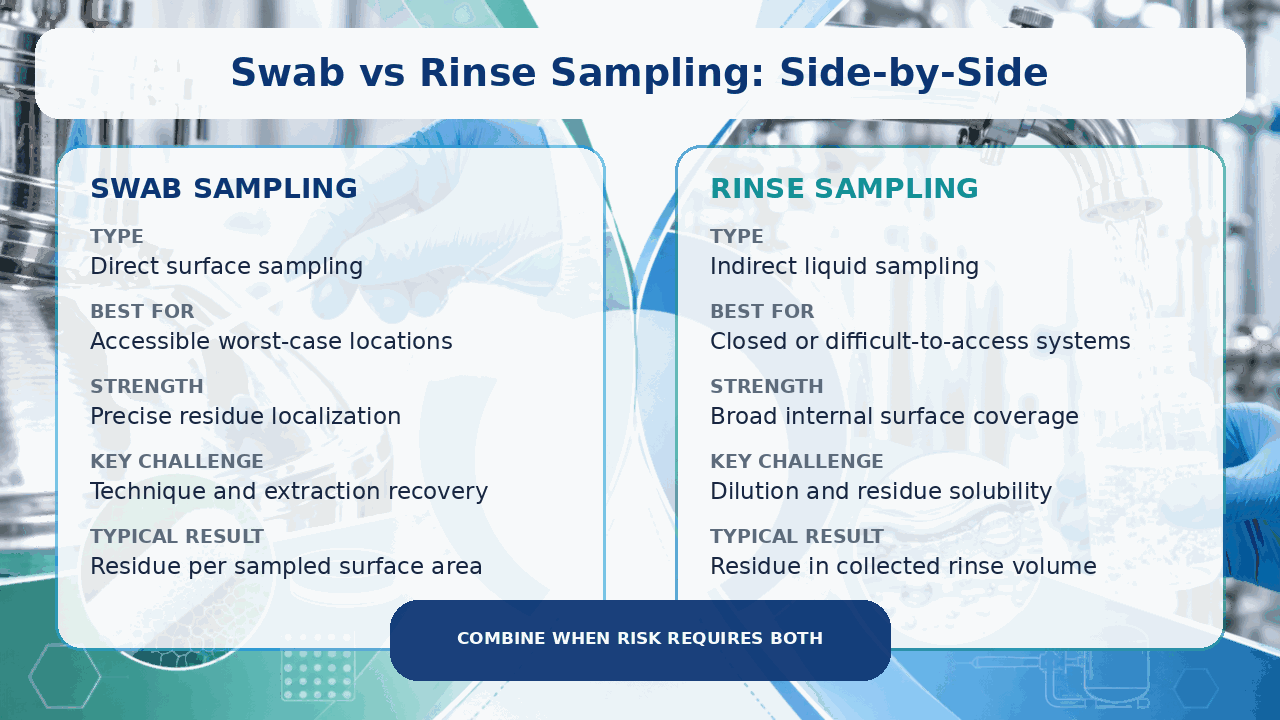
Rinse sampling measures residue transferred from equipment into a rinse solution. The method can cover broader surfaces than a single swab location.
It is especially useful for closed systems and hard-to-access product-contact areas. However, results represent the sampled system rather than one precise surface location.
Therefore, dilution and residue solubility require careful control and interpretation.
How Rinse Sampling Works
A defined liquid volume contacts selected equipment surfaces after the cleaning cycle. The liquid may circulate through piping, vessels, hoses, or internal components.
A representative portion is collected using a controlled sampling procedure. The laboratory then measures target residue or a justified non-specific parameter.
The calculation should account for rinse volume, method sensitivity, and acceptance limits.
Best-Suited Equipment and Surfaces
Rinse sampling suits systems where direct physical access remains limited. Examples include transfer lines, narrow piping, hoses, and closed processing vessels.
It can also support clean-in-place systems with defined flow paths. Large surface areas may benefit from rinse coverage during a validation exercise.
Still, coverage depends on actual liquid contact with potentially contaminated surfaces.
Advantages of Rinse Sampling
Rinse sampling can assess surfaces that technicians cannot safely reach. It can represent large equipment areas using one controlled rinse sequence.
Sampling usually causes less physical disturbance than dismantling complex equipment. Routine collection can also integrate well with automated cleaning systems.
These benefits make rinse methods valuable when accessibility drives sampling risk.
Limitations of Rinse Sampling
Rinse results may dilute small residue quantities below analytical capability. Insoluble residues may not transfer efficiently into the selected rinse medium.
Occluded contamination may remain trapped behind fittings or internal equipment features. Results cannot usually identify one exact contaminated surface location.
Therefore, clean rinse results require demonstrated recovery and suitable method sensitivity.
Key Variables That Affect Recovery
Recovery depends on residue chemistry, surface material, sampling media, and technique. Swab recovery also depends on pressure, wiping pattern, and extraction efficiency.
Rinse recovery depends strongly on solubility, contact, agitation, and rinse volume. Surface roughness can change how tightly residues adhere after processing.
Recovery studies should reflect representative materials and realistic residue levels.
Key Differences Between Swab and Rinse Sampling
Swab and rinse methods differ mainly through localization and equipment accessibility. Swabs provide location-specific evidence from a known sampled area.
Rinses provide broader indirect evidence from contacted internal surfaces. Analytical sensitivity matters for both methods, but dilution especially affects rinse samples.
Likewise, recovery studies should demonstrate expected performance for each sampling approach. The comparison below summarizes the practical differences used during cleaning validation.
Prospective vs Concurrent Validation Comparison Table
| Feature | Swab | Rinse |
|---|---|---|
|
Location specificity |
High |
Low to moderate |
|
Inaccessible surfaces |
Limited |
Strong coverage |
|
Dried residues |
Better physical removal |
May recover poorly |
|
Dilution risk |
Lower |
Higher |
|
Operator dependence |
Higher |
Usually lower |
|
Best fit |
Accessible hotspots |
Closed systems |
When Should You Use Swab Sampling vs Rinse Sampling?
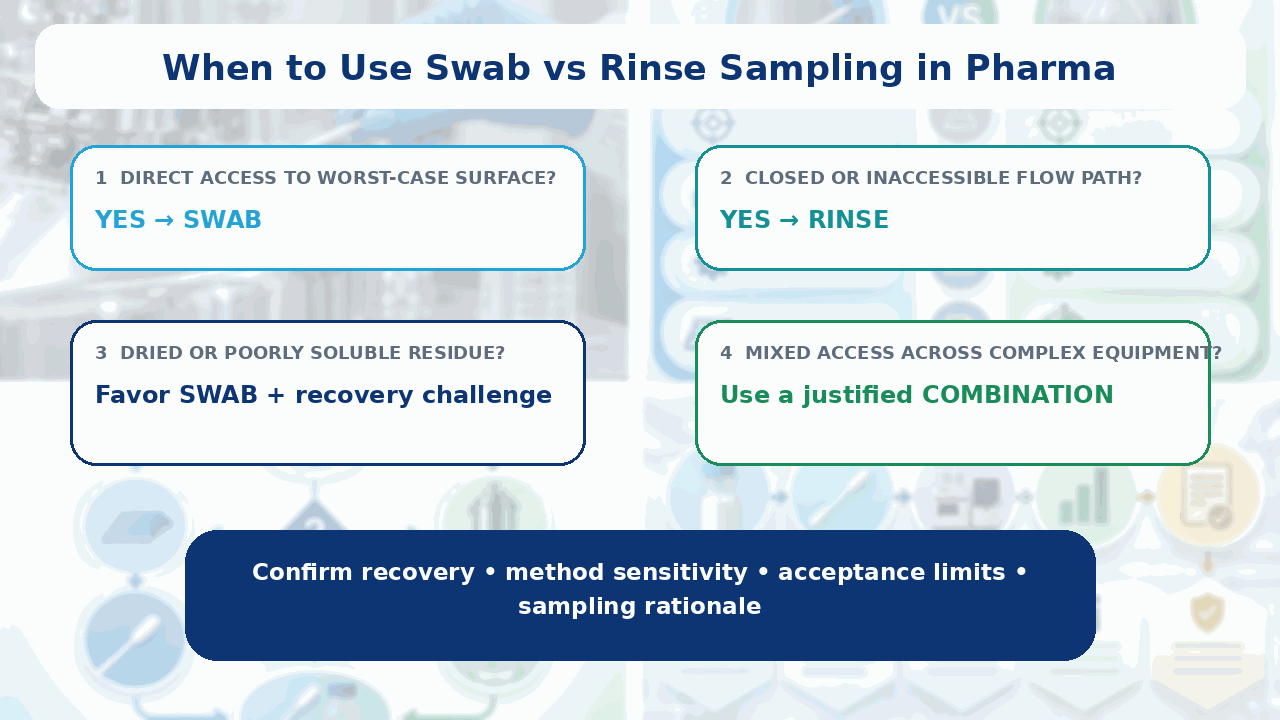
Method selection should begin with equipment design and contamination risk. Teams should identify surfaces most likely to retain the previous product.
They should also consider sampling accessibility before choosing the final method. A risk-based plan may combine swab and rinse evidence when one method misses important areas.
Choose Based on Equipment Design and Sampling Accessibility
Accessible equipment usually supports direct sampling at difficult-to-clean locations. Closed or narrow systems often require rinse sampling for practical coverage.
Use equipment drawings and cleaning flow paths during sampling-plan development. Then confirm that selected locations represent credible worst-case residue retention.
- Use swabs for accessible worst-case surfaces and visible residue-retention points.
- Use rinses for closed pathways, hoses, narrow lines, and internal equipment areas.
- Combine methods when neither approach alone represents the complete contamination risk.
- Document every selected location and its scientific sampling rationale.
Consider Residue Properties, Analytical Method, and Acceptance Limits
Residue properties can make one sampling method more reliable than another. Solubility affects rinse transfer, while adhesion can challenge swab recovery.
Analytical methods must detect residues below the applicable acceptance limit. Consequently, method sensitivity should be assessed before finalizing sample volumes.
- Recovery factors should also be addressed using a documented scientific rationale.
- Evaluate residue solubility before relying heavily on rinse recovery.
- Confirm swab material does not interfere with the analytical method
Recovery Studies, Method Suitability, and GMP Expectations
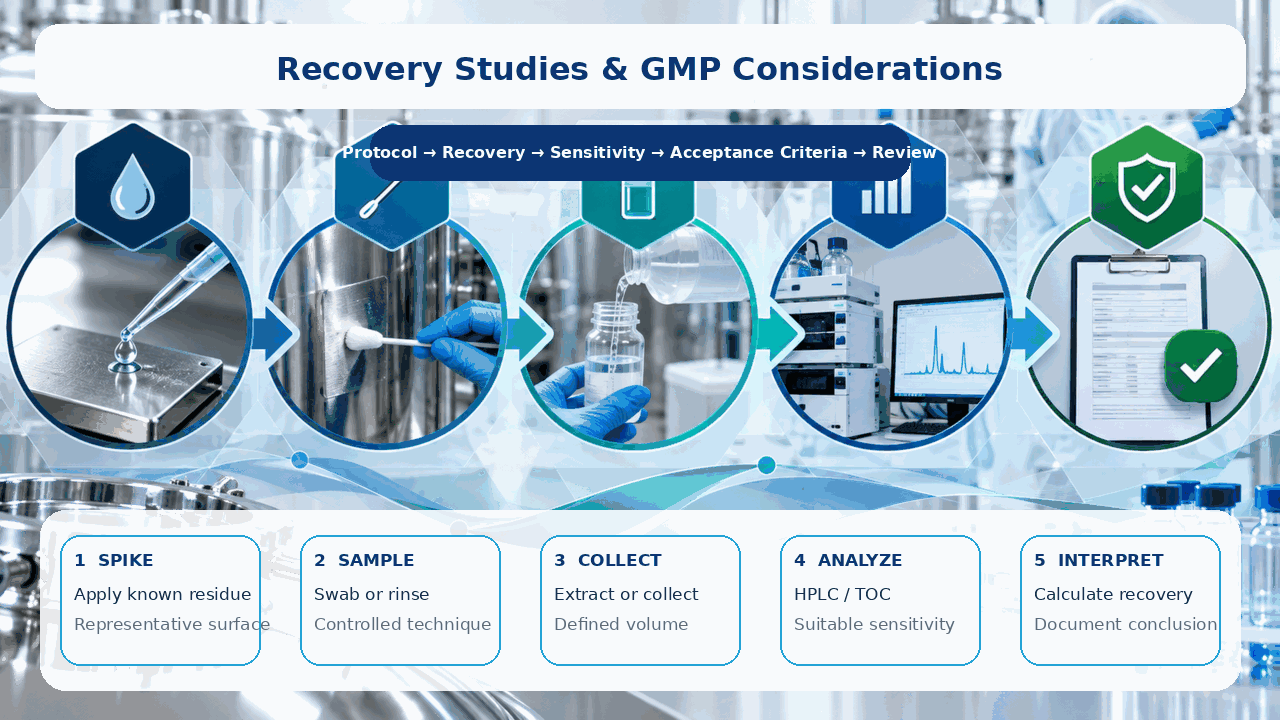
Recovery studies connect laboratory results with actual residue remaining on equipment. They challenge the complete sampling and analytical process under controlled conditions.
Known residue amounts are applied onto representative equipment surface materials. After recovery, analysts compare measured amounts with the applied quantities.
Consistent recovery supports interpretation of routine cleaning-validation samples. Poor recovery can hide unacceptable residue despite apparently compliant analytical results.
Final Word
Swab sampling targets accessible, risk-based locations, while rinse sampling covers larger or difficult-to-reach surfaces. EU GMP Annex 15 Sections 10.11–10.12 require justified sampling locations, acceptance criteria, and demonstrated recovery.
FDA guidance also notes that direct sampling is preferred where feasible and cites 50% and 90% recovery only as examples, not fixed limits. Selection should consider equipment design, residue properties, solubility, recovery, and analytical sensitivity.
FAQs
Prospective validation is normally preferred for planned commercial processes. However, regulations recognize limited exceptions in specific circumstances. The final choice depends on product type and jurisdiction. Companies must follow approved procedures and regulatory commitments.
Yes, certain frameworks allow release under defined conditions. Each batch must meet GMP and release requirements. The validation protocol should define applicable acceptance criteria. Quality teams must review emerging evidence before release decisions.
No, concurrent validation does not justify reduced control. It often requires intensified monitoring and faster review. Sampling should address meaningful process variability. The protocol must define scientifically justified testing before execution.

Ershad Moradi
Ershad Moradi, a Content Marketing Specialist at Zamann Pharma Support, brings 6 years of experience in the pharmaceutical industry. Specializing in pharmaceutical and medical technologies, Ershad is currently focused on expanding his knowledge in marketing and improving communication in the field. Outside of work, Ershad enjoys reading and attending industry related networks to stay up-to-date on the latest advancements. With a passion for continuous learning and growth, Ershad is always looking for new opportunities to enhance his skills and contribute to pharmaceutical industry. Connect with Ershad on Facebook for more information.
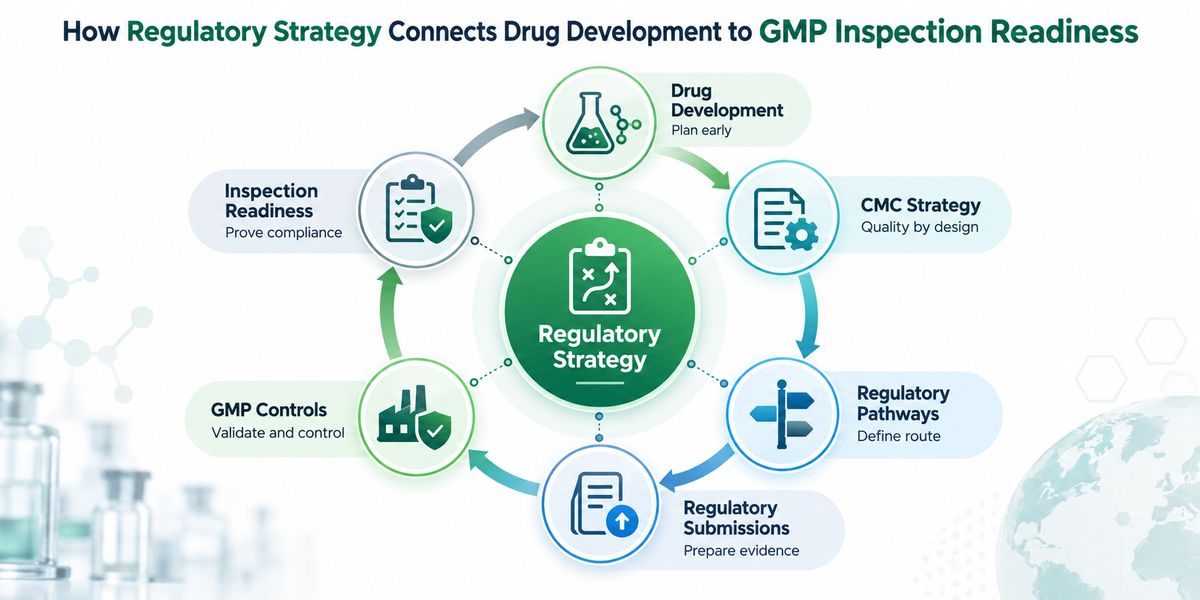
Regulatory Strategy in Pharma in 2026: From Drug Development to GMP Inspection Readiness
Effective regulatory planning connects drug development, CMC, submissions, manufacturing, and lifecycle obligations. This article explains how regulatory teams can reduce compliance gaps, prepare for inspections, manage post-approval changes, and make better decisions across the pharmaceutical product lifecycle.

Alison vs Pharmuni in 2026: Free Learning at Scale or a Guided Pharma Career System?
Alison offers 6,000+ free courses plus career tools and recruitment. Pharmuni is smaller but pharma-focused, with role assessments, Career Paths, CV tools, and 1,000+ life-science jobs.

Udemy vs Pharmuni in 2026: One Course Fast or a Full Pharma Career Path?
Udemy makes it easy to buy a specific self-paced course from a huge marketplace. Pharmuni takes a different approach, connecting pharma learning with assessments, Career Paths, competency visibility, CV tools, and job matching.