


Prospective vs concurrent validation helps manufacturers demonstrate reliable pharmaceutical process performance. Timing changes both risk and evidence. FDA lifecycle guidance defines three stages: Process Design, Process Qualification, and Continued Process Verification. ICH Q7 notes that three consecutive successful production batches are commonly used for API validation, but this is not a universal requirement.
EU GMP Annex 15 allows concurrent validation only in exceptional, justified situations. Therefore, concurrent validation should not become a routine shortcut. Strategy should reflect process knowledge, patient risk, supply needs, approved procedures, and regulatory commitments. Readers can explore broader Pharma Validation principles through the linked learning resource.
Table of Contents
What Is Prospective Validation?
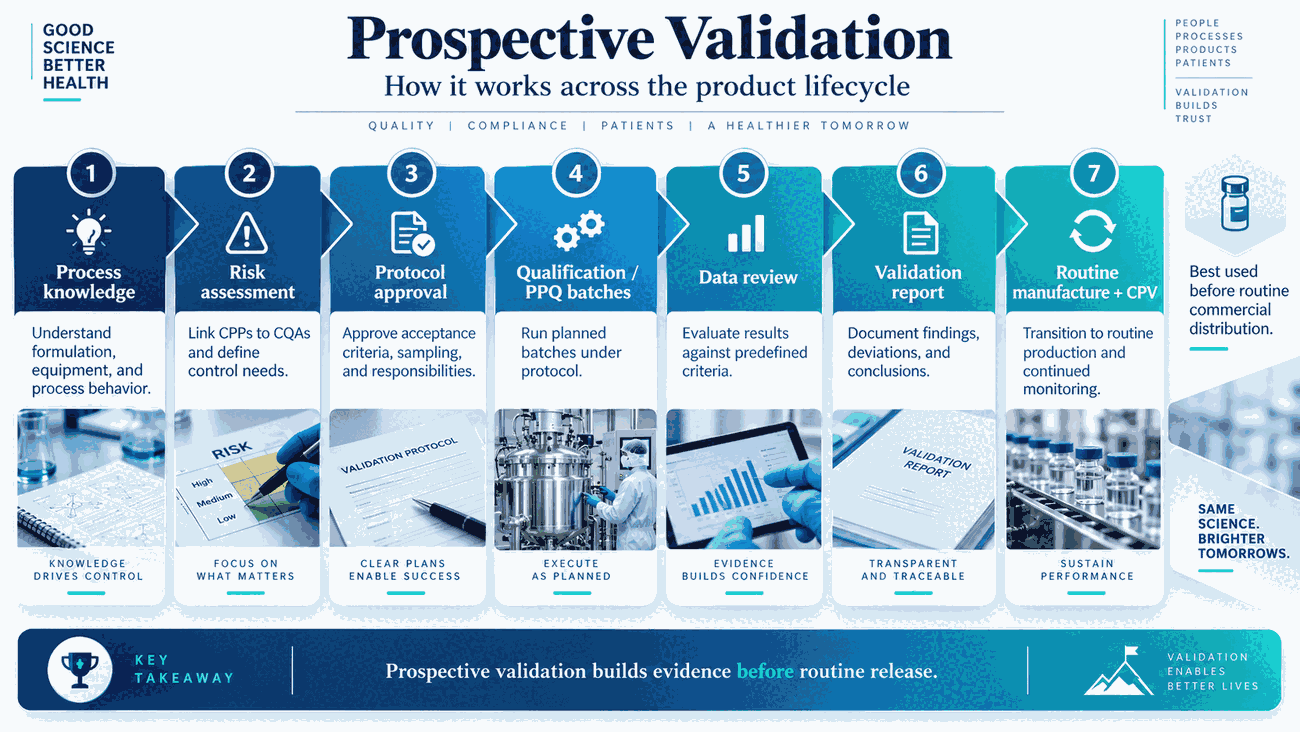
Prospective validation is preferred in API GMP guidance for API processes. Teams plan validation before routine commercial distribution. First, they define the process and its critical controls. Next, they establish measurable acceptance criteria before execution. Then, they manufacture planned validation batches under controlled conditions. Finally, they review results before relying on routine commercial performance. This sequence reduces uncertainty before sustained commercial operation.
- Process steps and critical process parameters.
- Critical quality attributes and justified acceptance criteria.
- Equipment, utilities, methods, and calibration status.
- Sampling locations, frequencies, tests, and responsibilities.
- Deviation handling, data review, and final approval.
What Is Concurrent Validation?
Concurrent validation collects validation evidence during routine commercial manufacture. It can support unusual situations with limited production opportunities. API GMP guidance allows it for certain limited API production situations. European GMP requirements expect exceptional justification for medicinal products. U.S. lifecycle guidance describes concurrent release of PPQ batches as rare. Therefore, firms should document why prospective completion is impractical.
Prospective vs Concurrent Validation: What Is the Key Difference?
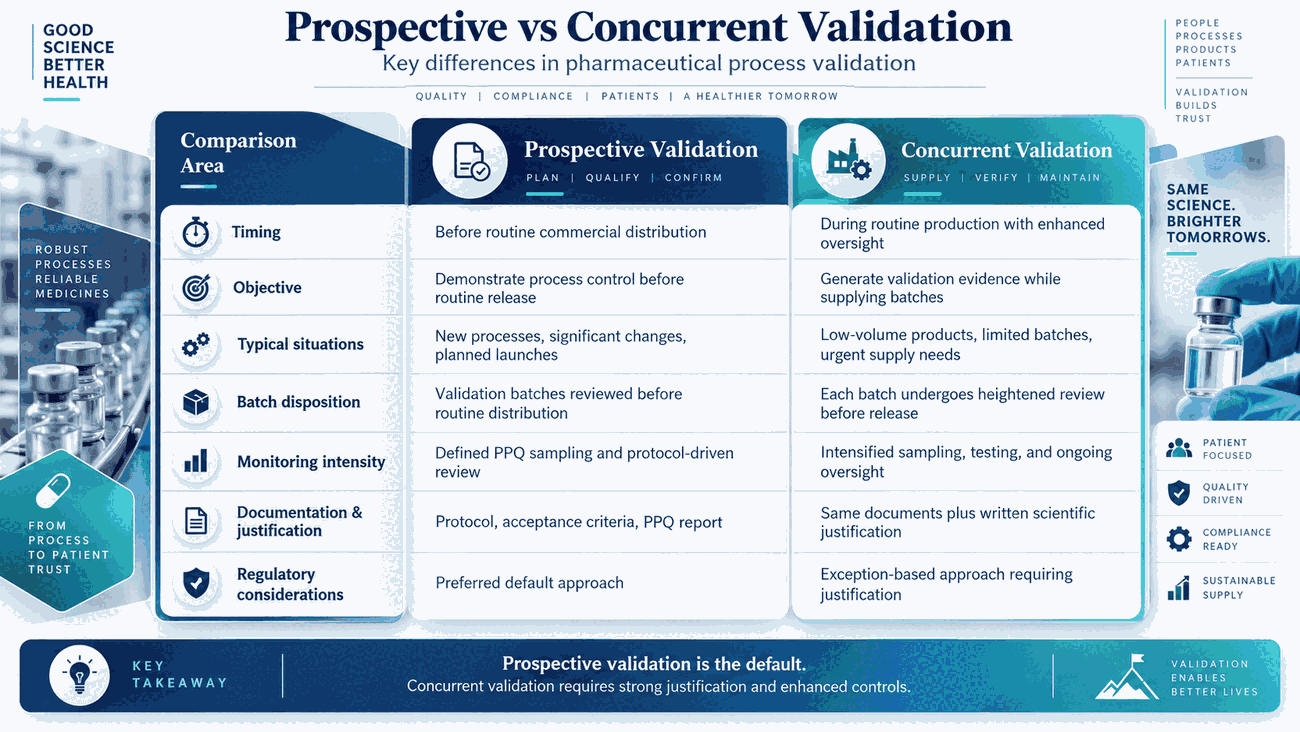
Prospective validation occurs before routine commercial distribution starts. Concurrent validation occurs while commercial manufacturing and validation proceed together. That timing difference creates several operational consequences. Prospective validation allows evidence review before routine market supply.
Concurrent validation requires stronger justification and tighter real-time oversight. Both approaches require predefined protocols and acceptance criteria. Both require qualified equipment, trained personnel, and suitable test methods. However, concurrent validation increases the consequences of unexpected failure.
Difference 1 Timing and Batch Release
Prospective validation normally finishes before routine commercial distribution. Concurrent validation may overlap commercial supply under approved controls. However, each batch must still meet release requirements. Validation status never replaces normal GMP release responsibilities. Teams should review available validation data before each release decision. A failed acceptance criterion can affect distributed batches and future production.
Difference 2 When Each Validation Approach Is Appropriate
Prospective validation suits new processes with adequate planning time. It also suits significant process changes requiring renewed qualification evidence. Concurrent validation can suit infrequent production or limited batch availability. It may support exceptional supply or patient-need situations. Yet the approach must fit applicable regulations and approvals. Production pressure alone does not create scientific justification.
Difference 3 Protocol, Sampling, and Documentation Requirements
Both approaches require an approved validation protocol before execution. The protocol should define objectives, responsibilities, sampling, tests, and acceptance criteria. It should identify CPPs and CQAs using process knowledge. Sampling should capture expected variability across meaningful process stages. Data collection must follow controlled and traceable procedures. Any deviation needs documented assessment before final conclusions.
Difference 4 Risk Assessment and Scientific Justification
Risk assessment should shape validation scope and monitoring intensity. Teams should identify failure modes affecting product quality. They should connect those risks with controls and measurements. Higher uncertainty generally requires stronger sampling and oversight. Concurrent validation usually demands especially prompt review of emerging data. However, risk tools cannot justify weak process understanding.
Difference 5 Regulatory Expectations and Lifecycle Context
Modern validation uses a lifecycle perspective. Current U.S. guidance describes process design, process qualification, and continued process verification. API lifecycle guidance also supports ongoing assurance. European GMP requirements link validation with process knowledge. Therefore, both approaches sit inside a broader control strategy. They do not replace continued monitoring after qualification. Change control can also trigger additional validation activities.
Prospective vs Concurrent Validation Comparison Table
| Comparison point | Prospective validation | Concurrent validation |
|---|---|---|
|
Timing |
Before routine commercial distribution |
During routine commercial manufacture |
|
Typical use |
New or changed process with planned qualification |
Exceptional limited or infrequent production |
|
Batch disposition |
Routine distribution follows successful qualification |
Release may occur under defined controls |
|
Justification |
Standard planned validation strategy |
Specific scientific and regulatory justification |
|
Monitoring |
Protocol-driven qualification monitoring |
Enhanced monitoring plus rapid ongoing review |
|
Documentation |
Approved protocol and final report |
Protocol, VMP justification, release criteria, rapid review |
|
Risk profile |
Lower distributed-product exposure during qualification |
Higher consequences if validation fails |
|
Regulatory context |
Preferred or normal planned approach |
Exceptional or limited-use approach |
When Can Concurrent Validation Be Justified?
Concurrent validation needs strong justification because validation continues during commercial activity. European GMP requirements link this approach with exceptional circumstances. The justification should describe patient benefit and identified risks. The validation master plan should document the selected strategy. Authorized personnel should approve the decision before execution. Teams should define release controls before manufacturing validation batches.
Exceptional Circumstances and Limited Production Scenarios
Exceptional scenarios may include infrequent or limited production. API GMP guidance recognizes those situations for active substance manufacturing. A modified validated API process can also support concurrent validation. U.S. guidance describes concurrent PPQ release for limited-demand products. It also mentions medically necessary products during certain shortage responses. These examples do not create automatic permission. Each situation still requires product-specific assessment and documented controls.
Controls Required During Concurrent Validation
- Preapproved protocols with clear batch-release criteria.
- Enhanced monitoring of CPPs, CQAs, and process trends.
- Rapid review of deviations, OOS events, and unexpected signals.
- Qualified equipment, validated methods, and trained personnel.
- Formal batch-by-batch quality review before release.
- Defined actions for validation failure or adverse trends.
Management should also plan post-release oversight where relevant. U.S. guidance recommends careful oversight for concurrently released PPQ batches. Complaint signals and defect reports need rapid evaluation. Stability data also deserve prompt review when included.
How to Choose the Right Validation Approach
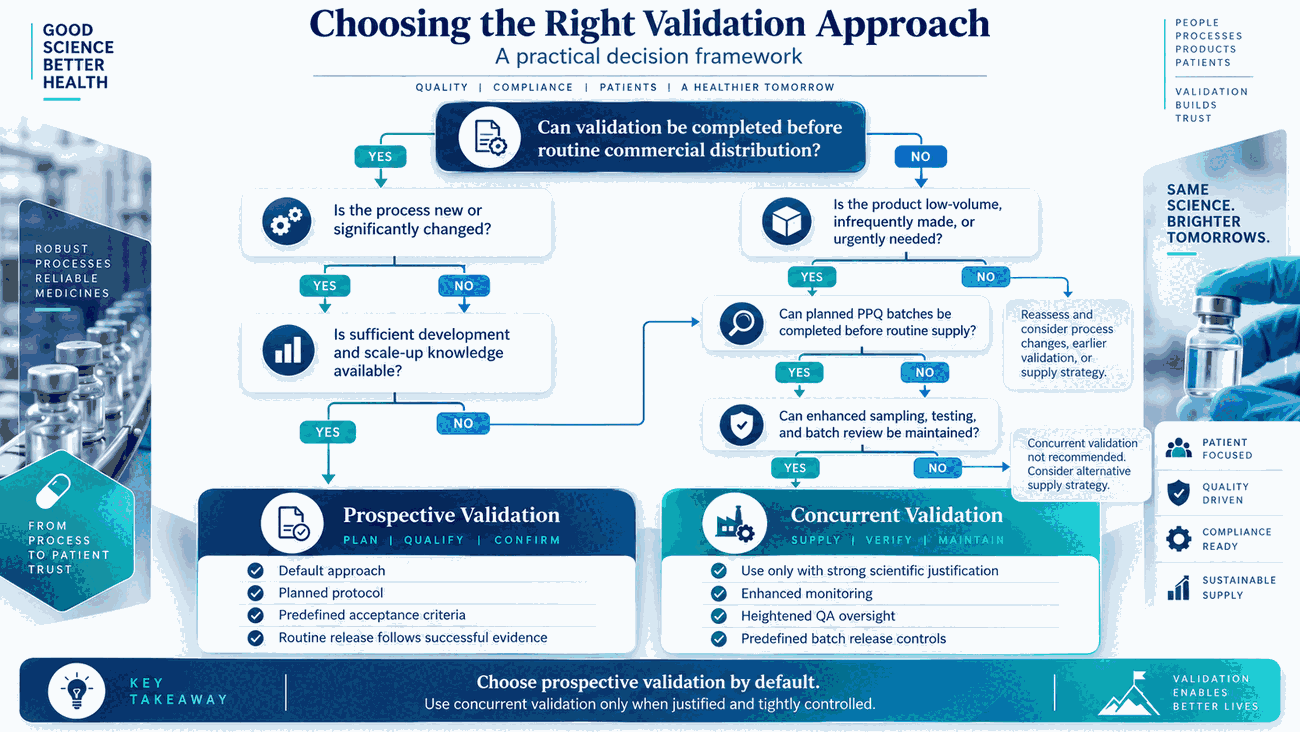
Choosing the correct approach begins with process knowledge. Teams should evaluate development evidence and commercial manufacturing readiness. Next, they should assess patient and supply consequences. They should review marketing authorization commitments and site procedures. A risk-based validation decision should explain why the chosen approach fits. Prospective validation remains the normal starting point for planned processes.
- Can validation finish before routine commercial distribution?
- Is process knowledge adequate for commercial-scale qualification?
- Does batch availability limit a conventional prospective study?
- Is an exceptional patient or supply benefit clearly documented?
Final Word
Prospective vs concurrent validation remains a practical lifecycle decision. Prospective validation provides evidence before routine commercial distribution. Concurrent validation overlaps qualification with commercial manufacturing under exceptional controls.
FDA requirements under 21 CFR 211.110 address in-process controls needed to assure batch uniformity and integrity. Therefore, the choice should follow science, risk, and regulatory expectations. Teams need qualified systems, meaningful sampling, and rapid data review. Continued process verification then confirms performance during routine manufacture. In 2026, lifecycle thinking remains central to modern process validation. A justified validation strategy protects product quality, process consistency, and patients.
FAQs
Prospective validation is normally preferred for planned commercial processes. However, regulations recognize limited exceptions in specific circumstances. The final choice depends on product type and jurisdiction. Companies must follow approved procedures and regulatory commitments.
Yes, certain frameworks allow release under defined conditions. Each batch must meet GMP and release requirements. The validation protocol should define applicable acceptance criteria. Quality teams must review emerging evidence before release decisions.
No, concurrent validation does not justify reduced control. It often requires intensified monitoring and faster review. Sampling should address meaningful process variability. The protocol must define scientifically justified testing before execution.

Ershad Moradi
Ershad Moradi, a Content Marketing Specialist at Zamann Pharma Support, brings 6 years of experience in the pharmaceutical industry. Specializing in pharmaceutical and medical technologies, Ershad is currently focused on expanding his knowledge in marketing and improving communication in the field. Outside of work, Ershad enjoys reading and attending industry related networks to stay up-to-date on the latest advancements. With a passion for continuous learning and growth, Ershad is always looking for new opportunities to enhance his skills and contribute to pharmaceutical industry. Connect with Ershad on Facebook for more information.
Regulatory Strategy in Pharma in 2026: From Drug Development to GMP Inspection Readiness
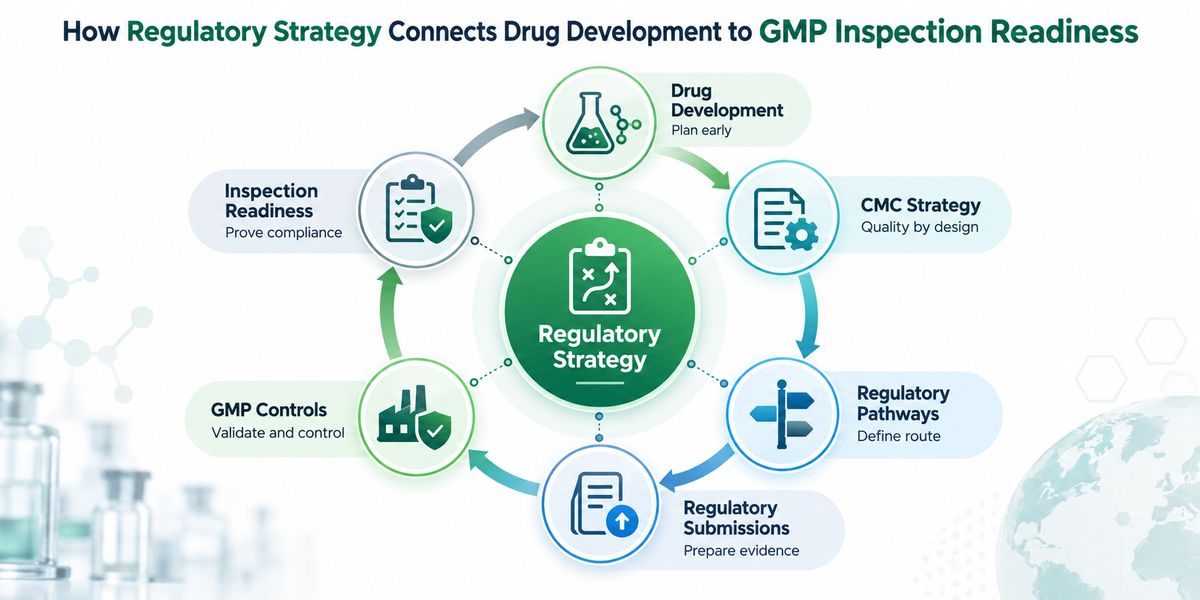
Effective regulatory planning connects drug development, CMC, submissions, manufacturing, and lifecycle obligations. This article explains how regulatory teams can reduce compliance gaps, prepare for inspections, manage post-approval changes, and make better decisions across the pharmaceutical product lifecycle.

Alison vs Pharmuni in 2026: Free Learning at Scale or a Guided Pharma Career System?
Alison offers 6,000+ free courses plus career tools and recruitment. Pharmuni is smaller but pharma-focused, with role assessments, Career Paths, CV tools, and 1,000+ life-science jobs.

Udemy vs Pharmuni in 2026: One Course Fast or a Full Pharma Career Path?
Udemy makes it easy to buy a specific self-paced course from a huge marketplace. Pharmuni takes a different approach, connecting pharma learning with assessments, Career Paths, competency visibility, CV tools, and job matching.