


Cleaning validation acceptance criteria define when cleaned equipment becomes suitable for reuse. These limits protect products from unintended residue and cross-contamination. They also support patient safety, batch quality, and reliable manufacturing continuity. Many teams still seek one universal numerical limit. However, regulators expect product-specific, equipment-specific, and scientifically justified decisions.
The regulatory framework also continues evolving. PIC/S published PI 006-4 on July 30, 2026. This recommendation enters force on October 1, 2026. Its cleaning validation section strengthens lifecycle controls and continued verification. Effective Pharma Validation therefore connects toxicology, equipment knowledge, sampling, and analytical capability. This guide explains those connections and practical calculations.
Table of Contents
What are Cleaning Validation Acceptance Criteria?
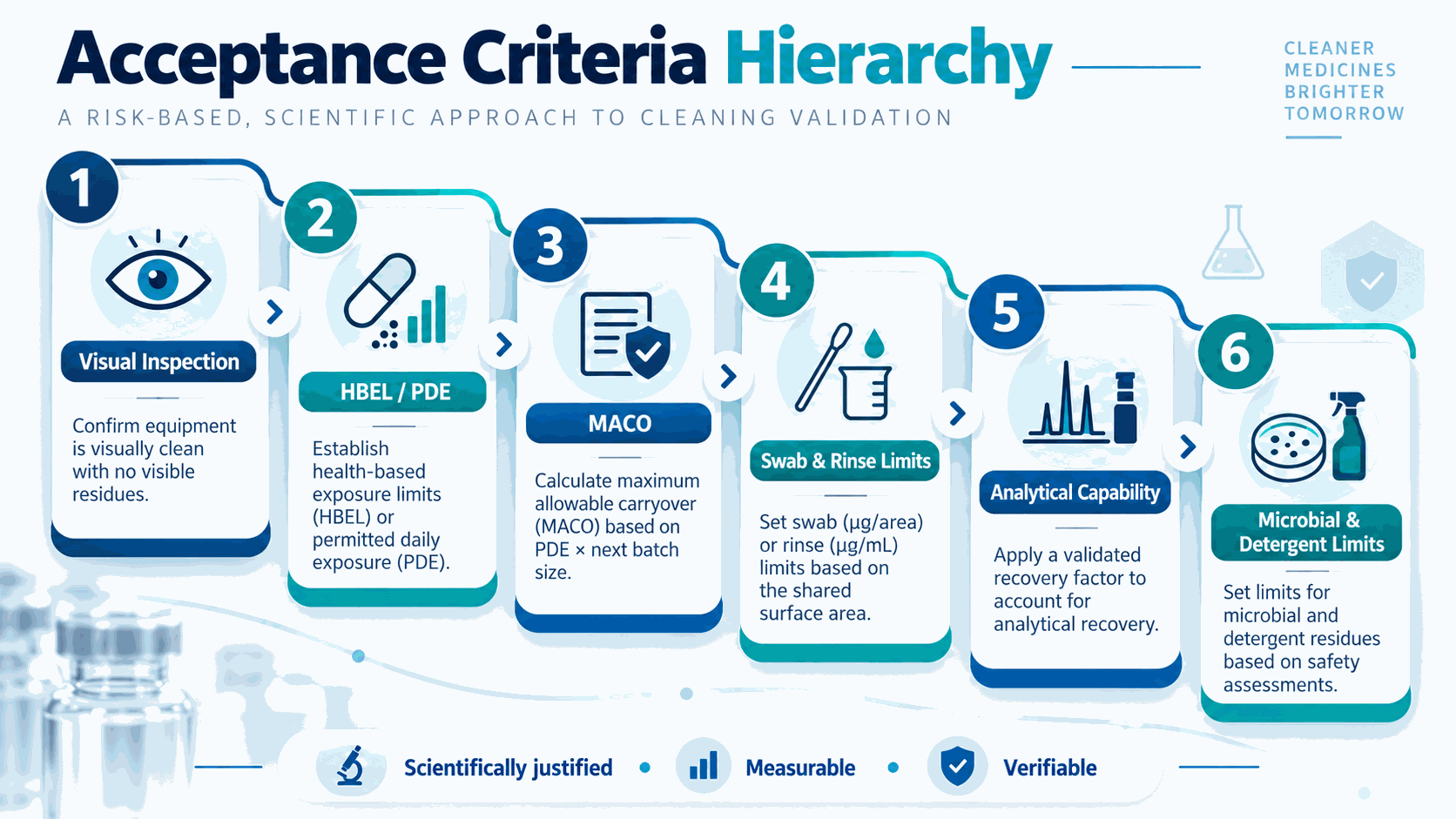
Acceptance criteria are predefined conditions for judging cleaning results. They cover product residues, degradants, detergents, and microbial contamination. Good criteria remain safe, measurable, practical, achievable, and verifiable. They also reflect the complete shared equipment train. A passing result requires more than a low chromatographic response. The entire control package must support the same conclusion.
- Visual inspection confirms the absence of visible residue and foreign material.
- HBEL or PDE establishes a health-based exposure boundary for each compound.
- MACO converts that exposure boundary into an allowable carryover mass.
- Surface limits translate MACO into swab or rinse acceptance values.
FDA Expectations for Specific and Justifiable Limits
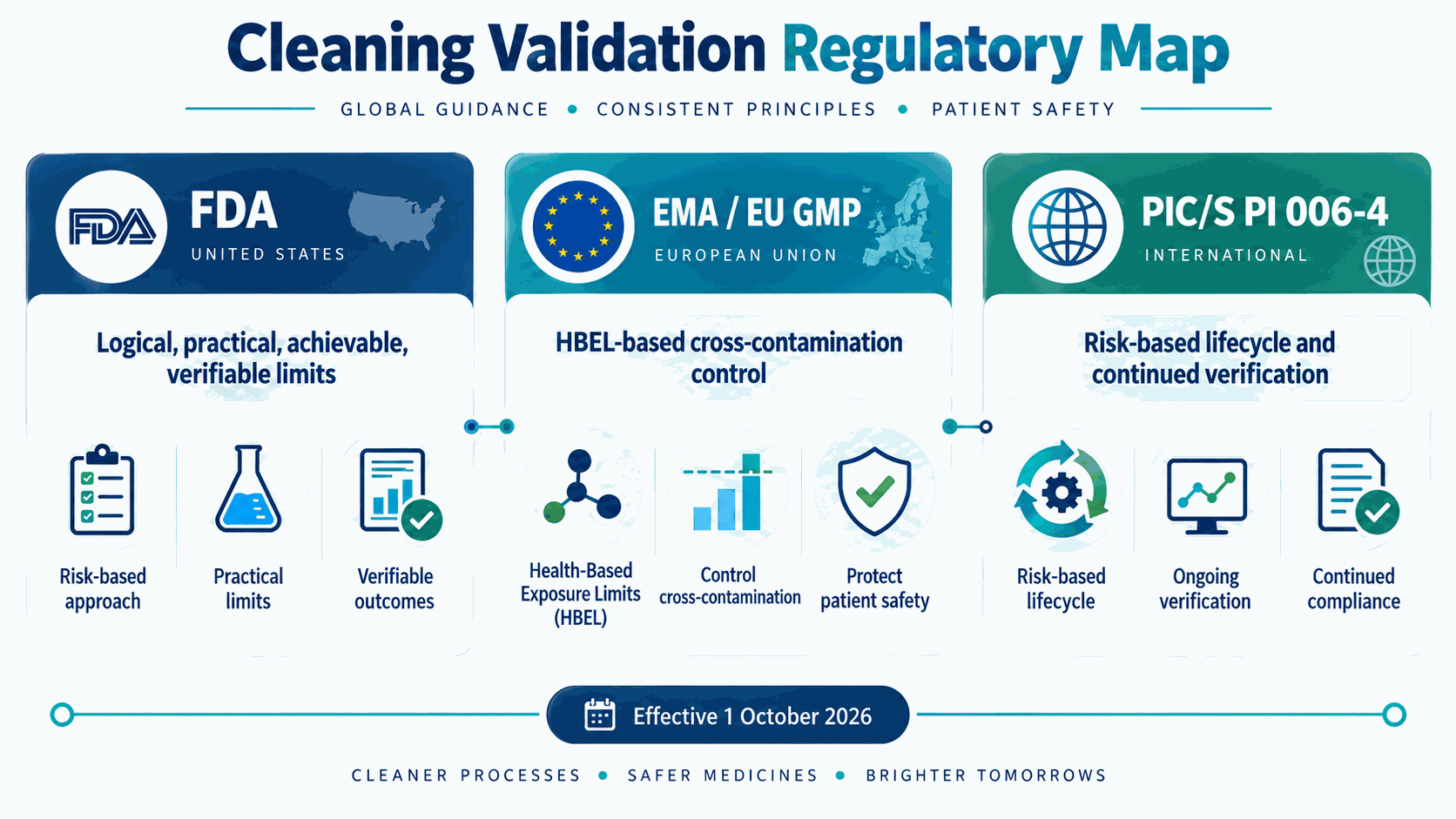
FDA does not prescribe one universal cleaning limit. Instead, firms must justify every residue acceptance limit logically. The limit must remain practical, achievable, and verifiable. Written protocols should define sampling, methods, sensitivity, responsibilities, and acceptance criteria. FDA also expects recovery studies for combined sampling and analytical methods. Therefore, a negative result only proves absence above the method’s detection capability.
Health-Based Limits Versus Legacy Rules
EMA guidance connects carryover control with health-based exposure limits. A qualified toxicologist derives the PDE from pharmacological and toxicological evidence. Sites then translate that value into operational cleaning validation limits. Legacy rules may still provide supporting comparisons. However, they should never replace stronger health-based evidence without justification.
Here are Key roles
Rule 1 Visual Cleanliness as a Mandatory but Supporting Criterion
Rule 2 HBEL and PDE-Based Product Residue Limits
Rule 3 Dose-Based and 10 ppm Limits: When Legacy Criteria May Apply
Rule 4 Analytical Method and Recovery Acceptance Criteria
Rule 5 Cleaning Agent and Microbiological Acceptance Limits
Rule 1 Visual Cleanliness as a Mandatory but Supporting Criterion
Visually clean remains the minimum expected condition. Inspectors should evaluate dry equipment under suitable lighting. Qualified personnel must inspect accessible and difficult locations. However, visual inspection cannot always detect low HBEL residues. Analytical verification becomes essential when safety limits approach visual detection thresholds.
Rule 2 HBEL and PDE-Based Product Residue Limits
HBEL expresses a safe exposure boundary for a specific compound. PDE represents a daily dose unlikely to cause harmful lifetime effects. Toxicologists select critical effects, reference doses, and adjustment factors. Sites must document assumptions and route considerations. Cleaning limits should include operational margins below calculated health boundaries.
Health-based limits and their operational cleaning roles
| Element | Purpose | Practical application |
|---|---|---|
|
HBEL |
Defines a health-based exposure boundary |
Supports cross-contamination risk decisions |
|
PDE |
Expresses a safe daily compound exposure |
Provides the toxicological input for MACO |
|
MACO |
Defines allowable carryover mass |
Allocates residue across shared equipment |
|
Operational limit |
Adds method and process capability |
Creates a measurable release criterion |
Rule 3 Dose-Based and 10 ppm Limits: When Legacy Criteria May Apply
Dose-based and 10 ppm rules came from historical industry practice. They can support comparisons or interim assessments. However, neither rule considers every toxicological hazard. A low-dose product may require a stricter health-based limit. Conversely, rigid legacy limits may create unnecessary testing burdens. Document the selected basis and its limitations.
Rule 4 Analytical Method and Recovery Acceptance Criteria
The analytical method must measure residues below the reportable limit. Specificity should distinguish actives, degradants, detergents, and possible interferences. Accuracy and precision support dependable quantitation.
LOD identifies detectable residue, while LOQ supports reliable measurement. Recovery studies connect laboratory performance with actual equipment surfaces.
Rule 5 Cleaning Agent and Microbiological Acceptance Limits
Cleaning agents require documented residue limits and suitable analytical controls. PIC/S prefers defined detergent compositions and minimal remaining residue. Microbial criteria should consider product risk and equipment storage. Moisture, temperature, crevices, and extended hold times promote microbial growth. Therefore, dry storage and controlled clean-hold times remain essential.
How to Calculate Maximum Allowable Carryover
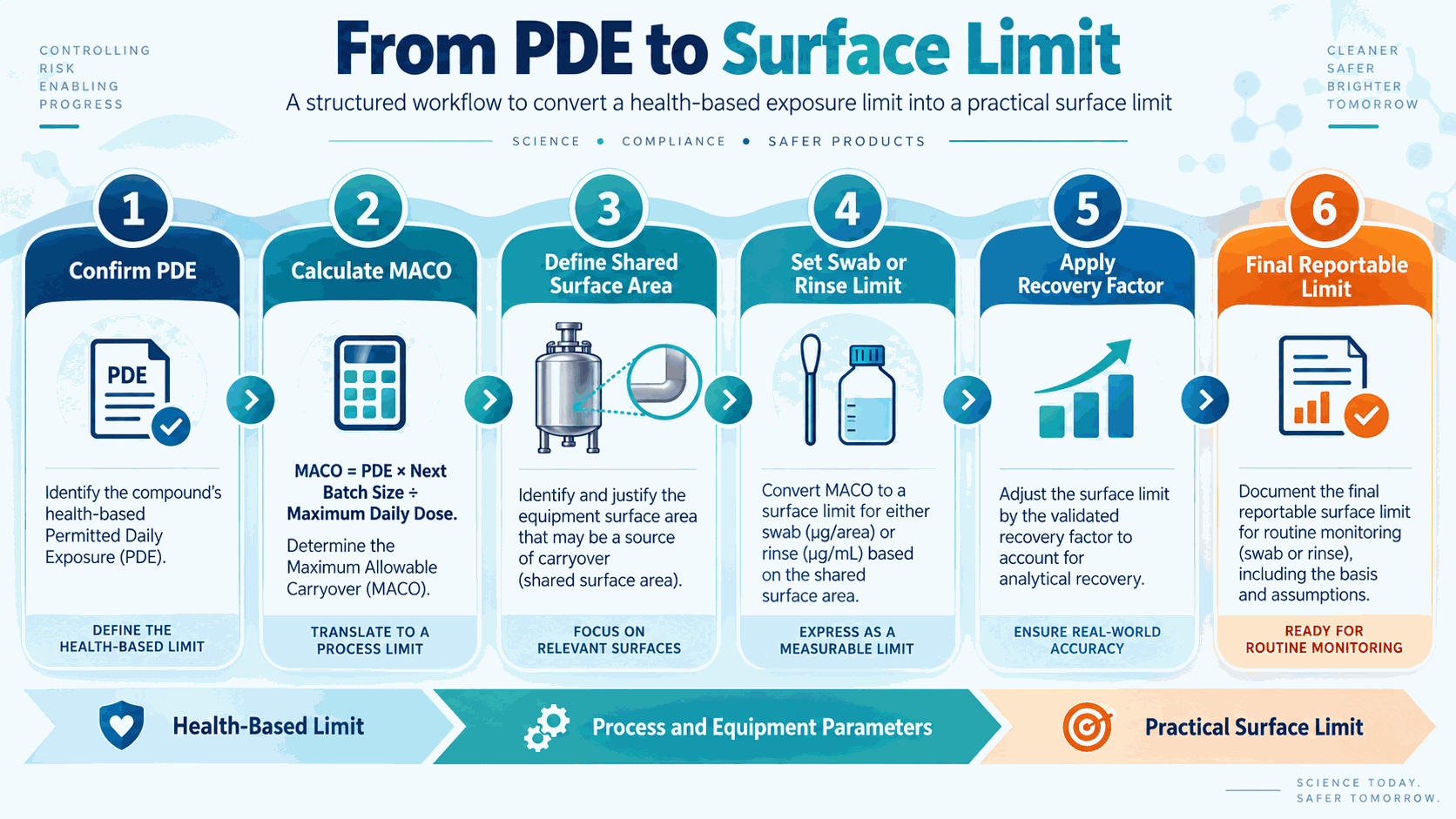
MACO converts the PDE into a maximum residue mass entering the next product. A common health-based formula uses PDE, next-batch size, and maximum daily dose. Units must remain consistent throughout the calculation. The toxicological value should match the relevant exposure route. Sites should also consider cumulative carryover across shared equipment.
MACO = PDE × Next Product Batch Size ÷ Maximum Daily Dose
For example, assume a PDE of 0.01 milligrams daily. The next batch contains 100,000 kilograms. Its maximum daily dose equals 1 kilogram. The calculated MACO equals 1,000 milligrams. This fictional example only demonstrates unit handling. Actual values require approved toxicology and manufacturing data.
Translating MACO into swab and rinse acceptance limits
| Calculation stage | Typical expression | Control point |
|---|---|---|
|
MACO |
PDE × next batch ÷ daily dose |
Confirm units and exposure route |
|
Surface limit |
MACO ÷ shared surface area |
Address the full equipment train |
|
Swab limit |
Surface limit × sampled area |
Define area and recovery correction |
|
Rinse limit |
Allowable mass ÷ rinse volume |
Confirm solubility and total volume |
Sampling and Analytical Requirements for Reliable Results
Sampling design must capture representative and hardest-to-clean locations. Swabs directly evaluate a defined surface area. Rinses cover inaccessible systems and larger internal surfaces. However, rinse results can hide localized contamination through dilution. Consequently, teams should combine methods when equipment accessibility limits direct sampling.
- Map seals, flanges, valves, transfer lines, corners, and product-contact joints.
- Select sampling solvents that dissolve residues without damaging surfaces.
- Define swab material, pattern, pressure, area, and extraction conditions.
- Challenge stainless steel, plastics, silicone, glass, and coated surfaces.
Swab Recovery Factors and Surface-Specific Studies
Step 1 — Prepare representative coupons using relevant construction materials.
Step 2 — Spike known residue amounts across the validated range.
Step 3 — Swab each coupon using the approved technique.
Step 4 — Extract and analyze every sample consistently. Finally, calculate recovery and variability. Apply correction factors when justified.
Specificity, LOD, LOQ, Accuracy, and Precision
Method suitability begins with the required surface or rinse limit. The LOQ should remain below that operational criterion. Specificity must address expected degradants and cleaning-related interferences. Accuracy should cover the working range. Precision should include analytical and sampling variability. Sample stability must support the planned testing timeline.
How to Define Protocol Pass and Fail Criteria
Protocols should define every decision before validation begins. Each sampled location needs an applicable limit and calculation basis. Visual acceptance should never compensate for failed analytical results. Likewise, passing average results cannot conceal a failing individual location. Quality reviewers should assess cumulative carryover across the complete equipment train.
- All inspected surfaces meet the documented visually clean criterion.
- Every individual swab result remains below its corrected surface limit.
- Rinse results remain below validated concentration and total-mass limits.
Handling Failures, Deviations, and Ongoing Verification
Record every visual or analytical failure within the quality system. Investigate procedures, operators, equipment design, sampling, and analytical performance. Repeated cleaning and testing until passing remains unacceptable. Instead, teams should remediate the process and assess product impact. Continued verification should follow risk and historical performance. Low HBEL products may require every-changeover verification.
Final Word
Defensible criteria unite toxicology, equipment knowledge, analytical science, and quality oversight. EMA guidance supports health-based exposure limits (HBELs), including PDE values derived from toxicological data and adjustment factors. Teams can translate the PDE into MACO, then into swab or rinse limits using batch size, maximum daily dose, shared surface area, and validated recovery.
FDA does not prescribe one universal residue limit. It expects limits to be logical, practical, achievable, verifiable, and scientifically justified. Historical examples include 10 ppm and 1/1000 of the therapeutic dose, but these are not automatic acceptance criteria. Teams should reassess limits after equipment, product, process, or cleaning changes. A robust cleaning validation in pharma program therefore protects patients, strengthens inspection readiness, and supports reliable manufacturing decisions.
FAQs
Sometimes, but only with strong scientific justification. The visible-residue threshold must stay below the safety limit. Inspectors also need suitable access, lighting, training, and documented qualification. Low HBEL products usually need analytical verification.
It may support a documented comparison. However, health-based limits usually provide stronger patient protection. Sites should select the safest scientifically justified criterion. They must also explain any reliance on legacy rules.
Recovery connects the measured result with actual surface residue. Apply a validated correction when incomplete recovery affects reporting. Use representative surfaces, residue levels, solvents, and swab techniques during recovery studies.
References

Ershad Moradi
Ershad Moradi, a Content Marketing Specialist at Zamann Pharma Support, brings 6 years of experience in the pharmaceutical industry. Specializing in pharmaceutical and medical technologies, Ershad is currently focused on expanding his knowledge in marketing and improving communication in the field. Outside of work, Ershad enjoys reading and attending industry related networks to stay up-to-date on the latest advancements. With a passion for continuous learning and growth, Ershad is always looking for new opportunities to enhance his skills and contribute to pharmaceutical industry. Connect with Ershad on Facebook for more information.

COURSERA VS PHARMUNI in 2026: Global Learning Scale or a Pharma Career System?
Coursera offers global provider choice and multidisciplinary learning. Pharmuni focuses on pharma-specific assessments, Career Paths, job skills, CV tools, and job matching.

PharmaState Academy vs Pharmuni in 2026: More Courses, More Direction, or Both?
PharmaState Academy offers broad, often low-cost pharma learning across QA/QC, manufacturing, regulatory, sales and marketing. Pharmuni adds role-based assessments, Career Paths, competency benchmarking, CV tools and job matching. Here is where each platform fits best.

CfPIE vs Pharmuni in 2026: Specialist Training or a Career Growth Ecosystem?
Compare CfPIE vs Pharmuni in 2026 by training depth, learning format, pricing, certificates, career tools, and job support. See whether instructor-led specialist training or an integrated pharma career ecosystem better matches your goals.