


Pharmacovigilance case narrative writing converts structured safety data into an understandable clinical story. A strong narrative supports timing, seriousness, causality, treatment, and outcome assessment. It also supports consistent medical review across global safety systems.
EMA received over 1.7 million ADR reports in EudraVigilance during 2025. Sixty-four percent originated outside the European Economic Area. EMA also reviewed 1,201 potential safety signals during that year. About 68 percent came from EudraVigilance monitoring.
These volumes show why narrative quality matters operationally. Reviewers cannot depend only on coded fields and isolated dates. They need concise clinical context explaining how each event developed.
Table of Contents
What Is a Pharmacovigilance Case Narrative?
A pharmacovigilance case narrative summarizes one individual case safety report. It combines relevant patient, drug, event, treatment, laboratory, and outcome information. The narrative should remain factual, concise, chronological, and medically meaningful.
ICH E2B(R3) identifies H.1 as the case narrative field. It captures clinical course, therapeutic measures, outcome, and other relevant information. Current ICH guidance marks this narrative data element as required.
The narrative differs from reporter comments and sender comments. Reporter comments reflect the reporter’s observations or assessment. Sender comments capture additional interpretation or medical reasoning. The case narrative instead presents the integrated clinical story.
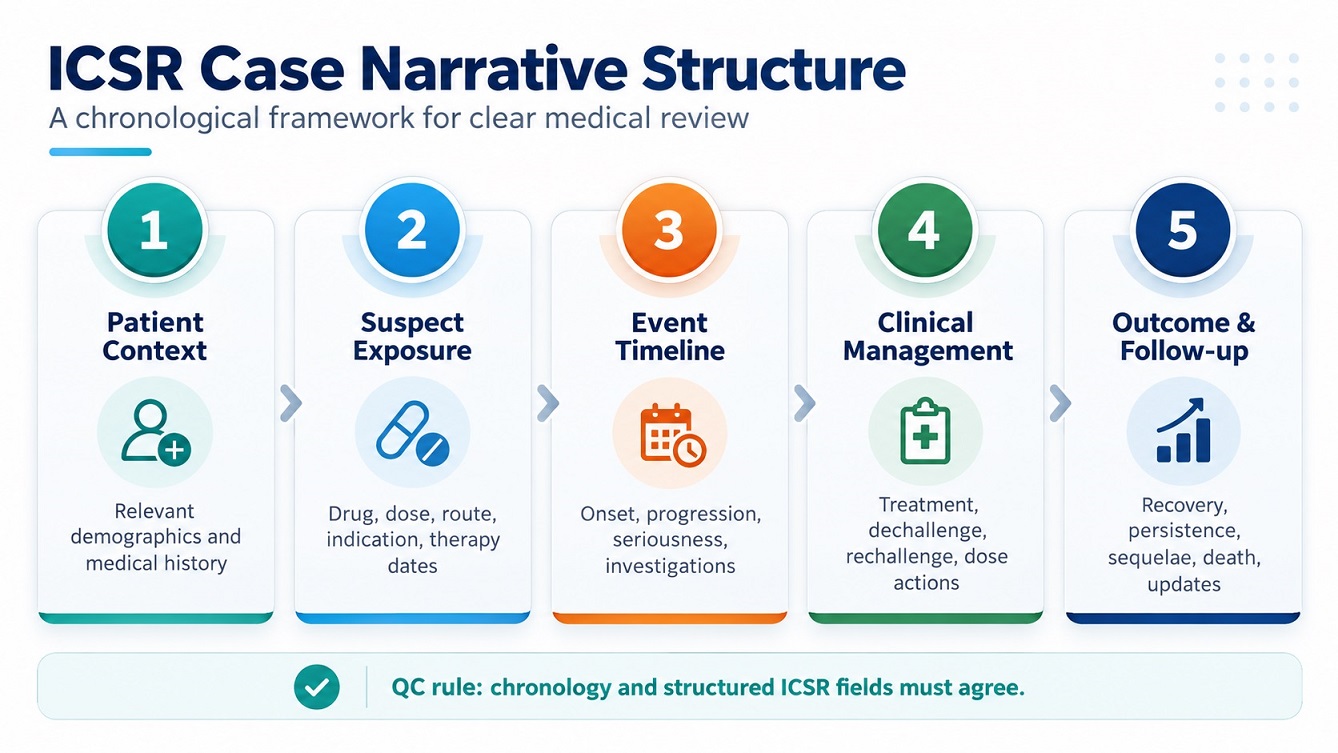
Main Examples of Pharmacovigilance Case Narrative
Narratives vary according to case source and clinical complexity. However, each case should preserve relevant chronology and medical context.
- Spontaneous reports may describe one suspect drug and one adverse reaction.
- Literature cases combine published findings with author-reported clinical details.
- Clinical study cases can include treatment assignment and protocol-related information.
- Follow-up cases may add laboratory results, outcomes, or treatment changes.
- Fatal cases may include death details and available post-mortem findings.
Case Narrative Priorities by Report Type
| Case Type | Main Narrative Priority | Key Information |
|---|---|---|
|
Spontaneous report |
Clear temporal relationship |
Exposure, onset, action, outcome |
|
Literature case |
Accurate source synthesis |
Patient details, publication facts, chronology |
|
Follow-up case |
New information integration |
Changed outcome, tests, therapies, dates |
|
Serious hospitalization |
Clinical course reconstruction |
Admission, interventions, discharge status |
Regulatory Requirements for ICSR Case Narratives
Regulatory guidance expects narratives to support reliable scientific case assessment. EMA GVP Module VI describes a stand-alone medical report. It should summarize known relevant clinical and related information.
Narratives should avoid unnecessary personal identifiers. They should remain consistent with coded and structured safety fields. Authors should separate factual case description from medical interpretation.
Element 1 – Regulatory Narrative Requirements
The narrative should provide sufficient clinical context for regulatory assessment. Serious cases usually need especially complete and medically coherent narratives. Local privacy requirements also affect included patient information.
Element 2 – Chronological Case Sequence
Events should follow a logical time sequence. Start with relevant background, then describe exposure, onset, treatment, and outcome. Place follow-up details correctly within that chronology.
Element 3 – Clinical Course & Outcome
Describe symptom progression and important clinical decisions. Include therapeutic measures, drug withdrawal, dose changes, and supportive treatment. State recovery, persistence, sequelae, death, or unknown outcome clearly.
Element 4 – Supporting & Refuting Evidence
Include relevant laboratory tests, imaging, diagnoses, and alternative explanations. Normal results can matter when they challenge suspected causality. Medical history may also provide important confounding information.
Element 5 – E2B(R3) Data Consistency
Narrative facts should match corresponding E2B(R3) data elements. Check dates, coded reactions, suspect products, seriousness, outcomes, and reporter information. Inconsistent fields can weaken medical review and data quality.
Essential Information to Include in a Case Narrative
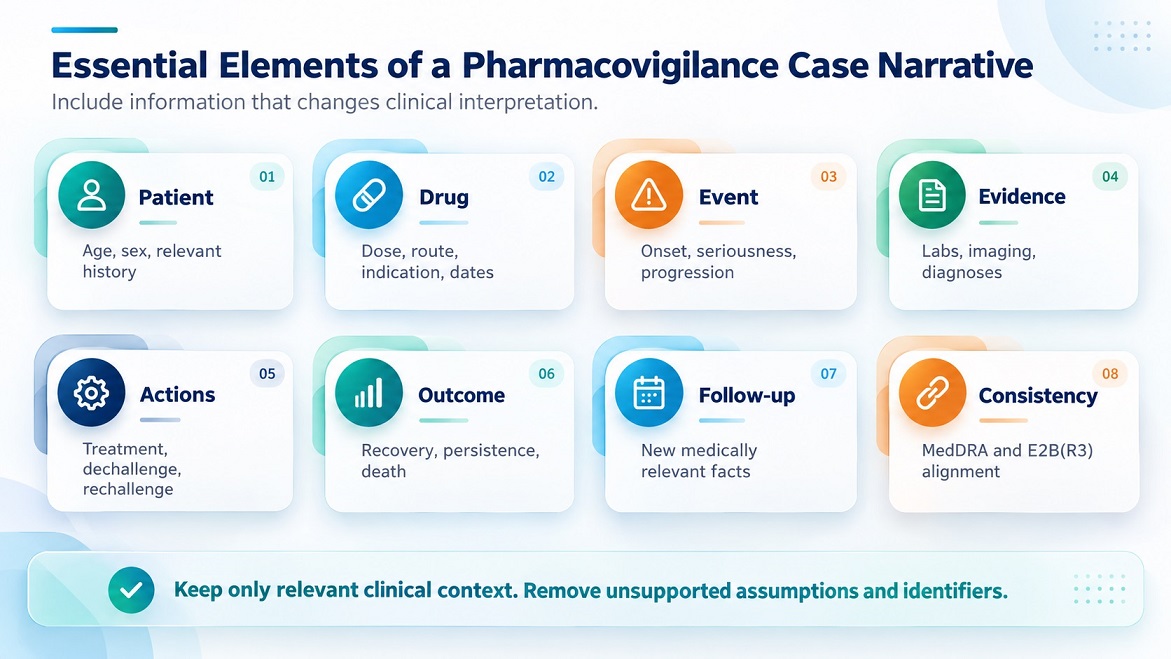
Each narrative should include information that changes case understanding. Unrelated background details usually add noise without improving assessment.
- Include relevant patient age, sex, and clinical characteristics.
- Include medical history affecting event interpretation.
- Record suspect drug dose, route, indication, and therapy dates.
- Include concomitant medicines when they influence causality assessment.
- Describe event onset, seriousness, progression, and outcome.
- Report relevant tests with results, units, dates, and ranges.
- Include dechallenge, rechallenge, treatment, and follow-up when available.
How to Write a Pharmacovigilance Case Narrative Step by Step
A repeatable process improves accuracy and writing efficiency. First, review every available source document before drafting. Next, identify facts that influence clinical interpretation.
Create a simple timeline before writing full sentences. Record therapy start, event onset, medical evaluation, interventions, and outcome. Then compare those dates with structured ICSR fields.
Write the narrative using neutral medical language. Avoid assumptions that the source does not support. Distinguish reported facts from sender assessments.
Recommended Narrative Sequence and Writing Style
Step 1 — Introduce the patient and relevant medical background. Keep unrelated history outside the narrative.
Step 2 — Introduce the suspect product and treatment indication. Include dose, route, and therapy timing.
Step 3 — Describe event onset and clinical progression chronologically. Connect symptoms with relevant examinations and investigations.
Step 4 — Describe treatment changes and therapeutic measures. Include dechallenge or rechallenge when available.
Step 5 — State event outcome and follow-up information. Add new details without disrupting the timeline.
Step 6 — Reconcile the narrative with coded ICSR information. Resolve discrepancies before final medical review.
Clear writing uses direct sentences and standard medical terminology. Avoid repeating structured fields without clinical context. Instead, explain relationships between those fields through chronology.
Common Case Narrative Writing Mistakes to Avoid
Several writing errors reduce narrative clarity and regulatory usefulness. Most problems involve missing chronology, copying, or internal inconsistency.
- Copying source text without synthesizing the clinical timeline.
- Omitting dates that define the temporal relationship.
- Adding unsupported causality statements or unverified assumptions.
- Repeating structured fields without adding clinical context.
- Ignoring conflicting dates, seriousness criteria, or outcomes.
- Including identifiable patient details without regulatory need.
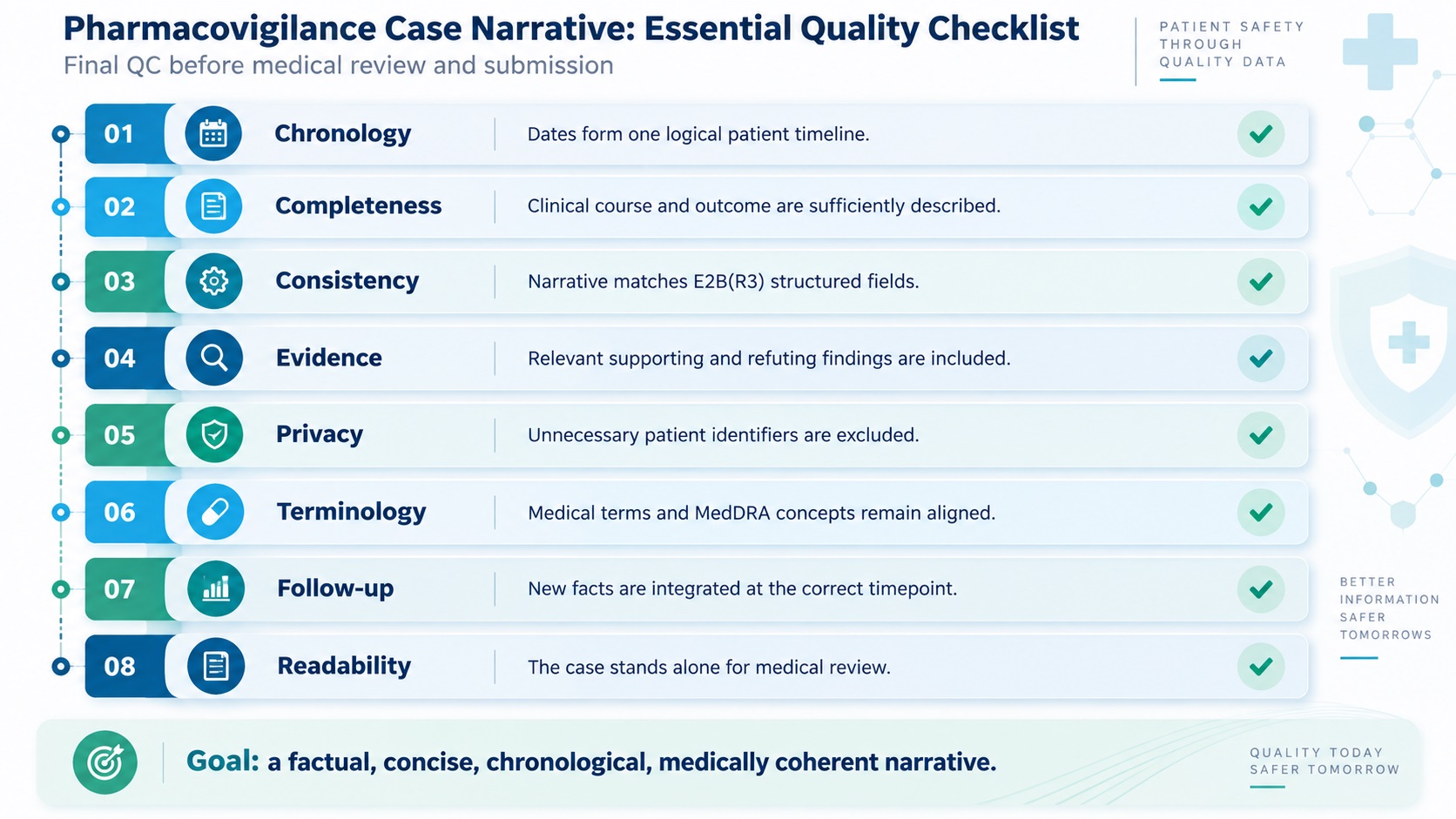
Pharmacovigilance Case Narrative Checklist
A final checklist should confirm medical completeness and technical consistency. Independent review can improve error detection when resources permit. Confirm patient information without unnecessary personal details. Confirm suspect therapy and event dates create a coherent timeline. Verify clinical course, investigations, treatment, dechallenge, rechallenge, and outcome.
Check serious events against applicable seriousness criteria. Compare reaction terms with coded MedDRA information. Confirm laboratory units and reference ranges remain accurate.
The narrative should also match E2B(R3) structured data. Reporter comments should remain separate from the factual summary. Sender comments should not replace missing narrative content.
Final Word
Pharmacovigilance case narrative writing transforms coded information into meaningful clinical context. That function matters as global safety databases continue expanding.
EudraVigilance received over 1.7 million ADR reports during 2025. EMA also reviewed 1,201 potential safety signals that year. Strong narratives support efficient assessment across this growing data volume.
ICH E2B(R3) defines the core technical narrative structure. EMA GVP Module VI provides additional European regulatory expectations. Together, these references support consistent and medically useful case narratives.
Writers should prioritize chronology, relevant evidence, outcomes, and structured-data consistency. A disciplined checklist can reduce avoidable discrepancies before submission.
FAQs
A high-quality narrative is factual, chronological, concise, and medically complete. It connects drug exposure with event development and outcome. It also matches relevant structured ICSR fields.
Internal consistency is a major quality priority. Dates, products, reactions, seriousness, and outcomes should agree everywhere. Resolve discrepancies before case submission.
ICH E2B(R3) guidance defines H.1 as a required narrative element. Regional requirements can add specific implementation expectations. Always follow applicable local pharmacovigilance procedures.
References

Ershad Moradi
Ershad Moradi, a Content Marketing Specialist at Zamann Pharma Support, brings 6 years of experience in the pharmaceutical industry. Specializing in pharmaceutical and medical technologies, Ershad is currently focused on expanding his knowledge in marketing and improving communication in the field. Outside of work, Ershad enjoys reading and attending industry related networks to stay up-to-date on the latest advancements. With a passion for continuous learning and growth, Ershad is always looking for new opportunities to enhance his skills and contribute to pharmaceutical industry. Connect with Ershad on Facebook for more information.

Medical Device Regulation in 2026: FDA, EU MDR and UK Compliance
Medical device regulation is evolving in 2026. Discover how FDA QMSR, EU MDR requirements, and UK rules shape device classification, market access, inspections, and post-market surveillance, with practical guidance for manufacturers seeking stronger quality systems and compliance.

FDA Accelerated Approval Pathway in 2026: Requirements and Inspection Readiness
How does FDA accelerated approval affect drug development and GMP compliance? Explore clinical evidence requirements, confirmatory trials, postmarketing obligations, and inspection readiness. Learn how pharmaceutical manufacturers can reduce regulatory risks and prepare for FDA approval decisions in 2026.

Deviation vs Nonconformance 2026: 5 Critical GMP Mistakes to Avoid
Explore 5 critical differences between deviation and nonconformance in pharma, including GMP investigations, OOS, risk assessment, and CAPA.