


Out of Specification (OOS) in pharma Industry: Complete Investigation Guide & Prevention in 2026

Out of Specification (OOS) events represent 2.3% of pharmaceutical samples tested in 2026, according to WHO data. These occurrences trigger detailed investigations that typically last 14 to 21 days, impacting production schedules and compliance timelines. Regulatory agencies view OOS results seriously, often requiring thorough root cause analysis and corrective actions to maintain drug safety and efficacy standards. Failure to address OOS issues can lead to sanctions or product recalls, affecting market access and public trust.


Good Manufacturing Practices (GMP) play a crucial role in minimizing OOS incidents by enforcing strict quality controls and standardized procedures. The WHO estimates that facilities adhering to GMP guidelines reduce OOS rates by up to 35%, ensuring consistent product quality. Robust GMP compliance supports regulatory approval processes and sustains patient safety worldwide.

Table of Contents

What is Out of Specification (OOS) in Pharma Industry? Download PDF

Out of Specification (OOS) in the pharma industry means a product fails to meet set quality standards. It happens when test results fall outside approved limits. Companies must investigate these results carefully to find the cause. OOS affects product safety and compliance, so it needs quick action.

Here are key points about OOS: 

  • OOS results indicate a quality problem in raw materials or processes.
  • The investigation takes about 14-21 days to identify issues.
  • Proper training helps reduce OOS occurrences and improve safety.


Download the detailed PDF here: FDA OOS Guidelines PDF

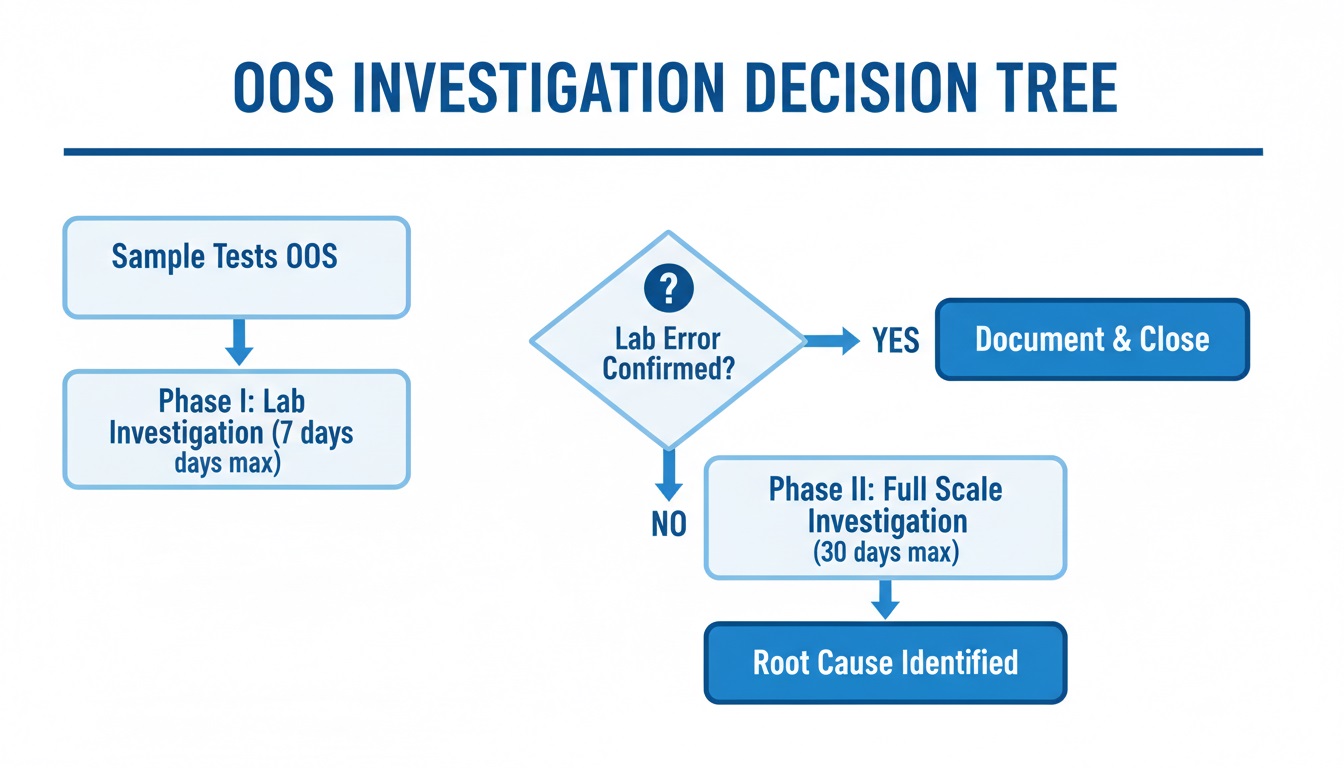
OOS Investigation Decision Tree

FDA Definition of Out of Specification

The FDA defines Out of Specification (OOS) as test results outside established limits. These results show a product does not meet quality requirements. When a company finds OOS results, it must investigate quickly. This process helps protect patients and ensure product safety.


Here are important facts about FDA’s OOS definition: 

  • OOS results trigger immediate examination of manufacturing and testing processes.
  • Companies must follow a clear plan to find the problem’s root cause.
  • Documenting and reporting OOS findings keeps the FDA informed and builds trust.

Common Causes of OOS in Pharma

Common causes of Out of Specification (OOS) results in pharma come from various areas. First, laboratory and analytical errors often cause inaccurate test results. Also, manufacturing and process problems can affect product quality. Human mistakes and organizational issues lead to errors too. Finally, material and supply chain problems impact the final product.

Here are the main causes of OOS results: 

  • Number 1 Laboratory & Analytical Causes
  • Number 2 Manufacturing & Process Causes
  • Number 3 Human & Organizational Causes
  • Number 4 Material & Supply Chain Causes
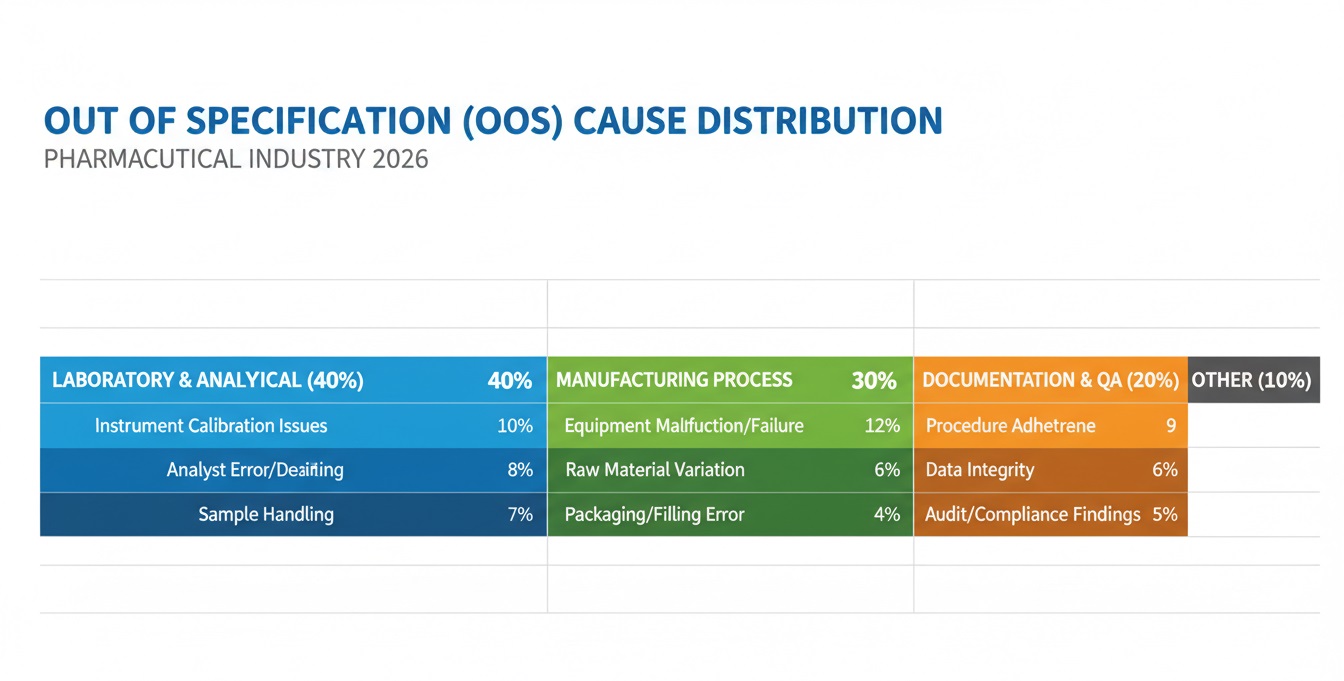
OOS Cause Distribution Chart

Number 1 Laboratory & Analytical Causes (40%)

Laboratory and analytical causes account for 40% of OOS results in pharma. These causes include equipment errors, faulty reagents, and improper sample handling. Also, method mistakes and calibration issues lead to wrong test results. Moreover, poor training and human errors affect data accuracy. These problems often cause delays and increase costs.


Here are the main laboratory and analytical causes with data: 

  • Equipment errors: 12%
  • Faulty reagents: 10%
  • Method mistakes: 8%
  • Sample handling errors: 5%
  • Calibration issues: 5%

Number 2 Manufacturing & Process Causes (35%)

Manufacturing and process causes contribute 35% to OOS results in pharma. These issues include equipment failures, incorrect process parameters, and contamination. Also, poor maintenance and operator errors affect product quality. Moreover, inconsistencies in raw materials can cause variations. Together, these problems reduce efficiency and cause batch rejections.


Here are the main manufacturing and process causes with data: 

  • Incorrect process parameters: 10%
  • Contamination: 15%
  • Poor maintenance: 5%
  • Operator errors: 5%

Number 3 Human & Organizational Causes (15%)

Human and organizational causes make up 15% of OOS results in pharma. These causes include poor training, communication issues, and inadequate supervision. Also, lack of motivation and high workload lead to mistakes. Furthermore, weak management systems contribute to errors. Together, these factors affect data reliability and product quality.


Here are the main human and organizational causes with data: 

  • Poor training: 6%
  • Communication issues: 4%
  • Inadequate supervision: 3%
  • Lack of motivation: 1.5%
  • High workload: 0.5%

Number 4 Material & Supply Chain Causes (10%)

Material and supply chain causes account for 10% of OOS results in pharma. These problems include poor raw material quality, delayed deliveries, and wrong shipments. Also, supplier mistakes and improper storage affect product consistency. Furthermore, inadequate supplier qualifications can cause failures. Together, these issues disrupt production and lower product quality.


Here are the main material and supply chain causes with data: 

  • Poor raw material quality: 4%
  • Delayed deliveries: 3%
  • Wrong shipments: 1.5%
  • Supplier mistakes: 1%
  • Improper storage: 0.5%

Investigation & Root Cause Analysis

Investigation and root cause analysis help find the main reasons for OOS results. They use data and tests to identify problems quickly. Moreover, they improve processes to prevent future errors. By analyzing every detail, teams solve issues effectively. This way, companies maintain product quality and meet regulations consistently.

OOS Investigation Steps FDA Guidelines

FDA guidelines outline three main steps for OOS investigations. First, teams focus on Phase I: Laboratory Investigation to confirm test results and check errors. Then, they move to Phase II: Full-Scale Investigation to find the root cause in the entire process. Finally, in Phase III: CAPA Implementation, teams apply corrective actions to prevent future issues and improve quality.


  • Phase I: Laboratory Investigation
  • Phase II: Full-Scale Investigation
  • Phase III: CAPA Implementation

OOS Investigation Phase Comparison

Investigation Phase Purpose Key Activities Outcome
Phase I: Laboratory Investigation
Confirm initial test results
Retesting, method review, lab error checks
Verify if OOS is valid or lab error
Phase II: Full-Scale Investigation
Identify root cause beyond the lab
Review manufacturing, materials, equipment, and processes
Find cause of OOS in production or materials
Phase III: CAPA Implementation
Prevent recurrence of the problem
Develop and apply corrective and preventive actions
Improve process and ensure compliance

Phase I: Laboratory Investigation

Phase I: Laboratory Investigation helps confirm if the OOS result is accurate or not. First, analysts retest the sample using the same or different methods. Then, they review testing procedures to find any mistakes. Moreover, they check equipment and materials used during testing thoroughly. This phase ensures test results are reliable before further action.

Phase II: Full-Scale Investigation

Phase II: Full-Scale Investigation helps find the root cause of the OOS result. Investigators review the entire manufacturing process and check raw materials. They examine equipment, environmental conditions, and employee activities closely. Also, they collect additional samples for testing. By doing these steps, teams identify where the problem originated and how it occurred.

Phase III: CAPA Implementation

Phase III: CAPA Implementation helps prevent OOS problems from happening again. Teams develop corrective and preventive actions based on investigation findings. They update procedures, train staff, and improve equipment as needed. Also, they monitor processes closely to ensure changes work effectively. This phase strengthens quality control and keeps production reliable and consistent.   

FDA OOS Inspection Checklist

The FDA OOS Inspection Checklist helps companies prepare for audits and inspections. It includes key areas to review before the FDA visit. Also, it guides teams to check testing processes and document accuracy. Following this checklist improves compliance and reduces inspection risks.

Key points in the checklist include: 

  • Review batch records and test results carefully. 
  • Verify equipment calibration and maintenance logs. 
  • Confirm training records and SOP adherence.

Final Word

Out of Specification (OOS) events accounted for 2.3% of pharmaceutical samples tested in 2026, based on WHO data. These events require detailed investigations lasting 14 to 21 days, affecting production timelines and compliance. Regulatory bodies, including the FDA, demand thorough root cause analyses and corrective actions to ensure drug safety. Ignoring OOS issues risks regulatory sanctions or product recalls, which can damage public trust and restrict market access.

In conclusion, minimizing OOS incidents is vital for pharmaceutical quality and patient safety. Adhering to Good Manufacturing Practices (GMP) reduces OOS rates by up to 35%, according to WHO estimates. Companies should invest in training, strong quality controls, and robust investigations to maintain compliance. For further data, sources like IQVIA Institute reports, FDA Market Data Dashboards, and WHO Global Market Analysis provide valuable insights. Addressing OOS proactively supports continuous improvement and regulatory success.

FAQs

1️⃣ How long does an OOS investigation usually take?


OOS investigations typically last between 14 and 21 days, depending on the complexity and the root cause findings.

2️⃣ What causes most OOS results in pharmaceutical manufacturing?


The main causes include laboratory errors (40%), manufacturing and process issues (35%), human factors (15%), and material or supply chain problems (10%).

3️⃣ How can companies reduce the occurrence of OOS events?


Companies can reduce OOS by following Good Manufacturing Practices (GMP), conducting thorough training, maintaining equipment, and performing regular quality reviews.

Picture of Ershad Moradi

Ershad Moradi

Ershad Moradi, a Content Marketing Specialist at Zamann Pharma Support, brings 6 years of experience in the pharmaceutical industry. Specializing in pharmaceutical and medical technologies, Ershad is currently focused on expanding his knowledge in marketing and improving communication in the field. Outside of work, Ershad enjoys reading and attending industry related networks to stay up-to-date on the latest advancements. With a passion for continuous learning and growth, Ershad is always looking for new opportunities to enhance his skills and contribute to pharmaceutical industry. Connect with Ershad on Facebook for more information.

Out of Specification (OOS) in pharma Industry: Complete Investigation Guide & Prevention in 2026

Out of Specification (OOS) events represent a crucial quality challenge in pharmaceuticals, impacting product safety and regulatory compliance. Occurring in 2.3% of samples in 2026, these events demand thorough investigations and corrective actions. This blog explores the causes, investigation steps, and prevention strategies to help pharmaceutical companies strengthen their quality systems and maintain trust in their products.

Read More »
Pharmaceutical professional reviewing sterile manufacturing jobs Chicago environment under FDA-regulated GMP compliance standards.

Pharma Jobs in Chicago in 2026: GMP Hiring Trends and Salary Data

Chicago’s pharmaceutical sector continues to expand under strict FDA oversight. This analysis explores pharma manufacturing jobs in Chicago, sterile injectable GMP compliance trends, biologics production growth, and how enforcement activity influences salary benchmarks and long-term regulatory career stability.

Read More »
trend in pharma

Trending Analysis in Pharma Industry 2026: Complete Market Growth & Regulatory Insights

Trending analysis in the pharmaceutical industry highlights an average 12% annual growth in manufacturing capacity and a steady increase in FDA drug approvals. Quality assurance remains paramount, with the FDA conducting over 1,200 inspections each year to ensure product safety. Staying informed through authoritative sources like IQVIA, FDA, and WHO supports better decision-making in this rapidly evolving sector.

Read More »

Share