


NDA Regulatory Affairs in 2026: Key Processes, Documents, and RA Responsibilities

NDA Regulatory Affairs helps teams prepare a New Drug Application (NDA) for market approval. This guide focuses on Regulatory Affairs work, not only FDA science: planning meetings, aligning data owners, and building a submission-ready dossier. WHO also uses a structured CTD approach for full assessments, organized in 5 modules. 

Pharma regulation strengthen the quality story inside the dossier. WHO’s GMP guide (TRS 986, Annex 2) supports inspections and manufacturing authorization decisions, so RA should confirm GMP status, site readiness, and documentation before filing. Then clinical, nonclinical, and CMC evidence stays credible under review. 

Table of Contents

What Is NDA in Regulatory Affairs?

NDA in regulatory affairs means New Drug Application for marketing approval. Regulatory teams plan the submission and align every function. They confirm timelines, owners, and evidence readiness. Then they prepare FDA meeting packages and responses.

  • Define the NDA strategy and key claims.
  • Coordinate Module owners and publishing.

NDA work also includes quality and compliance checks. Therefore, regulatory affairs links clinical, nonclinical, and CMC content. They track gaps and drive fixes before submission. They control versioning and submission rules.

  • Check document consistency and traceability.
  • Manage queries, commitments, and labeling updates.

NDA Meaning in Pharma

FDA says an NDA lets sponsors ask to market a drug in the US. NDA means New Drug Application. In the EU, companies submit a Marketing Authorisation Application for EMA review. EU GMP sets minimum production standards for medicine makers.

WHO uses CTD-format dossiers for assessments and prequalification. Therefore, regulatory affairs teams align clinical, nonclinical, and CMC sections early. They verify GMP readiness and document control before filing.

Why an NDA Matters for Drug Approval

An NDA links evidence to approval decisions. It shows safety, efficacy, and quality for the intended use. Regulators need clear data, not marketing claims.

  • Prove benefits outweigh risks.

NDA quality speeds review and reduces questions. Therefore, teams align clinical, nonclinical, and CMC early. They use consistent summaries and traceable data.

  • Reduce gaps and contradictions.

A strong NDA supports GMP-ready manufacturing. It connects process controls, validation, and release testing to patient safety. Teams also plan labeling and post-approval commitments. 

Pre-NDA Planning and FDA Interactions: Step-by-Step

Pre-NDA planning starts with early alignment and clear FDA communication. Teams schedule key meetings and confirm decision questions. Therefore, Regulatory Affairs sets timelines, owners, and document standards. They track gaps and close them fast.

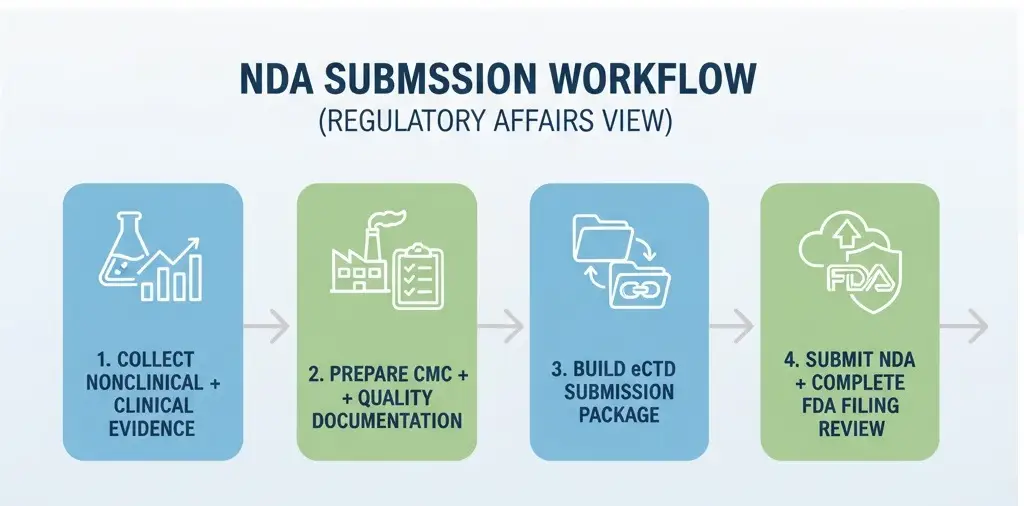
Step 1: Collect Nonclinical and Clinical Evidence.
Step 2: Prepare CMC and Quality Documentation.
Step 3: Build the eCTD Submission Package.
Step 4: Submit the NDA and Complete FDA Filing Review.

NDA Submission Workflow (RA View)

Step 1: Collect Nonclinical and Clinical Evidence

Collect nonclinical and clinical evidence to support your NDA claims. Start with study reports, datasets, and key summaries. Then align endpoints, populations, and analyses across documents. Regulatory Affairs checks traceability from raw data to conclusions.

  • Confirm GLP and GCP compliance.
  • Summarize safety signals and efficacy outcomes.
  • Map evidence to intended labeling claims.
  • Prepare clear responses for FDA questions.

Step 2: Prepare CMC and Quality Documentation

Prepare CMC and quality documents to prove consistent drug quality. Start with manufacturing flow, controls, and specifications. Then confirm methods, validation, and stability data. Therefore, align sites, batch records, and change controls early.

  • Link critical quality attributes to control strategy.
  • Confirm supplier, equipment, and process readiness.

Step 3: Build the eCTD Submission Package

Build the eCTD package to organize the NDA for fast review. Start with the CTD structure and regional requirements. Then add clean PDFs, correct metadata, and working hyperlinks. Therefore, run technical checks before you lock files.

  • Validate sequences, file names, and lifecycle operations.
  • Test navigation, bookmarks, and cross-references end-to-end.

Step 4: Submit the NDA and Complete FDA Filing Review

Submit the NDA through the electronic gateway with the final eCTD sequence. Confirm receipts, timestamps, and submission tracking in your internal system and archive confirmation emails.

During filing review, FDA checks completeness and technical acceptability. Therefore, respond fast to missing-item requests and validation errors.

  • Log all filing questions and answers.
  • Prepare the team for the 60-day filing decision.

What Documents Are Included in an NDA?

An NDA includes documents in the CTD structure: Module 1–5. Module 1 covers regional admin forms and labeling. Modules 2–5 cover summaries, quality (CMC), nonclinical reports, and clinical reports. FDA and ICH describe this five-module format in CTD and eCTD guidance.

WHO also accepts CTD-style dossiers and expects the same core modules. Therefore, Regulatory Affairs should build a master checklist by module and owner. Then teams control versions, links, and traceability before submission. Use WHO CTD guidance to align structure and reduce rework. 

NDA Document Checklist by Functional Are

Functional Area Key NDA Documents (Examples) CTD Module
Regulatory Affairs
Forms, cover letter, labeling drafts, submission plan, meeting packages
1 (+2 summaries)
Clinical
Clinical study reports, protocols, SAPs, efficacy/safety summaries
5 (+2)
Nonclinical
Pharmacology, toxicology study reports, summaries
4 (+2)
CMC / Quality
Drug substance/product sections, control strategy, validation, stability
3 (+2)
Biostats / Data
Analysis datasets, define.xml, analysis outputs, traceability notes
5

NDA CTD / eCTD Modules Explained

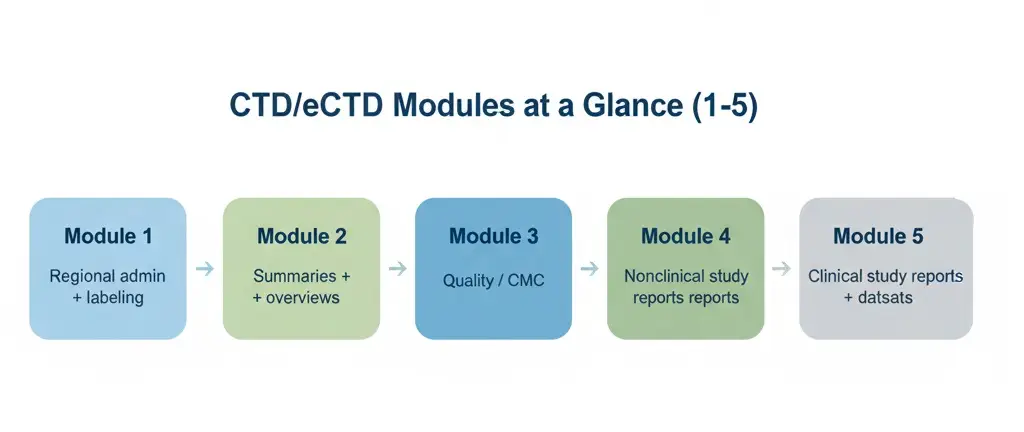
CTD organizes an NDA into 5 modules. eCTD delivers the content in an electronic format.

  • Module 1 holds regional forms and labeling.
  • Module 2 summarizes quality, nonclinical, and clinical data.

Therefore, teams map each file to the right module.

  • Module 3: CMC and manufacturing controls.
  • Module 4: nonclinical study reports.
  • Module 5: clinical reports and datasets.

eCTD sequences track updates during review each cycle.

CTD modules made simple—save this guide.
CTDeCTD Modules at a Glance (Modules 1–5)

What Does Regulatory Affairs Do in NDA Submission?

Regulatory Affairs leads NDA strategy and FDA submission planning. NDA means New Drug Application. FDA calls the NDA the vehicle to request U.S. marketing approval. RA sets timelines, assigns owners, and controls final dossier consistency. 

Therefore, RA builds the eCTD sequence and validates files before sending. FDA says eCTD is the standard format for applications and amendments. ICH defines the CTD in five modules, with Module 1 regional. 

Core Responsibilities of Regulatory Affairs in NDA Submission

Regulatory Affairs owns the NDA plan and submission governance. They align teams on claims, evidence, and timelines. Then they control document standards and decision logs. Therefore, they keep the dossier consistent from draft to filing.

  • Set regulatory strategy, milestones, and owners.
  • Lead CTD mapping, publishing, and QC checks.
  • Manage FDA questions, commitments, and labeling updates.

How Regulatory Affairs Coordinates Cross-Functional NDA Teams

Regulatory Affairs connects clinical, nonclinical, CMC, and safety teams. They set meeting cadence and clear owners for each module. Therefore, they prevent gaps, duplicates, and conflicting messages. They track risks and escalate issues early.

  • Run weekly submission standups with action logs.
  • Align Module 2 summaries with source reports.
  • Lock versions using controlled document systems.
  • Coordinate responses and timelines for FDA queries.

Final Word

NDA Regulatory Affairs keeps FDA drug approvals on track by controlling the submission story. An NDA is the formal FDA marketing application for a new drug, and FDA expects a complete package for review. RA sets the strategy, aligns claims to evidence, assigns owners, and enforces document quality before filing. FDA also runs a filing check within 60 days to decide if the application is reviewable.

Next, RA uses the CTD’s 5-module structure and FDA’s eCTD standard to publish consistent, review-ready sequences today. That structure improves traceability, reduces gaps, and speeds responses to FDA questions. 

FAQs

1️⃣ What does “NDA” mean in pharma regulatory affairs?

NDA means New Drug Application. It is the formal step a sponsor uses to ask FDA to approve a new drug for marketing in the U.S.

2️⃣ How long does FDA take to decide if it will “file” an NDA?

FDA makes a filing decision within 60 days after it receives an NDA. This is a threshold check for completeness before full review.

3️⃣ What structure does an NDA follow to keep content consistent?

Most NDAs follow the CTD, organized into 5 modules. Module 1 is region-specific; Modules 2–5 are intended to be common across regions.

Picture of Ershad Moradi

Ershad Moradi

Ershad Moradi, a Content Marketing Specialist at Zamann Pharma Support, brings 6 years of experience in the pharmaceutical industry. Specializing in pharmaceutical and medical technologies, Ershad is currently focused on expanding his knowledge in marketing and improving communication in the field. Outside of work, Ershad enjoys reading and attending industry related networks to stay up-to-date on the latest advancements. With a passion for continuous learning and growth, Ershad is always looking for new opportunities to enhance his skills and contribute to pharmaceutical industry. Connect with Ershad on Facebook for more information.

NDA Regulatory Affairs

NDA Regulatory Affairs in 2026: Key Processes, Documents, and RA Responsibilities

NDA regulatory affairs work turns science into a review-ready submission. An NDA is the formal FDA marketing application for a new drug. FDA first runs a filing check within 60 days to confirm completeness. Then the team reviews the dossier. The CTD’s five-module structure, delivered through eCTD, improves consistency, traceability, and lifecycle management during review.

Read More »
Sampling Plan

Sampling Plan in Pharma: GMP, FDA/EMA Expectations, and QC Workflow

A pharmaceutical sampling plan ensures that tested samples truly represent the entire batch. Because results determine product release, regulators require representative collection, justified sample size, controlled handling, and full documentation. Strong sampling practices reduce risk, support compliance, and protect patient safety.

Read More »

Share