


Features
Topics
Discover

Unlock the potential of your career in the Pharma industry with our online courses and qualifications.

Career Path

Pick a career path, follow its guided course roadmap, and secure industry-verified credentials in a few months.

Courses

Earn career credentials from industry leaders that demonstrate your expertise.

Visual Inspection in Pharma (2026): What It Is, Scope, PDF Guides and SOP Essentials

Visual Inspection in pharma is a check for visible particles, leaks, and defects before batch release. WHO says all parenteral containers should be inspected individually (100% units), and defect types should be categorized and trended. It requires illumination and controlled inspection rates.

Under Good Manufacturing Practices (GMP), the SOP should define training, method sequence, risk-based defect classification, and documentation. WHO expects inspector qualification at least annually using defect-library samples, plus eyesight checks. This article helps QA, QC, production, and validation teams build or review a visual inspection process that stands up in audits.

Table of Contents

What is Visual Inspection in Pharma?

Visual Inspection in pharma means trained staff check each unit for visible defects. Teams look for particles, cracks, leaks, wrong fill level, and cosmetic damage. They protect patients and prevent batch release errors.

Therefore, teams set strict inspection conditions and document decisions in controlled records. QA, QC, production, and validation teams align criteria and trend rejects daily.

  • Classify defects as critical, major, or minor to guide actions.

  • Use defined lighting, backgrounds, and rotation time to reduce misses.

  • Validate methods with challenge sets, then analyze trends and CAPA triggers.

Download Now FDA Guide on Inspection of Injectable Products for Visible Particulates As Sample Visual inspection Guidance Here

Visual Inspection in Pharma
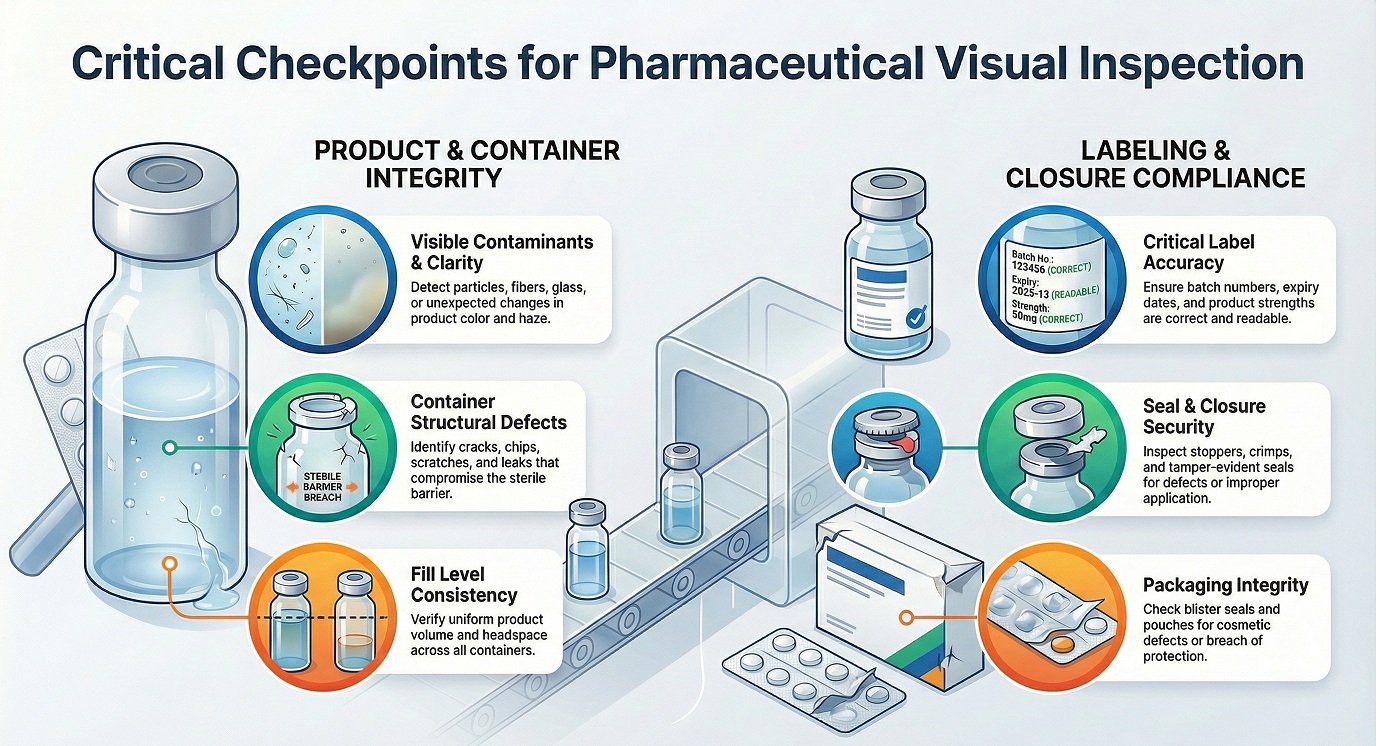
Inspection in Pharma: What Inspectors Check

What is Checked During Visual Inspection?

Inspectors check every unit for visible particles or haze in the solution. They also check container damage, cracks, leaks, and seals. They verify fill level, clarity, and stopper or cap defects. Example: EU GMP Annex 1 expects 100% inspection of parenteral containers.

Therefore, teams set defect limits and record every reject with a code. Example: FDA advises no more than one reinspection to release a lot. Inspectors trend rejects by defect type and line speed each shift. Validation teams qualify lighting, background, and rotation time to improve detection.

Common Defects Checked During Visual Inspection (Defect, Example, Risk, Action)

Defect Risk Action
Visible particles / fibers
Critical
Reject; investigate; CAPA if trending
Cracks / chips
Critical
Reject; check handling and equipment
Wrong fill level
Major
Reject; adjust filler; document
Haze / cloudy solution
Major/Critical
Reject; assess batch trend

Scope of Visual Inspection in Pharmaceutical Products

Scope defines which products, containers, and defects your Visual Inspection covers.
Poor scope causes missed particles, false rejects, and weak investigations.
Therefore, follow GMP data: WHO expects individual inspection of all parenteral filled containers. 
FDA does not recommend more than one reinspection to release a batch. 

Use this scope to align QA, QC, production, and validation reviews.
Document boundaries in SOP and records.

  1. Products Covered by Visual Inspection (Sterile and Non-Sterile)

  2. Container Types Included in Inspection Scope

  3. Defects And Attributes Evaluated During Inspection

  4. In-Process Vs Finished Product Visual Inspection Scope

1) Products Covered by Visual Inspection (Sterile and Non-Sterile)

Sterile products need visual inspection because patients receive them directly. Teams inspect injectables, ophthalmics, and sterile irrigations for particles and container defects. However, non-sterile products also need checks for mix-ups and damage.
QC includes topical creams, syrups, and powders when appearance signals quality issues.

  • Tablets: chips, discoloration, and wrong imprint.

  • Liquids: haze, sediment, and label or cap errors.

2) Container Types Included in Inspection Scope

Include vials, ampoules, syringes, cartridges, bottles, blisters, tubes, and IV bags for batch release. FDA says inspectors should check each final parenteral container for visible particulates.  

Therefore, include container parts: stoppers, seals, crimps, caps, and labels. Set defect rules for cracks, chips, leaks, dents, scuffs, loose closures, and label tears.

3) Defects and Attributes Evaluated During Inspection

Inspectors look for defects that can harm patients or block release. They check product appearance, container integrity, and correct presentation. They code each reject and trend results by batch and line.

Therefore, use a clear defect list and consistent definitions across teams.

  • Visible particles, fibers, or glass flakes in solution.

  • Cracks, chips, leaks, or weak seals.

  • Wrong fill level, foam, or haze.

  • Missing stopper, loose cap, or damaged crimp.

  • Label mix-ups, wrong text, or poor print quality.

4) In-Process vs Finished Product Visual Inspection Scope

In-process visual inspection checks defects during filling, sealing, and labeling. It helps production stop the line and prevent repeat defects.

Therefore, finished product inspection confirms final units meet release criteria. QA and QC review rejects, trends, and deviations before disposition.

  • In-process: operators check closure and label setup.

  • Finished: inspectors confirm particulates and container integrity.

Inspection SOP for Pharmaceutical Products (Sterile and Nonsterile)

The SOP standardizes Visual Inspection for sterile and nonsterile products. It defines station controls: black/white background, lighting level, and viewing time. It sets handling: rotate units, avoid bubbles, and prevent contamination.

Therefore, it defines defect codes, reinspection rules, and reject reconciliation for trending. Validation verifies setup, timing, and defect detection. SOP headings:

  • Scope

  • Equipment and setup

  • Inspection method

  • Defect criteria

  • Records and escalation

Core SOP Elements for Visual Inspection

Core SOP elements define how teams run Visual Inspection consistently. They reduce misses, false rejects, and inconsistent defect calls across shifts.

Therefore, QA, QC, production, and validation align on these technical sections:

  • Training, eyesight checks, and annual requalification.

  • Inspection setup: lighting, background, speed, and handling rules.

  • Defect library, reject codes, trending, and CAPA triggers.

Training and Qualification Requirements

Train inspectors and document training for 100% and AQL inspections. Use SOPs and testing to standardize decisions. FDA recommends certified inspectors and qualified equipment for visible particulates.

Therefore, qualify inspectors using mixed test sets with masked defects. FDA suggests 10–20% defective units per set and near-normal visual acuity.

Inspection Method and Sequence

Inspect each parenteral container individually and check for contamination and defects. Run manual inspection under controlled illumination and background, and qualify inspection rates. 

Therefore, categorize defects and trend defect counts to spot unusual reject levels. Trigger an investigation if you later find any critical defect in accepted units. 

Defect Classification and Reject Handling

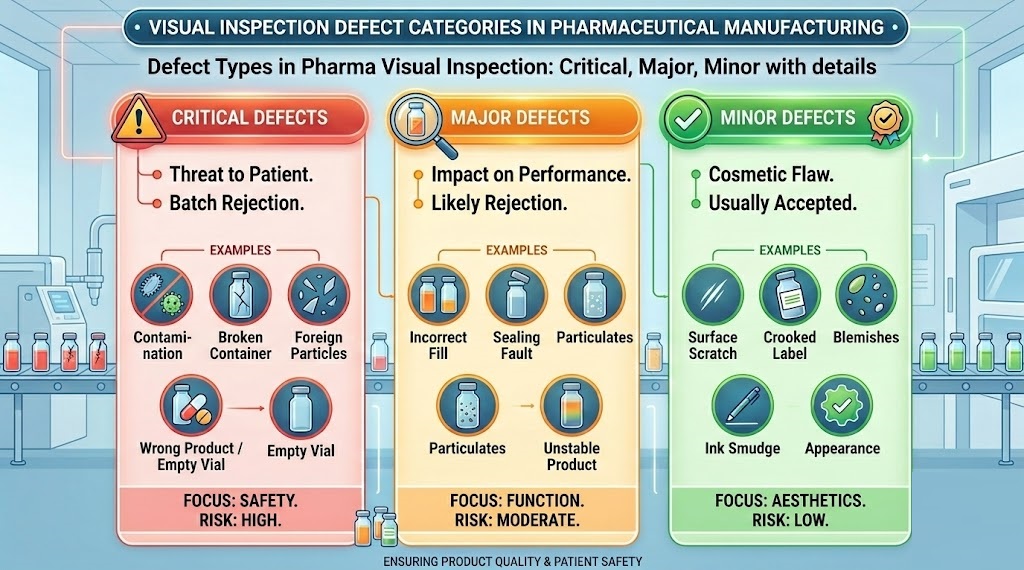
Classify defects to support consistent reject decisions and batch disposition. Use critical, major, and minor categories linked to patient risk. Segregate rejects immediately and lock them in labeled containers.

Therefore, handle rejects with controlled rules and full traceability.

  • Record defect code, time, line, and inspector ID.

  • Reconcile rejects versus produced counts every shift.

  • Trigger deviation and CAPA when trends exceed alert limits.

Defect Types in Pharma Visual Inspection: Critical, Major, Minor

Final Word

Visual Inspection in pharma checks parenteral units for contamination and defects. EU GMP Annex 1 says all filled parenteral containers must be inspected individually; set defect criticality during qualification and trend defect levels by batch. This helps QA, QC, production, and validation teams align scope and reject rules.

Write an SOP covering illumination/background, sequence, inspector training, defect codes, and trending. EU GMP Annex 1 also requires 100% integrity testing for ≤100 ml containers closed by fusion and notes visual inspection cannot replace integrity testing. Use both controls to reduce risk and support audits.

FAQs

1️⃣ Do pharma teams use inspection only for injectables?

 No. Teams inspect parenterals (sterile injectables) plus many non-sterile products where appearance signals quality (e.g., discoloration, damaged packs). WHO expects individual inspection of all filled parenteral containers.

2️⃣ What do inspectors check during inspection?

 Inspectors check visible particulates, clarity/haze, container integrity (cracks, chips, leaks), closure defects, and label/print errors. FDA frames this as a risk-based visible particulate control program across process and inspection.

3️⃣ What must an SOP include to make inspection consistent across shifts?


 Define scope, inspection conditions, defect classification/criticality, training/qualification, and batch performance trending. WHO expects teams to categorize defect types and analyze batch performance.

Picture of Ershad Moradi

Ershad Moradi

Ershad Moradi, a Content Marketing Specialist at Zamann Pharma Support, brings 6 years of experience in the pharmaceutical industry. Specializing in pharmaceutical and medical technologies, Ershad is currently focused on expanding his knowledge in marketing and improving communication in the field. Outside of work, Ershad enjoys reading and attending industry related networks to stay up-to-date on the latest advancements. With a passion for continuous learning and growth, Ershad is always looking for new opportunities to enhance his skills and contribute to pharmaceutical industry. Connect with Ershad on Facebook for more information.

Wide view of a regulated pharmaceutical manufacturing facility during a quality inspection, illustrating pharmaceutical GxP compliance, GxP inspection readiness, quality risk management, data integrity expectations, and pharmaceutical governance systems.

GxP in pharma in 2026: How Inspectors Evaluate System Control

This article explains how GxP quality systems are assessed during inspections, why gaps in governance and execution lead to repeat audit findings, and how regulated pharma operations strengthen inspection readiness through risk management, data integrity, and lifecycle compliance controls.

Read More »

Share