

Features
Topics
Discover

Unlock the potential of your career in the Pharma industry with our online courses and qualifications.

Career Path

Pick a career path, follow its guided course roadmap, and secure industry-verified credentials in a few months.

Courses

Earn career credentials from industry leaders that demonstrate your expertise.

Master GMP Compliance in 2026: Meaning, Core Elements, and How to Implement

GMP compliance means making medicines the same quality, every batch, every time. Use this guide to cut audit risk in 5 clear steps. For QA, production, QC, engineering, startups, and suppliers, it sets priorities fast. Expect clear roles and timelines.

Good Manufacturing Practices (GMP) start with WHO TRS 986, Annex 2 (2014). That standard links training, hygiene, documentation, and inspection readiness.  Add WHO TRS 981, Annex 2 (2013) to run quality risk management.  Then track deviations, validate changes, and trend data integrity signals. By the end, teams hold a checklist, KPI set, and evidence trail.

Table of Contents

What is GMP Compliance?

GMP compliance means teams follow rules to make safe, consistent medicines. It covers training, clean work habits, validated processes, and clear records. It also helps teams pass audits and protect patients.

However, strong compliance needs discipline and proof, not slogans. Teams document actions, investigate deviations, and fix root causes fast. They review trends and improve controls over time.

  • Train staff and confirm competency regularly.

  • Keep SOPs current and follow them every shift.

  • Record data clearly and review it daily.

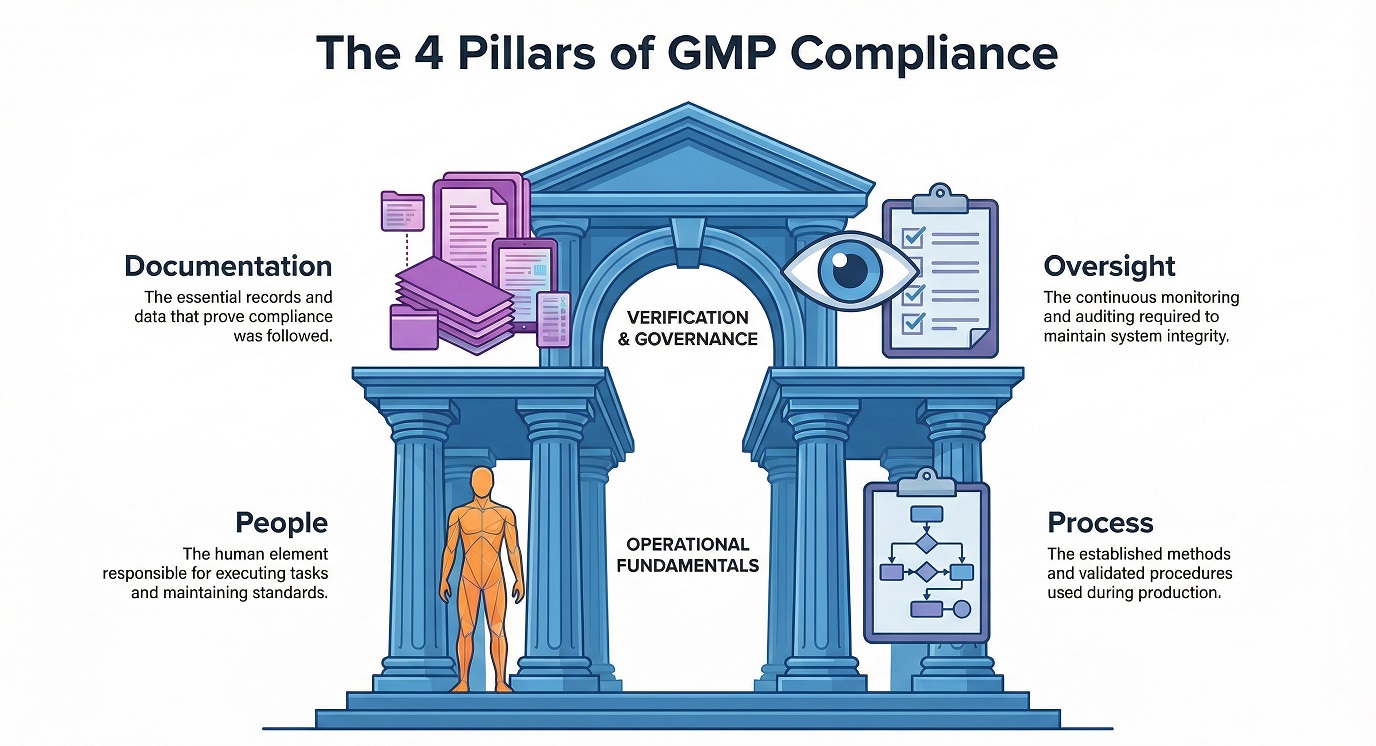
4 Pillars: People, Process, Documentation, Oversight
4 Pillars of GMP: People, Process, Documentation, Oversight

Core Elements of GMP and cGMP Compliance

Core GMP and cGMP elements keep products safe, consistent, and inspection-ready. Teams build a system that controls work, records, people, and materials. They also prevent mix-ups and reduce deviation risk across operations.

However, compliance needs daily habits and strong oversight. Teams review trends, correct gaps quickly, and strengthen controls over time. They align QA, QC, production, and suppliers

Quality Management System Basics

A quality management system defines how teams control quality every day. It sets roles, workflows, and approvals across QA, QC, and production.

Teams use SOPs, change control, deviations, and CAPA to manage risk. They track actions and close issues on time. Management reviews trends and sets clear quality objectives.
Teams improve processes and prevent repeat failures.

Documentation and Data Integrity Basics

Good documentation proves what teams do and when they do it. Clear records support investigations, releases, and audits. Data integrity keeps records complete, accurate, and traceable. Teams write entries immediately and explain changes. Strong habits prevent missing data and unclear decisions.

  • Use clear dates, times, signatures, and reasons.

  • Review records daily and fix errors fast.

Training and Qualification of Personnel

Training builds consistent skills and reduces human error. Qualification confirms people can perform tasks correctly and safely.  They track training status and refresh critical skills regularly.

  • Train by role, process, and GMP risk level.

  • Test competency with observations and short quizzes.

  • Retrain after deviations, changes, or new equipment.

Control of Materials, Suppliers, and Storage

Material control prevents mix-ups and protects product quality. Supplier control confirms consistent inputs and reliable documents. Storage control keeps materials within required conditions. Teams label, segregate, and track every movement.

  • Qualify suppliers and review their audit history.

  • Set acceptance criteria and test incoming materials.

  • Label status: quarantine, approved, rejected.

  • Monitor storage temperature and humidity daily.

How to Become GMP Compliant

Compliance in GMP starts with everyday habits, not big slogans. Teams pick one process and standardize it. Leaders set clear roles and remove shortcuts. Everyone writes records as work happens. QA partners with production and solves problems early. Small checks prevent big deviations.

Then teams build proof for audits and reviews. They keep training current and update SOPs after changes. They track trends and fix root causes fast.

  • Map the process, risks, and required controls.

  • Document actions, review records, and close CAPAs.

GMP Compliance Steps: a Practical Rollout Plan

GMP rollout works best with a simple plan and clear owners. They start small, then expand once routines stay stable. Leaders choose priority areas and stop workarounds early. Everyone keeps records as work happens and fixes issues fast.

Then the system grows through templates, training, and steady oversight. Teams review deviations, update SOPs, and tighten controls each month. They keep audits calm by staying ready every day.

  • Step 1 — Define Scope, Products, and Compliance Boundaries

  • Step 2 — Build the QMS Structure and Ownership

  • Step 3 — Create SOPs and Controlled Templates

  • Step 4 — Train Staff and Qualify Critical Roles

Step 1 — Define Scope, Products, and Compliance Boundaries

In Step 1 sets the GMP scope and avoids confusion later. Pharma groups list products, sites, processes, and intended markets. They define quality boundaries for materials, rooms, systems, and records. They also document what sits outside GMP control.

  • List products, strengths, and dosage forms.

  • Map processes from receipt to release.

  • Define GMP areas, utilities, and systems.

  • Set regulatory markets and compliance standards.

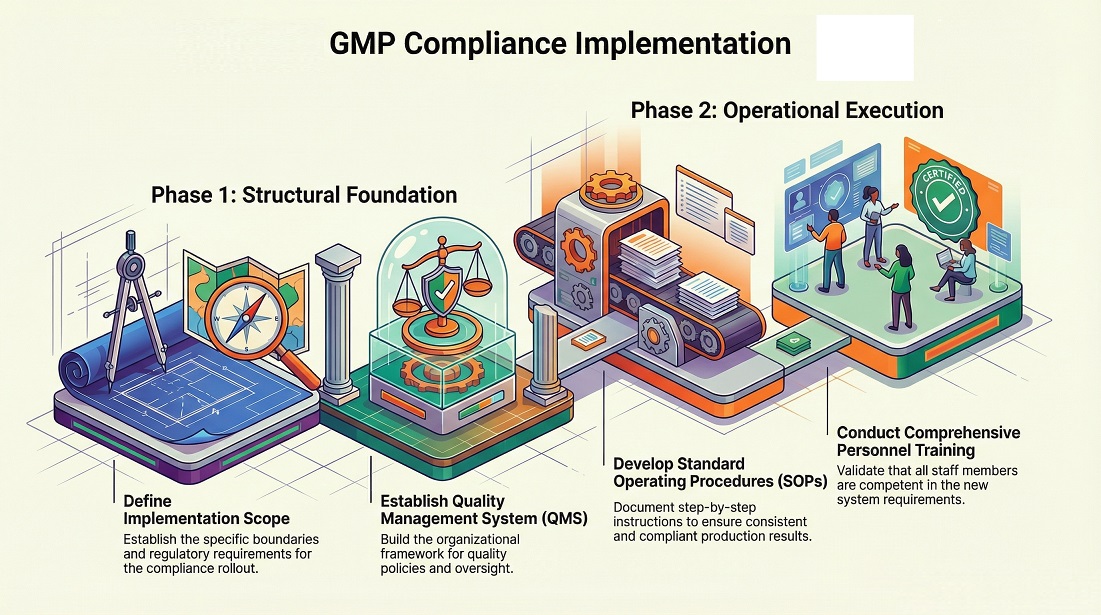
GMP Compliance Rollout in 4 Steps (Scope → QMS → SOPs → Training)
GMP Implementation in 4 Steps

Step 2 — Build the QMS Structure and Ownership

A strong QMS structure gives everyone clear ownership. They define who approves, who executes, and who checks quality tasks. However, shared accountability prevents gaps between departments. Leaders set escalation paths and meeting routines for quick decisions.

  • Assign process owners for SOPs, deviations, CAPA, and change control.

  • Define QA authority for release, audits, and risk decisions.

Step 3 — Create SOPs and Controlled Templates

SOPs turn GMP rules into repeatable daily actions. Teams write steps, roles, and records for each process. WHO TRS 986 and TRS 981 guide GMP and risk-based controls.  Controlled templates standardize records, logs, and deviation forms. Teams apply version control, approvals, and dates. However, clear templates reduce errors and speed training.

  • Use one header format.

  • Link fields to SOP numbers.

Step 4 — Train Staff and Qualify Critical Roles

Training keeps GMP work consistent and reduces errors. FDA 21 CFR 211.25 requires training for job functions and GMP. Teams build role-based training for QA, production, QC, and engineering.

Qualification confirms staff can run critical tasks safely. FDA 21 CFR 211.22 assigns the quality unit oversight. Teams test competency with observation and quizzes. They retrain after deviations and major changes.

GMP Training and Competence Management

GMP training builds safe habits and consistent batch decisions. FDA 21 CFR 211.25 sets training expectations for each job function. Managers keep curricula current for QA, QC, production, engineering, and suppliers.

Competence management proves people can perform critical tasks correctly. WHO TRS 986 and TRS 981 support role-based training and risk-based refreshers. Therefore, teams test skills, document results, and retrain after changes or deviations.Use checklists and short quizzes monthly.

Common Compliance Mistakes in GMP and How to Avoid Them

Common GMP mistakes start with rushed work and weak habits. Teams skip checks, delay documentation, or ignore early warning signals. These gaps grow fast and trigger deviations, CAPAs, and audit findings. However, simple routines prevent most compliance failures. Teams set clear owners, review trends, and correct issues early. They keep records clean and follow SOPs every shift.

  • Backdate or overwrite entries instead of correcting.

  • Use uncontrolled templates or outdated SOPs.

  • Ignore OOS/OOT signals and weak investigations.

  • Delay CAPA actions and miss due dates.

Common GMP mistakes

Common GMP mistake Impact How to avoid it
Late or unclear documentation
Missing evidence and audit findings
Record actions immediately and review daily
Using outdated SOPs/templates
Wrong steps and inconsistent batches
Control versions and remove old copies
Weak deviation/OOS investigations
Repeat failures and long CAPAs
Use RCA, confirm effectiveness, trend issues
Poor training and role qualification
Human error and rework
Train by role and test competency regularly

Final Words

GMP compliance keeps every batch safe, consistent, and traceable. FDA 21 CFR Part 211 defines Quality Unit duties (211.22) and training needs (211.25). USP <1078> guides excipient GMP, and USP <1058> supports instrument qualification. Focus on 4 controls: people, process, data, and materials. It aligns suppliers with clear expectations.

This article explains the meaning, core elements, rollout steps, and common mistakes. Use 3 daily habits: document in real time, investigate deviations fast, and trend KPIs. Next, pick one high-risk process and build templates plus a review cadence. 

FAQs

1️⃣ Which GMP areas trigger the most audit findings?

Documentation control, training evidence, deviations/CAPA closure, and data integrity reviews.

2️⃣ How can a site prove data integrity fast?

Use ALCOA+ habits, restrict access, and perform routine audit-trail reviews.

3️⃣ What is the fastest way to start improving GMP?

Pick one high-risk process, publish one SOP + one template, then review 10 records.

References

Picture of Ershad Moradi

Ershad Moradi

Ershad Moradi, a Content Marketing Specialist at Zamann Pharma Support, brings 6 years of experience in the pharmaceutical industry. Specializing in pharmaceutical and medical technologies, Ershad is currently focused on expanding his knowledge in marketing and improving communication in the field. Outside of work, Ershad enjoys reading and attending industry related networks to stay up-to-date on the latest advancements. With a passion for continuous learning and growth, Ershad is always looking for new opportunities to enhance his skills and contribute to pharmaceutical industry. Connect with Ershad on Facebook for more information.

Share