

Features
Topics
Discover

Unlock the potential of your career in the Pharma industry with our online courses and qualifications.

Career Path

Pick a career path, follow its guided course roadmap, and secure industry-verified credentials in a few months.

Courses

Earn career credentials from industry leaders that demonstrate your expertise.

Periodic Safety Update Reports (PSUR) in Pharmacovigilance: Regulatory Expectations and Inspection Impact in 2026

Recent pharmacovigilance inspection cycles indicate that approximately 25–35% of pharmacovigilance-related findings are linked to weaknesses in periodic safety reporting, particularly gaps in cumulative data review and benefit–risk evaluation. As a result, psur in pharmacovigilance is increasingly treated as core inspection evidence rather than a routine regulatory submission, because it consolidates long-term safety data, signal assessment, and regulatory decision logic into a single document inspectors use to judge system control.

For pharmacovigilance, regulatory, and QA teams, PSUR quality directly influences inspection scope, follow-up actions, and regulatory confidence in post-marketing safety oversight.

Table of Contents

What Is a PSUR in a Pharmacovigilance Context

A PSUR is a structured regulatory report used to evaluate cumulative safety data and the ongoing benefit–risk balance of an authorised medicinal product.

Periodic Safety Update Reports (PSUR) are a core pharmacovigilance requirement designed to provide regulators with a consolidated, periodic assessment of all relevant safety information generated since product authorisation. In a pharmacovigilance context, PSURs function as formal evidence that post-marketing safety surveillance is active, systematic, and scientifically grounded.

In simple terms: PSURs show regulators how a company monitors real-world safety data and decides whether a product’s benefits continue to outweigh its risks.

From an inspection perspective, PSURs are reviewed not as standalone documents, but as outputs of the broader pharmacovigilance system. Inspectors assess whether PSUR conclusions align with safety databases, signal detection activities, and risk management decisions carried out during routine operations.

To visually consolidate the regulatory evolution described above, the following timeline highlights the key milestones that transformed pharmacovigilance into an inspectable, quality-driven system.

Why PSURs Matter for Regulatory Compliance and Inspections

PSURs matter because inspectors use them to judge whether pharmacovigilance systems are functioning in practice, not merely documented. From an inspection perspective, psur in pharmacovigilance serves as cumulative evidence that safety monitoring and benefit–risk evaluation remain under control throughout the product lifecycle.

During inspections, regulators rely on PSURs to verify that companies consistently evaluate safety signals, reassess benefit–risk profiles, and implement follow-up actions when new risks emerge. Weak PSURs often indicate deeper issues in safety governance, data integration, or medical review processes rather than isolated reporting gaps.

From a compliance standpoint, PSUR quality directly influences how regulators assess accountability. Clear, well-supported conclusions demonstrate system control, while vague assessments or delayed updates raise concerns about the effectiveness of ongoing safety oversight rather than one-time submission accuracy.

Core PSUR Components Reviewed During Inspections

Inspectors focus on whether PSURs integrate safety data, analysis, and decisions into a coherent, defensible benefit–risk narrative.

Inspectors evaluate specific PSUR components to determine whether safety data is assessed consistently and translated into regulatory action. During inspections, psur in pharmacovigilance is reviewed as an integrated safety narrative rather than a standalone report, with focus on data consistency, signal evaluation, and regulatory decision logic.

We will discuss:

  • Safety Data Collection and Signal Evaluation
  • Benefit–Risk Evaluation and Medical Assessment
  • Risk Minimization Measures and Follow-Up Actions
  • Data Consistency Across Pharmacovigilance Systems

Safety Data Collection and Signal Evaluation

Inspectors review how cumulative safety data is gathered from multiple sources, including spontaneous reports, studies, and literature. PSURs are expected to reflect active signal detection, not passive data compilation.

During inspections, reviewers often cross-check PSUR signal discussions against case trends visible in safety databases to confirm consistency.

Benefit–Risk Evaluation and Medical Assessment

PSURs must demonstrate an up-to-date medical evaluation of benefits and risks. Inspectors assess whether conclusions are evidence-based, clinically meaningful, and responsive to emerging safety concerns.

Risk Minimization Measures and Follow-Up Actions

Regulators examine how identified risks translate into concrete actions. PSURs should clearly describe implemented or proposed risk minimisation measures and their effectiveness over time.

Data Consistency Across Pharmacovigilance Systems

Consistency is critical. Inspectors compare PSUR content with other regulatory submissions, risk management plans, and internal assessments to confirm alignment across pharmacovigilance systems.

Common PSUR Deficiencies Identified During Inspections

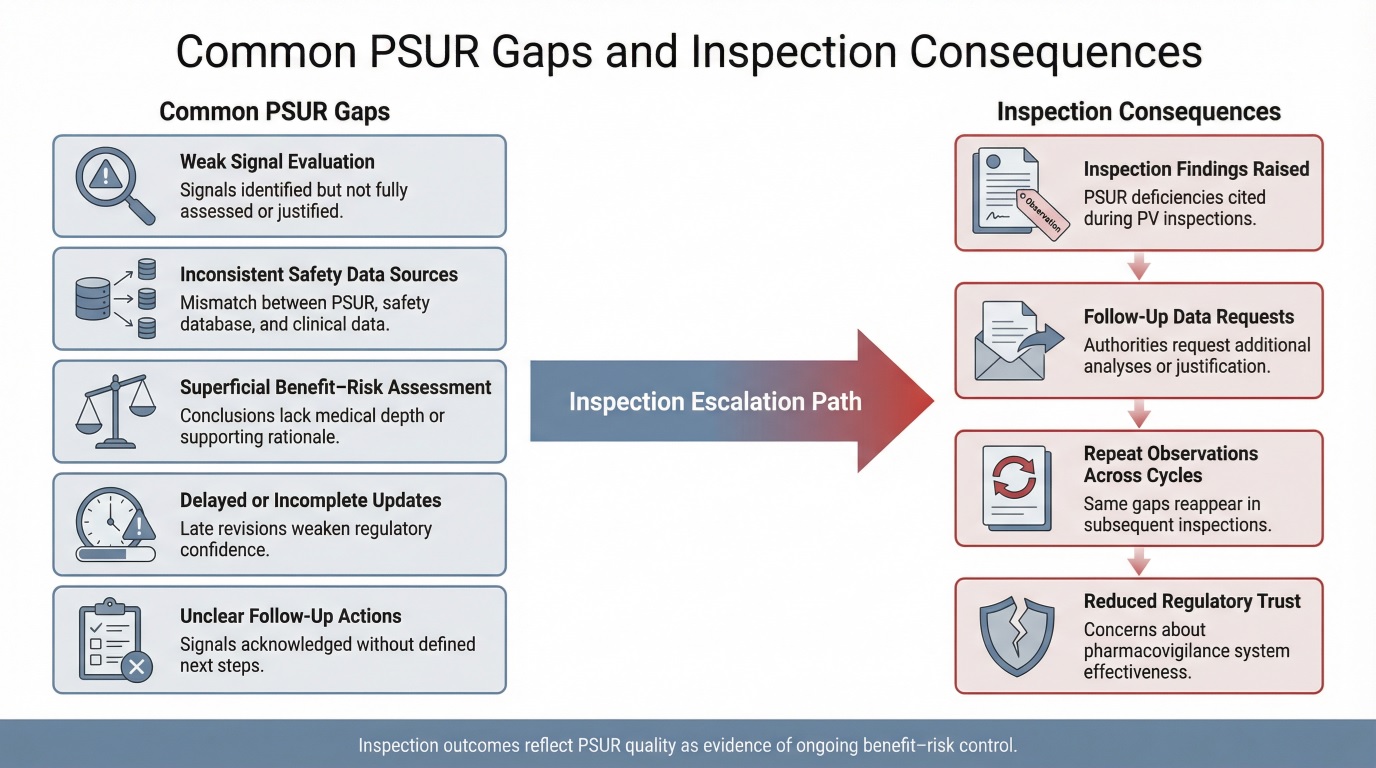
During pharmacovigilance inspections, regulators consistently link PSUR quality gaps to downstream inspection outcomes rather than treating them as isolated reporting issues. The following visual summarizes the most common PSUR weaknesses observed during inspections and shows how these gaps escalate into repeat findings, follow-up requests, and reduced regulatory confidence over time.

Common PSUR Gaps observed during inspections
Common PSUR Gaps Observed During Inspections

Most PSUR findings arise from weak analysis and inconsistent data, not missing sections.

Common deficiencies include:

  • Superficial signal evaluation without clear medical rationale
  • Inconsistencies between PSUR conclusions and safety database trends
  • Delayed updates following emerging safety concerns
  • Poor justification of benefit–risk balance
  • Limited linkage between PSUR findings and risk management actions

These gaps often indicate fragmented pharmacovigilance processes rather than isolated documentation errors. Inspectors interpret repeated PSUR issues as signs of inadequate system oversight.

How High-Quality PSURs Support Inspection Readiness

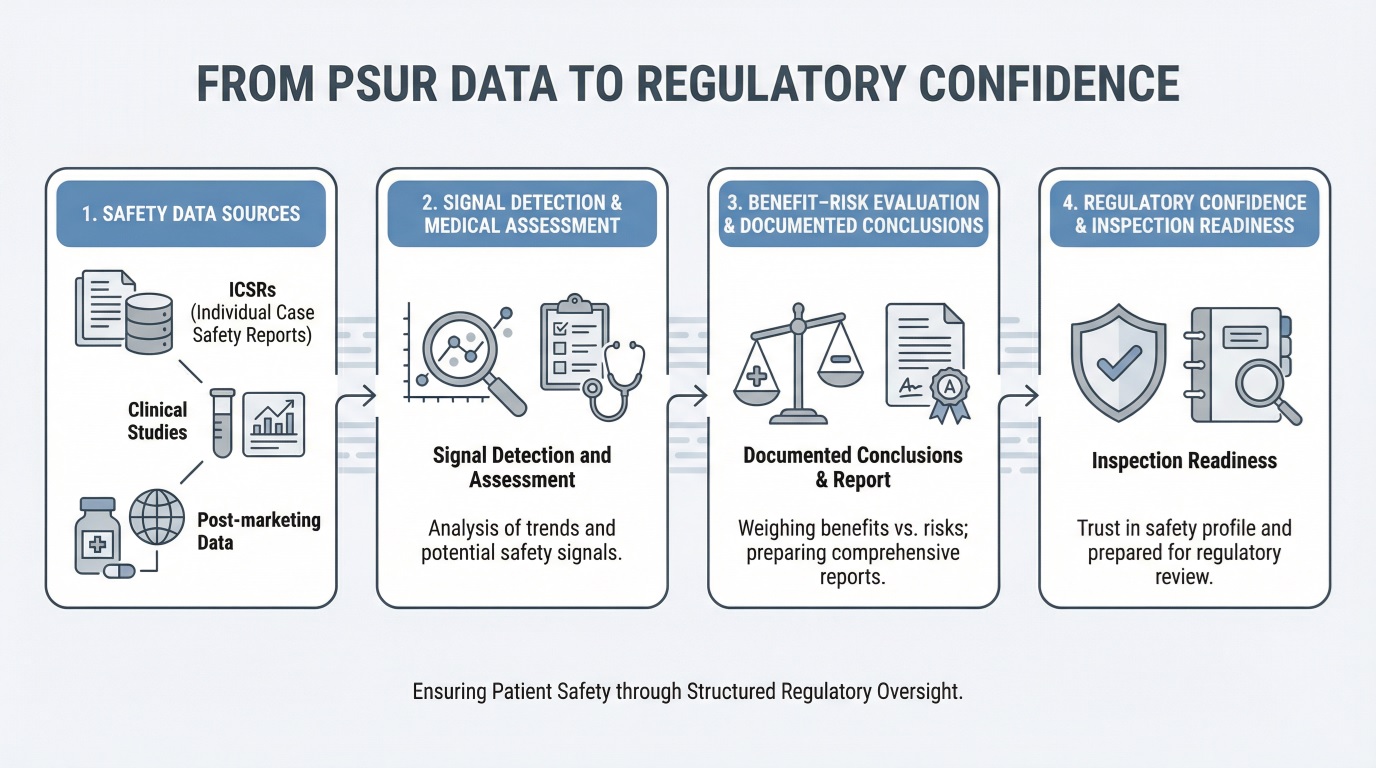
Inspectors assess PSURs as an evidence chain, where safety data, signal evaluation, and benefit–risk conclusions must connect clearly to inspection readiness.

From PSUR Data to Regulatory Confidence

Well-prepared PSURs reduce inspection friction by providing clear, traceable safety evidence.

High-quality PSURs support inspection readiness by:

  • Demonstrating continuous safety monitoring
  • Showing timely response to new risks
  • Aligning safety data with regulatory decisions

PSUR Practice and Inspection Benefit

PSUR Practice Inspection Benefit
Integrated safety data review
Fewer follow-up questions
Clear benefit–risk rationale
Stronger regulatory confidence
Documented follow-up actions
Reduced repeat observations

When PSURs are inspection-ready, inspectors can verify control without extensive data reconciliation, shortening inspection timelines and reducing regulatory uncertainty.

Final Word

Inspection reviews across multiple regions show that PSUR-related deficiencies contribute to roughly 15–25% of follow-up questions raised during pharmacovigilance inspections, particularly when benefit–risk conclusions are not clearly justified. In this context, psur in pharmacovigilance functions as regulatory evidence that safety evaluation is continuous, medically reasoned, and responsive to emerging risks. When PSURs document signals without clear assessment or action, inspectors often escalate their review beyond reporting compliance to system effectiveness. High-quality PSURs reduce inspection friction by demonstrating accountable safety governance, coherent medical judgment, and defensible regulatory decision-making over time.

FAQs

1️⃣ What do inspectors actually look for when reviewing PSURs during inspections?

They check whether cumulative safety data is critically assessed, signals are addressed, and benefit–risk conclusions are supported by consistent medical and regulatory rationale.

Because gaps in signal evaluation, data integration across safety systems, or medical review logic tend to persist across reporting cycles if not structurally corrected.

3️⃣ What most improves inspection outcomes for PSUR reviews?

Clear linkage between safety findings, benefit–risk conclusions, and documented follow-up actions within the pharmacovigilance system.

Picture of Mahtab Shardi

Mahtab Shardi

Mahtab is a pharmaceutical professional with a Master’s degree in Physical Chemistry and over five years of experience in laboratory and QC roles. Mahtab contributes reliable, well-structured pharmaceutical content to Pharmuni, helping turn complex scientific topics into clear, practical insights for industry professionals and students.

Share