


Features
Topics
Discover

Unlock the potential of your career in the Pharma industry with our online courses and qualifications.

Career Path

Pick a career path, follow its guided course roadmap, and secure industry-verified credentials in a few months.

Courses

Earn career credentials from industry leaders that demonstrate your expertise.

ICSR in Pharmacovigilance: Meaning & Validity 

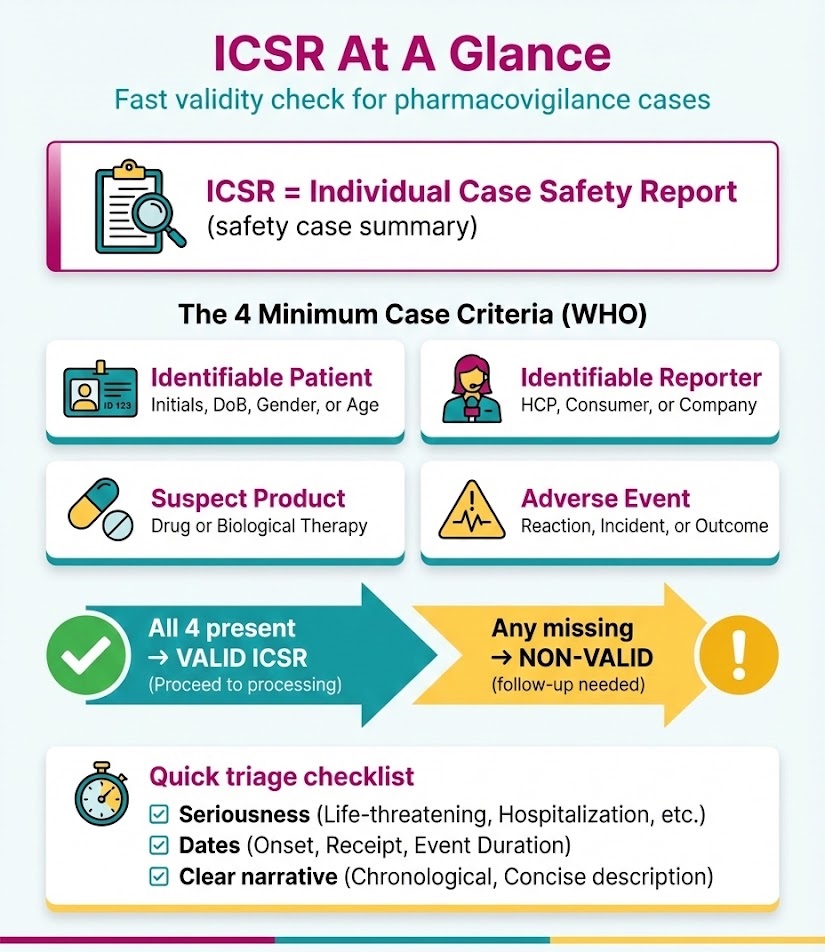
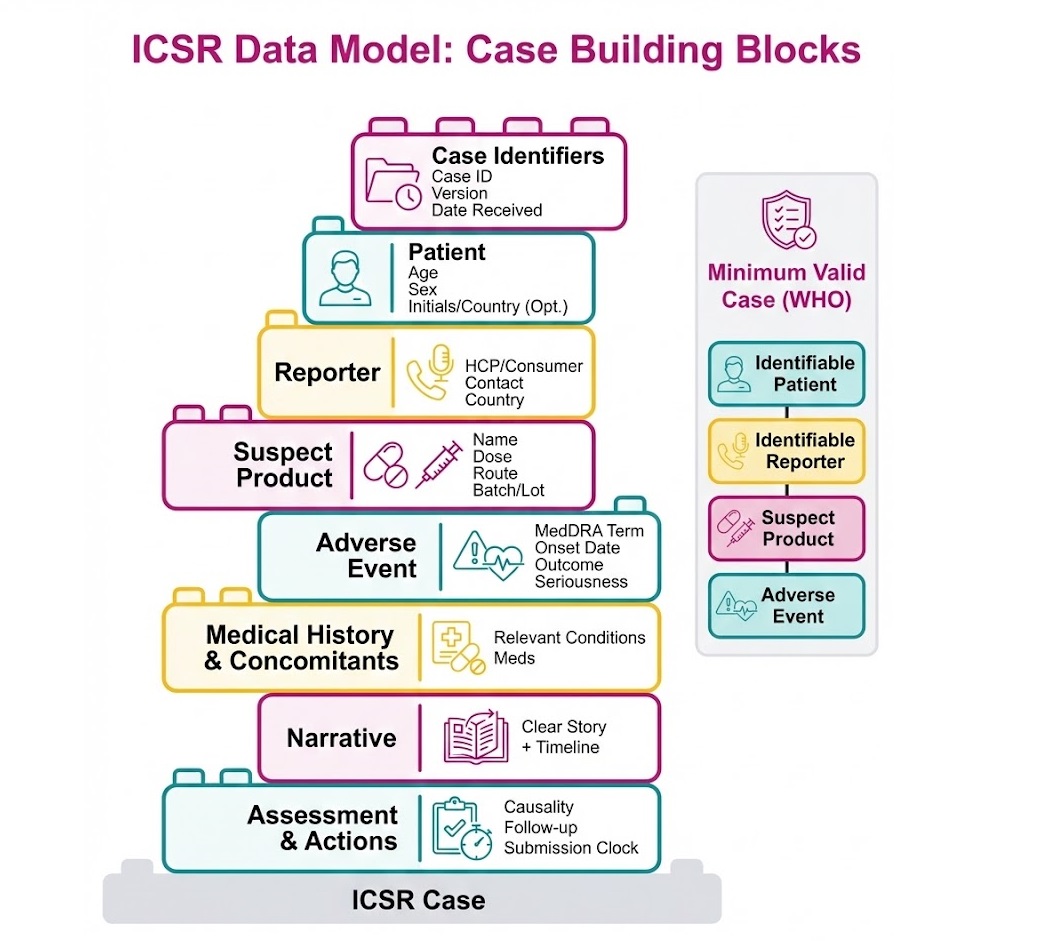
An ICSR in Pharmacovigilance is a structured safety report that links one patientone reporterone suspect product, and one adverse event/reaction. 

Validity matters because it protects compliancereporting timelines, and data quality. First, it defines Day 0 and starts the reporting clock. Next, it helps you avoid non-valid cases and document decisions with audit-ready logic. 

ICSR Meaning and Definition in Pharmacovigilance

In daily ICSR pharmacovigilance work, teams treat an ICSR as the “unit of evidence” for one safety experience in one person. ICH guidance describes an ICSR as a description of an adverse event/adverse drug reaction (AE/ADR) or observation in an individual patient at a specific time.  

icsr in pharmacovigilance

ICSR: Definition for Beginners

Beginners often mix “a complaint,” “a question,” and “a safety case.” However, an ICSR only forms when the report connects the four minimum criteria in a way you can trace and verify. 

icsr in pharmacovigilance

ICSR Full Form and Official Term

ICSR stands for Individual Case Safety Report. Teams use it as the official term for a standardized safety case record in PV systems.  

ICSR Purpose In Pharmacovigilance Systems

ICSRs support pharmacovigilance systems in practical ways: 

Protect patients by identifying new risks earlier. 
Meet reporting duties with consistent case processing PV. 
Improve signal detection through structured data. 
Support inspections with traceable, audit-ready decisions. 

ICSR Versus Adverse Event Report

Topic Adverse Event Report (general) ICSR in pharmacovigilance (standardized)
Meaning
Any mention of a medical issue after product use
A structured case record for PV reporting
Minimum info
Can be incomplete or vague
Requires 4 minimum criteria to be valid
Use
Awareness, customer service, medical inquiry screening
Compliance, timelines, data quality, signal detection
Output
Notes, ticket, email thread
Case in safety database + submission where required
Audit risk
Higher if no clear logic exists
Lower when you document validity and follow-up

Core Terms Used in ICSR Work

These terms keep your ICSR validity decisions consistent: 

ICSR Validity and Minimum Case Criteria

Validity answers one question: Do we have enough to treat this report as a real, follow-up-worthy safety case? Regulators describe the minimum data elements as identifiable patient, identifiable reporter, suspect product, and adverse reaction/event.

1) Identifiable patient

A patient becomes “identifiable” when you can distinguish them as a real, unique person. Therefore, use practical identifiers:

  • Age or age range (adult/child can help, but add more when possible)
  • Gender
  • Initials
  • Date of birth (even partial)
  • Patient ID (clinic number, case number)

However, “a group of patients” without individual identifiers does not meet the criterion.

2) Identifiable reporter

A reporter becomes “identifiable” when you can confirm a real source exists. Also, you need enough detail to avoid duplicates and request follow-up. Health Canada explains “identifiable” as verification of the existence of a patient and reporter.

Practical examples include:

  • Name or initials
  • Email or phone
  • HCP details (clinic/hospital + role)
  • A traceable social media handle plus a message thread
3) Suspect medicinal product

A report meets this criterion when it names a suspect medicinal product. So, capture:

  • Product name (brand or generic)
  • Strength and dose (when available)
  • Route and indication (when available)
  • Start/stop dates, batch, and expiry (when available)

If the report mentions “a medicine” with no name, treat it as non-valid now and request details.

4) Adverse event / reaction

The report must describe an event or reaction. Therefore, document what happened in plain language first. Next, code it later in your PV system.

Examples that usually work:

  • “Rash after dose increase”
  • “Seizure two days after start”
  • “Liver enzymes increased”

Examples that often fail:

  • “It did not work” (lack of efficacy can qualify in specific contexts, but you still need clear event details)
  • “They felt weird” (needs clarification)

Why validity drives compliance, timelines, and data quality

Non-Valid ICSR Scenarios and Case Nullification Rules

Non-valid does not mean “ignore it.” Instead, it means you cannot treat the report as a valid ICSR yet. So, document your logic, attempt follow-up, and track the outcome.

Common non-valid case scenarios
How to handle non-valid cases without audit pain
  • First, log the intake source and date.
  • Next, record which minimum criterion is missing.
  • Then, send a follow-up question set that targets the missing elements.
  • Finally, close the ticket with a clear outcome label: “non-valid—missing patient,” for example.
ICSR nullification: when you remove a case from your valid pool

Nullification applies when you previously treated a report as valid, but later facts require a controlled correction. Here are typical drivers:

  • True duplicate confirmation (same patient, same reporter, same product, same event). 
  • Wrong product identity (the suspect product never existed, or the reporter mixed names). 
  • Non-case confirmation (for example, the “patient” turns out fictional). 

For audit readinesskeep these records: 

  • A short nullification rationale (one paragraph) 
  • A link to the “master case” if duplication caused the change 
  • Follow-up attempts and results 
  • A supervisor or QA check, if your SOP requires it 

Final words

ICSR in pharmacovigilance work becomes easy when you standardize validity. Therefore, anchor every decision on the four minimum criteria. Also, treat follow-up as your data-quality engine. Finally, keep your documentation crisp for inspections.  

Start here:

A) Do Ihavethe 4 minimum criteria? 

  • Identifiable patient 
  • Identifiable reporter 
  • Suspect medicinal product 
  • Adverse event / reaction 

B)If“no,” what do I do next? 

  • Mark as non-valid and state the missing element 
  • Request follow-up with 2–4 focused questions 
  • Save proof of outreach (email, call log, screenshot) 
  • Reassess when new information arrives 

C)If“yes,” what do I do next? 

  • Start Day 0 and document the receipt date logic 
  • Enter the case and code the reaction 
  • Check duplicates early 
  • Submit per local timelines and track acknowledgements 

FAQ:

What is an ICSR in one sentence?

An ICSR is a structured safety report that links patientreporter, suspect product, and event 

What are the ICSR validity criteria?

Use the four minimum elements: identifiable patient, identifiable reporter, suspect product, and adverse event/reaction. 

Can a consumer create a valid ICSR?

Yes, because validity depends on the four elements, not on HCP status.

How do I reduce non-valid case scenarios?

Use a standard intake form, ask focused follow-up questions, and train teams on minimum criteria for PV. 

References:

Picture of Stephanie Männicke

Stephanie Männicke

Digital Marketing Especialist at Zamann Pharma Support, brings 8 years of experience in Corporate and Digital Communication. Specializing in Digital Marketing and Content Creation, Stephanie is currently focused on creating strategic content for Pharmuni's networks, especially content on topics such as recruitment, onboarding and employer branding. Outside of work, Stephanie is a mum, a crocheter and a movie fan. An avid reader and in search of expanding her knowledge, Stephanie is always looking for ways to innovate communication in the digital environment and connect people in a genuine way.

Share