


More than 70% of critical GMP inspection findings relate to weaknesses in pharmaceutical quality systems rather than individual errors. During a single inspection, regulators may review 30–50 quality documents and raise 5–10 observations to assess how well quality processes, documentation, and risk management function together. These figures explain why inspectors focus on system performance, not isolated mistakes. A quality management pharma course addresses this gap by explaining how regulated organizations design, operate, and maintain compliant quality systems.
As regulatory expectations rise, pharmaceutical quality training has become a core professional requirement. Professionals who understand how GMP requirements, documentation, and inspection logic connect gain a clear advantage in regulated roles. For this reason, many learners begin by enrolling in a structured Pharma Course aligned with real regulatory practice.
Table of Contents
What Is a Quality Management Pharma Course?
A quality management pharma course is a professional training program that explains how pharmaceutical organizations build, manage, and continuously improve quality systems across the entire product lifecycle.
In practice, such courses focus on the following core areas:
- Designing pharmaceutical quality systems aligned with GMP requirements
- Applying quality assurance principles in regulated operations
- Managing deviations, CAPA, and change control systematically
- Interpreting global regulatory expectations with confidence
- Supporting audit readiness and inspection performance
Unlike general quality education, this type of training reflects the high-risk nature of pharmaceutical products and the strict regulatory oversight of the industry.
Regulatory Frameworks in Pharmaceutical Quality Training
Pharmaceutical quality training relies on globally recognized regulatory frameworks. These standards define how companies must structure and operate their quality systems.
Key frameworks typically include:
- Good Manufacturing Practice (GMP)
- ICH Q10 Pharmaceutical Quality System
- FDA 21 CFR Parts 210 and 211
- EMA and EU GMP Guidelines
Together, these regulations establish expectations for product quality, data integrity, and patient safety. Moreover, courses teach how regulators interpret these standards during inspections, not just how they appear in guidance documents.
General Quality Training vs Pharma-Specific Quality Courses
General quality training and pharmaceutical quality training may sound similar. However, they differ significantly in depth, regulatory exposure, and risk profile.
The comparison below highlights these differences clearly.
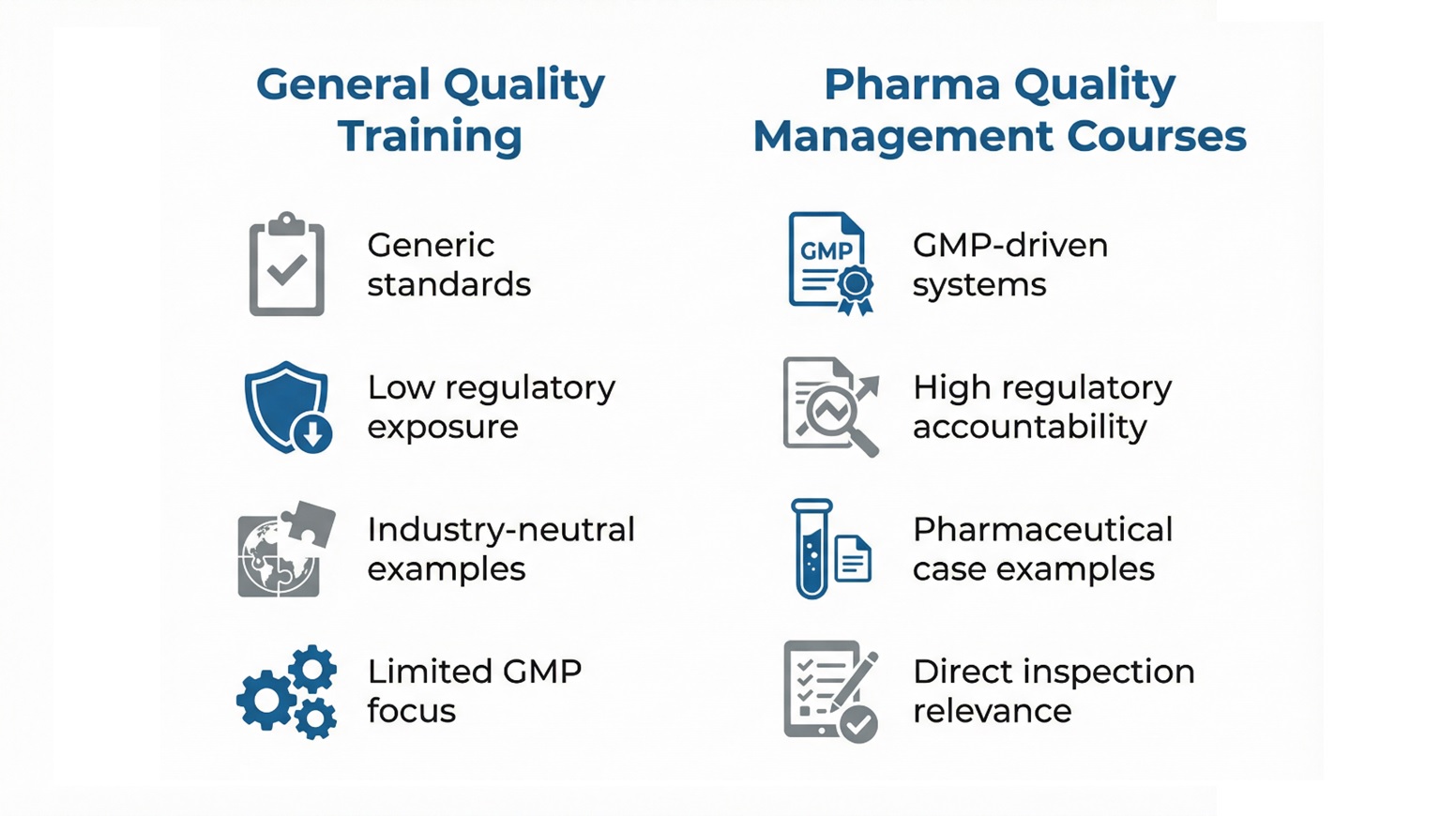
The table below translates these visual differences into concrete regulatory, documentation, and inspection-related criteria used across pharmaceutical environments.
Make comparisons audit-proof by mapping each difference to compliance evidence
| Area | General Quality Training | Pharma-Specific Quality Training |
|---|---|---|
|
Regulatory depth |
Limited |
Extensive GMP and regulatory focus |
|
Industry risk |
Low |
High patient and compliance risk |
|
Documentation |
Business records |
GMP-controlled documentation |
|
Inspection relevance |
Minimal |
Central learning objective |
|
Industry alignment |
Cross-industry |
Pharmaceutical-specific |
As a result, pharmaceutical professionals benefit far more from training that reflects real GMP environments.
How Global Regulations Shape Pharma Quality Systems
Pharmaceutical quality systems operate as integrated frameworks where GMP, documentation, risk management, and CAPA function together rather than as isolated controls.
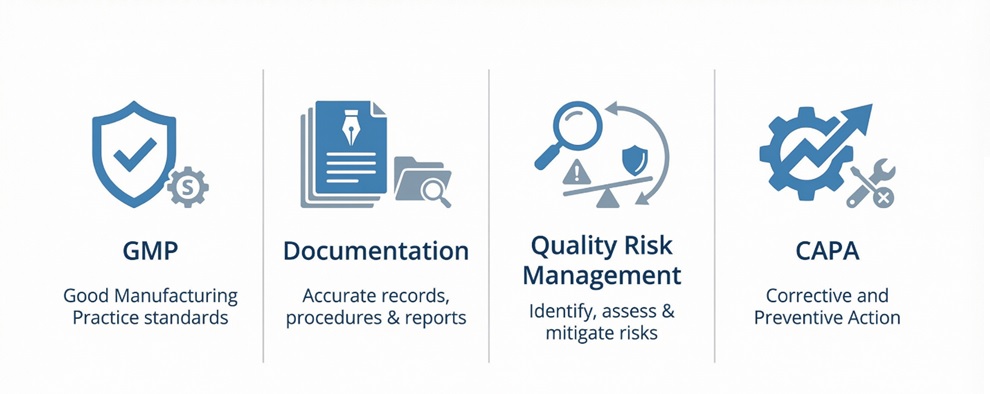
This section explains how global regulatory frameworks such as GMP and ICH Q10 define the structure, responsibilities, and integration of pharmaceutical quality systems across the product lifecycle.
Global regulations actively shape how pharmaceutical quality systems function. Regulators expect integrated systems rather than isolated procedures. Consequently, quality training emphasizes system ownership, lifecycle oversight, and continuous improvement.
In practice, this approach helps professionals understand how quality decisions influence manufacturing performance, regulatory outcomes, and patient safety at the same time.
GMP and Pharmaceutical Quality Systems
GMP principles form the foundation of pharmaceutical quality systems. They guide how organizations control processes, train personnel, qualify equipment, and release products.
As a result, professionals learn that quality does not rely on final testing alone. Instead, it depends on robust systems that prevent errors before they affect patients.
Documentation and Data Integrity Principles
Documentation plays a critical role in pharmaceutical compliance. Therefore, quality training presents ALCOA+ principles as practical rules for daily operations.
Key principles include:
- Attributable – teams link actions clearly to individuals
- Legible – records remain readable and permanent
- Contemporaneous – staff record data at the time of activity
- Original – systems preserve source data
- Accurate – records reflect real events
- Complete, Consistent, Enduring, Available
As a result, organizations build regulatory trust through reliable and transparent data practices.
Deviation, CAPA, and Change Control
Pharmaceutical quality systems treat deviations as indicators of system weakness, not individual failure. For example, when a deviation occurs during production, trained teams investigate root causes, assess risks, and implement CAPA actions.
Moreover, change control ensures that improvements do not introduce new compliance risks. Consequently, organizations maintain control while continuously improving performance.
Risk Management in Pharmaceutical Quality
Risk-based thinking plays a central role in modern pharmaceutical quality systems. Therefore, training introduces ICH Q9 principles and structured risk assessment tools.
Professionals learn how to prioritize controls based on patient impact, process criticality, and data integrity. As a result, quality decisions remain defensible during regulatory inspections.
Audit Readiness and Inspection Preparation
Regulatory inspections remain a constant reality in the pharmaceutical industry. Quality training prepares professionals to explain system logic clearly and demonstrate compliance through documentation.
Consequently, trained teams reduce inspection stress and improve regulatory outcomes.
Who Should Enroll in a Pharmaceutical Quality Course?
Pharmaceutical quality systems involve multiple departments. Therefore, professionals across functions can benefit from structured quality training.
The table below shows who gains the most value from this type of education.
| Audience | Relevance to the Pharmaceutical Industry |
|---|---|
|
Pharmacy and life science graduates |
Builds GMP-ready industry skills |
|
Quality assurance professionals |
Strengthens regulatory credibility |
|
Manufacturing teams |
Aligns operations with quality systems |
|
Regulatory affairs professionals |
Improves system-level understanding |
|
Career switchers into pharma |
Accelerates compliance readiness |
Career Benefits of a Quality Management Pharma Course
Pharmaceutical quality systems training strengthens both technical competence and professional credibility. As a result, trained professionals integrate faster into GMP-regulated pharmaceutical environments.
Key benefits include:
- Faster onboarding into pharmaceutical roles
- Higher confidence during audits and inspections
- Reduced compliance-related stress
- Access to cross-functional quality and compliance roles
- Positioning as a quality system owner rather than a task executor
Therefore, pharmaceutical organizations increasingly prioritize candidates with structured quality training.
Final words
Regulatory authorities issue more than 10,000 GMP observations worldwide every year, and a large proportion of them highlight system-level weaknesses rather than isolated procedural mistakes. This reality confirms one clear fact: pharmaceutical organizations increasingly evaluate quality through integrated systems, not checklists. A quality management pharma course prepares professionals to understand, manage, and improve these systems before inspection pressure exposes their gaps.
Structured training builds regulatory awareness, system thinking, and inspection readiness across pharmaceutical functions. If your goal is to develop future-ready expertise and operate confidently in regulated environments, the next logical step is to explore pharma courses designed specifically for the pharmaceutical industry.
FAQs:
Quality training explains how GMP requirements translate into controlled systems and documented processes. As a result, pharmaceutical teams apply compliance principles consistently across manufacturing operations.
Yes. Manufacturing, regulatory affairs, and supply chain professionals benefit from understanding pharmaceutical quality systems. Therefore, training improves cross-functional collaboration during inspections.
General quality education focuses on broad concepts. In contrast, pharmaceutical quality training addresses GMP regulations, inspection expectations, and patient safety risks unique to the pharma industry.
References

Mahtab Shardi
Mahtab is a pharmaceutical professional with a Master’s degree in Physical Chemistry and over five years of experience in laboratory and QC roles. Mahtab contributes reliable, well-structured pharmaceutical content to Pharmuni, helping turn complex scientific topics into clear, practical insights for industry professionals and students.

Out of Trend (OOT) Masterclass 2026: Essential Strategies for Bulletproof Pharma Compliance
Out of Trend (OOT) results signal deviations in data that differ from expected norms, often acting as early warnings in pharmaceutical manufacturing. Ignoring these trends can lead to costly Out of Specification (OOS) failures, which account for nearly 20% of batch rejections globally

Pharma Jobs Los Angeles in 2026: GMP Compliance and Salary Trends
Los Angeles continues to expand across pharmaceutical companies in Los Angeles and biologics manufacturing Southern California. From GMP jobs in Los Angeles to pharmacist jobs Los Angeles CA, hiring demand reflects strong regulatory oversight and advanced clinical research growth in LA – California.

Master ICH Q7 Guideline in 2026: Essential API GMP Rules You Must Know
ICH Q7 is the GMP guide for active pharmaceutical ingredients (APIs). It sets detailed standards for quality, documentation, validation, and supplier control. WHO reports that poor supplier management causes up to 30% of API quality issues. Following ICH Q7 ensures consistent product safety and regulatory compliance worldwide.