

Features
Topics
Discover

Unlock the potential of your career in the Pharma industry with our online courses and qualifications.

Career Path

Pick a career path, follow its guided course roadmap, and secure industry-verified credentials in a few months.

Courses

Earn career credentials from industry leaders that demonstrate your expertise.

FDA Inspection Checklist: What Inspectors Review for GMP Compliance in 2026

Why do more than half of FDA drug manufacturing inspections still end with Form 483 observations, even at companies with established GMP systems?

Across the pharmaceutical industry, inspection results show a clear pattern. FDA findings rarely come from missing procedures. Instead, inspections expose Pharma Quality Assurance systems that fail to perform consistently when regulators review real deviations, investigations, and CAPA outcomes. As a result, compliance that looks strong on paper often breaks down under inspection pressure.

Today, inspectors connect quality oversight, documentation, manufacturing execution, and laboratory data to judge system control. Therefore, inspection success depends on operational performance, not document volume. This is why the FDA inspection checklist has become central to modern GMP inspections.

Table of Contents

What Is an FDA Inspection Checklist in a GMP Context

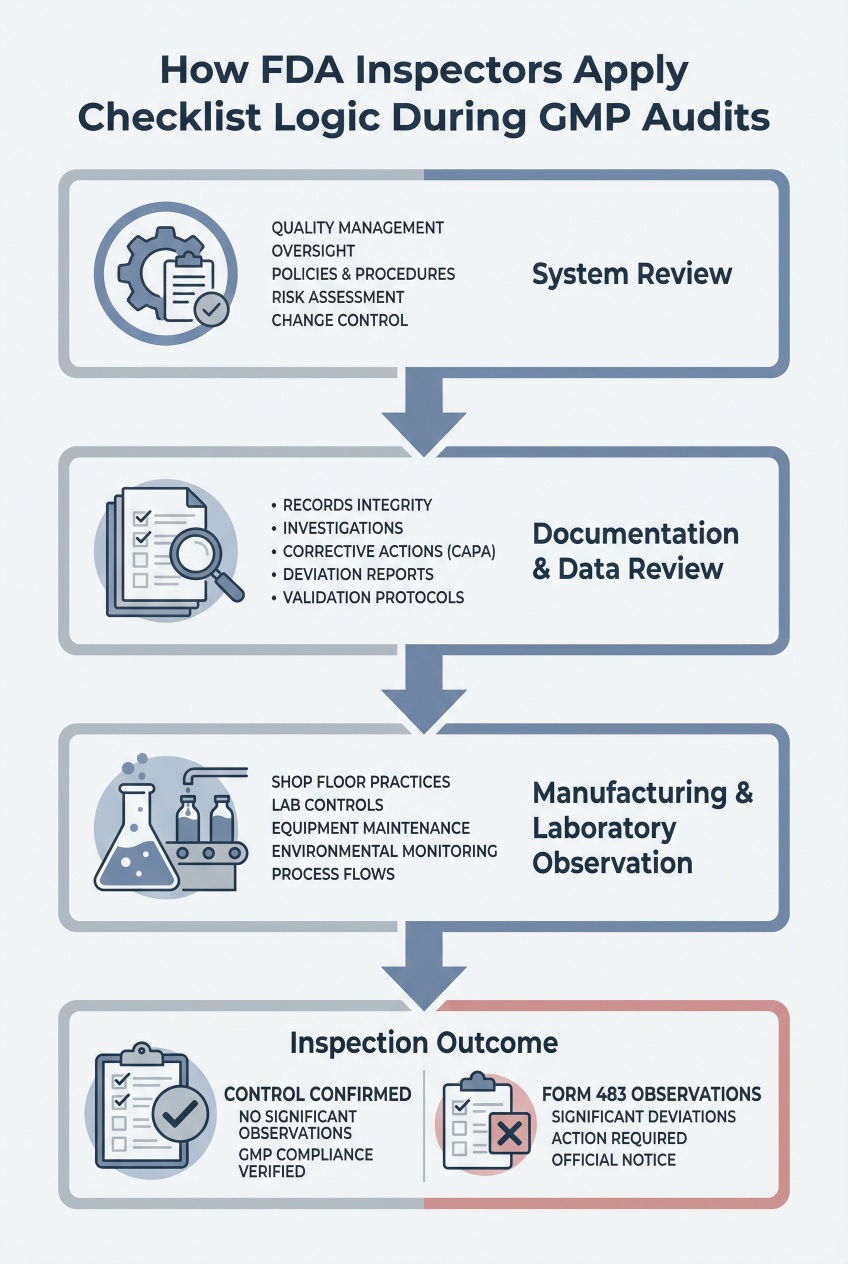
The infographic below illustrates how FDA investigators apply checklist logic step by step to evaluate GMP system control during inspections.

how FDA investigators apply checklist logic step by step to evaluate GMP system

The FDA inspection checklist refers to the structured inspection logic FDA investigators use to assess GMP compliance during inspections.

Inspectors do not follow a public checklist. Instead, they apply a risk-based inspection framework to test how quality systems perform in real operations. They start at the system level, review records and data, and then confirm execution on the manufacturing floor or in the laboratory. As a result, inspections focus on system effectiveness, not document volume.

Why FDA GMP Inspections Are Critical to Regulatory Compliance

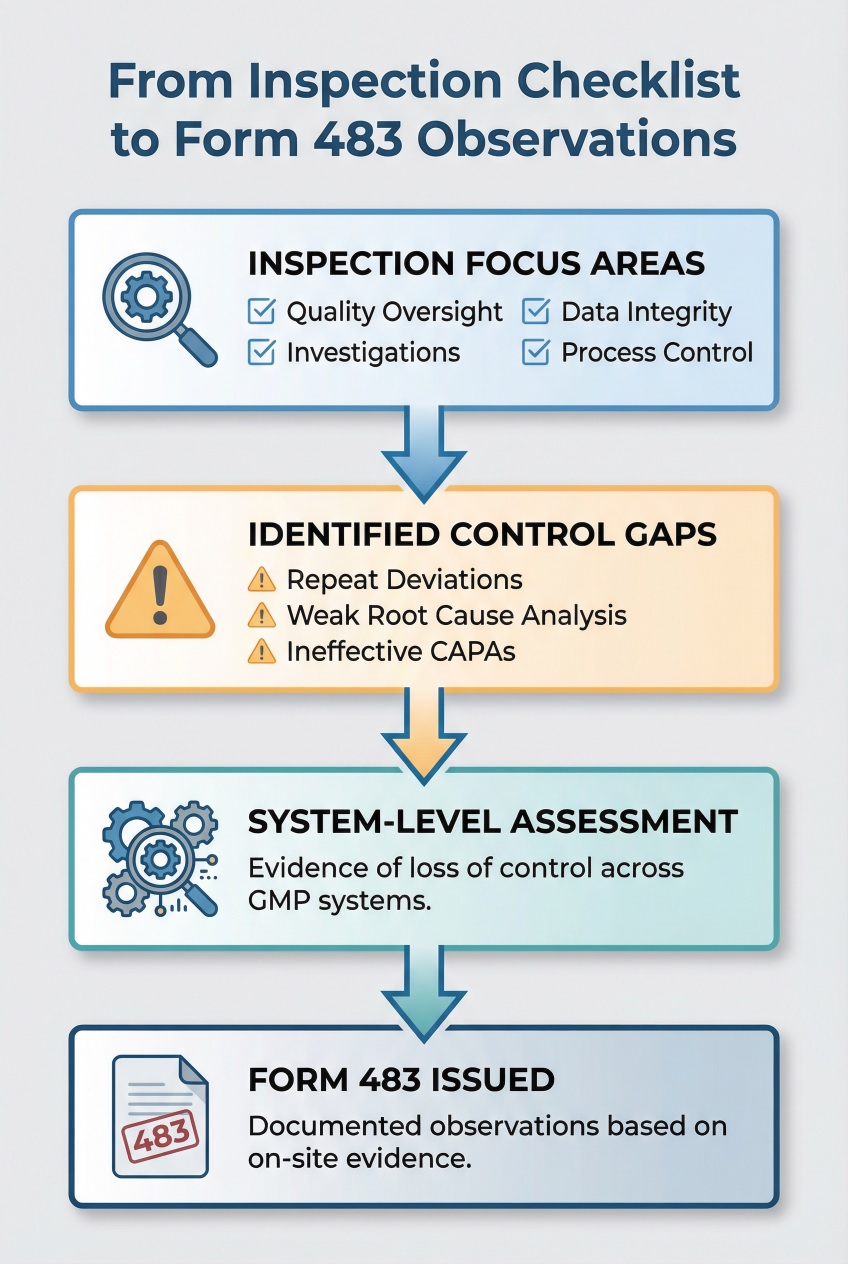
FDA GMP inspections act as the most direct test of regulatory compliance. Inspectors rely on checklist logic to identify control gaps quickly. Moreover, they use this logic to prioritize findings based on patient risk and system impact. As a result, inspections escalate when investigators detect repeat weaknesses across deviations, investigations, or CAPA records.

Form 483 observations often reflect this system-based assessment. Inspectors document observations when evidence shows loss of control, not when paperwork looks incomplete. Therefore, inspection outcomes rarely depend on a single error. Instead, they show how effectively quality systems prevent, detect, and correct problems over time when inspectors apply FDA inspection checklist logic.

For regulatory teams, this means one thing. Inspection readiness depends on system performance, not presentation.

GMP Areas FDA Inspectors Review Using Checklist Logic

FDA investigators apply checklist logic across several interconnected GMP systems to evaluate whether operations remain in control under real conditions. Instead of reviewing functions in isolation, inspectors assess how these systems work together to prevent risk, detect failures, and support consistent decision-making throughout the organization. For this reason, inspection outcomes often depend on the weakest link between these systems, not on individual documents or departments.

We will discuss:

  • Quality Management System and Oversight
  • Documentation and Data Integrity Controls
  • Manufacturing and Process Controls
  • Laboratory Controls and Testing Practices

Quality Management System and Oversight

Inspectors start with quality management and leadership oversight.

They review how management evaluates quality signals. They assess escalation pathways. They also confirm whether the quality unit has real authority. Therefore, weak oversight often raises early concern.

When leadership allows repeat deviations or delayed CAPAs, inspectors view that behavior as a system failure. In contrast, timely decisions and documented follow-up signal control.

Documentation and Data Integrity Controls

Documentation review plays a central role during inspections. Inspectors examine records to confirm accuracy, traceability, and timing. They expect records to reflect real events, not reconstructed narratives. In addition, they review data integrity controls such as access management, audit trails, and review discipline.

However, inspectors do not reward document volume. Instead, they value clarity and consistency. Clear records support confident decisions and reduce inspection risk.

Manufacturing and Process Controls

Manufacturing execution receives direct inspection attention. Inspectors observe operations, review batch records, and assess deviation handling. Often, small inconsistencies reveal larger weaknesses. For example, repeated minor deviations may indicate unstable processes.

Moreover, inspectors expect operators and supervisors to understand their processes. When teams explain deviations clearly, inspections progress more smoothly.

Laboratory Controls and Testing Practices

Laboratory systems strongly influence inspection outcomes. Inspectors assess method use, sampling practices, and investigation quality. They review OOS and OOT handling carefully. They also evaluate how laboratory data supports batch release decisions.

When laboratories rely on weak conclusions, inspectors challenge credibility. Therefore, strong scientific reasoning remains essential.

Common Gaps Identified Through FDA Inspection Checklists

The infographic below shows how recurring GMP gaps identified during inspections escalate from initial checklist focus areas to documented Form 483 observations.

how recurring GMP gaps identified during inspections escalate from initial checklist focus areas to documented Form 483 observations.
From Inspection Checklist to From 483 Observations

Many inspection findings follow predictable patterns.

Because inspectors trend issues across systems, repeat weaknesses stand out quickly. As a result, unresolved gaps often reappear during future inspections.

Common GMP gaps include:

  • Investigations that lack root cause depth
  • CAPAs that close without measurable improvement
  • Inconsistent batch record execution
  • Weak data integrity controls
  • Poorly justified change controls
  • Repeated OOS conclusions without evidence

To reduce inspection risk, companies must correct systems, not symptoms.

How to Use Inspection Checklist Logic for Inspection Readiness

Effective inspection readiness starts with inspector thinking. Instead of auditing SOP existence, teams should audit evidence flow. They should confirm whether they can reconstruct decisions and show improvement. Moreover, teams that align internal audits with FDA inspection checklist logic reduce inspection risk by preparing for how inspectors actually trace systems during GMP inspections.

Inspection checklist focus and inspectors expect

Inspection checklist focus What inspectors expect Readiness action
System control
Consistent outcomes
Trend deviations and complaints together
Data traceability
Clear decisions
Run data-to-release reviews
Repeat issues
Escalation discipline
Define investigation thresholds
Investigation quality
Scientific logic
Require evidence-based conclusions
CAPA effectiveness
Outcome change
Verify recurrence reduction

In short, readiness improves when quality systems perform under pressure.

Final Words

Recent FDA inspection cycles show a clear and measurable pattern. At many sites, inspectors issue repeat Form 483 observations within one to two years, even after companies close CAPAs on schedule. In several inspection reviews, close to 30 percent of cited deficiencies relate to issues already flagged during previous inspections, particularly in investigations and laboratory controls. This reality explains why FDA inspection checklist logic prioritizes system effectiveness over formal closure, because only visible, sustained improvement prevents repeat findings and shortens inspection close-out timelines.

FAQs

1️⃣ What usually triggers a Form 483 during a GMP inspection?

Inspectors issue Form 483 observations when they see gaps between written controls and real execution, especially in deviations, investigations, batch release decisions, and laboratory practices.

2️⃣ Why do inspections still find issues even when procedures and training records look complete?

Because inspectors test how systems behave in real situations. When similar deviations, lab findings, or quality decisions repeat across production cycles, documentation alone does not prove control.

3️⃣ What is the most effective way to avoid repeat inspection observations?

Quality teams should strengthen investigation depth, verify that CAPAs change outcomes in production and testing, and align internal audits with how inspectors trace evidence during inspections.

Picture of Mahtab Shardi

Mahtab Shardi

Mahtab is a pharmaceutical professional with a Master’s degree in Physical Chemistry and over five years of experience in laboratory and QC roles. Mahtab contributes reliable, well-structured pharmaceutical content to Pharmuni, helping turn complex scientific topics into clear, practical insights for industry professionals and students.

Share