

Features
Topics
Discover

Unlock the potential of your career in the Pharma industry with our online courses and qualifications.

Career Path

Pick a career path, follow its guided course roadmap, and secure industry-verified credentials in a few months.

Courses

Earn career credentials from industry leaders that demonstrate your expertise.

SOP vs Work Instruction: GMP Compliance Differences

Clear documentation keeps GMP operations safe, consistent, and inspection ready. Many teams still confuse SOP vs Work Instruction or even combine both into one overloaded document. This confusion creates gaps, deviations, and extra rework, and auditors quickly link these problems to weak documentation and poor control. 

Over time, GMP rules and ISO 9000/9001 standards helped shape a clear hierarchy of processes, procedures, and work instructions. Today, SOPs should control the overall process, while Work Instructions (WIs) guide each task in detail at the workstation. When both are aligned, daily work becomes easier and inspections go smoother. To deepen this topic in practice, you can join a specialized Pharma Course and connect documentation to real GMP work on the shop floor. 

SOP vs Work Instruction: Key Differences

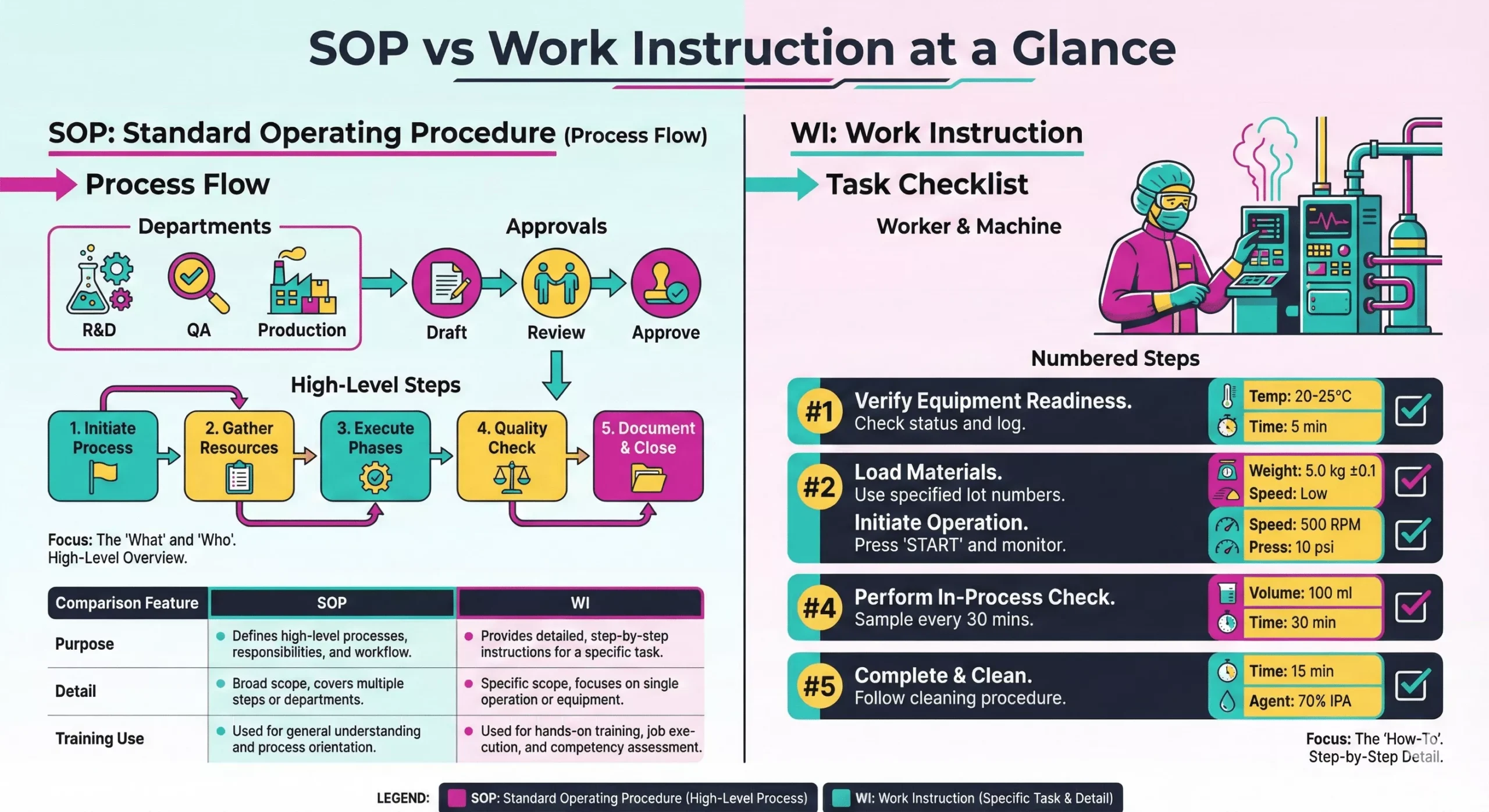
Aspect SOP (Standard Operating Procedure) Work Instruction (WI)

Purpose 

Controls a process from end to end 

Guides a specific task inside that process 

Focus level 

Process-level, cross-functional
Task-level, step-by-step

Audience 

Supervisors, QA, production leads, support teams
Operators, technicians, line staff

Detail level

Tells what to do and who does it 

Shows exactly how to do it (steps, settings, screenshots, photos) 

Format 

Text, flow diagrams, sometimes high-level decision trees
Checklists, numbered steps, annotated images, screen-by-screen guides

Audit exposure 

Auditors always review SOPs; they check alignment with regulations and records
Auditors sample WIs to confirm that execution really matches the SOP and the batch records

Training use 

Supports theory training and process understanding
Supports hands-on training, qualification, and competency checks

Change frequency 

Changes less often; driven by process or regulatory change
Changes more often; driven by equipment updates, UI changes, or method optimization

Typical owners 

QA / Quality Systems, process owners
Area supervisors, SMEs, senior operators, reviewed by QA

What Is an SOP

An SOP (Standard Operating Procedure) defines how a GMP-relevant process runs from start to finish. It describes responsibilities, inputs, outputs, and key controls that protect product quality and patient safety. Both FDA 21 CFR 211 and EU GMP Chapter 4 expect written procedures for critical production and quality activities, so SOPs sit at the heart of compliance. 

Unlike a WI, an SOP remains at process level. It does not explain every button press or manual adjustment. Instead, it points to the specific tasks that need work instructions and tells staff when they must follow them. 

Core Structure of an SOP

Most GMP SOPs follow a similar structure. Each part supports compliance in a different way: 

When this structure stays stable across the QMS, people find information faster and auditors see a logical, consistent system. 

SOP vs. Work Instruction

What Is a Work Instruction

Work Instruction (WI) is a detailed, step-by-step guide for performing a single task. It sits below the SOP in the documentation hierarchy and turns the process “what” into the execution “how.” While the SOP describes the overall process, the WI focuses on the hands-on actions at the workstation. 

In the SOP vs Work Instruction comparison, a WI usually: 

  • Focuses on one specific task within a larger GMP process. 
  • Uses numbered steps, photos, diagrams, or screenshots to guide execution. 
  • Includes exact settings and parameters, such as time, temperature, speed, and volumes. 
  • Speaks directly to operators and technicians, not to managers or auditors. 
  • Lives close to the point of use, for example next to the machine or inside the MES/LMS screen. 

A strong WI removes guesswork. Any trained operator can follow it, even when tired or new, and still perform the task in a consistent way. 

When SOPs and WIs Apply in GMP Operations

In daily GMP work, SOP vs Work Instruction each covers a clear space. 

Apply SOPs when you: 

  • Describe a regulated process such as batch manufacturing, equipment cleaning, or deviation management. 
  • Needs to align multiple teams or departments. 
  • Want to show regulators that you control critical activities from input to output. 

Use WIs when you: 

  • Break a process into repeatable tasks that demand precision. 
  • Need repeatable execution by many operators across shifts. 
  • Standardisz how staff use specific equipment, software, or tools. 

When a system relies only on SOPs and never creates WIs, operators start to fill gaps with tribal knowledge.
In the opposite situation, where teams use only WIs and skip process-level SOPs, the big picture disappears and regulatory expectations break. These documentation gaps increase deviation risk and confuse auditors.

Regulatory Expectations: SOP vs WI (FDA & EU GMP)

FDA 21 CFR 211 requires written procedures for production and process control, along with documented adherence and deviation management. EU GMP Chapter 4 defines documentation as a core part of the Pharmaceutical Quality System and expects clear instructions and records for GMP activities.  

Regulations rarely say “Work Instruction” explicitly. However, they expect sufficient detail for consistent execution. Many companies meet that expectation by combining process-level SOPs with task-level WIs. 

Audit Findings Caused by SOP–WI Misalignment

Inspectors regularly see issues that come directly from SOP vs Work Instruction confusion. Typical findings include: 

Unclear SOPs that never mention the WI

Staff follow different local instructions, and batch records show inconsistent practices between shifts. 

Outdated WIs that do not match the current SOP

Operators use old settings, and validation data no longer reflects real execution. 

Mixed content: SOP reads like a WI

Documents become too long, training loses focus, and critical controls hide inside excessive detail. 

No controlled WI for a critical manual step

Teams rely on verbal instructions, and inspectors question how consistency is ensured.

Training done only on the SOP, not on the WI

Staff sign training records but cannot accurately describe task steps during interviews. 

Many FDA 483 observations connect back to weak procedures, poor document control, or failure to follow written instructions, all of which relate to SOP and WI design. 

Deviation Example: When SOP and WI Conflict

Imagine this simple deviation: 

  • SOP for equipment cleaning states: “Clean the granulator after each batch per WI-CLN-030.” 
  • The WI-CLN-030 still uses an old disinfectant and does not include a required contact time from a recent validation study. 
  • An operator follows the WI. Swab results fail. QA opens a deviation and traces the root cause to SOP–WI misalignment. 

By updating the WI in sync with the SOP change, the company would have avoided the failed result, rework, and potential 483 observation.

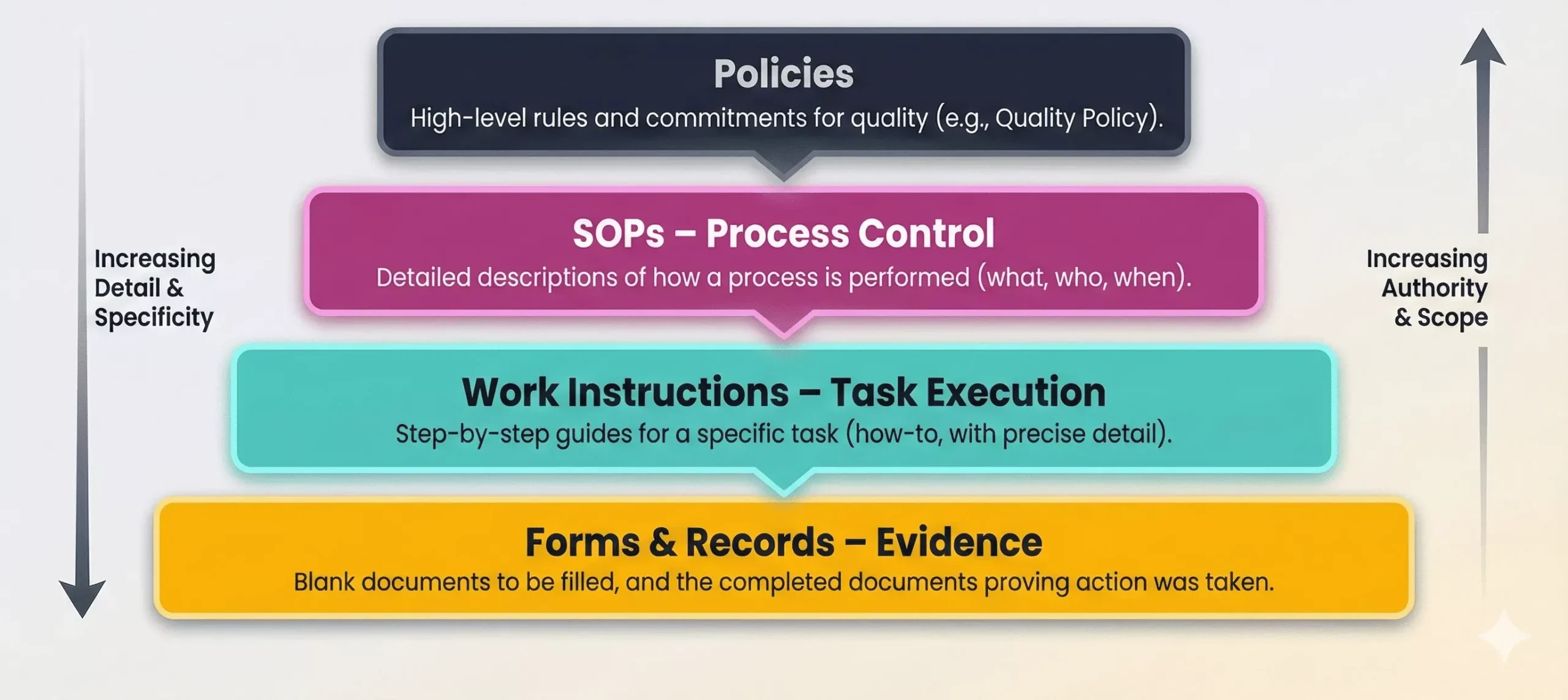
SOP vs WI in QMS Documentation Hierarchy

You can place SOP vs Work Instruction clearly inside a GMP documentation hierarchy like this: 

When you mix SOP and WI content in one uncontrolled way, you blur these layers and weaken your QMS design. 

SOP vs. Work Instruction

Training Impact: SOP Knowledge vs WI Execution

Training programs must respect SOP vs Work Instruction roles: 

  • SOP training builds theoretical understanding: why the process exists, which risks it controls, and who holds responsibilities. 
  • Work Instruction training builds hands-on competence: how to execute each task correctly, which buttons to press, and which parameters to verify. 

Training records should show both levels: acknowledgement of SOP training and successful competency checks against the WI, often through practical assessments or on-the-job observations. 

Final Words

Clear separation of SOP vs Work Instruction makes your GMP system more robust, easier to train, and less vulnerable during inspections. One industry analysis reported that almost 48% of observed quality-system failures involved uncontrolled or poorly documented procedures and changes. Strong SOPs and aligned WIs directly reduce that risk. 

When you design your documentation hierarchy on purpose, you cut deviations, speed up onboarding, and build a culture where people trust the documents they use. If you want to turn these principles into real-world skills, you can Explore Pharma Courses that cover GMP documentation, QMS design, and audit readiness in depth. 

FAQ:

Who approves SOP vs Work Instruction in a GMP company?

In most GMP companies, SOPs are approved by QA or Quality Systems together with process owners, while WIs are usually drafted by area SMEs or supervisors and then released under QA-controlled document procedures. 

How often should we update SOP/Work Instruction?

SOPs are typically revised when processes or regulations change, whereas WIs are updated more frequently to reflect equipment, software, or task-detail changes, and both documents must stay synchronized in version control. 

Which document has priority in training: SOP or Work Instruction?

Training usually starts with SOPs to build process understanding and then moves to WI-based practical training so staff can perform specific tasks correctly and consistently. 

References:

Picture of Stephanie Männicke

Stephanie Männicke

Digital Marketing Especialist at Zamann Pharma Support, brings 8 years of experience in Corporate and Digital Communication. Specializing in Digital Marketing and Content Creation, Stephanie is currently focused on creating strategic content for Pharmuni's networks, especially content on topics such as recruitment, onboarding and employer branding. Outside of work, Stephanie is a mum, a crocheter and a movie fan. An avid reader and in search of expanding her knowledge, Stephanie is always looking for ways to innovate communication in the digital environment and connect people in a genuine way.

Share