
Good Pharmacovigilance Practices (GVP) 2024: Core Principles and Regulatory Requirements

Understand what Good Pharmacovigilance Practices (GVP) are and download the PDF to get a concise map of EU/WHO-aligned safety obligations. GVP defines quality systems, reporting timelines, and oversight roles for MAHs, QPPVs, and regulators, supporting consistent benefit–risk decisions.

Pharmacovigilance turns these rules into action: collecting ICSRs, detecting signals, updating RMPs, and communicating risks. WHO notes medication-related harm costs about US$42 billion yearly and 170+ countries participate in the WHO Programme for International Drug Monitoring, underscoring global expectations for robust compliant systems.

Table of Contents

What are Good Pharmacovigilance Practices (GVP)?

Good Pharmacovigilance Practices (GVP) guide how teams keep medicines safe. They set clear rules for reporting, tracking, and reducing risks. MAHs and QPPVs act fast and document decisions.

You can follow GVP by doing these actions: 

  • Collect and review adverse event reports.
  • Detect safety signals and update risk plans.
  • Share new risks with regulators and patients.


Download PDF EMA GVP guidance Annex 1 Here

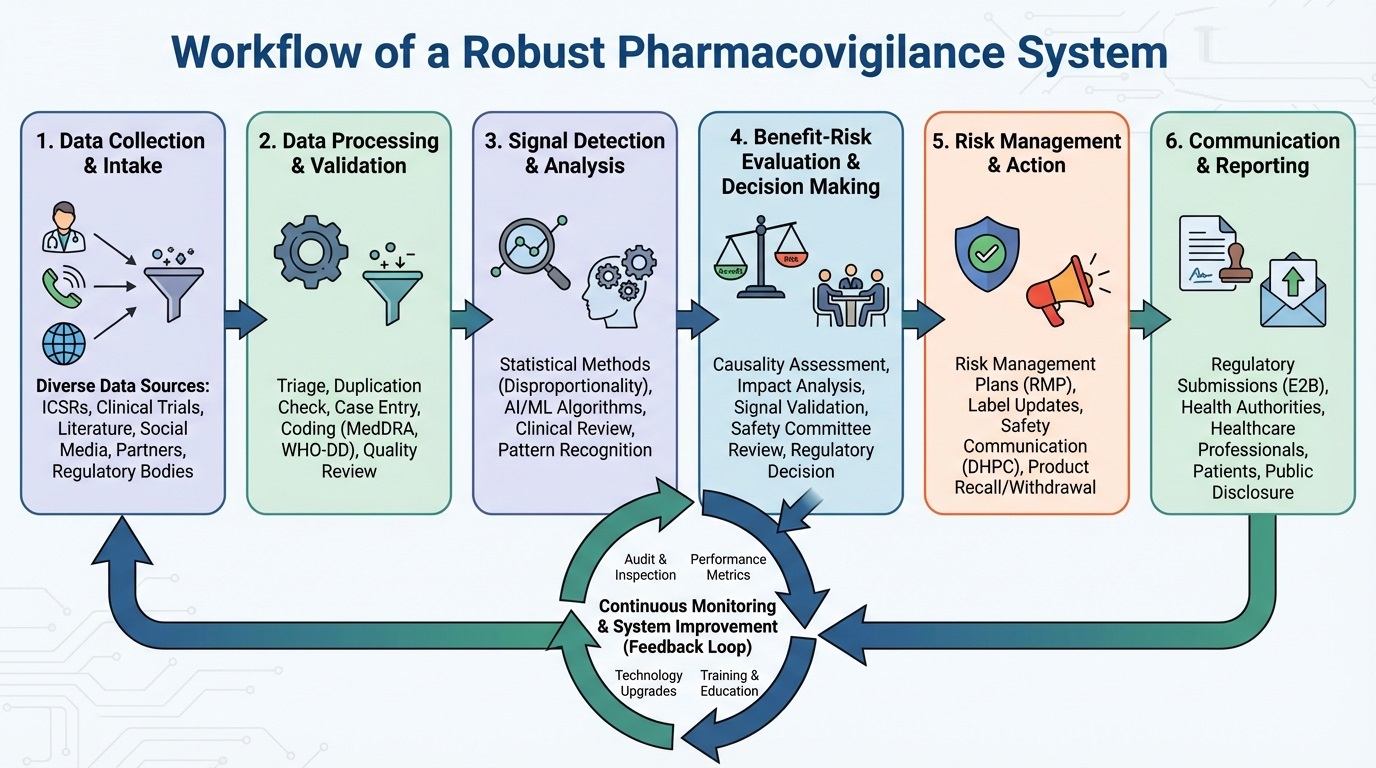
Workflow of a Robust Pharmacovigilance System

Regulatory requirements for pharmacovigilance under GVP

GVP sets clear pharmacovigilance rules for marketing authorisation holders in the EU. You must collect, assess, and report adverse reactions within legal timelines.

  • Maintain a pharmacovigilance system master file and a qualified person.
  • Submit ICSRs, PSURs, and RMP updates through EudraVigilance and EU portals.
  • Perform signal detection, manage risks, and run audits regularly.

Key Principles of Good Pharmacovigilance Practices

Good pharmacovigilance protects patients and supports safe medicine use. Teams collect safety reports and act fast on new risks.

Therefore, follow four principles to keep safety work clear.

  1. Establish a Robust Pharmacovigilance System: Assign roles, train staff, record decisions.
  2. Ensure Timely and Accurate Reporting: Submit cases quickly and verify details.
  3. Risk Management and Minimization: Update plans, communicate warnings, reduce harm.
  4. Continuous Monitoring and Evaluation: Track signals, trends, improve processes.

Number 1: Establish a Robust Pharmacovigilance System

Build a pharmacovigilance system with roles and trained staff. Use standard procedures to capture, assess, and document every safety case. Keep auditable records, track deadlines, and review metrics monthly.

Next, align processes with ICH requirements to avoid gaps.

Download ICH E2E guidance

Number 2: Ensure Timely and Accurate Reporting

Set clear timelines for case intake, assessment, and submission to regulators. Train staff to capture complete patient, product, and event details at first contact. 

Then, use validated electronic forms; therefore, you reduce errors and speed follow-up. Audit reports weekly, correct discrepancies quickly, and meet strict ICH deadlines always.

Number 3: Risk Management and Minimization

Identify key risks early and score them by impact and likelihood. Therefore, set clear controls, assign owners, and track actions weekly.


  • Train teams to follow procedures and report deviations immediately.
  • Use checklists and automated alerts to prevent recurring errors.
  • Review metrics monthly and update the risk plan after every change.

Number 4: Continuous Monitoring and Evaluation

Set clear goals and choose metrics for performance and compliance. Then, collect data daily and flag unusual changes quickly.

  • Review dashboards weekly and ask teams to explain gaps.
  • Test controls monthly and fix issues immediately.
  • Report results to leaders and adjust plans after each review to prevent repeat problems fast.

Differences between GVP and Good Clinical Practice (GCP)

GCP follows ICH E6(R2) and FDA 21 CFR 312 rules. Teams protect subjects, get consent, and record trial adverse events quickly. Monitors check data at every visit and ensure investigators follow the protocol.


GVP uses ICH E2E and FDA 21 CFR 314.80 to report safety. However, after approval, teams track real‑world side effects daily and manage risks. Example: during a trial, staff log nausea; later, safety teams detect clusters worldwide.

Comparison of GVP and GCP Key Differences

Aspect GVP (Good Pharmacovigilance Practices) GCP (Good Clinical Practice)
Main purpose
Detect, assess, and prevent medicine safety risks post-authorization
Protect subjects and ensure reliable clinical trial data
Primary focus
Adverse event monitoring and benefit–risk management
Trial conduct, ethics, and data integrity
When it applies
After marketing authorization (and during trials for ongoing safety)
During clinical trial design, conduct, and reporting
Key activities
Case processing, signal detection, PSUR/PBRER, risk management plans
Informed consent, protocol compliance, monitoring, auditing
Key stakeholders
MAH, PV/QPPV teams, regulators, healthcare professionals
Sponsors, investigators, CROs, IRB/IEC, monitors

Roles and responsibilities according to GVP guidelines

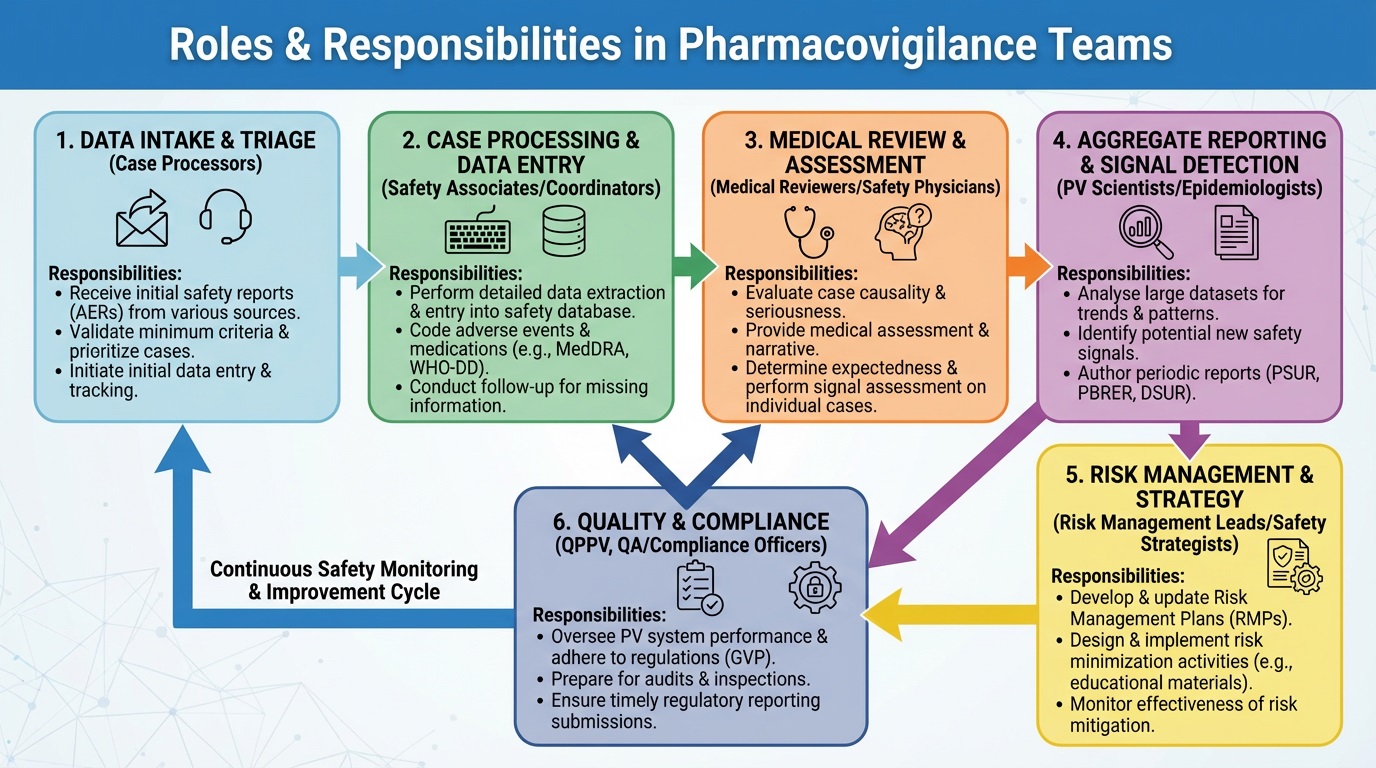
The QPPV leads the global pharmacovigilance system and approves procedures. Safety staff collect adverse event reports from patients, literature, and call centers.  They code events in MedDRA and enter cases within one day. 


However, case processors submit serious unexpected reports within 15 days to regulators. Medical reviewers assess causality, signal trends, and request follow-up within 7 days.  The MAH audits vendors, trains staff yearly, and delivers PSURs every six months.

Roles & Responsibilities in Pharmacovigilance Teams

Pharmacovigilance Officer/Qualified Person Responsible for Pharmacovigilance (QPPV)

The QPPV leads the global pharmacovigilance system and signs PV procedures. The QPPV reviews serious reports daily and confirms data within 24 hours.

However, the QPPV reports SUSARs within 15 days. The QPPV trains staff yearly and checks vendors quarterly. The QPPV submits PSURs every six months and tracks signals.

Pharmacovigilance Team Members

The QPPV leads the PV system and approves procedures. Case processors enter 30 reports daily and triage serious cases fast. Medical reviewers assess causality and code events with MedDRA. 

However, signal managers review dashboards weekly and flag new trends quickly. Data analysts check duplicates daily and keep errors below 2%.

Senior Management

Senior PV leaders set strategy and track compliance metrics monthly. They review 120 serious cases weekly and approve 24-hour reporting.

Therefore, managers fund two new safety analysts to cut backlog. They chair one signal meeting weekly and log five actions. They aim for 98% audit readiness and 2-day case triage.

Final Words

Good Pharmacovigilance Practices (GVP) drive early risk detection and protect patients. Teams assess cases and communicate signals promptly. Under FDA rules, sponsors submit serious, unexpected IND safety reports within 7 or 15 calendar days (21 CFR 312.32). Thus, GVP supports safer labeling and faster risk mitigation.

quality assurance builds compliance through training, audits, and CAPA. It checks that systems submit 15-day postmarketing alert reports for serious, unexpected events (21 CFR 314.80). Moreover, it verifies data integrity in FAERS submissions and reviews. Leaders track 100% on-time reporting, reduce inspection findings, and strengthen public health protection overall.

FAQs

1️⃣ What’s the difference between GVP and pharmacovigilance (PV) activities?

GVP is the quality framework (systems, roles, documentation, oversight, audits) that defines how PV must be run; PV activities are the operational work (ICSR intake, case processing, signal detection, RMP updates, risk communication) performed within that framework.

2️⃣ Who is responsible for GVP compliance in an EU marketing authorisation holder (MAH)?

The MAH is ultimately accountable, with the QPPV ensuring the pharmacovigilance system is established, maintained, and inspection-ready (e.g., oversight of the PSMF, processes, vendors, and CAPA), while senior management provides resources and governance.

3️⃣ How does quality assurance (QA) strengthen pharmacovigilance outcomes?

QA verifies process compliance and data integrity through training, audits, SOP control, deviation management, and CAPA—reducing late/incorrect reporting, preventing repeat findings, and supporting consistent benefit–risk decisions and patient protection.

References

Picture of Ershad Moradi

Ershad Moradi

Ershad Moradi, a Content Marketing Specialist at Zamann Pharma Support, brings 6 years of experience in the pharmaceutical industry. Specializing in pharmaceutical and medical technologies, Ershad is currently focused on expanding his knowledge in marketing and improving communication in the field. Outside of work, Ershad enjoys reading and attending industry related networks to stay up-to-date on the latest advancements. With a passion for continuous learning and growth, Ershad is always looking for new opportunities to enhance his skills and contribute to pharmaceutical industry. Connect with Ershad on Facebook for more information.

Share