

FDA published the Sun Pharma recall notice on May 13, 2026. The recall involved one batch of DOXOrubicin Hydrochloride Liposome Injection 50mg/25 mL.
The affected batch included 675 vials with possible glass particles.
FDA warned that intravenous glass particles may create serious patient-safety risks.
This matters for QA, QC, production, validation, and GMP professionals because contamination control protects patients and careers.
What Did FDA Report About the Sun Pharma Recall?
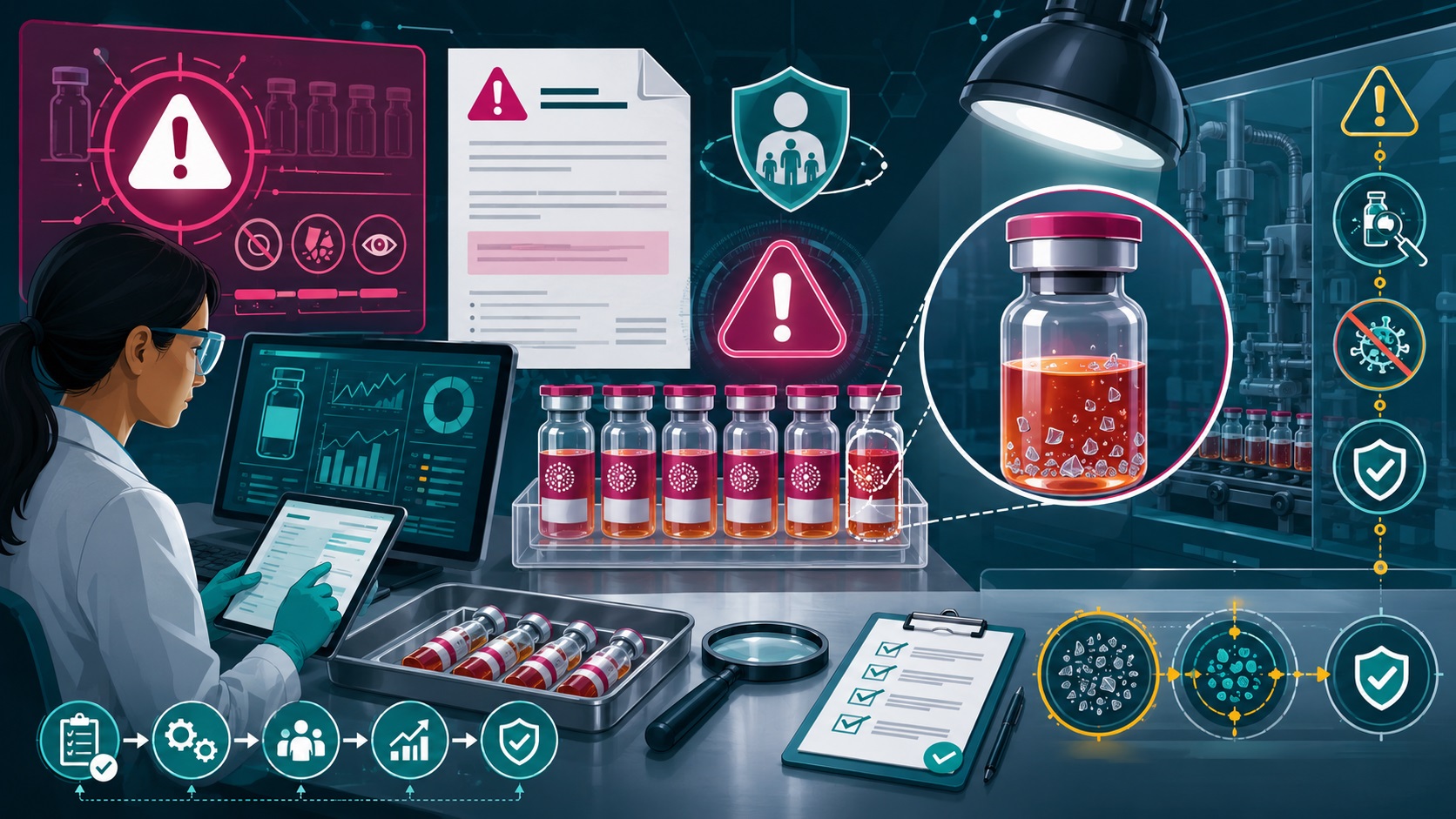
FDA reported that Sun Pharma recalled 675 vials of DOXOrubicin Hydrochloride Liposome Injection 50mg/25 mL after detecting glass particles in some vials during production. The affected batch was Lot HAG2581B, with expiration 05/31/2027. This recall shows how one visible defect can trigger major patient-safety action.
Why Can Glass Particles Create Serious GMP Pressure?
Strong QC visual inspection can catch visible defects before release, and strong CAPA can prevent recurrence. However, glass particles in injectable products can create serious patient-safety risks, including irritation, swelling, blocked blood vessels, and life-threatening clot events. For QA, QC, production, and validation teams, weak contamination control can damage product trust, inspection confidence, and career credibility.
How Does This Recall Connect to Pharma Careers?
This recall matters for QA, QC, production, validation, GMP professionals, graduates, and immigrant pharma professionals. It shows why contamination control, visual inspection, deviation handling, CAPA, and production discipline are practical career skills, not only technical requirements.
Why QC Teams Should Care
QC teams must protect patients by detecting visible defects, particles, and contamination risks before release. Injectable products need strong inspection discipline, clear acceptance criteria, and documented quality decisions.
- Strengthen visual inspection training and sampling controls.
- Review particle detection and defect classification procedures.
Why Production and Validation Teams Should Watch
Production and validation teams must control equipment, glass handling, line clearance, and filling conditions. Strong validation and deviation review can reduce contamination risk during manufacturing.
- Check line clearance and equipment inspection records.
- Verify that deviations receive scientific root cause review.
Why Immigrant Pharma Professionals Must Prepare
Immigrant professionals need GMP contamination-control language for resumes, interviews, and regulated job markets. Recall knowledge can help them target QA, QC, and production roles.
- Add visual inspection, CAPA, and contamination-control keywords to resumes.
- Practice interview answers about recalls, deviations, and patient safety.
What Could Be the Result for GMP Teams?
This FDA recall involved 675 vials and possible glass particles in an injectable product. The result is clear: patient safety depends on strong inspection, contamination control, and CAPA. For QA, QC, production, and validation professionals, recall knowledge can improve inspection readiness and interview confidence.
Build your GMP foundation before inspection pressure increases. Start learning quality systems, documentation, production control, validation, and inspection readiness with Pharmuni’s GMP Basics Career Path.
To go deeper, explore Pharmuni’s GMP Corrective and Preventive Actions (CAPA) Management course. Learn how root cause analysis, CAPA effectiveness, and quality documentation help protect patients and products.
Read more on Pharmuni:
Explore GMP Basics Career Path
Start GMP Corrective and Preventive Actions (CAPA) Management