

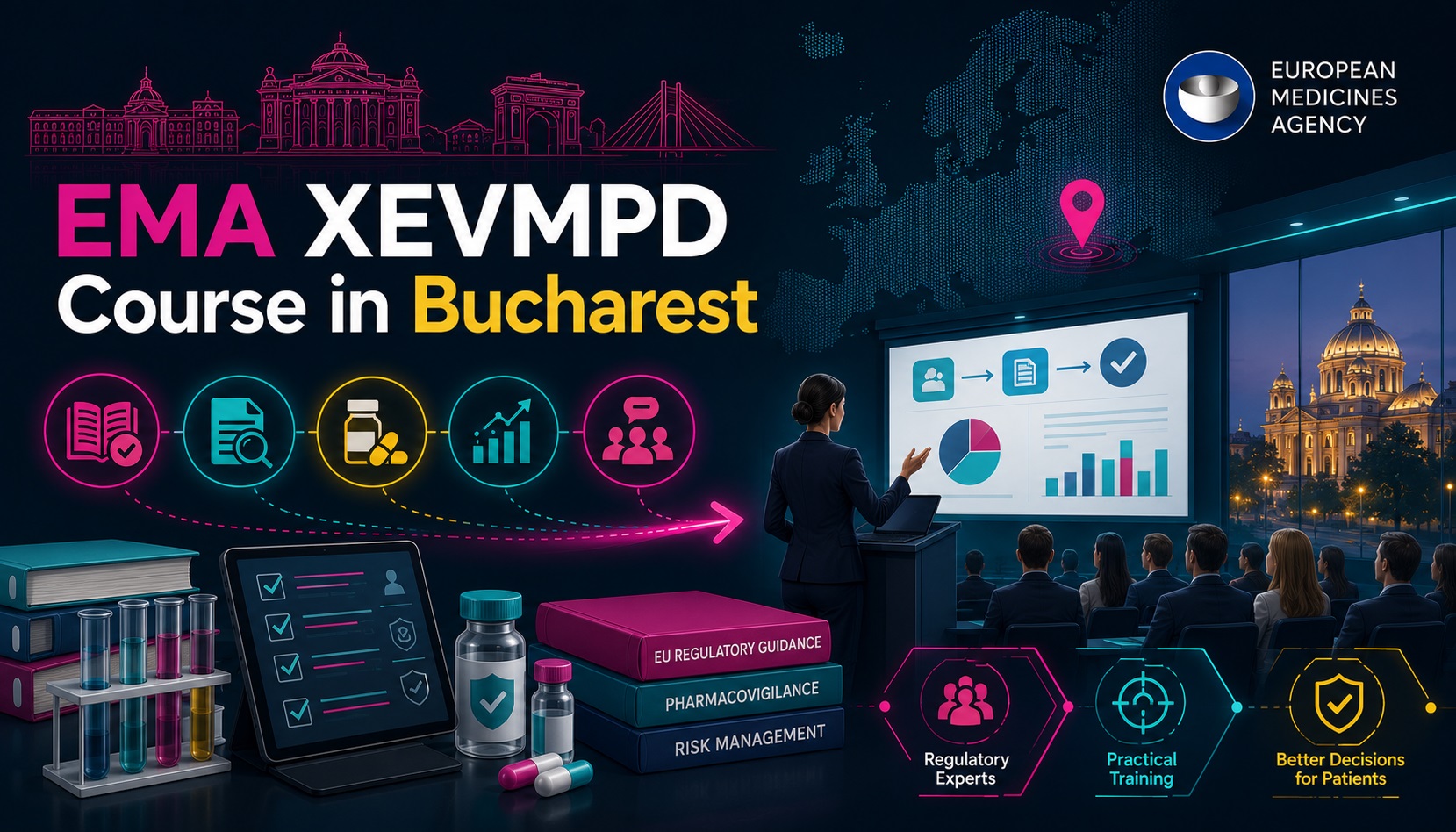
The European Medicines Agency published details of an in-person XEVMPD training course in Bucharest on 8 July 2026. The sessions will run on 29 and 30 October and cover mandatory medicinal-product data, the XEVPRM message format and practical use of XEVMPDweb. Regulatory affairs and pharmacovigilance professionals often work with this information throughout a product’s lifecycle. Structured medicines data is now a career skill, not an administrative afterthought. Accurate records support regulatory action, safety systems and reliable communication across organisations.
Understand the Business Purpose
XEVMPD is used for the electronic submission and maintenance of information on authorised and development medicinal products. The work involves controlled terms, product identifiers, substance information and defined business rules. A single incorrect field can create mismatches across regulatory and safety systems. Learners should therefore understand why the data exists, who owns it and which downstream processes depend on it. Technical entry is only one part of the job; governance and quality review matter equally.
See the Cross-Functional Workflow
Regulatory operations may coordinate the submission, but data can originate from clinical, safety, manufacturing and quality teams. Changes to product names, formulations, authorisations or organisations may require controlled updates. Professionals need to compare source documents, resolve inconsistencies and maintain traceability. This makes XEVMPD knowledge relevant to regulatory data associates, submission specialists, pharmacovigilance operations staff and master-data professionals. Employers value candidates who can explain both the system and the process surrounding it.
Prepare Before the Practical Session
Participants should review Article 57 concepts, common medicinal-product fields and basic XEVMPD terminology before attending. They can map one fictional medicine from substance and dosage form to authorisation details. They should also list likely data owners and approval steps. During the course, questions should focus on error handling, maintenance, validation messages and difficult scenarios. Preparation allows learners to spend more time applying the rules instead of decoding every acronym.
Show Capability After Training
Attendance alone does not prove competence. After the course, create a one-page workflow showing how a data change is requested, checked, approved, submitted and verified. Record the business rules learned and describe one quality risk prevented by each control. This portfolio evidence can support an interview without exposing confidential company information. It shows that the learner can translate regulatory training into an organised, inspection-ready process.
Bring Better Training Questions
Participants should arrive with examples from their own product-data workflow, including difficult fields, validation errors and ownership gaps. Specific questions help convert a general course into improvements that can be applied immediately after returning to work.
The strongest data specialist understands the regulation behind every field. Continue with Pharmuni’s Introduction to Regulatory Affairs course and connect XEVMPD operations with the wider medicines lifecycle.