


Deviation Management in Pharma in 2026: GMP Process and Inspection Expectations

Recent inspection trends show that over 65% of GMP findings in 2024–2025 link directly to weak deviation handling or delayed closure, which makes Deviation Management in pharma one of the most scrutinized quality processes today. As regulators tighten expectations, companies must not only document deviations but also demonstrate clear root cause logic, strong CAPA linkage, and consistent lifecycle control. Therefore, teams working in pharma quality assurance need to move beyond basic reporting and focus on structured investigations, risk-based classification, and measurable effectiveness checks. In addition, inspectors now expect real-time visibility into recurring deviations and systemic gaps, which means that deviation systems must actively prevent issues not just record them.

Table of Contents

What is Deviation Management in GMP systems

Deviation management refers to a structured process that handles any unplanned event that differs from approved instructions, procedures, or specifications. In GMP systems, teams use deviation management to maintain control over manufacturing and quality processes.

For example, if a production step does not follow the standard operating procedure (SOP), the team must log it as a deviation. Then, they investigate the root cause and implement corrective actions. Therefore, deviation management ensures continuous improvement and operational transparency.

How deviation control supports inspection readiness

Effective control of deviations builds a clear and defensible quality narrative during inspections. When teams ensure full traceability, inspectors can quickly understand what happened, why it happened, and how the system responded. Moreover, timely closure shows strong process control, while structured investigations with justified root causes increase credibility. Therefore, Deviation Management in pharma does not only document problems; it demonstrates how consistently a company controls risk and prevents recurrence. In addition, linking deviations to CAPA and tracking effectiveness creates a proactive system that inspectors trust.

Deviation lifecycle stages in GMP systems

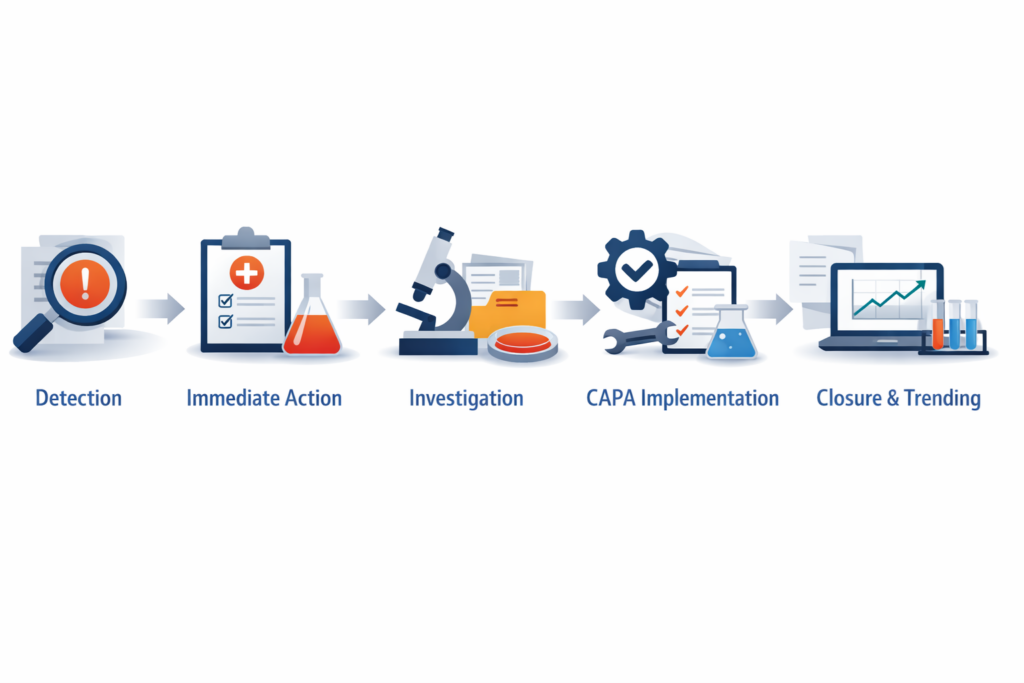
A structured deviation lifecycle gives teams a clear path from detection to resolution. At detection, teams act quickly to contain risk and protect product quality. Then, they investigate using data to identify the true root cause and link findings to corrective and preventive actions. As the process continues, teams review effectiveness and confirm measurable improvement. Therefore, a controlled lifecycle not only resolves individual events but also strengthens the overall quality system and helps detect patterns before issues become systemic.

In the following sections, we break down each stage of the deviation lifecycle and explain how it contributes to a controlled and inspection-ready GMP system:

  • Deviation identification and immediate action (PDF)
  • Investigation and root cause analysis (PDF)
  • CAPA linkage and implementation (PDF)
  • Closure, review, and trending (PDF)


This infographic outlines the pharmaceutical deviation lifecycle, demonstrating how deviations are systematically managed from initial detection through investigation and CAPA implementation to final closure and trending analysis.

Pharmaceutical deviation management lifecycle showing detection, investigation, CAPA implementation, and quality risk management in GMP environments
A structured overview of the pharmaceutical deviation lifecycle, illustrating how GMP deviation management integrates investigation, root cause analysis, and CAPA processes to ensure product quality and regulatory compliance.

Deviation identification and immediate action (PDF)

Teams must detect deviations immediately and assess their impact on product quality. Then, they apply containment actions quickly to control risk and document the event.

Investigation and root cause analysis (PDF)

Teams must investigate deviations using structured methods to identify the true root cause. Moreover, they must support conclusions with clear and scientific evidence.

CAPA linkage and implementation (PDF)

Teams must define CAPAs that directly address the root cause and prevent recurrence. In addition, they must track implementation and verify effectiveness.

Closure, review, and trending (PDF)

Teams must confirm all actions before closing the deviation and ensure effectiveness. Furthermore, they must analyze trends to identify recurring issues.

Inspection findings in deviation management systems

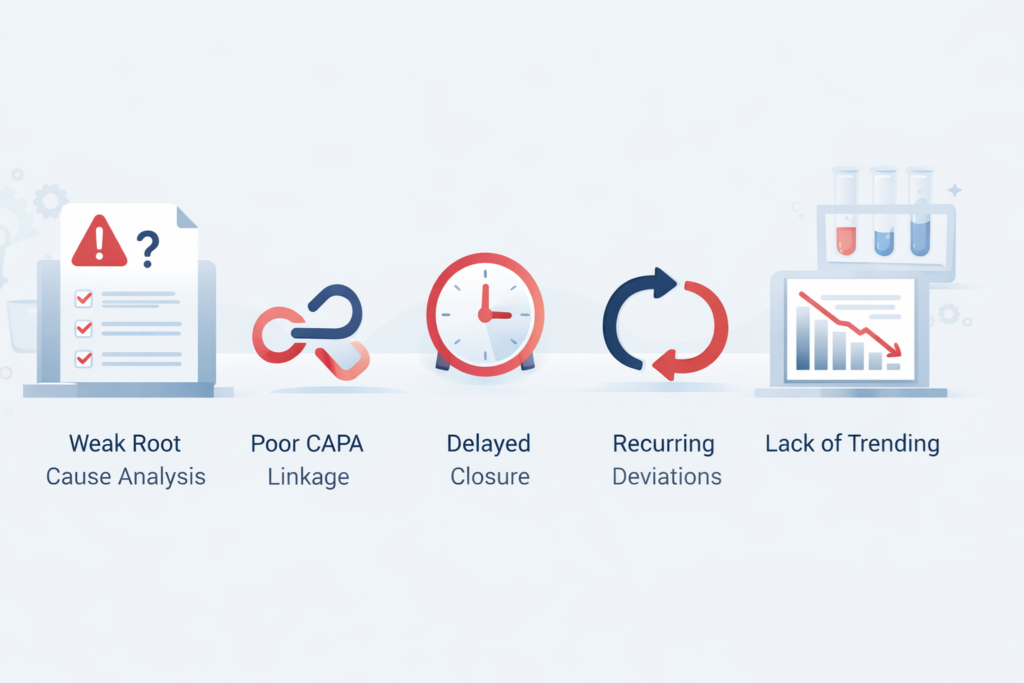
Inspection findings show that many companies struggle to justify root causes with clear data and often fail to link CAPA to the real issue. Moreover, delayed closure signals weak system control, especially when recurring deviations lack proper trending.

The infographic below highlights the most common GMP inspection findings and key failure points in deviation management systems.

Common GMP inspection findings in pharmaceutical deviation management including root cause gaps, weak CAPA linkage, delayed closure, and recurring deviations
An overview of the most frequent inspection findings in deviation management systems, showing how gaps in root cause analysis, CAPA effectiveness, and closure timelines impact GMP compliance.

Inspection-ready deviation tracking systems in GMP

Inspection-ready systems give companies strong control over deviations through structured workflows, real-time visibility, and reliable data integrity. Moreover, they ensure clear linkage between deviations, investigations, and CAPA actions, which improves traceability across the lifecycle. At the same time, regulators expect audit trails, enforced timelines, and complete data. Therefore, companies that move to integrated QMS platforms achieve faster closure, stronger compliance, and better inspection outcomes, while reducing human error and detecting recurring issues earlier.


The table below compares key capabilities of inspection-ready deviation tracking systems with common weaknesses found in non-compliant GMP environments:

System Capability (Inspection-Ready) Common GMP Gap (Inspection Findings) Impact on Inspection
Standardized deviation records with complete data fields
Inconsistent or incomplete deviation documentation
Inspectors cannot trace events clearly
Automated workflow and task assignment
Manual follow-up and unclear responsibilities
Delays in investigation and closure
Integrated root cause analysis tools
Weak or subjective root cause justification
Repeated findings and lack of credibility
Direct linkage between deviation, RCA, and CAPA
CAPA disconnected from root cause
Ineffective corrective actions
Built-in audit trails and data integrity controls
Missing or unreliable data history
Data integrity concerns (critical findings)
Real-time dashboards and trend analysis
No deviation trending or recurrence tracking
Increased risk of repeat deviations
Defined timelines with escalation alerts
Delayed deviation closure
Signals weak quality system control
Centralized document and evidence storage
Scattered or missing investigation records
Difficult audit readiness

Final words

A deeper review of regulatory data shows that 82% of GMP observations cluster into just a few recurring quality failures, including weak investigations, poor CAPA effectiveness, and inadequate deviation control, which clearly demonstrates how systemic gaps continue to drive inspection outcomes. Therefore, companies that treat deviations as isolated records will repeatedly face the same findings, while those that build structured, data-driven systems will demonstrate real control. In addition, regulators now expect organizations to learn from patterns, not just close individual cases. As a result, Deviation Management in pharma has become a critical indicator of how mature, proactive, and inspection-ready a quality system truly is.

FAQs

1️⃣Why do inspectors reject root cause analysis in deviation investigations?

Because teams often rely on assumptions instead of data. Inspectors expect clear evidence, logical reasoning, and a direct link between the root cause and the deviation.

2️⃣What makes a CAPA ineffective during GMP inspections?

A CAPA fails when it does not address the true root cause or lacks measurable effectiveness checks. In regulated manufacturing, actions must prevent recurrence, not just fix the immediate issue.

3️⃣Why do deviation closures get flagged during inspections?

Delays and incomplete documentation trigger most findings. Inspectors expect timely closure supported by verified actions, full records, and trend evaluation across batches and processes.

Picture of Mahtab Shardi
Mahtab Shardi

Mahtab is a pharmaceutical professional with a Master’s degree in Physical Chemistry and over five years of experience in laboratory and QC roles. Mahtab contributes reliable, well-structured pharmaceutical content to Pharmuni, helping turn complex scientific topics into clear, practical insights for industry professionals and students.

Pharmaceutical professionals working in a modern lab environment aligned with Kuwait Ministry of Health regulations and GMP compliance standards in the Gulf pharmaceutical industry.

Pharma Jobs in Kuwait in 2026: GCC Hiring and Compliance Insights

Kuwait’s pharmaceutical sector continues to expand under strict Ministry of Health regulations and GCC compliance frameworks. This guide explains regulatory pathways, major employers, salary expectations, and licensing requirements for professionals pursuing pharmaceutical careers within Kuwait’s growing Gulf healthcare market.

Read More »
CQA

Critical Quality Attribute (CQA) in 2026: Expert Guide to Ensure Drug Quality

Critical Quality Attributes (CQAs) are crucial in pharmaceutical manufacturing because they directly affect drug safety, efficacy, and consistency. Regulatory agencies including the FDA and ICH require thorough CQA assessment to minimize risks and ensure high-quality medicines. By following best practices like early identification, risk assessment, and continuous monitoring, manufacturers can maintain robust production processes. Implementing modern strategies such as Quality by Design and integrating CQAs with quality assurance systems ensures compliance and safeguards patient health throughout the product lifecycle

Read More »

Share