


Critical Quality Attribute (CQA) in 2026: Expert Guide to Ensure Drug Quality

Critical Quality Attribute (CQA) is essential in pharmaceutical manufacturing, directly impacting drug safety, efficacy, and consistency. According to the World Health Organization, over 40% of drug failures in quality tests are attributed to uncontrolled CQAs, highlighting their critical role. Modern approaches like Quality by Design (QbD) emphasize early identification and control of CQAs to ensure robust drug development and manufacturing processes. Regulatory agencies such as the FDA and ICH mandate thorough CQA assessment to minimize risks and maintain high-quality standards throughout the product lifecycle.

Adhering to Good Manufacturing Practices (GMP) ensures consistent monitoring and control of CQAs, reducing variability and safeguarding patient health. GMP frameworks integrate CQA management as a core component to maintain product integrity and comply with regulatory requirements. This systematic control supports pharmaceutical companies in delivering safe, effective, and reliable medicines to the market, fulfilling both patient needs and regulatory expectations.

Table of Contents

What is Critical Quality Attribute (CQA) in pharmaceuticals?

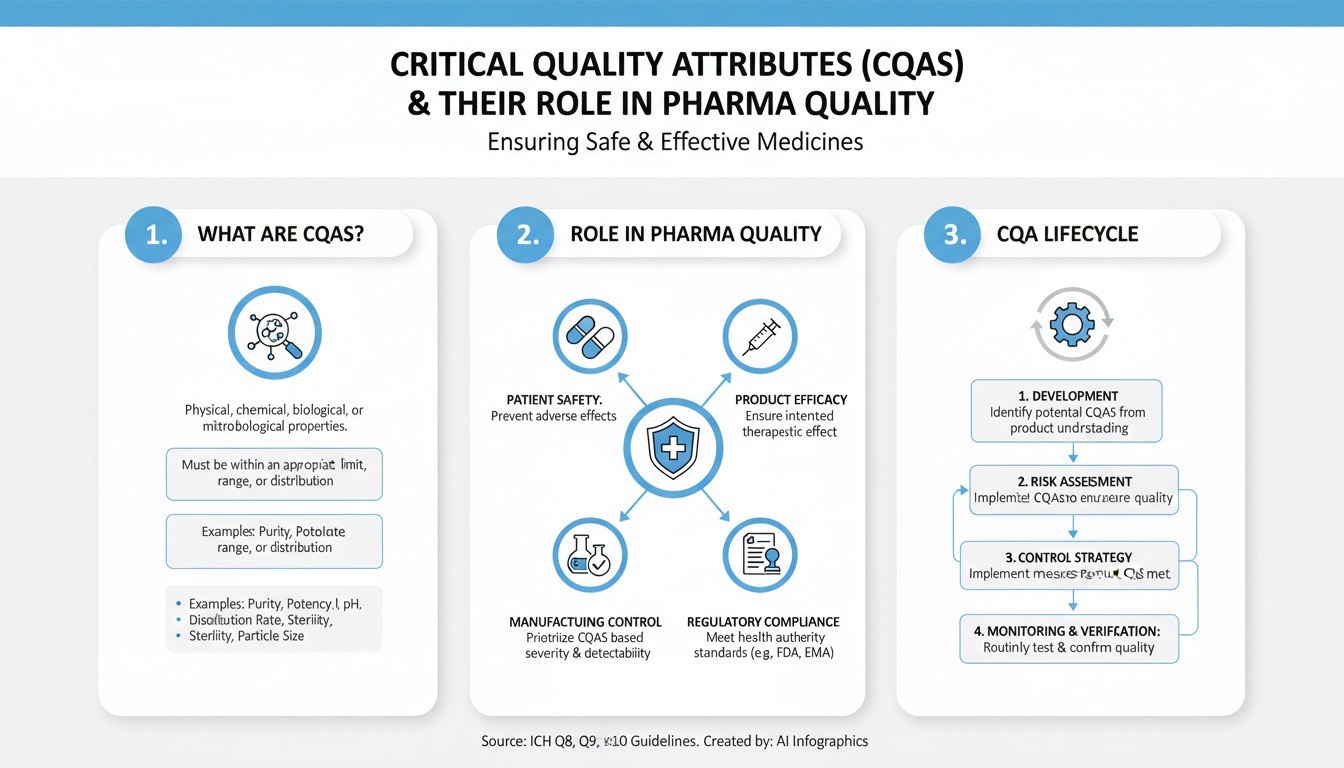
Critical Quality Attribute (CQA) in pharmaceuticals refers to a property that affects drug quality. These attributes influence the drug’s safety, effectiveness, and consistency. Manufacturers focus on CQAs to ensure products meet quality standards. Also, regulatory agencies require strict control of CQAs to protect patients and provide reliable medicines.


CQAs include many important factors, such as:


  • Drug potency
  • Purity levels
  • Dissolution rate
  • Sterility
  • Stability
  • Particle size
  • pH level


Overview of Critical Quality Attributes and their Role in Pharma Quality

Examples of Critical Quality Attributes in pharma products

Critical Quality Attributes vary depending on the pharmaceutical product type. For example, in tablets, drug potency and dissolution rate matter most. In injectables, sterility and particle size hold high importance. Similarly, in liquid medicines, pH level and stability play key roles. Manufacturers monitor these CQAs closely to maintain product quality and patient safety.


Moreover, solid oral dosage forms require uniformity in weight and hardness. Meanwhile, inhalers need particle size control for proper lung delivery. These examples show how CQAs change with drug forms but always focus on safety and effectiveness.

How to identify and define CQAs in pharmaceutical processes in 4 Steps

To identify and define CQAs, start by understanding the product and process. Learn how the drug works and the manufacturing steps. Then, identify potential quality attributes that might affect safety or effectiveness. Next, assess the risk and impact of each attribute carefully to prioritize them.

Finally, define and document the CQAs clearly for future control and monitoring. These four steps help ensure high drug quality:

  • Step 1: Understand the Product and Process
  • Step 2: Identify Potential Quality Attributes
  • Step 3: Assess Risk and Impact
  • Step 4: Define and Document CQAs

Stepwise Approach to Defining CQAs with Key Activities

Step Description Key Activity Outcome
1
Understand Product and Process
Study product properties
Clear understanding of product
2
Identify Potential Attributes
List attributes affecting quality
Comprehensive attribute list
3
Assess Risk and Impact
Analyze impact on safety and efficacy
Prioritized attribute risks
4
Define and Document CQAs
Record critical quality attributes
Official CQA documentation

Step 1: Understand the Product and Process

Critical Quality Attributes (CQAs) are important features that affect a drug’s safety and effectiveness. They include physical, chemical, and biological properties. Additionally, CQAs help control product quality during manufacturing. Therefore, identifying CQAs early improves product consistency and patient safety.

To understand the product and process, study all manufacturing steps carefully. Learn how each step impacts the final product. Also, consider the raw materials’ quality and source. Together, these factors guide you to define meaningful CQAs that ensure product reliability.

Step 2: Identify Potential Quality Attributes

Identify potential quality attributes by focusing on factors that affect product performance. Look at material properties and process parameters. Also, consider patient safety and regulatory requirements. Moreover, gather team input for a comprehensive view. Thus, you create a solid list for further analysis.

  • Review product specifications carefully.
  • Analyze manufacturing process steps.
  • Check raw material characteristics.
  • Consult with experts and stakeholders.
  • Consider customer and regulatory needs.

Step 3: Assess Risk and Impact

Assess risk and impact by evaluating how each attribute affects product safety and quality. Use data and experience to rank the risks. Then, focus on attributes with the highest impact to ensure product success.

  • Analyze historical data and trends.
  • Evaluate potential safety concerns.
  • Prioritize attributes based on impact and likelihood.

Step 4: Define and Document CQAs

Define and document CQAs clearly to ensure everyone understands their importance. Describe each attribute’s limits and why it matters. Also, record how you measure and monitor these attributes. This step helps maintain consistent product quality over time.

  • List all critical quality attributes.
  • Specify acceptable ranges for each attribute.
  • Explain the impact on product safety.
  • Detail measurement methods and tools.
  • Assign responsibility for monitoring each CQA.
  • Update documents as processes change.

Regulatory guidelines for Critical Quality Attributes (FDA, ICH)-Download PDF

Regulatory agencies like FDA and ICH provide guidelines for managing Critical Quality Attributes. These guidelines help manufacturers ensure product safety and effectiveness. They explain how to identify, assess, and control CQAs throughout development and production.

For more details, download the FDA and ICH guideline PDFs below. Also, follow these guidelines to meet regulatory expectations and avoid delays.

Download FDA Guidance for Industry PAT; A Framework for Innovative Pharmaceutical Development, Manufacturing, and Quality Assurance Here

Download ICH Q8 (R2) Guideline Here

Difference between Critical Quality Attribute (CQA) and Critical Process Parameter (CPP)

Critical Quality Attributes (CQA) define the product’s quality and safety. In contrast, Critical Process Parameters (CPP) control the manufacturing steps. CQAs focus on the end product, while CPPs focus on the process. Together, they ensure a consistent and high-quality product.

Moreover, CQAs measure product properties like purity and strength, while CPPs control variables like temperature and mixing speed. CQAs set the goal, and CPPs guide how to achieve it. Both require careful monitoring to meet quality standards.

Methods to monitor and control CQAs during pharma production

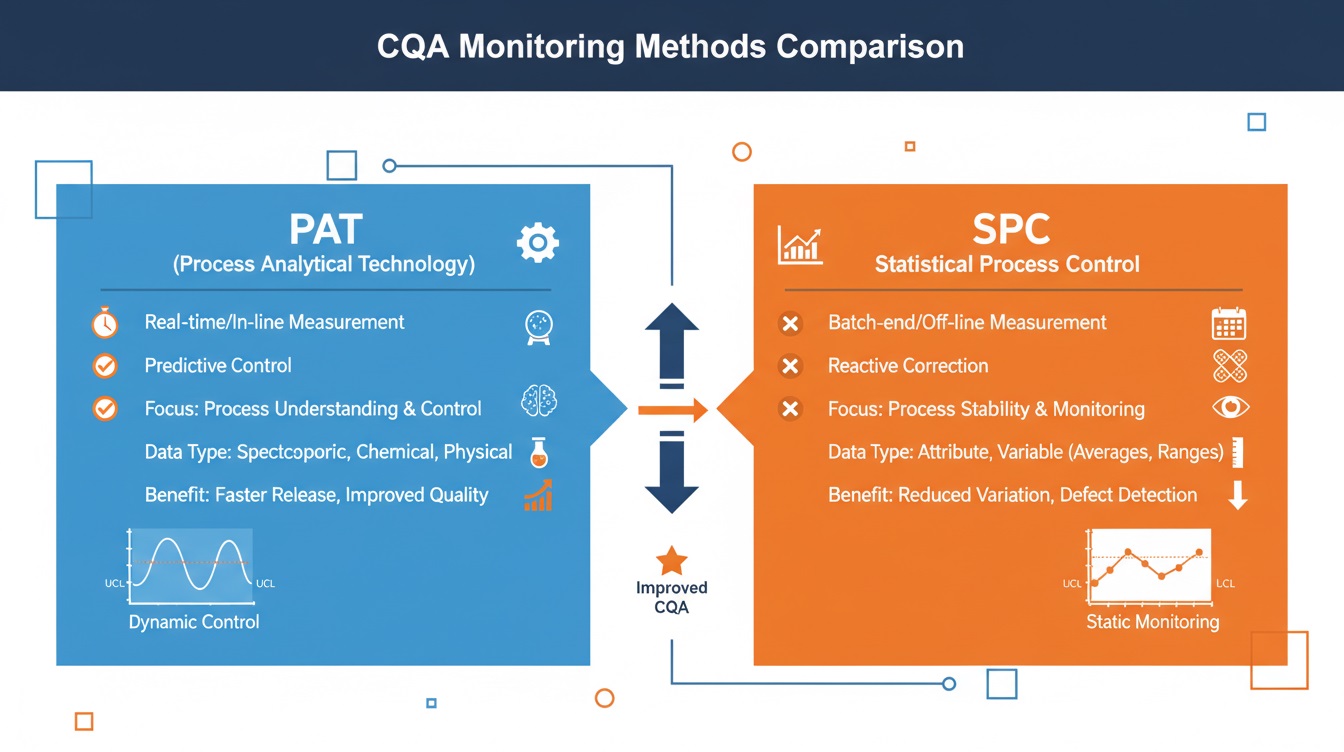
Process Analytical Technology (PAT) helps monitor CQAs in real time during production. It uses sensors and analyzers to measure product quality continuously. Also, PAT allows quick adjustments to keep the product within specifications. This method improves efficiency and reduces errors.

Similarly, Statistical Process Control (SPC) tracks data trends and detects variations early. It uses charts to visualize process performance over time. Operators act on SPC findings to prevent quality issues. Both PAT and SPC work together to ensure consistent pharmaceutical quality.

  • Use PAT for real-time quality monitoring
  • Apply SPC to track and control process variations
Comparison of PAT and SPC Methods for CQA Monitoring

Process Analytical Technology (PAT)

The FDA’s PAT guidance helps companies apply Process Analytical Technology in manufacturing. It encourages real-time monitoring to control product quality during production. Also, this guide supports using sensors and analyzers to detect issues early and reduce waste.

Furthermore, the FDA guide promotes continuous improvement by integrating PAT with quality systems. It helps firms increase efficiency while ensuring safe, effective medicines. 

Statistical Process Control (SPC)

The FDA supports Statistical Process Control (SPC) to monitor manufacturing processes and ensure quality. It encourages using control charts to detect variations early and prevent defects. Also, SPC helps companies maintain consistent product quality by analyzing data over time.

Moreover, the FDA guide recommends integrating SPC with overall quality management systems for better results. This approach helps improve efficiency and reduces production errors consistently.

Download now the FDA’s SPC guidance here

Final Word

Critical Quality Attributes (CQAs) are vital for pharmaceutical product safety and efficacy. According to the FDA, identifying and controlling CQAs ensures product consistency and compliance with regulatory standards. The FDA’s Process Validation guidance (2011) highlights that monitoring CQAs reduces risks and improves manufacturing robustness. Companies should prioritize risk assessment and real-time data analysis to effectively manage CQAs and prevent deviations during production.


Quality assurance relies on comprehensive CQA management to maintain high standards throughout the product lifecycle. The FDA emphasizes integrating quality assurance with continuous monitoring and process improvements. Implementing best practices like Statistical Process Control (SPC) further strengthens quality assurance efforts. 

FAQs

1️⃣ What is a Critical Quality Attribute (CQA) in pharmaceuticals?


CQA is a physical, chemical, or biological property affecting drug safety, effectiveness, and consistency. Controlling CQAs is essential for regulatory compliance and patient safety.

2️⃣ How do CQAs differ from Critical Process Parameters (CPPs)?


CQAs relate to product quality attributes, while CPPs control manufacturing process variables. Both must be monitored for consistent product quality.

3️⃣ How do regulatory agencies like FDA and ICH guide CQA management?


They provide guidelines detailing CQA identification, assessment, and control throughout drug development and manufacturing to ensure high-quality standards.

Picture of Ershad Moradi

Ershad Moradi

Ershad Moradi, a Content Marketing Specialist at Zamann Pharma Support, brings 6 years of experience in the pharmaceutical industry. Specializing in pharmaceutical and medical technologies, Ershad is currently focused on expanding his knowledge in marketing and improving communication in the field. Outside of work, Ershad enjoys reading and attending industry related networks to stay up-to-date on the latest advancements. With a passion for continuous learning and growth, Ershad is always looking for new opportunities to enhance his skills and contribute to pharmaceutical industry. Connect with Ershad on Facebook for more information.

Pharmaceutical professionals working in a modern lab environment aligned with Kuwait Ministry of Health regulations and GMP compliance standards in the Gulf pharmaceutical industry.

Pharma Jobs in Kuwait in 2026: GCC Hiring and Compliance Insights

Kuwait’s pharmaceutical sector continues to expand under strict Ministry of Health regulations and GCC compliance frameworks. This guide explains regulatory pathways, major employers, salary expectations, and licensing requirements for professionals pursuing pharmaceutical careers within Kuwait’s growing Gulf healthcare market.

Read More »
CQA

Critical Quality Attribute (CQA) in 2026: Expert Guide to Ensure Drug Quality

Critical Quality Attributes (CQAs) are crucial in pharmaceutical manufacturing because they directly affect drug safety, efficacy, and consistency. Regulatory agencies including the FDA and ICH require thorough CQA assessment to minimize risks and ensure high-quality medicines. By following best practices like early identification, risk assessment, and continuous monitoring, manufacturers can maintain robust production processes. Implementing modern strategies such as Quality by Design and integrating CQAs with quality assurance systems ensures compliance and safeguards patient health throughout the product lifecycle

Read More »
Scientists working under sterile manufacturing Sydney standards with focus on GMP validation lifecycle documentation and batch release compliance TGA requirements.

Pharma Jobs in Sydney in 2026: Salary, GMP and Hiring Trends

Sydney’s pharmaceutical sector continues to expand under strict TGA GMP inspection trends and PIC/S compliance Australia alignment. This article analyzes regulatory hiring growth, salary positioning, and compliance-driven career opportunities across manufacturing, quality assurance, and regulatory functions.

Read More »

Share