


Drug Regulatory Agencies Complete Guide 2026: Regulatory Approval & Compliance

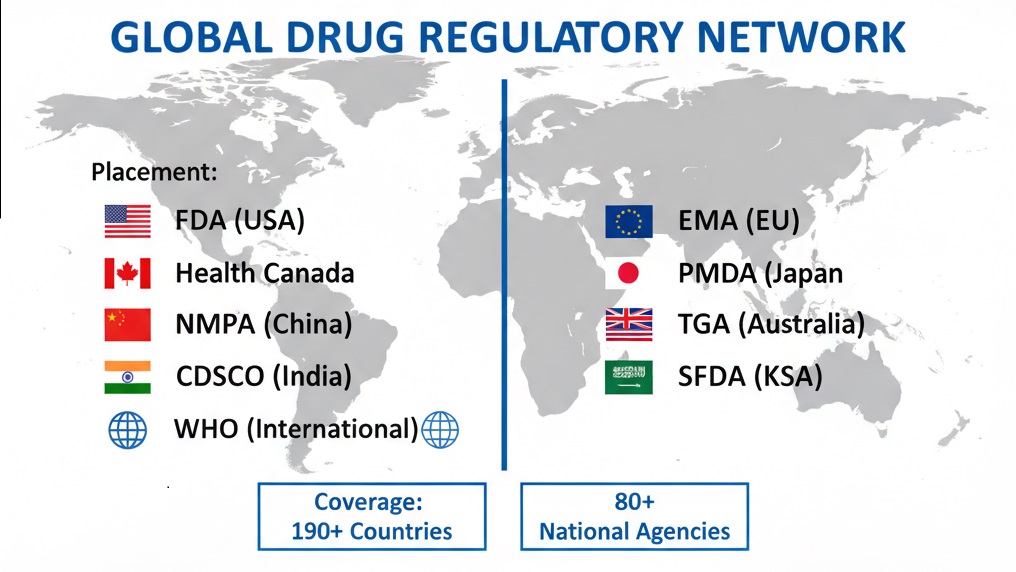
Over 80 national regulatory agencies exist globally, with FDA, EMA, WHO, and Health Canada as key Drug Regulatory Agencies. These bodies ensure medicine safety and efficacy worldwide. However, 25% of new drug submissions face regulatory delays caused by incomplete documentation or non-compliance issues. Such delays impact patient access and company timelines.


Effective pharma regulation relies on clear guidelines and robust compliance. The WHO emphasizes harmonizing standards to reduce approval times and improve product quality. Companies must focus on thorough documentation, continuous monitoring, and proactive communication with authorities to avoid setbacks and meet global regulatory requirements successfully.

Table of Contents

What are Drug Regulatory Agencies?

Drug Regulatory Agencies protect public health by ensuring medicine safety and effectiveness. They set rules, review drug data, and approve new medicines. These agencies monitor manufacturing to keep standards high and recall unsafe products. You will find agencies like FDA, EMA, and WHO working worldwide to protect patients.


To follow their rules, companies should: 

  • Submit complete and accurate documents on time.
  • Use validated equipment and processes.
  • Train staff in compliance and safety.
  • Perform regular quality checks and audits.

These guidelines help companies comply and ensure patient safety effectively.

Global Regulatory Agency Map

Role of Regulatory Bodies

Regulatory bodies protect public health by reviewing drugs and ensuring safety. They approve over 4,000 new medicines yearly worldwide. Additionally, these agencies inspect manufacturing sites to maintain quality standards. For example, the FDA conducts more than 3,000 inspections annually to ensure compliance.


Moreover, regulatory bodies issue recalls to remove unsafe products from the market quickly. They also provide clear guidelines to help companies follow pharma regulation. By enforcing these rules strictly, they reduce drug-related risks and protect patients globally.

Global Regulatory Agency Comparison

Agency Region Key Role Approval Time (avg)
FDA
USA
Drug approval and safety
10 months
EMA
Europe
Medicine evaluation
12 months
Health Canada
Canada
Drug regulation and review
9 months

Regulatory Approval Processes

Regulatory approval processes help ensure that medicines are safe and effective. Agencies review clinical trial data and manufacturing details carefully. For example, the FDA completes reviews in about 10 months on average. During this process, they ask companies to provide clear and complete information for faster decisions.


Furthermore, companies must submit applications with thorough data to meet regulatory standards. They also respond to questions and update documents when needed. Because approvals take time, companies plan their product launches accordingly to comply with all rules. This method helps protect patients from unsafe or ineffective drugs.

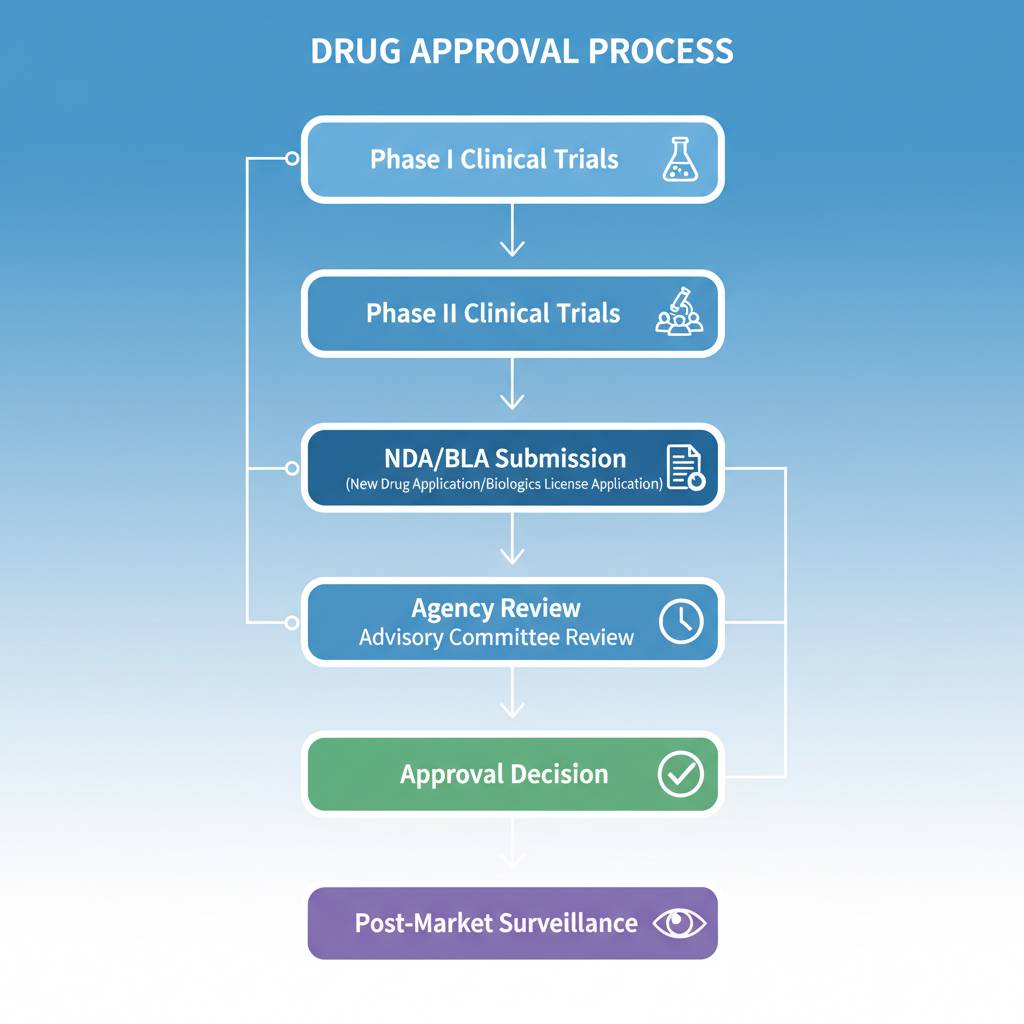
Drug Approval Timeline from IND to NDA

The drug approval timeline involves key steps to ensure safety and effectiveness. First, companies submit the Investigational New Drug (IND) application with necessary data. Next, they conduct Phase I-III clinical trials to test safety, dosage, and effectiveness. Then, they prepare the New Drug Application (NDA) following specific submission guidelines. Finally, the FDA reviews the NDA and makes timely decisions.


Here are the main steps:

  1. Investigational New Drug (IND) Application Requirements
  2. Phase I-III Clinical Trial Approval Process
  3. New Drug Application (NDA) Submission Guidelines
  4. FDA Review Timelines and Decision-Making
Drug Approval Process Flowchart

Investigational New Drug (IND) Application Requirements

Companies must submit the Investigational New Drug (IND) application before starting human trials. This application includes preclinical data, manufacturing details, and trial plans. The FDA reviews INDs within 30 days. If the FDA raises concerns, companies revise their application. Therefore, submitting complete data speeds up approval and trial start times.

Phase I-III Clinical Trial Approval Process

The clinical trial approval process involves three phases to test drug safety and effectiveness. Phase I tests safety with 20-100 healthy volunteers. Phase II studies effectiveness in 100-300 patients. Finally, Phase III confirms results in 1,000-3,000 patients. The FDA reviews trial data after each phase.


Key points include:

  • Phase I focuses on safety.
  • Phase II assesses effectiveness.
  • Phase III confirms results.


Together, these phases provide thorough testing before submitting a New Drug Application.

New Drug Application (NDA) Submission Guidelines

Companies submit the New Drug Application (NDA) after successful clinical trials. The NDA must include:

  • Safety and effectiveness data,
  • Manufacturing details,
  • Labeling proposals.

The FDA aims to review NDAs within 10 months. Therefore, following guidelines helps speed up the approval process.


Additionally, companies must submit complete and accurate documents to avoid delays. The NDA guidelines require clear summaries and detailed reports. Meeting all requirements improves chances of timely approval and marketing authorization.

FDA Review Timelines and Decision-Making

The FDA reviews New Drug Applications within standard timelines of 10 months or 6 months for priority reviews. They analyze safety, effectiveness, and quality data carefully. Also, FDA experts discuss trial results and approve or request more information before deciding.


Key steps include:

  • Initial application screening,
  • In-depth data evaluation,
  • Advisory committee meetings.

Accelerated Approval Pathways

The FDA uses accelerated drug approval pathways to speed up access to important medicines. These pathways help patients get treatments faster for serious conditions.

Moreover, companies benefit from more frequent FDA meetings and rolling submissions. These options shorten review times to as little as six months and encourage innovation.

Technical Topics in Drug Regulation

Regulators require companies to use specific submission formats. These formats ensure clear communication and efficient reviews. Key technical topics include:


  • Regulatory Submission Formats for organizing data,
  • eCTD (Electronic Common Technical Document) Standards for electronic submissions,
  • Biologics License Application (BLA) Requirements for biological products.


Therefore, companies must follow these standards closely to avoid delays in drug approvals.

Regulatory Submission Formats

Regulatory submission formats help companies present data clearly and consistently. They streamline the review process and reduce errors. Important guidelines include:


  • ICH M4 for common technical document structure,
  • FDA’s eCTD guidance for electronic format submissions.


Therefore, companies must follow these guidelines carefully to ensure smooth regulatory reviews.

eCTD (Electronic Common Technical Document) Standards

The eCTD standards improve drug application submissions in over 40 countries worldwide. They reduce review time by up to 30%. These standards organize files logically, making reviews easier. Important guidelines include ICH M2 and FDA eCTD submission guidance. Thus, companies use eCTD standards to speed approval and meet global requirements efficiently.

Biologics License Application (BLA) Requirements

The Biologics License Application (BLA) requires companies to submit detailed information about their biologic product. They must provide product manufacturing data and clinical trial results. Important requirements include:


  1. Complete application forms,
  2. Detailed manufacturing process,
  3. Clinical study reports,
  4. Safety and efficacy data,
  5. Proposed labeling information.


Therefore, companies must meet all these requirements to get product approval on time.

Final Word

Drug Regulatory Agencies play a vital role in ensuring the safety and effectiveness of medicines. For example, the FDA reviews over 1,200 drug applications annually, enforcing strict requirements on manufacturing and clinical data. These agencies help companies navigate complex approval processes, reducing risks and protecting public health. Understanding their guidelines is essential for successful market entry and patient safety.


EMA Regulatory Standards govern drug approval in the European Union, with the agency evaluating about 700 applications each year. These standards emphasize quality, safety, and efficacy, aligning closely with global practices.

FAQs

1️⃣ How does the FDA review drug applications?

The FDA reviews approximately 1,200 new drug applications annually by evaluating preclinical and clinical data, manufacturing details, and labeling to ensure the drug’s safety and effectiveness.

2️⃣ What are EMA Regulatory Standards?


EMA Regulatory Standards set the requirements for drug approval across the European Union. They emphasize rigorous assessment of quality, safety, and efficacy to harmonize drug approval processes across member states.

3️⃣ How do Drug Regulatory Agencies and EMA work together?

Drug Regulatory Agencies like the FDA and EMA collaborate on regulatory guidelines and share scientific expertise, aiming to streamline global drug development and harmonize standards.

Picture of Ershad Moradi

Ershad Moradi

Ershad Moradi, a Content Marketing Specialist at Zamann Pharma Support, brings 6 years of experience in the pharmaceutical industry. Specializing in pharmaceutical and medical technologies, Ershad is currently focused on expanding his knowledge in marketing and improving communication in the field. Outside of work, Ershad enjoys reading and attending industry related networks to stay up-to-date on the latest advancements. With a passion for continuous learning and growth, Ershad is always looking for new opportunities to enhance his skills and contribute to pharmaceutical industry. Connect with Ershad on Facebook for more information.

Key Performance Indicators

Key Performance Indicator (KPI) Guide for Pharmaceutical Industry 2026 : Complete Quality Metrics

Approximately 30% of FDA Warning Letters cite inadequate monitoring of Key Performance Indicators (KPIs) as a major compliance issue, highlighting their crucial role in pharmaceutical operations. KPIs provide measurable data to track process efficiency, product quality, and regulatory adherence. Proper KPI management supports risk mitigation, enhances decision-making, and ensures patient safety.

Read More »

Share