


GMP SOPs Guide 2026: Master the Ultimate Compliance Framework for Pharma Excellence

The “Golden Rule” of Pharma: If it isn’t written, it didn’t happen. This highlights the critical role of a detailed GMP SOPs in pharmaceutical manufacturing. According to WHO guidelines and ICH Q10, proper documentation improves process consistency and quality control, reducing deviations by up to 35%. Over 90% of pharmaceutical companies implement SOPs to meet regulatory requirements and ensure product safety.

Good Manufacturing Practices (GMP) encompass the systematic procedures necessary to maintain product quality. WHO estimates that adherence to GMP can decrease product defects by 25%, emphasizing its role in safeguarding patient health worldwide. Maintaining Good Manufacturing Practices (GMP) is essential for global compliance and trust.

Table of Contents

What are GMP SOPs?

A GMP SOP is a step-by-step document that guides safe product manufacturing. It ensures workers follow correct processes every time and prevent errors. This document supports consistent product quality and meets FDA requirements. Also, it helps companies prepare for FDA inspections and audits.

When writing a GMP SOPs, follow these FDA guidelines: 

  • Provide clear, detailed instructions on each manufacturing step.
  • Keep records accessible for audits and reviews.
  • Train employees regularly on SOP updates and procedures.

By applying these guidelines, companies improve compliance and product safety.

Understanding the Role of Standard Operating Procedures in Quality Systems

Standard Operating Procedures (SOPs) help companies keep quality systems strong and consistent. They guide workers step by step to complete tasks correctly and safely. Also, SOPs reduce mistakes and improve product reliability. Every SOP includes important components to ensure clarity and effectiveness.

Key SOP components include: 

  • Header & Document Metadata (The Identification)
  • Objective (The “Why”)
  • Scope (The “Where” and “What”)
  • Responsibility (The “Who”)
  • Materials and Equipment
  • The Procedure (The “How”)

Together, these parts help companies maintain high standards and meet quality goals.

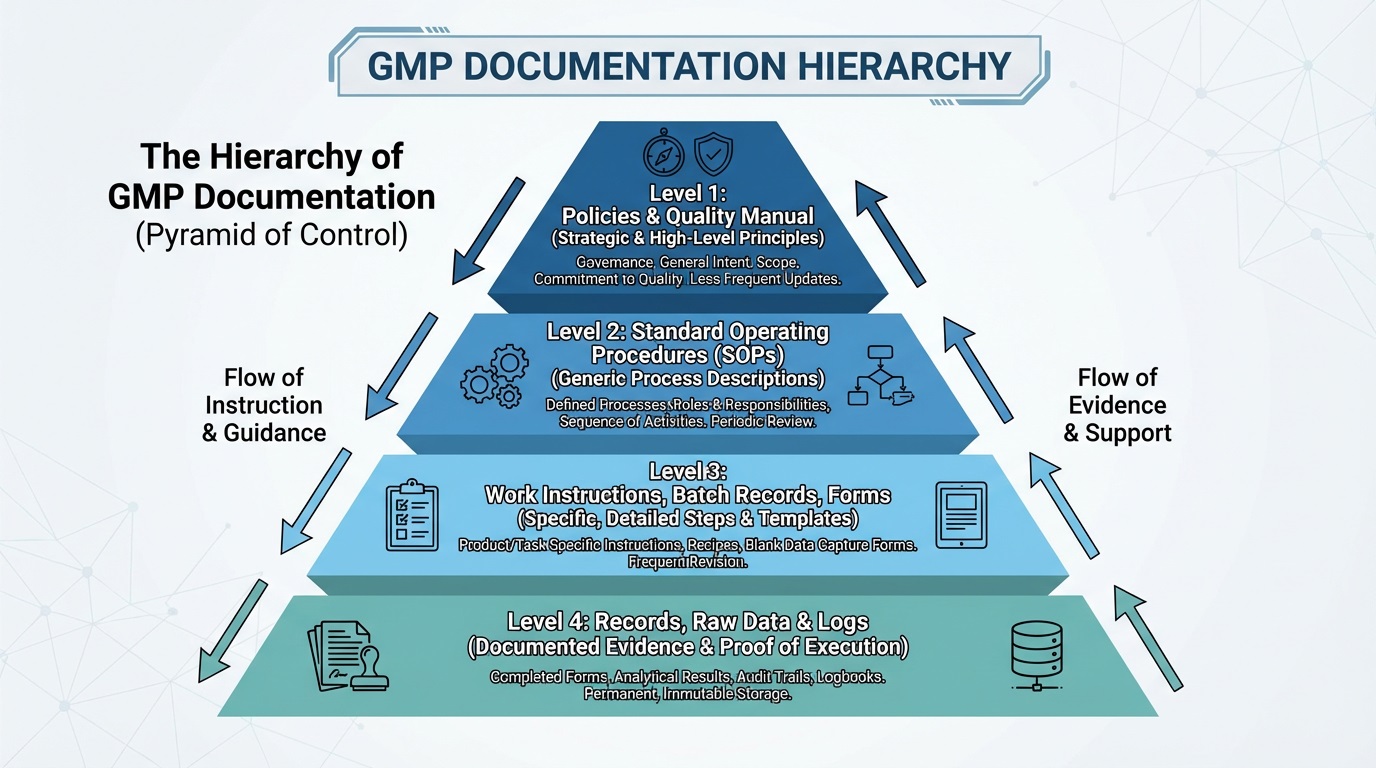
The Hierarchy of GMP Documentation

Component 1: Header & Document Metadata (The Identification)

The header and document metadata identify each SOP clearly and quickly. They help users find and reference the right procedure every time. Also, these parts include important details that track the document’s purpose and updates.


Key header and metadata elements include: 

  • Document title and ID number
  • Version and revision date
  • Author and approval names
  • Page number and total pages

Together, they make the SOP easy to manage and use.

Component 2: Objective (The "Why")

The SOP objective explains why the procedure exists and its main purpose. It guides workers to focus on important tasks and goals. Moreover, the objective helps improve process consistency and quality across teams.


Important elements of the SOP objective include: 

  • Clear purpose statement
  • Desired outcome or goal

These points ensure everyone understands the SOP’s reason and aims.

Component 3: Scope (The "Where" and "What")

The SOP scope defines where and when the procedure applies. It limits the process to specific areas, tasks, or departments. For example, it may cover only the packaging section in a factory, ensuring clear boundaries and focus.


Scope details often describe these: 

  • Applicable departments or locations
  • Specific tasks or equipment involved

These details help workers know when to use the SOP and what to follow.

Component 4: Responsibility (The "Who")

The SOP responsibility section identifies who performs each task in the process. It clarifies roles for better accountability and teamwork. For example, the quality control team inspects products, while the packing team handles shipment preparation.


Additionally, this section explains communication lines among employees. Therefore, everyone knows whom to contact for support or issues during operations. Clear responsibilities improve workflow and reduce mistakes.

Component 5: Materials and Equipment

The Materials and Equipment SOP lists all needed items for the process.  It helps workers prepare and use tools correctly every time. 

For example, operators check machines and materials before starting their tasks.

Also, this SOP guides how to maintain and store equipment safely.  Therefore, employees avoid damage and ensure long-lasting use of tools.  Following these steps improves work quality and prevents delays.

Component 6: The Procedure (The "How")

The SOP Procedure explains how to perform each task step-by-step clearly.  Workers follow these instructions to complete jobs correctly and efficiently. 

As an example, the technician starts machines by pressing the green button first.


This section highlights safety and quality checks during the process.   Therefore, employees reduce errors and maintain high standards every time.  Following procedures helps finish tasks quickly and with fewer problems.

Best Practices for Reducing Human Error in GMP SOPs

Workers should read SOPs carefully before starting tasks.  They must follow each step without skipping or rushing.  Also, supervisors should train employees regularly on SOP updates. 

This practice helps everyone stay accurate and confident in their work.  Furthermore, using checklists during tasks reduces mistakes and improves results. 

– How often do you review SOPs with your team? 

– What tools help you avoid errors during your work?

Comparison of “Poor vs. Good” SOP Phrasing

Aspect Poor SOP Phrasing Good SOP Phrasing
Clarity
Do the thing quickly.
Complete the task within 10 minutes.
Specificity
Check equipment sometimes.
Inspect the equipment before each use.
Action Verbs
It is recommended to start.
Press the start button to begin.

Regulatory Compliance & Global GMP SOPs Guidelines

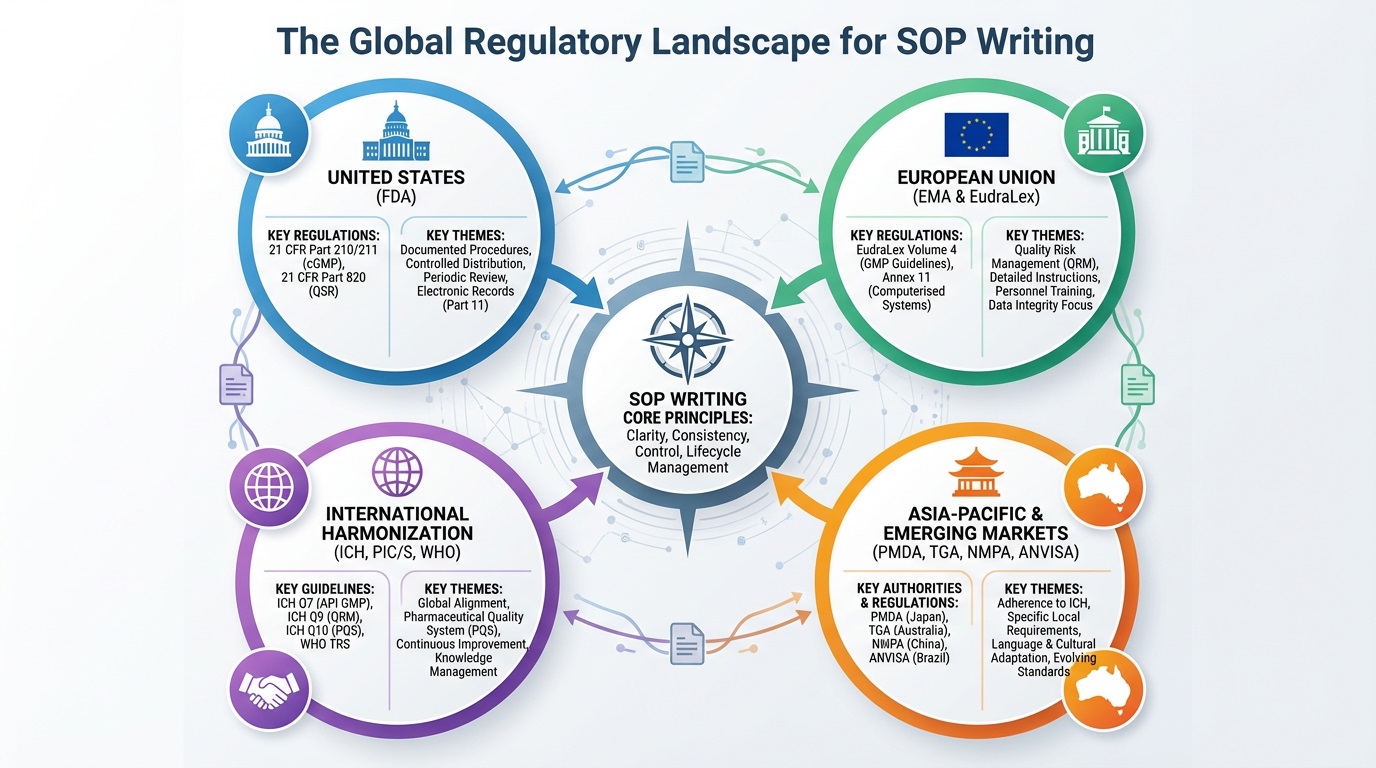
Regulatory compliance helps companies meet quality and safety standards worldwide. Companies must align with FDA 21 CFR Part 211 (Subpart J) to control records properly. They should follow EudraLex Volume 4 (Chapter 4) to maintain clear documentation. Also, they must implement data integrity using ALCOA+ principles to ensure accurate records.

To comply with global GMP guidelines, companies should: 

  •  Alignment with FDA 21 CFR Part 211 (Subpart J)
  • Adhering to EudraLex Volume 4 (Chapter 4: Documentation)
  • Data Integrity Implementation: Applying ALCOA+ Principles

These steps improve product safety and build customer trust over time.

The Global Regulatory Landscape for SOP writing

Alignment with FDA 21 CFR Part 211 (Subpart J)

Companies must follow FDA 21 CFR Part 211 (Subpart J) to handle records correctly. It sets rules for creating, maintaining, and storing records carefully. Moreover, firms should update their processes to meet these technical guidelines efficiently.

Key technical guidelines include: 

  • Keep records legible, accurate, and readily available.
  • Store data securely with restricted access.
  • Review records regularly for completeness and errors.

Adhering to EudraLex Volume 4 (Chapter 4: Documentation)

Companies must follow EudraLex Volume 4 (Chapter 4) to manage documentation well. It guides firms to create clear, accurate, and complete records. Also, they should update documents regularly to comply with these technical guidelines.

Key technical guidelines include: 

  • Use standard formats and templates for all documents.
  • Ensure document versions and dates are clear.
  • Keep documents safe and easy to access.

Data Integrity Implementation: Applying ALCOA+ Principles

Companies must apply ALCOA+ principles to ensure data integrity in all records. These principles help keep data accurate, complete, and trustworthy. Furthermore, firms should train staff on ALCOA+ rules to maintain strong data management.


Key guidelines include: 

– Record data Attributable, Legible, and Contemporaneous. 

– Keep data Original and Accurate. 

– Ensure data is Complete, Consistent, and Enduring. 

Following ALCOA+ improves reliability and regulatory compliance.

Final Word

GMP SOPs are living document that requires regular updates and reviews to stay effective. According to FDA 21 CFR Part 211.180(e), companies must review their SOPs periodically to ensure continuous compliance. USP <1223> emphasizes that SOPs should evolve with process changes, preventing them from becoming “set and forget” files. Moreover, ISPE GAMP 5 recommends integrating automation and revision controls to maintain SOP accuracy.

Quality assurance depends heavily on continuous training and periodic reviews. WHO Technical Report Series highlights that ongoing staff training improves adherence to SOPs and regulatory standards. Without consistent updates and training, companies risk non-compliance and quality failures. Therefore, organizations should treat SOPs as dynamic tools that support operational excellence and safety.

FAQs

1️⃣ How often should companies review and update their SOPs?

Companies should review SOPs periodically, at least annually or after any process change, to maintain compliance and reflect current best practices, as per FDA 21 CFR Part 211.180(e) and USP <1223>.

2️⃣ Why is continuous training important for SOP effectiveness?

Continuous training ensures employees understand updates and follow procedures accurately. WHO Technical Report Series indicates that regular training improves SOP adherence and reduces errors.

3️⃣ What are the key components of an effective SOP?

Effective SOPs include: header & document metadata, objective, scope, responsibility, materials & equipment, and detailed procedure steps. These parts provide clarity and support quality assurance across teams.

Picture of Ershad Moradi

Ershad Moradi

Ershad Moradi, a Content Marketing Specialist at Zamann Pharma Support, brings 6 years of experience in the pharmaceutical industry. Specializing in pharmaceutical and medical technologies, Ershad is currently focused on expanding his knowledge in marketing and improving communication in the field. Outside of work, Ershad enjoys reading and attending industry related networks to stay up-to-date on the latest advancements. With a passion for continuous learning and growth, Ershad is always looking for new opportunities to enhance his skills and contribute to pharmaceutical industry. Connect with Ershad on Facebook for more information.

GMP and SOP

GMP SOPs Guide 2026: Master the Ultimate Compliance Framework for Pharma Excellence

Discover how mastering the GMP SOP framework drives pharmaceutical excellence. This guide explains why SOPs are living documents requiring ongoing updates, training, and reviews to maintain compliance and safeguard product quality. Learn key components, best practices, and global regulatory insights that empower pharma companies to excel in quality assurance and regulatory readiness.

Read More »
Sterile injectable manufacturing New York laboratory environment reflecting FDA inspection history New York facilities and CAPA and deviation management pharma standards.

Pharma Jobs in NYC in 2026: GMP Compliance and Salary Trends

New York continues to expand across pharmaceutical companies in NYC and biologics manufacturing jobs New York. Hiring demand reflects strict 21 CFR Part 210 and 211 GMP compliance NYC standards, growing clinical research jobs New York, and strong regulatory oversight across manufacturing facilities.

Read More »

Share