


Master ICH Q7 Guideline in 2026: Essential API GMP Rules You Must Know

ICH Q7 is the Good Manufacturing Practice (GMP) guide for active pharmaceutical ingredients (APIs), providing detailed standards for quality, documentation, validation, supplier control, and inspection readiness. According to WHO, up to 30% of quality deviations in APIs are linked to poor supplier management and insufficient validation processes. Implementing ICH Q7 ensures consistent product quality and regulatory compliance, reducing risks of contamination and batch failures.

Effective pharma regulation relies on frameworks like ICH Q7 to safeguard public health. WHO data indicates that strict adherence to pharma regulation reduces drug recalls by 25%. Robust documentation and inspection preparedness under these regulations promote transparency and trust, improving overall API manufacturing standards globally.

Table of Contents

What Is ICH Q7?

ICH Q7 is the GMP guide for active pharmaceutical ingredients (APIs). It ensures high API quality and safety. The guideline covers documentation, validation, supplier control, and inspection readiness. Many companies follow ICH Q7 to meet global standards. For example, WHO reports that 30% of quality issues arise from poor supplier management. Following ICH Q7 reduces these risks and improves manufacturing consistency. 

Key technical guidelines include: 

  • Documenting every production step clearly for traceability and audit purposes.
  • Validating processes to confirm product quality and reliability.

Download the full ICH Q7 PDF here

What does this GMP guide for active pharmaceutical ingredients (APIs) require?

The GMP guide for active pharmaceutical ingredients (APIs) sets clear rules to ensure product safety. It requires companies to control all manufacturing steps. Furthermore, it helps maintain consistent quality to protect patients worldwide.


This guide requires companies to: 

  • Monitor and document every stage of production carefully.
  • Validate all processes to confirm they work correctly.
  • Control suppliers to guarantee raw material quality.


These actions help meet global pharma standards and improve trust in medicines.          

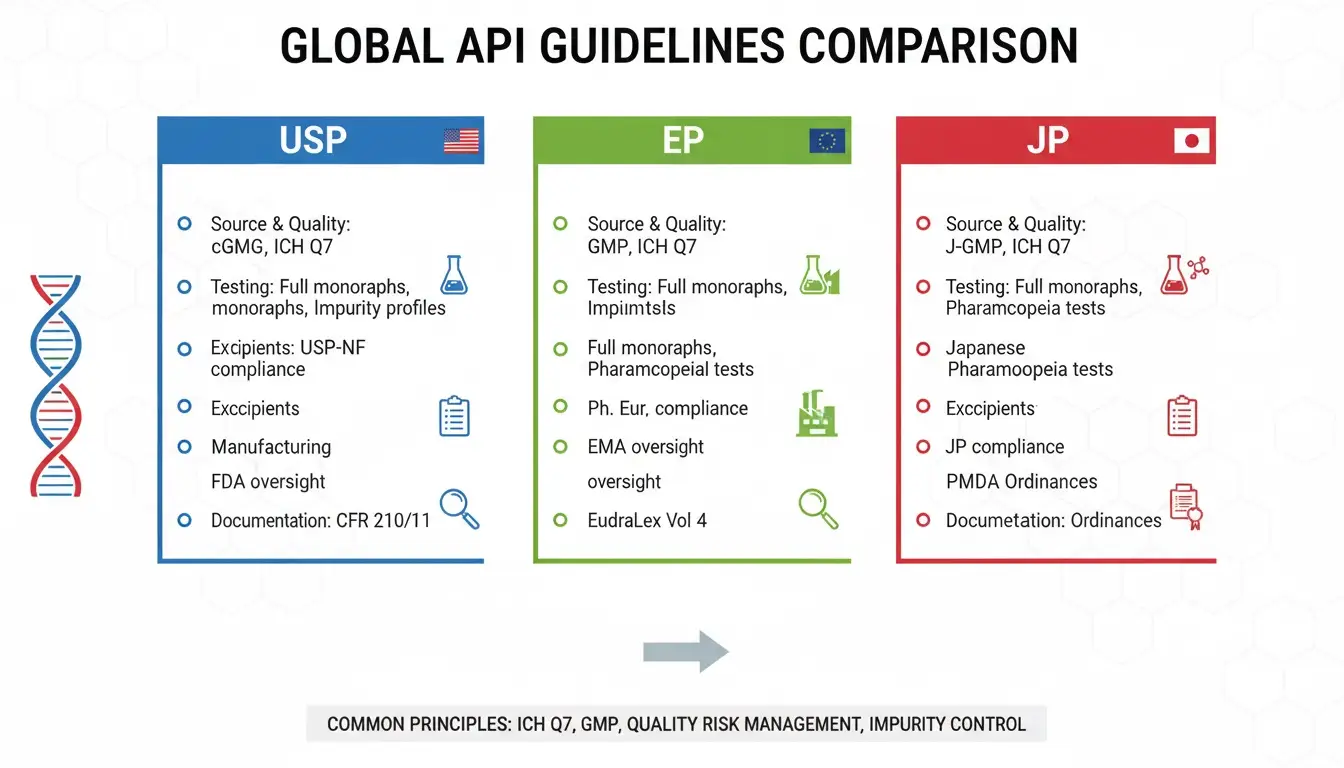
active pharmaceutical ingredients (APIs) guidelines comparison
Active pharmaceutical ingredients (APIs) guidelines comparison

Key scopes for ICH Q7

ICH Q7 covers key scopes to ensure high-quality pharmaceutical ingredients. First, it focuses on quality management to maintain strong control systems. Also, it requires proper facilities, equipment, and trained personnel. Next, it sets rules for materials and production controls to guarantee product consistency.


Moreover, the guide emphasizes documentation, laboratory work, and process validation. Lastly, it prepares companies for audits and continuous compliance. Key scopes include: 

Scopes 1 Quality Management 

Scopes 2 Facilities, Equipment, and Personnel 

Scopes 3 Materials and Production Controls 

Scopes 4 Documentation, Laboratory, and Validation 

Scopes 5 Audit Readiness and Continuous Compliance

Critical Process Controls and Documentation Requirements per ICH Q7

Category Key Points
Critical Process Controls
1-Monitor critical parameters during manufacturing 2-Use validated methods to ensure process control
Documentation Requirements
1-Maintain clear, accurate, and timely records 2-Document changes and deviations immediately 3-Keep batch production and control records

Scopes 1 Quality Management

Quality management plays a key role in Good Manufacturing Practice (GMP). The FDA states that quality management ensures product safety and effectiveness. It helps companies identify and control risks throughout production. Moreover, a strong quality system improves customer confidence and regulatory compliance. Therefore, companies must implement quality policies and regularly review their processes. This approach supports consistent product quality and consumer safety.

Scopes 2 Facilities, Equipment, and Personnel

Facilities, equipment, and personnel form the foundation of GMP compliance. The FDA highlights that companies must design facilities to prevent contamination. They should maintain equipment regularly to ensure proper function. Also, trained personnel must follow clear procedures. Furthermore, companies should monitor the environment to keep it clean and safe.


Here are five key GMP points about facilities, equipment, and personnel: 

  1. Design facilities for sanitation and contamination control.
  2. Maintain equipment to ensure accurate performance.
  3. Train personnel in hygiene and GMP practices.
  4. Monitor environmental conditions regularly.
  5. Enforce clear procedures for all operations.

Scopes 3 Materials and Production Controls

Companies must control materials and production to maintain product quality. The FDA requires careful selection and testing of raw materials. Also, companies should document every production step clearly. Moreover, controlling production prevents contamination and errors.


Key points include: 

  • Use approved suppliers and inspect all materials thoroughly.
  • Follow standardized procedures during production and monitor critical parameters constantly.

Scopes 4 Documentation, Laboratory, and Validation

Accurate documentation supports GMP by recording all processes clearly. The FDA advises companies to keep thorough records for traceability. Also, laboratories should test products regularly. Furthermore, validation ensures all systems work correctly.


Key points are: 

  • Document every step and keep records organized.
  • Perform regular lab tests and validate equipment properly.

Scopes 5 Audit Readiness and Continuous Compliance

Companies must stay ready for audits to prove GMP compliance. They should review processes regularly. Also, employees must understand their roles in compliance. Therefore, continuous improvement keeps quality consistent.


Important points include: 

  • Conduct internal audits and fix issues quickly.
  • Train staff on GMP rules often.
  • Maintain clear records for inspectors.
  • Update procedures when regulations change.

How Do You Implement ICH Q7 in API Manufacturing?

ICH Q7 sets 12 key principles for API manufacturing to ensure product quality. First, follow these principles strictly to control production and prevent contamination. Also, train all employees well to maintain good manufacturing practices. Use proper equipment and document every step clearly to meet ICH Q7 guidelines effectively.


Moreover, test raw materials and final products to confirm they meet quality standards. In addition, monitor processes and handle deviations quickly to avoid risks. Management should review procedures regularly and support continuous improvement. Finally, keep updated with ICH Q7 and apply changes promptly for compliance.

Establishing Quality Management Systems and Documentation

First, establish a strong quality management system (QMS) to ensure consistent product quality. Train employees on QMS policies and procedures clearly and regularly. Also, create detailed documentation to record processes, controls, and responsibilities accurately. This documentation supports transparency and helps maintain high standards throughout production.


Next, implement regular audits and reviews to check system effectiveness and compliance. Use findings to improve procedures and fix any issues quickly. Furthermore, update documentation as processes change, keeping records current and reliable. Managers must encourage a culture of quality and accountability in every team member.

Ensuring Good Manufacturing Practices (GMP) Compliance Throughout Production

Train employees on GMP rules and explain why compliance matters for product quality. Also, clean and maintain equipment regularly to avoid contamination and ensure safe production. Use proper controls for raw materials and monitor each production step carefully.


  • Conduct regular inspections to spot issues early and correct them quickly.
  • Keep detailed records of all processes and review them often for accuracy.
  • Investigate any deviations immediately and apply corrective actions to prevent repeats.
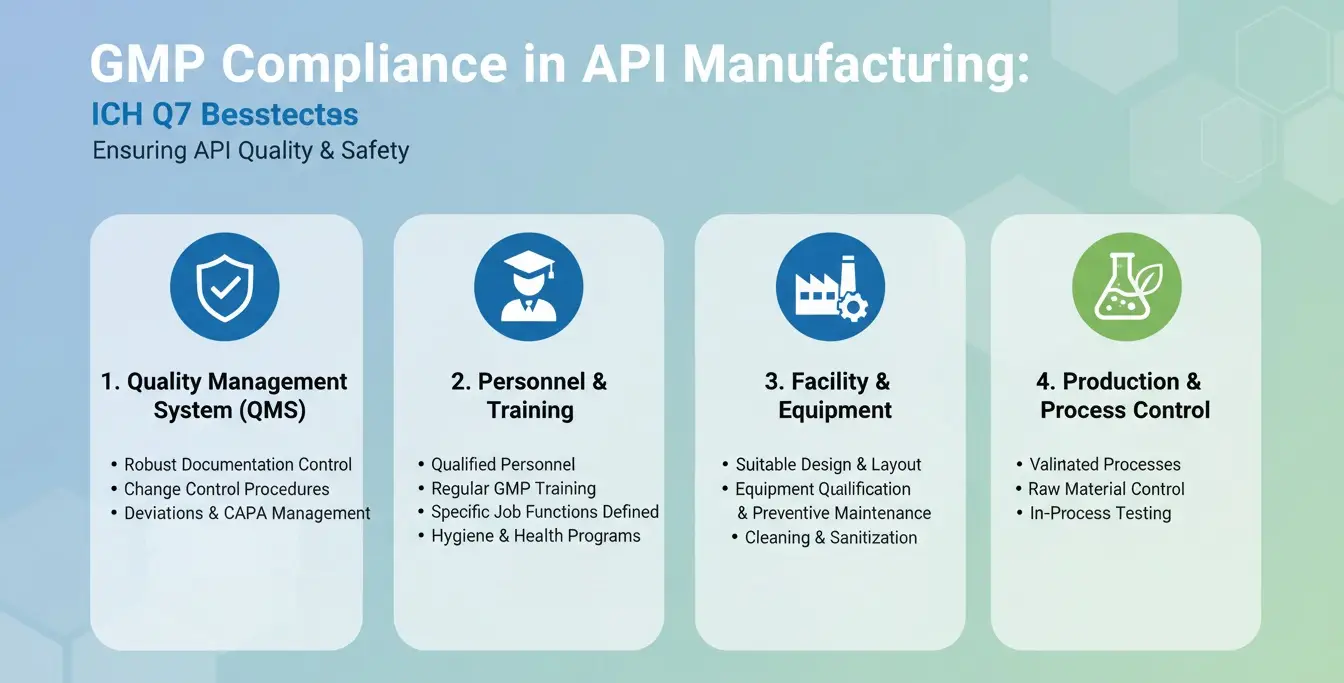
Best Practices for Ensuring GMP Compliance in API Manufacturing Under ICH Q7

Final Word

The FDA’s cGMP regulations (21 CFR Parts 210 and 211) provide detailed requirements for drug manufacturing and quality control. These regulations complement ICH Q7, which specifically targets active pharmaceutical ingredient (API) production. According to the FDA, manufacturers must follow strict processes to ensure product safety and efficacy. T

he FDA also encourages companies to adopt ICH Q7 for consistent API quality globally. Understanding these numbers helps firms align their operations with regulatory expectations and avoid compliance risks.


FAQs

1️⃣What is the main purpose of ICH Q7?


ICH Q7 provides GMP guidelines for manufacturing active pharmaceutical ingredients (APIs) to ensure quality and safety.

2️⃣ How does FDA’s cGMP relate to ICH Q7?

FDA’s cGMP (21 CFR Parts 210 and 211) complements ICH Q7 by covering broader drug manufacturing and quality requirements.

3️⃣ Why is supplier control important in ICH Q7?

Poor supplier management causes up to 30% of quality deviations in APIs, so ICH Q7 emphasizes controlling suppliers.

Picture of Ershad Moradi

Ershad Moradi

Ershad Moradi, a Content Marketing Specialist at Zamann Pharma Support, brings 6 years of experience in the pharmaceutical industry. Specializing in pharmaceutical and medical technologies, Ershad is currently focused on expanding his knowledge in marketing and improving communication in the field. Outside of work, Ershad enjoys reading and attending industry related networks to stay up-to-date on the latest advancements. With a passion for continuous learning and growth, Ershad is always looking for new opportunities to enhance his skills and contribute to pharmaceutical industry. Connect with Ershad on Facebook for more information.

Pharma Factory and GMP Complance

Master ICH Q7 Guideline in 2026: Essential API GMP Rules You Must Know

ICH Q7 is the GMP guide for active pharmaceutical ingredients (APIs). It sets detailed standards for quality, documentation, validation, and supplier control. WHO reports that poor supplier management causes up to 30% of API quality issues. Following ICH Q7 ensures consistent product safety and regulatory compliance worldwide.

Read More »
Pharmaceutical companies in Atlanta laboratory environment showing GMP jobs in Atlanta and quality assurance biotech Atlanta specialists working under FDA regulated companies in Georgia standards.

Pharma Jobs in Atlanta in 2026: Compliance and Salary Landscape

Atlanta’s regulated life sciences market reflects growing demand across pharmacist jobs in Atlanta, biotech jobs in Atlanta, and clinical research jobs in Atlanta. Within FDA regulated companies in Georgia, employers prioritize compliance expertise, validation accountability, and structured quality systems experience.

Read More »
Biotech laboratory team in Seattle conducting quality assurance biotech Seattle processes under FDA regulated companies in Seattle standards.

Pharma Jobs in Seattle in 2026: GMP, Salary, and Licensing Insights

Seattle’s regulated biotech ecosystem drives demand for professionals with GMP experience, licensing awareness, and quality system expertise. This article explores employer concentration, biologics manufacturing Seattle trends, and how compliance expectations shape hiring across pharmaceutical companies in Seattle.

Read More »

Share