


Audit Trail Review: Complete Guide to GMP Requirements, SOP Steps, and Inspection Readiness in 2026

Audit Trail Review is a critical process in pharmaceutical manufacturing that involves examining electronic records to ensure all entries, changes, and deletions are accurately documented and traceable. This review helps maintain data integrity, prevent errors, and detect unauthorized activities. The FDA’s 21 CFR Part 11 emphasizes the importance of audit trails in electronic records, ensuring compliance with regulatory requirements. Proper Audit Trail Review supports reliable decision-making and protects patient safety by verifying that all manufacturing data are trustworthy and complete.

Adhering to Good Manufacturing Practices (GMP) requires rigorous control over documentation and data management. Regulatory bodies such as the FDA, EMA/EU GMP, ICH, and USP all mandate comprehensive audit trail reviews as part of their quality systems to ensure consistency and compliance.


Table of Contents

What Is Audit Trail Review in GMP/Pharma?

Audit Trail Review in GMP/pharma means checking electronic records for accuracy and completeness. It helps identify any changes, deletions, or unusual activities in data entries. This process ensures data integrity and supports reliable product quality decisions.


Good Manufacturing Practices (GMP) require thorough audit trail reviews. They help companies:

  • Detect unauthorized data changes quickly
  • Maintain clear records for regulatory inspections
  • Ensure consistent product quality and patient safety
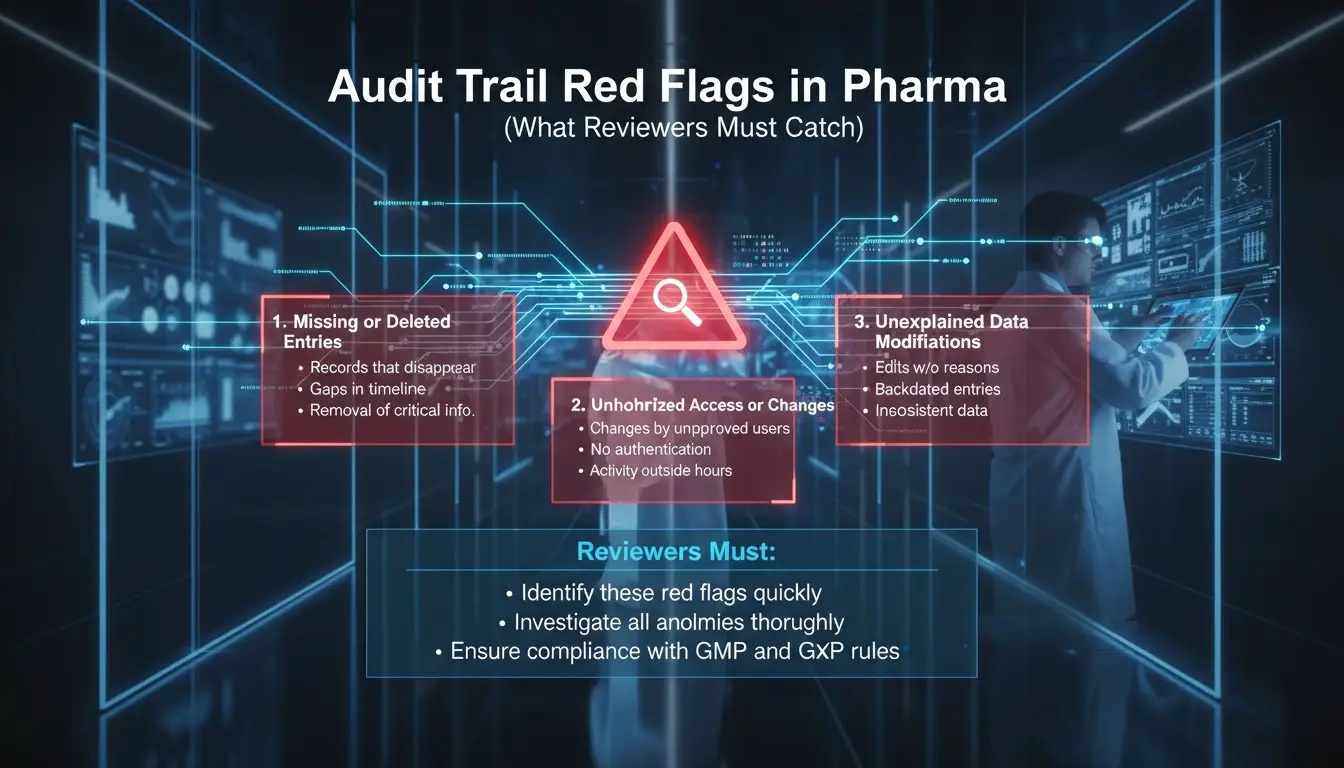
Audit Trail Red Flags in Pharma (What Reviewers Must Catch)

Definition of Audit Trail Review in GxP Systems

Audit Trail Review in GxP systems means checking electronic records for accuracy and changes. It tracks who made changes, when, and why. This review keeps data reliable and helps companies follow regulations. Because of this, audit trail reviews prevent errors and protect product quality.


GxP standards require companies to:


  • Monitor all data changes closely
  • Keep clear records for audits
  • Ensure data integrity and compliance


These steps help maintain high quality and regulatory trust in all processes.

FDA, EMA, ICH, and WHO Expectations for Audit

Regulators like FDA, EMA, ICH, and WHO set clear expectations for audit trails. They want companies to keep accurate, complete, and secure electronic records. These rules help ensure data integrity and protect patient safety. Therefore, companies must follow strict guidelines and reviews.

Key expectations include: 

  • Maintain detailed and accessible audit trails
  • Review data regularly for changes or errors
  • Secure systems against unauthorized access
  • Document all actions clearly for audits

FDA Expectations for Audit Trails and Data Integrity (PDF)

The FDA expects companies to maintain accurate, complete, and secure audit trails. They require firms to review electronic records regularly and report any changes promptly. Moreover, they emphasize protecting data integrity to ensure patient safety. Therefore, companies must implement strong controls and monitor systems continuously.

Key FDA expectations include: 

– Track all changes with user ID, date, and reason 

– Prevent unauthorized access and document all activities 

Learn more in the FDA Audit Trails and Data Integrity PDF

EMA / EU GMP Expectations for Computerized Systems and Review Controls (PDF)

The EMA expects companies to manage computerized systems carefully to ensure data accuracy. They require consistent review controls to detect errors or unauthorized changes quickly. Additionally, firms must document all system activities clearly and maintain system validation. Thus, organizations must follow strict procedures to comply with EU GMP standards.

Key EMA expectations include: 

– Monitor computerized systems for data integrity and security 

– Perform regular reviews and document all findings 

Learn more in the EMA EU GMP Computerized Systems PDF


ICH Data Governance and Lifecycle Relevance (PDF)

ICH expects companies to manage data throughout its entire lifecycle for accuracy and reliability. They recommend strong data governance to prevent errors and secure information. Furthermore, organizations must implement controls that maintain data integrity from creation to archiving. Therefore, firms improve compliance by following these guidelines carefully.


Learn more in the ICH Data Governance and Lifecycle PDF

WHO Expectations for Electronic Records / Data Integrity Practices

WHO expects companies to keep electronic records accurate and secure at all times. They stress strong data integrity practices to avoid errors and maintain trust. Also, organizations must regularly review electronic data and control access carefully. Therefore, firms stay compliant by following these clear guidelines strictly.

Key WHO expectations include: 

  1. Validate electronic systems before use
  2. Track every change with timestamps and user IDs
  3. Restrict access to authorized personnel only
  4. Regularly audit data for completeness and accuracy

Learn more in the WHO Data Integrity Guidelines PDF. 

How to Perform Audit Trail Review

To perform an audit trail review, first define the scope clearly. Identify systems, records, and critical data to review. Then, plan the review sequence and set escalation steps. Also, document findings carefully and follow up on actions promptly. These steps ensure a thorough and organized process.


Next, handle exceptions and deviations carefully. Link any issues to CAPA for resolution. Finally, communicate all results to your team for transparency and improvement.


  1. Define scope, systems, records, and critical data
  2. Review sequence, escalation, documentation, and follow-up
  3. Handle exceptions, deviations, and CAPA linkage
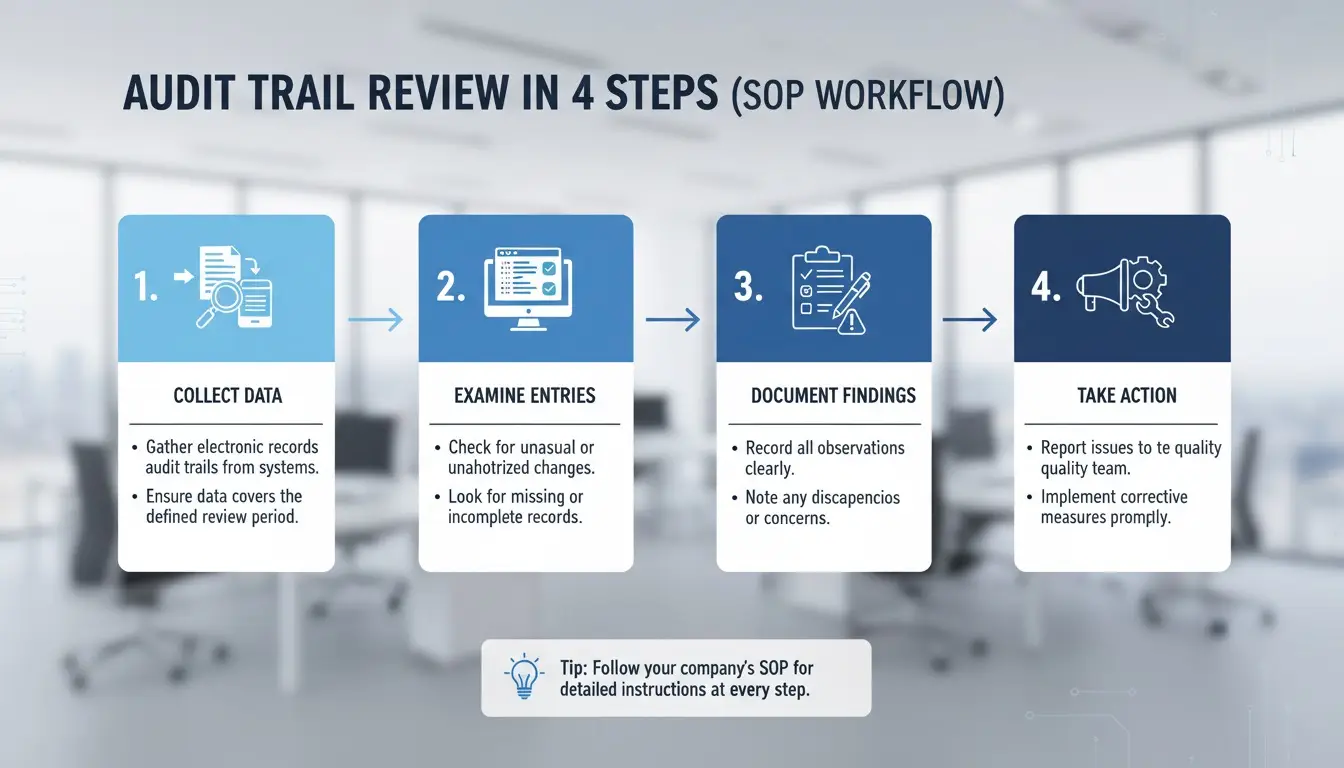
Audit Trail Review in 4 Steps (SOP Workflow)

Define Scope, Systems, Records, and Critical Data

Start by defining the scope of the audit clearly. Identify all relevant systems, records, and critical data involved. Next, list the data types that the audit must cover. Additionally, focus on the most important information that impacts quality or compliance. Clear scope helps target the review and save time.

Moreover, involve key team members to confirm the scope and data. Share the scope document with stakeholders to ensure agreement. Finally, update the scope if new systems or data emerge during the audit. This approach maintains accuracy and completeness throughout the process.

Review Sequence, Escalation, Documentation, and Follow-up

Begin by planning the review sequence to cover all audit steps logically. Next, establish clear escalation paths for issues found during the review. Also, document every finding with complete details. Furthermore, schedule timely follow-ups to ensure all actions complete. This process keeps the audit organized and effective.


During the review, communicate clearly with your team about progress. When you find problems, escalate them quickly to the right person. Additionally, maintain thorough records for audit transparency and future reference. Finally, follow up on corrective actions to confirm resolution. This routine improves audit quality and compliance.

Handling Exceptions, Deviations, and CAPA Linkage

When handling exceptions and deviations, identify the root cause quickly. Then, document the issue clearly with all details. Also, communicate the problem to the relevant team members. Next, link the issue to a CAPA for proper resolution. This process ensures that no problem goes unnoticed or unresolved.

To manage these issues effectively, follow these steps: 

  1. Detect and record exceptions or deviations immediately.
  2. Investigate root causes with the appropriate team.
  3. Create corrective and preventive actions (CAPA).
  4. Monitor CAPA effectiveness and close the loop.

Audit Trail Review Frequency and Responsibilities

Set a clear frequency for audit trail reviews to maintain data integrity. Review the audit trails regularly and consistently. Also, assign specific team members to handle these reviews. Moreover, keep the team informed about their responsibilities and deadlines. This approach ensures accountability and accuracy.

Furthermore, management should support the review process actively. They should also provide necessary resources and training.

QA vs QC vs Supervisor vs Independent Reviewer — Role Matrix

Role Key Responsibilities Focus Area
QA (Quality Assurance)
Develop processes, ensure compliance
Prevention
QC (Quality Control)
Test products, identify defects
Detection
Supervisor
Oversee daily operations, manage staff
Operations

Final Word

Audit Trail Review is a critical data integrity control and not just a checkbox activity. According to FDA guidance, audits must occur regularly and follow a risk-based approach to identify and address potential issues effectively. Documenting each review step provides evidence for inspection readiness. Companies should focus on meaningful analysis rather than completing reviews mechanically, ensuring continuous compliance and data accuracy.


Good Manufacturing Practices (GMP) require aligning standard operating procedures (SOPs), reviewer training, and QA oversight consistently. Implementing a strong audit trail review process supports GMP by protecting product quality and patient safety.

FAQs

1️⃣ What is the primary purpose of Audit Trail Review in pharmaceutical manufacturing?

Audit Trail Review ensures data integrity by verifying all electronic record entries, changes, and deletions are complete, accurate, and authorized, helping prevent errors and detect unauthorized activities.

2️⃣ How often should Audit Trail Reviews be conducted according to FDA guidance?

The FDA recommends a risk-based frequency, meaning reviews should occur regularly enough to timely detect anomalies based on the system’s risk profile, ensuring continuous compliance and inspection readiness.

3️⃣ Who is responsible for performing Audit Trail Reviews?

Typically, designated QA personnel or independent reviewers conduct the Audit Trail Reviews, supported by proper training and SOPs; management must oversee and enforce compliance.

Picture of Ershad Moradi

Ershad Moradi

Ershad Moradi, a Content Marketing Specialist at Zamann Pharma Support, brings 6 years of experience in the pharmaceutical industry. Specializing in pharmaceutical and medical technologies, Ershad is currently focused on expanding his knowledge in marketing and improving communication in the field. Outside of work, Ershad enjoys reading and attending industry related networks to stay up-to-date on the latest advancements. With a passion for continuous learning and growth, Ershad is always looking for new opportunities to enhance his skills and contribute to pharmaceutical industry. Connect with Ershad on Facebook for more information.

Release for Distribution in Pharma Manufacturing: a 2026 Guide on GMP Controls, Roles, and Required Documents

Release for Distribution requires Quality Unit authorization confirming all specifications met per WHO GDP Chapter 8, alongside logistics verification of temperature control, documentation, and shipping readiness before patient delivery. This dual authorization ensures regulatory compliance and product integrity throughout the supply chain. Understanding these processes prevents delays and protects patient safety by maintaining GMP standards and traceability requirements.

Read More »

Share