


A Sampling plan in pharma is a documented method defining how many units to take, from where, and how to test them so a small portion represents the whole batch. WHO Technical Report Series (TRS) No. 986, Annex 2 states samples must be statistically justified and representative, because testing often covers far less than 1% of total production. Yet results determine whether 100% of the batch is released or rejected. If samples are not representative, contamination or variability may remain undetected, leading to ineffective or unsafe medicines reaching patients.
Under Good Manufacturing Practices (GMP), WHO TRS No. 1025 emphasizes that Quality Control must supervise sampling to prevent mix-ups and contamination that could compromise the entire lot. Authorized personnel should use approved tools, clean containers, and documented procedures, since sampling errors can affect 100% of release decisions. Records must include batch identity, location, date, and sampler details to ensure traceability. WHO guidance highlights that robust GMP controls during sampling protect product quality, regulatory compliance, and ultimately patient safety.
Table of Contents
What Is a Sampling Plan in Pharma?
A sampling plan in pharma defines how many units to take and from where. It ensures samples represent the entire batch for reliable quality decisions. You test only a small portion, yet results decide batch release. Therefore, regulators demand documented, justified, and controlled sampling procedures. Technical guidance requires trained staff, clean tools, and clear labeling to prevent errors.
WHO TRS 986 Annex 2: Sampling must be representative and scientifically justified
EU GMP Annex 8: Quality Control oversees sampling of materials and containers
A strong plan reduces risk of contamination, mix-ups, and misleading results. It also supports traceability from warehouse to laboratory testing.
Types of Sampling in Pharmaceutical Manufacturing
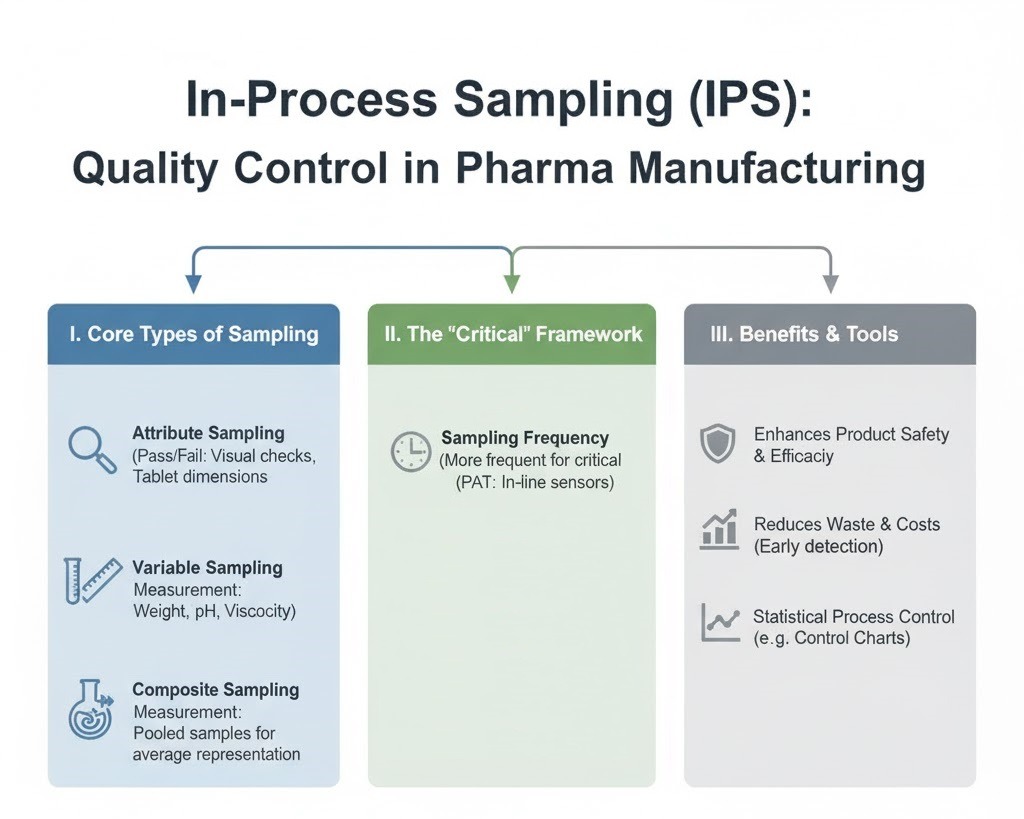
Pharmaceutical manufacturing uses different sampling types to control quality and reduce risk. Teams select methods based on process behavior and product characteristics. Sampling by strategy focuses on how units are chosen from a batch. Sampling by material or stage focuses on where samples come from.
Sampling By Sampling Strategy: random, stratified, systematic, or composite methods
Sampling Material or Stage: raw materials, IPC, finished product, stability samples
Each approach answers different quality questions during production and release. Strategy-based sampling checks uniformity, trends, or hidden variation across units. Stage-based sampling ensures control from incoming materials to final storage. However, teams must justify choices using data and risk assessment.
Strategy-based sampling supports process understanding and monitoring
Stage-based sampling ensures coverage across the product lifecycle
Sampling By Sampling Strategy
Sampling by strategy defines how teams choose units from a batch. Common methods include random, stratified, systematic, and composite sampling. Each method targets different risks such as bias or hidden variation. For example, random sampling selects units without pattern across the batch.
In tablet production, a team may sample every 30 minutes during compression. However, stratified sampling collects tablets from start, middle, and end stages. Composite sampling mixes portions from several containers into one test sample. These strategies help detect trends, non-uniformity, or process drift early.
Sampling Strategy Comparison (Random vs Stratified vs Systematic vs Composite
| Sampling Strategy | How It Works | Typical Use in Pharma |
|---|---|---|
|
Random |
Select units without pattern |
Check overall batch uniformity |
|
Stratified |
Sample from defined layers or zones |
Monitor trends during continuous production |
|
Systematic |
Sample at fixed intervals |
Segregation, status tags |
|
Composite |
Combine portions into one sample |
Reduce testing volume for homogeneous materials |
Sampling Material or Stage
Sampling by material or stage ensures quality control throughout the product lifecycle. Teams collect samples at key points from receipt to long-term storage. Each stage targets different risks, such as contamination or process variability. Clear stage-based sampling improves traceability and release confidence.
Stage 1 Raw Materials and Packaging Components: verify identity and supplier quality
Stage 2 In-Process Samples (IPC) and Critical Steps: monitor process performance
Stage 3 Finished Product and Batch Release Sampling: confirm final specifications
Stage 4 Stability, Retention, and Reserve Samples: support shelf-life and investigations
Stage 1 Raw Materials and Packaging Components
Stage 1 sampling checks raw materials and packaging components before production starts. Teams verify identity, purity, and supplier compliance with specifications. Correct sampling prevents mix-ups and unsuitable materials entering manufacturing. Therefore, staff collect samples from approved containers using clean tools.
Identity testing confirms materials match labels and purchase documents
Visual checks detect damage, contamination, or incorrect packaging components
Reliable incoming materials protect process stability and final product quality. Early detection avoids costly deviations, rework, or batch rejection later.
Stage 2 In-Process Samples (IPC) and Critical Steps
Stage 2 sampling monitors quality during manufacturing at predefined critical steps. Teams check parameters like weight, pH, viscosity, or blend uniformity. IPC testing often occurs every 15–30 minutes during compression or filling. Therefore, operators adjust settings quickly if results drift from limits.
Early detection prevents large quantities of nonconforming product from forming. Studies show IPC controls can reduce batch rejection rates by over 50%. Sampling also confirms equipment operates consistently throughout the run. Continuous monitoring supports process capability and regulatory compliance.
Stage 3 Finished Product and Batch Release Sampling
Finished product sampling confirms that the batch meets all approved specifications before release. Teams collect units randomly from packaged goods to represent the entire lot. Tests may include assay, dissolution, microbiology, and visual inspection. However, results determine whether the batch can reach patients.
Assay testing verifies active ingredient strength
Dissolution testing checks drug release performance
Microbiological testing detects contamination risks
Visual inspection identifies defects or damage
Packaging checks confirm labeling and integrity
Accurate sampling protects patient safety and regulatory compliance.
Stage 4 Stability, Retention, and Reserve Samples
Stability samples evaluate product quality over time under defined storage conditions. ICH Q1A(R2) requires testing at specific intervals throughout shelf life. Teams monitor potency, degradation, and physical changes during studies. Therefore, stability sampling confirms the product remains safe and effective until expiry.
Retention and reserve samples support investigations, complaints, and regulatory inspections. ICH guidance expects firms to store representative samples for each batch. These samples help compare original quality with later findings. Proper storage conditions preserve integrity for reliable future testing.
Sampling Plan as per GMP Requirements
A sampling plan under GMP defines how teams collect representative samples safely. WHO TRS 986 states Quality Control must supervise all sampling activities. Procedures must prevent contamination, mix-ups, and loss of sample integrity. Therefore, trained staff use approved tools, clean containers, and clear labels.
GMP also requires full documentation for traceability and audit readiness. Records must show batch number, location, date, and sampler identity. WHO guidance emphasizes that poor sampling can invalidate test results. Strong controls ensure reliable decisions about product quality and release.
FDA Expectations for Sampling-PDF
FDA expects firms to use representative sampling supported by written procedures and trained staff. 21 CFR 211.84 requires defined quantities, containers, and sampling locations. Samples must prevent contamination and mix-ups during collection and handling. Therefore, companies must justify methods scientifically before testing materials.
Download the official FDA guidance PDF for detailed requirements and examples. It explains expectations for components, containers, and closures in manufacturing.
EMA / EU GMP Expectations for Sampling-PDF
EMA / EU GMP expects companies to collect representative samples using approved procedures and trained personnel. Annex 8 of EudraLex Volume 4 gives detailed rules for sampling starting and packaging materials. It requires clean equipment, controlled environments, and documented methods to prevent contamination. Therefore, sampling must follow risk-based justification and Quality Control oversight.
Download the official EU GMP Annex 8 PDF for full requirements and examples. This document explains sampling locations, quantities, and precautions in detail.
Sampling Procedure in Pharmaceutical Quality Control
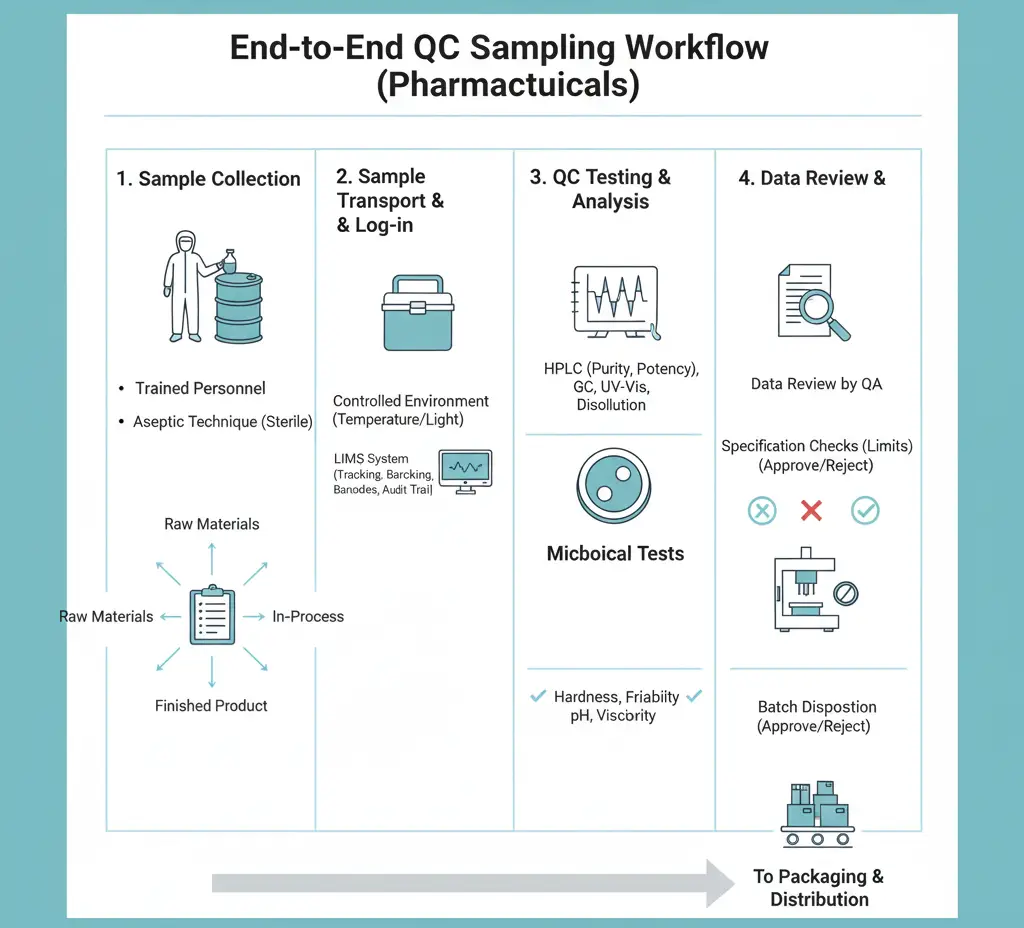
Sampling in Quality Control follows a defined procedure to ensure reliable results. Staff verify documents, tools, and labels before entering sampling areas. They use clean equipment to avoid contamination or mix-ups. However, every action must follow approved SOPs and safety rules.
Confirm batch details and sampling instructions
Use sterile or clean tools as required
Label containers immediately after collection
Record date, location, and sampler identity
Transport samples under controlled conditions
Proper procedures protect sample integrity and traceability.
Final Word
A Sampling plan in pharma defines how teams collect representative portions to make reliable quality decisions. ICH Q9 states risk management must guide controls that affect product quality. Because testing often covers only a tiny fraction of a batch, results influence of release decisions. Therefore, the plan acts as a formal risk control, not just a routine QC task. Poor sampling can hide variability, contamination, or process drift, leading to unsafe products or unnecessary rejection.
ICH Q10 emphasizes lifecycle quality systems and documented procedures for consistent outcomes. Good practice means representative samples + justified sample size + controlled handling + complete records. These elements ensure traceability and confidence during inspections or investigations. A robust sampling plan supports science-based decisions, protects patients, and demonstrates effective pharmaceutical quality management.
FAQs
A sampling plan ensures a small tested portion accurately represents the entire batch. Since release decisions apply to 100% of units, poor sampling can allow defects or contamination to go unnoticed. Regulators treat sampling as a key quality risk control under GMP.
Quality Control typically oversees sampling activities. Trained and authorized personnel must collect samples using approved procedures to prevent mix-ups, contamination, or bias.
Teams justify sample size using risk assessment, batch size, variability, and statistical confidence. Guidance such as ICH Q9 supports risk-based decisions rather than fixed numbers.

Ershad Moradi
Ershad Moradi, a Content Marketing Specialist at Zamann Pharma Support, brings 6 years of experience in the pharmaceutical industry. Specializing in pharmaceutical and medical technologies, Ershad is currently focused on expanding his knowledge in marketing and improving communication in the field. Outside of work, Ershad enjoys reading and attending industry related networks to stay up-to-date on the latest advancements. With a passion for continuous learning and growth, Ershad is always looking for new opportunities to enhance his skills and contribute to pharmaceutical industry. Connect with Ershad on Facebook for more information.

Pharma Jobs in Houston in 2026: FDA GMP Manufacturing and Salary Outlook
Houston’s life sciences sector continues to expand across pharmaceutical jobs in Houston, biotech manufacturing jobs Houston, and GMP jobs in Houston, driven by FDA inspections Texas activity, sterile manufacturing compliance standards, and growing clinical research infrastructure.

Key Performance Indicator (KPI) Guide for Pharmaceutical Industry 2026 : Complete Quality Metrics
Approximately 30% of FDA Warning Letters cite inadequate monitoring of Key Performance Indicators (KPIs) as a major compliance issue, highlighting their crucial role in pharmaceutical operations. KPIs provide measurable data to track process efficiency, product quality, and regulatory adherence. Proper KPI management supports risk mitigation, enhances decision-making, and ensures patient safety.

Pharma Jobs in San Diego in 2026: FDA Oversight, GMP Exposure, Salary Trends
San Diego’s life sciences market offers strong opportunities across pharmaceutical jobs in San Diego, biotech jobs in San Diego, and GMP jobs in San Diego, especially for professionals with FDA inspection exposure and regulatory affairs experience seeking compliance-driven career growth.