


Pharma Jobs in Qatar in 2026: Employers, Licensing, and Market Demand

Qatar’s pharmaceutical market is valued at approximately USD 480 million, and it continues to grow as hospitals expand and specialty services increase. As healthcare infrastructure develops, regulatory oversight becomes stricter. Therefore, hiring decisions depend more on compliance readiness than on simple staffing gaps. This structure directly shapes workforce demand across the sector.

Because hospital systems dominate the market, most hiring activity concentrates in clinical pharmacy, regulated distribution, and public health roles. As a result, Pharma Jobs in Qatar rely heavily on licensing status and institutional demand cycles. When facilities prepare for inspections or expand services, they accelerate recruitment to prevent operational delays. Understanding this link between market growth and compliance pressure helps professionals make informed career decisions instead of reacting to isolated vacancies.

Table of Contents

Pharma Jobs in Qatar: Market Structure and Workforce Demand

Qatar’s pharmaceutical workforce demand grows mainly through hospital expansion, regulatory oversight, and tightly controlled supply chains rather than large-scale local manufacturing. Because the country depends heavily on imports, pharmaceutical companies in Qatar focus on distribution, pharmacovigilance, and compliance instead of formulation facilities. As a result, healthcare jobs in Qatar concentrate in clinical services and regulated operations. Moreover, public institutions such as Hamad Medical Corporation and Sidra Medicine drive most hiring activity. Therefore, professionals must recognize that demand remains compliance-driven, and the Qatar Ministry of Public Health pharmacist license framework directly shapes both eligibility and employer selection standards.

Education and Academic Pathways for Pharmacy Positions in Qatar

Degrees and certifications determine eligibility before employers review applications, so candidates must align their education with Qatar’s regulatory standards early. The Qatar University College of Pharmacy serves as the main local pathway, while authorities strictly verify international degrees. Common routes include a Bachelor of Pharmacy, a PharmD, and postgraduate training in regulatory or quality fields. However, employers prioritize qualifications that match compliance requirements, which directly influences hiring speed for pharmacist jobs in Qatar.

The Four Primary Employer Tracks for Pharma Jobs in Qatar

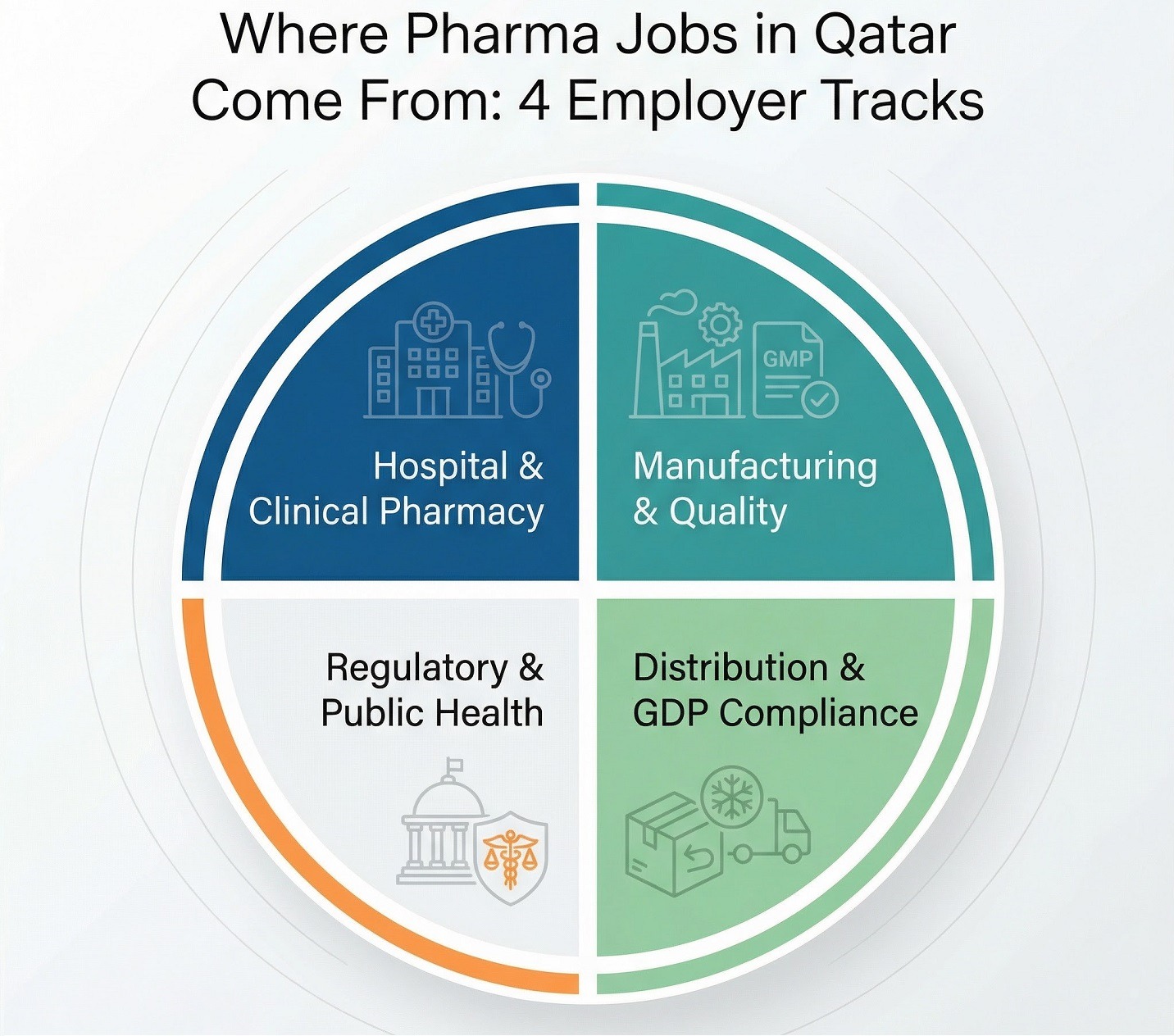
The infographic below highlights where hiring activity is concentrated and how pharma companies in Qatar distribute opportunities across four primary employer tracks.

Infographic showing four primary employer sectors driving pharma jobs in Qatar including hospitals, pharmaceutical manufacturing, distribution, and regulatory institutions.
A visual breakdown of the four main sectors driving pharma jobs in Qatar, including hospitals, manufacturing, distribution, and regulatory bodies.

Hiring activity concentrates mainly in hospital systems, regulated distributors, selected manufacturing units, and public health authorities. Therefore, professionals who understand this structure avoid low-probability applications and focus on sectors with sustained demand. Although pharmacy jobs in Qatar appear across job portals, institutional recruitment channels drive most real hiring decisions.

Below are the four primary employer tracks that shape workforce demand in the market:

1: Hospital and Clinical Pharmacy Roles

2: Pharmaceutical Manufacturing and Production

3: Distribution and Supply Chain Compliance Roles

4: Regulatory and Public Health Positions

Step 1: Hospital and Clinical Pharmacy Roles

Hospitals generate most pharmacist jobs in Qatar, especially in inpatient services, oncology, sterile compounding, and medication safety. Because clinical roles require active licensure and inspection readiness, hiring often increases during expansion or accreditation cycles.

Step 2: Pharmaceutical Manufacturing and Production

Although domestic manufacturing remains limited, companies prioritize quality assurance, validation, and compliance oversight roles. Moreover, sterile facility inspections focus heavily on documentation and deviation control, which makes GMP experience highly valuable.

Step 3: Distribution and Supply Chain Compliance Roles

Distribution centers ensure medicine availability through GDP-compliant storage, cold chain control, and batch traceability. Since compliance failures can trigger regulatory action, employers consistently seek professionals with strong quality and oversight skills.

Step 4: Regulatory and Public Health Positions

Regulatory roles operate within the Qatar Ministry of Public Health pharmacist license framework and focus on licensing review, pharmacovigilance, and inspection coordination. Therefore, these positions require strong documentation skills and solid knowledge of international regulatory standards.

Licensing and Eligibility Requirements for Pharmacist Job Offers in Qatar

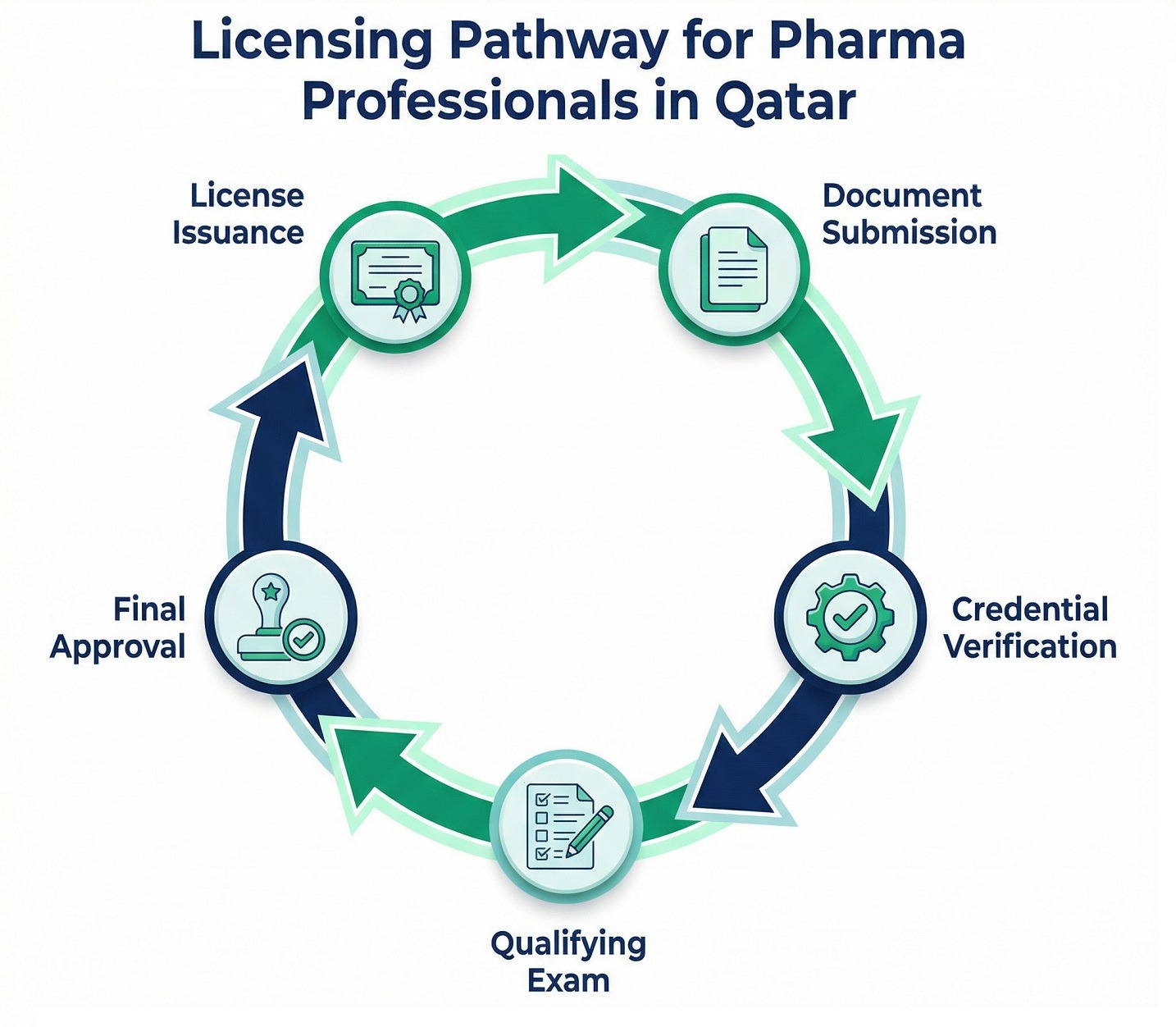
The visual below outlines the structured licensing pathway required under Qatar pharmacist license requirements and highlights the key approval stages candidates must complete.

Licensing process and eligibility steps for pharma jobs in Qatar including document verification and Ministry of Public Health approval stages.
Licensing Pathway for Pharma Professionals in Qatar

You must hold an active Ministry of Public Health license to work legally in Qatar’s pharmaceutical sector. First, you submit academic and experience documents through the official portal, and authorities verify your credentials, often requiring a qualifying exam. Once approved, they issue the license and employers can activate contracts. Because compliance rules remain strict, incomplete documentation frequently delays hiring, so candidates should prepare all required documents in advance.

Download Qatar Ministry of Public Health – Pharmacist Licensing Guidelines (PDF) Here

Future Demand Trends in Qatar’s Pharmaceutical Job Market

Qatar keeps expanding its healthcare system, and this expansion will shape hiring pressure across hospitals, regulated distribution, and public health functions. Moreover, import dependence and tighter oversight continue to push demand toward compliance-heavy roles. Therefore, you should track a few measurable signals before you forecast where employers will hire next.

use the indicators below to connect macro trends (spending, imports, strategy timelines) to the most likely hiring tracks.

Real-world indicator (Qatar) Latest available figure What it suggests for hiring Likely segments that grow first
Total healthcare spending outlook
Projected to reach ~$11B by 2028 (CAGR ~5.2% from 2023)
As spending rises, employers expand clinical services and tighten operating controls. Therefore, they recruit more licensed staff and compliance support.
Hospital pharmacy, clinical operations, medication safety
Government health expenditure as share of GDP
~2.10% of GDP (2023)
Stable public funding supports institutional hiring. Also, it keeps demand concentrated in government-linked systems.
Public hospitals, public health programs
Pharmaceutical imports value
~$1.13B (2024)
Import reliance increases GDP-style distribution pressure. Consequently, employers hire for traceability, cold chain, and release controls.
Distribution QA, GDP compliance, supply chain oversight
Health workforce density (system capacity signal)
~5.8 nurses and ~2.5 physicians per 1,000 people (reported in NHS document)
As Qatar scales service capacity, supporting functions grow too. Therefore, roles that protect safety and documentation expand alongside clinical services.
Clinical pharmacy support, quality systems, documentation-heavy roles
National health strategy timeline
National Health Strategy 2024–2030 launched
Strategy cycles trigger programs, audits, and modernization. As a result, employers increase hiring around implementation milestones.
Regulation-facing roles, pharmacovigilance oversight, compliance coordination

If you want the table to feel even more “decision-ready,” add one short sentence after it that names the top two tracks most likely to expand first (usually hospitals and regulated distribution), then link that directly to the Employer Tracks section.

How to Find the Best Pharmaceutical Positions in Qatar

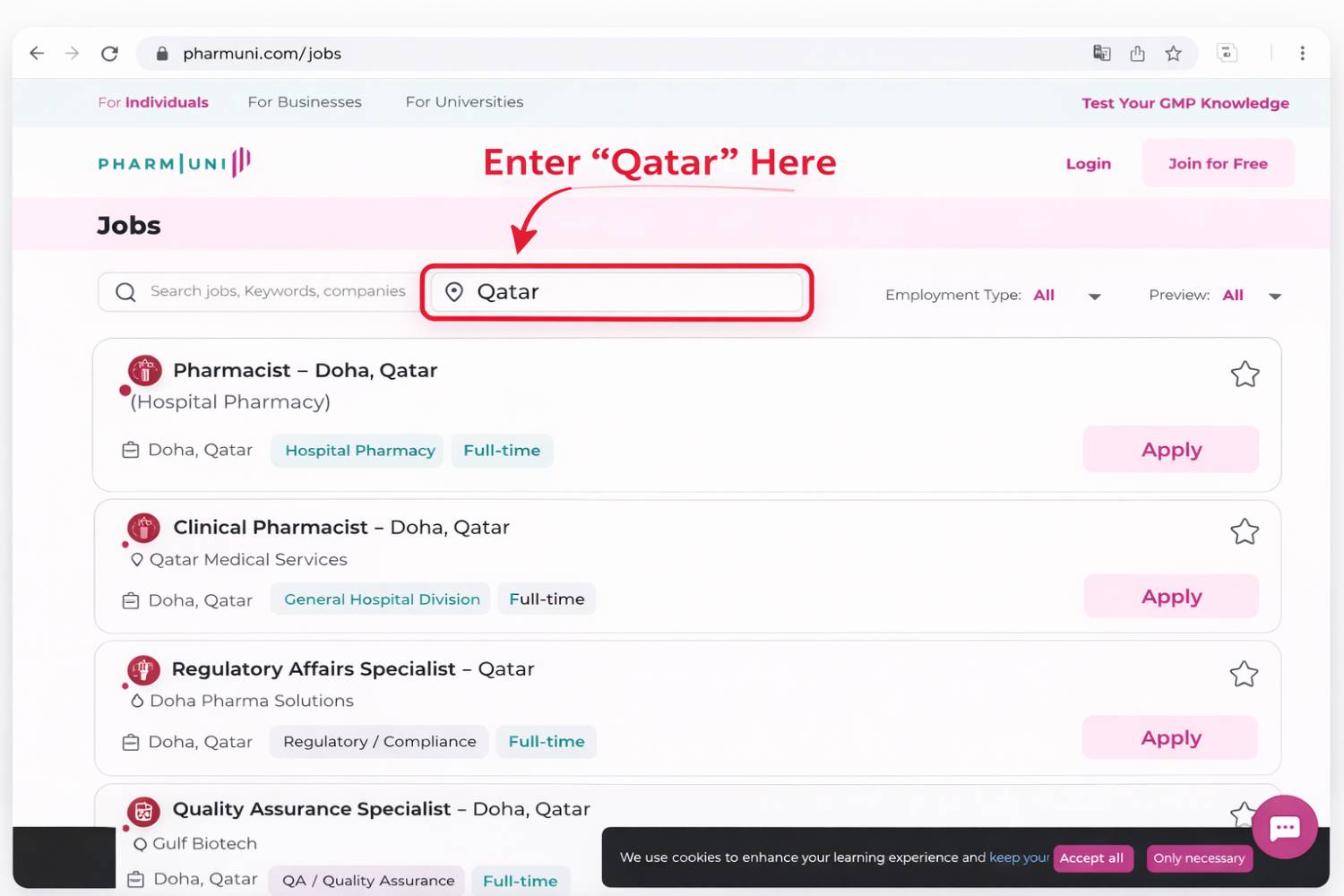
Finding the right pharmaceutical position in Qatar becomes much easier when you use a centralized platform. Instead of checking multiple employer websites, you can search updated listings in one place on PharmUni. You can filter roles by specialization, employer, or career level. For example, you can look for hospital pharmacy positions, regulatory roles, distribution compliance jobs, or manufacturing vacancies within seconds. Moreover, the listings focus specifically on the pharmaceutical sector, so you avoid irrelevant results. As a result, you save time and target your applications more effectively. If you want a structured and reliable way to identify relevant openings, you can Explore Pharma Jobs here.

Find the Best Pharmaceutical Positions in Qatar

Final Word

Qatar’s healthcare system continues to expand, and recent workforce data shows the country employs over 11,000 healthcare professionals, reflecting steady institutional growth rather than scattered hiring. As infrastructure and oversight mature, pharma jobs in Qatar increasingly align with compliance-driven roles in hospitals, regulated distribution, and public health functions.

Because employers prioritize licensing readiness and regulatory alignment, candidates must complete documentation early and strategically select their target sector. In inspection-sensitive environments, even minor credential gaps can delay onboarding and affect operational timelines. Therefore, professionals seeking long-term positioning in Qatar’s pharmaceutical sector should prioritize regulatory preparation, employer alignment, and sector-specific demand analysis instead of applying reactively to individual vacancies.

FAQs

1️⃣ What types of employers hire most licensed pharmacists in Qatar’s healthcare system?

Public hospital networks, regulated distributors, and Ministry-linked institutions hire the majority of licensed pharmacists. Clinical services and compliance-heavy roles account for most structured hiring.

2️⃣ Why does licensing approval delay employment in Qatar’s pharmaceutical sector?

Employers cannot activate contracts until the Ministry of Public Health verifies credentials and issues a professional license. Missing documents or incomplete verification often cause onboarding delays.

3️⃣How can candidates improve their chances in Qatar’s regulated healthcare market?

Prepare licensing documents early, align qualifications with local regulatory standards, and target sectors with sustained demand such as hospital pharmacy and GDP-compliant distribution.

Picture of Mahtab Shardi

Mahtab Shardi

Mahtab is a pharmaceutical professional with a Master’s degree in Physical Chemistry and over five years of experience in laboratory and QC roles. Mahtab contributes reliable, well-structured pharmaceutical content to Pharmuni, helping turn complex scientific topics into clear, practical insights for industry professionals and students.

Sampling Plan

Sampling Plan in Pharma: GMP, FDA/EMA Expectations, and QC Workflow

A pharmaceutical sampling plan ensures that tested samples truly represent the entire batch. Because results determine product release, regulators require representative collection, justified sample size, controlled handling, and full documentation. Strong sampling practices reduce risk, support compliance, and protect patient safety.

Read More »

Share