


GMP Packaging controls how medicinal products are packed, labeled, and protected to ensure identity, quality, and traceability until use. It includes component handling, line clearance, labeling checks, and documentation. However, packaging is a high-risk stage where mix-ups and labeling errors can occur. WHO TRS 1019 Annex 2 notes that labeling mistakes are among the most frequent causes of product recalls, with packaging-related defects accounting for a significant portion of reported quality incidents worldwide.
Under Good Manufacturing Practices (GMP), WHO guidance requires strict controls to prevent cross-contamination and product mix-ups during packaging operations. According to WHO Technical Report Series 986 and 1019, packaging areas must use segregation, reconciliation, and verified line clearance to reduce errors, since even small labeling discrepancies can affect large batch quantities. Studies cited in WHO reports indicate that labeling and packaging issues may contribute to roughly one-third of recall cases in some regions, emphasizing the need for robust controls and documented checks.
Table of Contents
What Is GMP Packaging in Pharmaceuticals?
GMP packaging controls how companies pack, label, and protect medicines before distribution. It ensures each product keeps identity, strength, quality, and traceability. Packaging teams verify correct components, labels, and batch details before starting operations. They document every step to prove compliance and enable full batch tracking.
However, packaging remains a high-risk stage where mix-ups and labeling errors occur.
Operators perform line clearance to remove previous materials and prevent cross-batch confusion.
Inspectors verify printed batch numbers, expiry dates, and product codes during packaging.
Teams reconcile used and returned components to detect discrepancies before batch release.
GMP Packaging Scope: What GMP Controls Cover
| Area | What GMP Controls Require | Typical Evidence (SOP / Record) |
|---|---|---|
|
Packaging components |
Use approved materials |
Specs, release labels |
|
Supplier control |
Qualify suppliers |
Audit reports, ASL |
|
Storage |
Prevent damage and mix-ups |
Segregation, status tags |
|
Label control |
Issue correct labels |
Issuance log |
Why Packaging Is a GMP-Critical Operation
Packaging is a GMP-critical operation because it directly affects product identity and patient safety. A single labeling mistake can send the wrong medicine to patients. Teams must confirm key controls before release: • correct product and strength • accurate batch and expiry • intact packaging • approved components. These checks prevent dangerous mix-ups and ensure traceability throughout distribution.
Moreover, packaging is the last major step before products reach the market. Errors at this stage can impact thousands of units at once. Therefore, operators verify documentation, perform reconciliation, and inspect packs continuously. Strong oversight ensures only compliant, correctly labeled products leave the facility.
Regulatory Frameworks and Requirements for Pharmaceutical Packaging
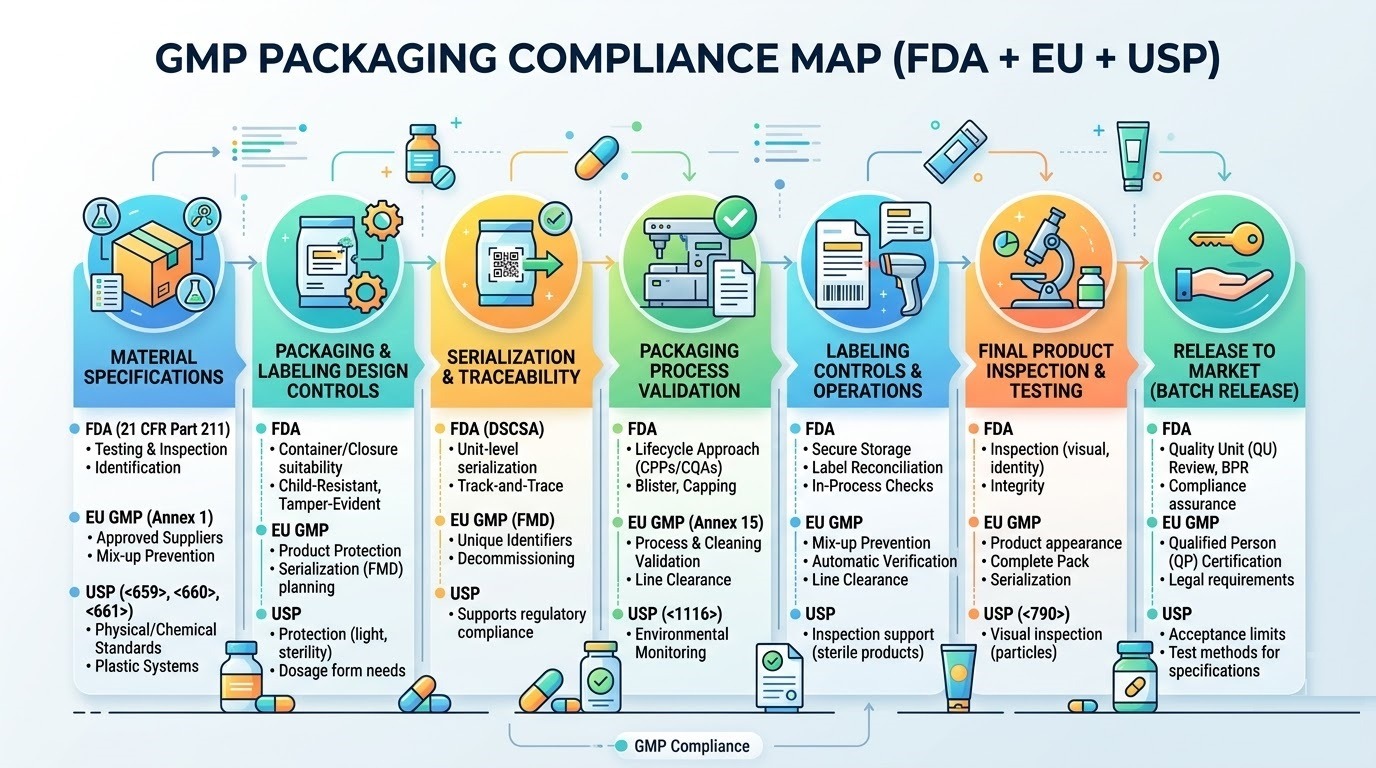
Regulatory frameworks define how companies control pharmaceutical packaging to protect patients. Authorities require clear procedures, trained staff, and documented checks. Companies must prevent mix-ups, mislabeling, and contamination during packaging operations. They also must maintain traceability from components to finished packs.
Key guidance documents explain specific expectations for compliant packaging systems.
1- FDA 21 CFR 211 Subpart G – Packaging & Labeling Control
2- EU GMP Part I/II – Packaging Operations and PQS Expectations
3- USP Standards – Container–Closure, Materials, and Product Protection
Companies use these standards to build procedures and pass inspections.
1- FDA 21 CFR 211 Subpart G – Packaging & Labeling Control -PDF
FDA 21 CFR 211 Subpart G defines strict controls for packaging and labeling operations. It requires companies to use correct labels and prevent mix-ups during packaging. Personnel must verify printed information and document each step carefully.
Moreover, the regulation emphasizes accountability for issued labeling materials and discrepancies.
Companies reconcile issued, used, and returned labels to detect losses or errors.
Supervisors investigate discrepancies immediately and approve actions before continuing packaging.
2- EU GMP Part I/II – Packaging Operations and PQS Expectations-PDF
EU GMP Part I and Part II define how companies control packaging operations within a Pharmaceutical Quality System. They require written procedures, trained personnel, and documented checks for every step. The guidance emphasizes prevention of mix-ups, cross-contamination, and labeling errors during production activities.
Download this official EU GMP PDF to understand packaging expectations and compliance requirements.
3- USP Standards – Container–Closure, Materials, and Product Protection
USP standards define requirements for container–closure systems, packaging materials, and product protection. They ensure packages maintain stability, sterility, and quality throughout shelf life. Manufacturers must select compatible materials and verify performance under storage conditions
Packaging Quality System Controls (PQS) for Packaging Operations
Packaging Quality System controls ensure packaging operations run consistently and safely. Companies establish procedures, train personnel, and monitor activities to prevent errors. These controls maintain product identity, quality, and traceability during packing. However, weak controls can quickly lead to serious mix-ups or labeling mistakes.
Key PQS elements focus on materials, storage, and operational readiness.
1- Supplier Qualification and Incoming Component Control
2- Material Status, Label Issuance, and Secure Storage Controls
3- Line Clearance, Segregation, and Mix-Up Prevention
1-Supplier Qualification and Incoming Component Control
Supplier qualification ensures companies use reliable vendors for packaging components. Teams evaluate quality systems, specifications, and past performance before approval. They establish agreements to define responsibilities and compliance expectations. However, unqualified suppliers can introduce defective or unsafe materials.
Incoming control verifies each delivery meets requirements before release to production.
Inspect packaging components for damage, contamination, or labeling errors.
Verify supplier certificates and compare results with approved specifications.
Check correct item code, lot number, and quantity received.
Assign quarantine status until quality review approves use.
Record inspections to maintain traceability and support investigations.
2-Material Status, Label Issuance, and Secure Storage Controls
Material status control ensures teams use only approved packaging components in production. Staff label materials clearly as quarantine, released, or rejected. They store items separately to prevent accidental use of incorrect components. However, unclear status labels can cause serious mix-ups.
Secure label issuance controls access to printed labeling materials and quantities.
Authorized staff issue labels in controlled amounts for one batch only.
Teams store unused labels securely and return them for reconciliation afterward.
3-Line Clearance, Segregation, and Mix-Up Prevention
Line clearance ensures teams remove all materials from the previous batch before starting. Operators inspect equipment, floors, and storage bins carefully. They confirm only correct components and documents remain on the line. However, skipped checks can allow dangerous mix-ups.
Segregation separates products, materials, and waste to prevent cross-batch confusion.
Teams use physical barriers or distance to keep different batches apart.
Staff label containers clearly to identify product, batch, and status.
Supervisors verify segregation during routine checks and before packaging begins.
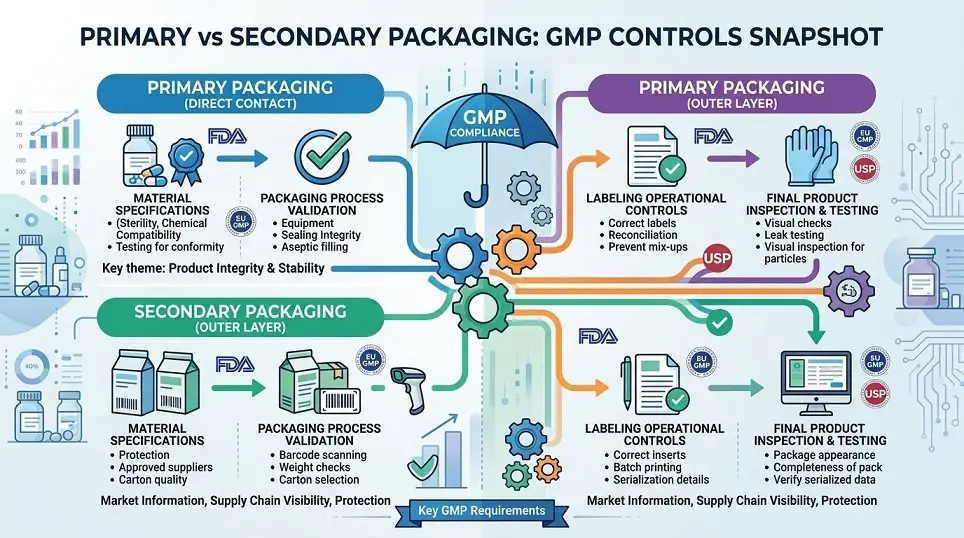
Primary vs Secondary Packaging in GMP
Primary packaging directly contacts the product and protects its quality and stability. Examples include bottles, vials, blisters, and closures. Teams must ensure compatibility, cleanliness, and integrity of these components. Damage or defects can affect safety and effectiveness immediately.
Secondary packaging does not contact the product but ensures correct identification and use. It includes cartons, labels, and leaflets that guide patients and distributors. However, errors here can still cause serious harm through mislabeling or wrong instructions.
Primary packaging protects the product from contamination, moisture, light, and physical damage.
Secondary packaging provides identification, information, tamper evidence, and transport protection.
Final Word
GMP Packaging ensures medicines remain correctly identified, protected, and traceable from production to patient use. It covers component control, labeling accuracy, line clearance, and reconciliation to prevent mix-ups. ICH Q9 highlights risk management, requiring companies to identify and control high-risk steps such as packaging operations. ICH Q10 further expects a robust pharmaceutical quality system with documented procedures, trained personnel, and effective change control to maintain consistent packaging performance across batches.
Overall, GMP Packaging success depends on strong systems, vigilant staff, and complete records. When companies apply ICH Q9 risk principles and Q10 quality governance, they reduce errors and improve product reliability. Clear procedures, segregation, and verification checks ensure only compliant, correctly labeled products reach the market.
FAQs
Because packaging errors can affect many units at once. Wrong labels, batch numbers, or leaflets can lead to incorrect product use and recalls. Packaging is also the final stage before distribution, so mistakes may escape detection.
Line clearance ensures removal of materials from the previous batch. It prevents cross-batch contamination and mix-ups before starting a new packaging run.
Reconciliation compares issued, used, returned, and rejected components. Discrepancies signal possible losses, misprints, or mislabeling risks that require investigation.

Ershad Moradi
Ershad Moradi, a Content Marketing Specialist at Zamann Pharma Support, brings 6 years of experience in the pharmaceutical industry. Specializing in pharmaceutical and medical technologies, Ershad is currently focused on expanding his knowledge in marketing and improving communication in the field. Outside of work, Ershad enjoys reading and attending industry related networks to stay up-to-date on the latest advancements. With a passion for continuous learning and growth, Ershad is always looking for new opportunities to enhance his skills and contribute to pharmaceutical industry. Connect with Ershad on Facebook for more information.

GMP Inspection Readiness : A Proven Audit Guide in 2026
GMP inspection readiness means showing that your pharmaceutical quality systems work every day. This practical guide walks QA, QC and site leaders through a five-step, risk-based preparation framework, with priority evidence to review, mock inspection tips, CAPA guidance and answers to common inspection questions.

GMP Training Matrix in 2026: How to Build an Audit-Ready, Role-Based Training System
Learn how to build a GMP training matrix that links pharma team roles to SOPs, records competency evidence, tracks retraining, and supports inspection readiness.

Universities vs Pharmuni in 2026: Faster Pharma Career Readiness
Universities provide formal degrees, research depth and academic credibility. Pharmuni adds faster pharma-specific upskilling, assessments, Career Paths, CV tools and job-readiness support. Here is how the two models differ—and when using both makes sense.