

Features
Topics
Discover

Unlock the potential of your career in the Pharma industry with our online courses and qualifications.

Career Path

Pick a career path, follow its guided course roadmap, and secure industry-verified credentials in a few months.

Courses

Earn career credentials from industry leaders that demonstrate your expertise.

Quality Oversight In 2026: Roles in pharma industry, GMP Expectations, And Risk-Based Control

Quality Oversight keeps GMP manufacturing controlled and documented. In the US, FDA cGMP rules in 21 CFR Parts 210 and 211 define controls for drug manufacturing, including written procedures, records, and quality unit authority. WHO GMP (TRS 986, Annex 2) supports similar principles for supply.

This article focuses on pharma manufacturing / GMP operations, not clinical or device QMS. It shows how pharma quality management uses EU GMP EudraLex Volume 4 (Chapters 1, 6, 8) to govern PQS, labs, and complaints. QP duties are EU/EEA-specific, and Annex 16 links QP certification to batch release decisions.

Table of Contents

What Is Quality Oversight in Pharma?

Quality Oversight means leaders and quality teams control GMP work every day. They confirm processes follow approved procedures, records, and specifications. Therefore, they spot risks early and act before patients get harmed.

Quality Oversight covers production, QC testing, and QA review across the full batch lifecycle. It also checks suppliers, deviations, CAPA, and change control decisions closely.

  • Set clear roles, escalations, and review frequencies for critical processes.

  • Track trends in deviations, complaints, and OOS results, then correct fast.

  • Document decisions, approvals, and follow-ups, so audits show real control.

What Is Quality Oversight in Pharma?

FDA expects Quality Oversight to enforce daily cGMP under 21 CFR 210 and 211. Teams must control procedures, investigate deviations, and review batch records for every release. Therefore, leaders track trends, review metrics, and close CAPAs with clear evidence.

EU GMP EudraLex Volume 4 expects PQS governance in Chapters 1, 6, and 8. Annex 16 assigns QP certification duties for batches in the EU/EEA only. In 2026, inspectors also expect documented oversight of suppliers, data integrity, and changes.

Regulatory Crosswalk: FDA, EU GMP, And EMA Expectations for Quality Oversight

Oversight area Evidence to show (examples) When to review
PQS governance
Management review minutes + action log
Quarterly (or per PQS)
Quality council / escalation
Escalation log + decisions + follow-ups
Monthly + event-driven
Batch disposition
Batch record checklist + release decision
Every batch
Deviations
Deviation record + impact assessment
Every deviation

Lifecycle of Validation and Re-validation; Key Points

Quality oversight fails when teams miss escalation and repeat deviations. Therefore, FDA issued 105 quality warning letters in FY2024 and ran 3,128 inspections. 

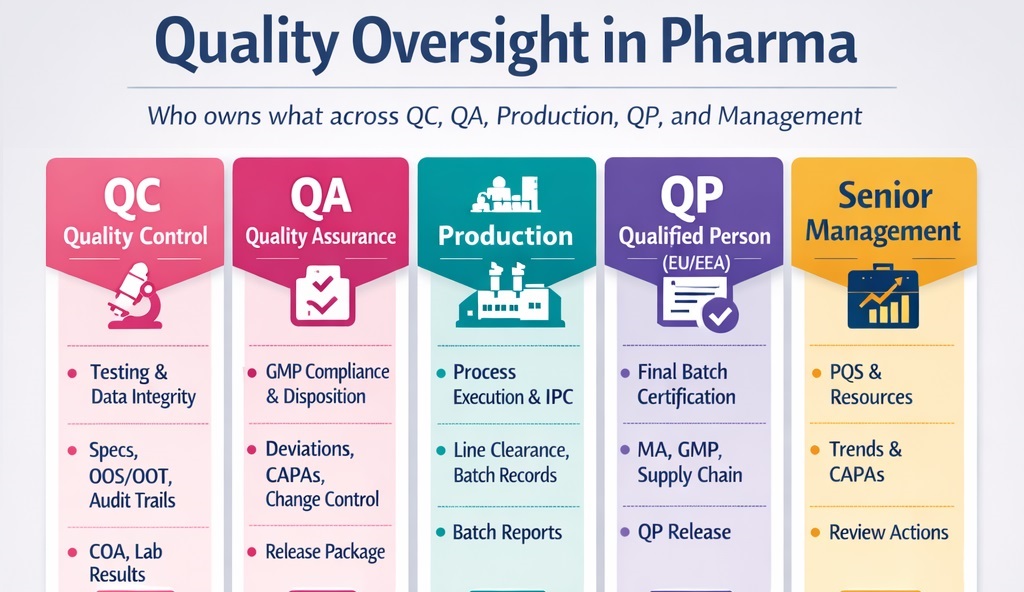
Use these role lanes to prevent gaps and prove control in GMP operations. Review evidence weekly for high-risk steps, and document decisions.

  1. Quality Control (QC)

  2. Quality Assurance (QA)

  3. Senior Management

  4. Qualified Person (QP)

  5. Production

Quality Oversight in Pharma: Who Owns What? (QC, QA, Production, QP, Senior Management)
Quality Roles in Pharma: Who Owns What? (QC, QA, Production, QP, Senior Management)

1) Quality Control (QC): Testing, Results Review, And Data Integrity Checks

Quality Control protects patients by testing materials, in-process samples, and finished batches. QC reviews results against specs and flags OOS or trends quickly.

Therefore, QC also checks data integrity in instruments and electronic records before release decisions.

  • Verify calibration, system suitability, and sample traceability for every run.

  • Review audit trails, chromatograms, and calculations; then document corrections and retests.

2) Quality Assurance (QA): Compliance Monitoring, And Batch Disposition Support

FDA’s 2011 guidance defines 3 lifecycle stages for process validation. Initial validation starts before routine production and confirms consistent performance readiness. 

WHO TRS 1019 Annex 3, published 2019, lists protocols and reports in documentation. However, validation reports show baseline study design, data, and initial conclusions. Re-validation reports emphasize trigger rationale, impact assessment, updated evidence, and QA decision traceability. 

3) Senior Management: PQS Governance, Resources, Escalation, And Quality Culture

Senior management sets PQS direction and funds quality priorities across sites. They review performance trends and remove barriers fast for teams.

Therefore, they drive escalation and build a speak-up culture.

  • Approve quality objectives and resources.

  • Demand timely CAPA closure and effectiveness checks.

  • Attend management reviews and document actions.

4) Qualified Person (QP): Final Certification and Release Responsibility

Qualified Person certifies each batch meets EU GMP and marketing authorization. QP reviews quality decisions before release.

Therefore, QP documents certification and escalates any unresolved GMP risk.

  • Confirm GMP compliance, deviations, and CAPA status before certification.

  • Verify supply chain, testing results, and release documentation for each EU/EEA batch.

5) Production: Process Execution, In-Process Controls, Documentation, And Deviation Reporting

Production runs GMP processes exactly as approved in master instructions. Teams perform in-process checks and record results at the time.

Therefore, production reports deviations early and supports investigations with facts.

  • Follow SOPs, verify line clearance, and document each critical step.

  • Stop the line for abnormalities, then open deviations and inform QA.

Common Quality Oversight Failures Trigger FDA 483s And Regulatory Findings

Revalidation checks whether a process still performs within approved limits after changes. Requalification checks equipment, utilities, or systems to confirm continued fitness and control.

Therefore, teams use 1 path for process performance and 2 paths for linked equipment checks. This distinction speeds decisions, targets evidence, and reduces unnecessary testing during GMP changes and reviews. It also helps QA document scope clearly and defend actions during inspections and audits.

High-Risk Gaps Inspectors Commonly Identify

Inspectors flag gaps that weaken control and repeat failures. They also look for missing oversight evidence and weak escalation routes.

Therefore, fix these high-risk gaps before audits.

  • Skip trend reviews for deviations, OOS, or complaints.

  • Close CAPAs late or without effectiveness checks.

  • Approve changes without risk assessment or validation impact.

  • Miss audit-trail reviews for critical GMP systems.

Weak Investigation Depth and Repeated Deviations

Weak investigations cause repeated deviations and growing compliance risk. Teams choose “operator error” and skip evidence collection and trend checks.

Therefore, strengthen investigations to stop recurrence.

  • Define a clear problem statement and timeline with facts.

  • Use tools like 5 Whys, fishbone, and fault tree.

  • Set CAPA actions, verify effectiveness, and track recurrence trends.

How Often Revalidation Should Be Done In Pharma

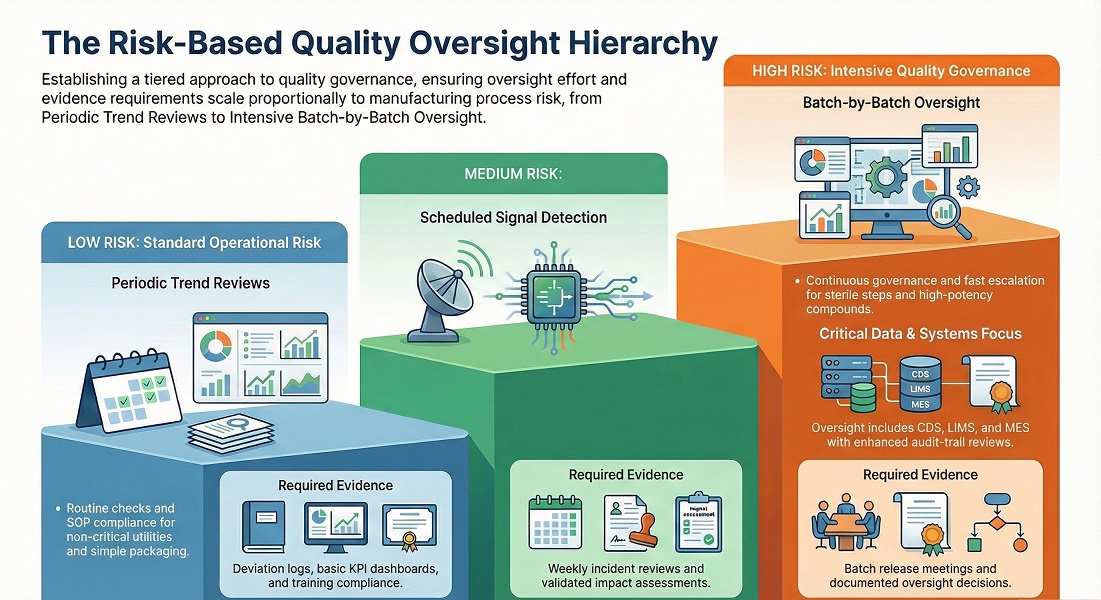
Design oversight by product risk, process complexity, and patient impact. Sterile and high-potent products need tighter controls and faster escalation. EU GMP Annex 1 defines sterility assurance as SAL 10⁻6 or better. Use that risk level to set review depth for aseptic filling.

Track process performance each month with deviations, OOS rates, and environmental monitoring trends. Therefore, raise oversight when trends repeat, or when CAPAs miss due dates. In FY2024, FDA issued 105 drug-quality warning letters. Use supplier scorecards and audit plans for high-risk steps and outsourced sites. 

Risk-Based Quality Model (Low / Medium / High Risk Processes)
Risk-Based Quality Model

Final Word

Quality Oversight keeps GMP manufacturing controlled, traceable, and inspection-ready during audits and inspections. ICH Q10 frames an effective PQS with 4 elements: monitoring, CAPA, change management, and management review. ICH Q9(R1) adds 2 principles: link risk decisions to patient protection, and use scientific knowledge.  These models help teams prevent repeated deviations and weak investigations.

Apply risk-based oversight to high-impact steps, suppliers, and data systems. Review trends monthly, escalate fast, and document decisions with clear rationale. Verify CAPA effectiveness, and close actions on time. Keep roles clear across QC, QA, production, and EU/EEA QP release duties.

FAQs

1️⃣Who is responsible for Quality in Pharma?

 QA coordinates oversight, but QC, Production, and Management share daily duties. In the US, the quality unit must approve or reject products and records.

2️⃣ What evidence do inspectors expect to see?

 Inspectors expect batch decisions, deviation investigations, CAPA effectiveness checks, and trend reviews. They also expect management review actions with owners and due dates.

3️⃣How do you apply risk-based oversight?


 Start with patient impact and process criticality, then set review depth and frequency. Increase oversight when deviations repeat or trends worsen. Use ICH Q9(R1) tools to justify decisions.

Picture of Ershad Moradi

Ershad Moradi

Ershad Moradi, a Content Marketing Specialist at Zamann Pharma Support, brings 6 years of experience in the pharmaceutical industry. Specializing in pharmaceutical and medical technologies, Ershad is currently focused on expanding his knowledge in marketing and improving communication in the field. Outside of work, Ershad enjoys reading and attending industry related networks to stay up-to-date on the latest advancements. With a passion for continuous learning and growth, Ershad is always looking for new opportunities to enhance his skills and contribute to pharmaceutical industry. Connect with Ershad on Facebook for more information.

Wide view of a regulated pharmaceutical manufacturing facility during a quality inspection, illustrating pharmaceutical GxP compliance, GxP inspection readiness, quality risk management, data integrity expectations, and pharmaceutical governance systems.

GxP in pharma in 2026: How Inspectors Evaluate System Control

This article explains how GxP quality systems are assessed during inspections, why gaps in governance and execution lead to repeat audit findings, and how regulated pharma operations strengthen inspection readiness through risk management, data integrity, and lifecycle compliance controls.

Read More »

Share