


Features
Topics
Discover

Unlock the potential of your career in the Pharma industry with our online courses and qualifications.

Career Path

Pick a career path, follow its guided course roadmap, and secure industry-verified credentials in a few months.

Courses

Earn career credentials from industry leaders that demonstrate your expertise.

GxP in pharma in 2026: How Inspectors Evaluate System Control

In recent global inspection cycles, approximately 30–40% of repeat inspection observations across pharmaceutical sites were traced back to failures in system alignment rather than isolated technical errors, underscoring how GXP in pharma is increasingly assessed as a measure of enterprise-level control rather than individual compliance tasks. These trends reflect growing regulatory scrutiny on how regulated operations sustain quality, data integrity, and risk management under routine manufacturing pressure, consistent with the principles of Good Manufacturing Practices.

This article examines how inspectors interpret GxP frameworks during on-site inspections, why misalignment across systems leads to recurring findings, and how pharmaceutical organizations can strengthen inspection readiness by focusing on governance, execution discipline, and lifecycle control.

Table of Contents

What GxP Means in Pharmaceutical Operations

GxP represents an integrated regulatory framework governing how pharmaceutical activities are planned, executed, documented, and controlled across regulated environments, often described collectively as GXP in pharma during regulatory inspections.

From a regulatory perspective, GxP is not a checklist of acronyms such as GMP, GDP, or GCP. Instead, it functions as an umbrella system that connects quality management, operational execution, data integrity, and governance across the full product lifecycle.

GxP defines how regulated pharmaceutical operations maintain control, accountability, and patient protection throughout everyday activities. Inspectors therefore evaluate whether quality systems, operational controls, and governance structures operate coherently. Compliance is demonstrated when decision-making, documentation, and risk management remain consistent across departments, shifts, and product stages rather than when individual procedures appear compliant in isolation.

Why GxP Alignment Influences Inspection Outcomes

Alignment across GxP systems directly influences inspection outcomes because regulators interpret it as evidence of organizational control maturity, particularly when evaluating GXP in pharma as an integrated operating model rather than isolated compliance elements.

During inspections, authorities assess whether quality systems guide real behavior under routine conditions. Fragmented ownership, inconsistent execution, or weak escalation pathways signal that compliance depends on individuals rather than systems. As a result, inspectors often escalate observations when misalignment exposes structural weaknesses.

Inspection history shows that sites with strong GxP alignment resolve deviations faster, maintain regulatory confidence, and reduce the likelihood of follow-up inspections driven by repeat observations.

How Inspectors Evaluate GxP Implementation Across Systems

Inspectors assess system control by observing how governance, operations, data, and execution remain aligned under routine conditions.

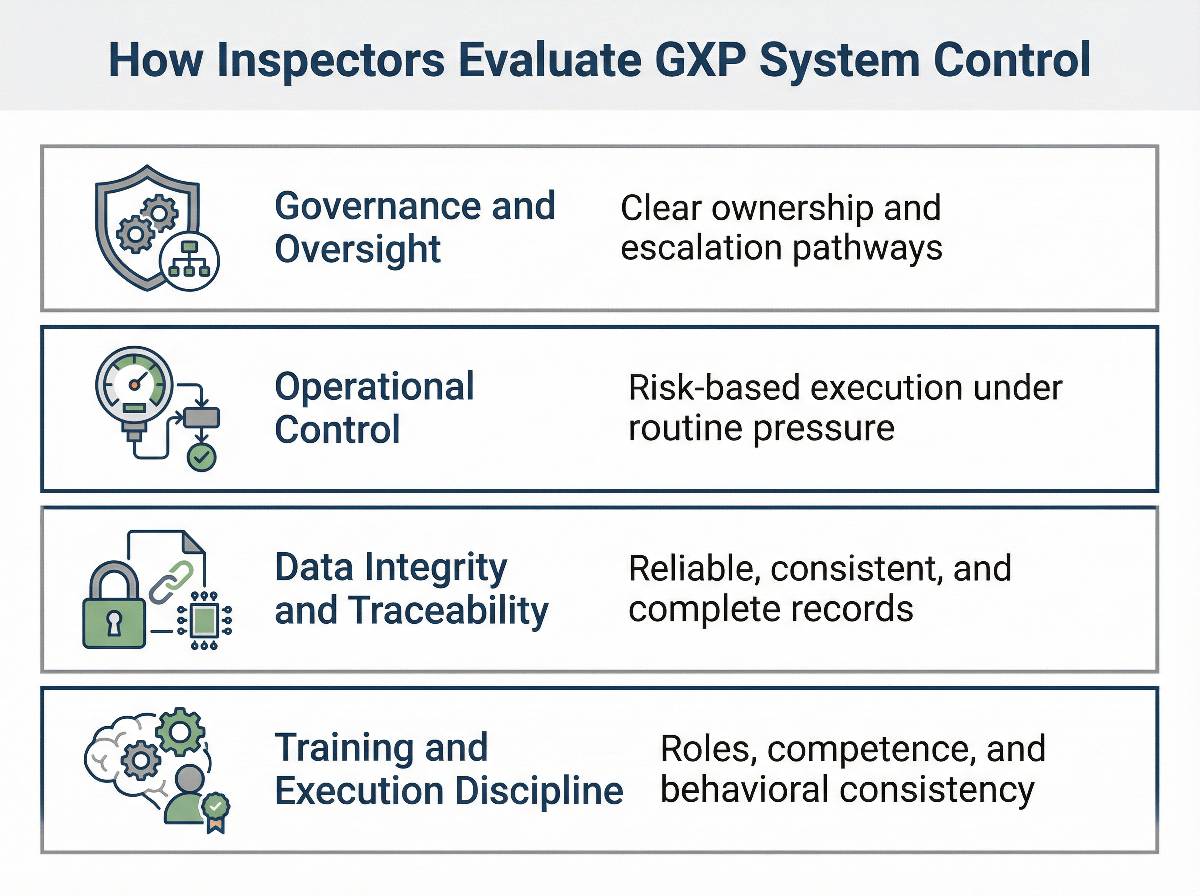
How Inspectors Evaluate GxP System Control

Inspectors evaluate GxP implementation by observing how quality governance, operational controls, data integrity, and personnel execution interact as a single system during routine activities. Rather than reviewing functions in isolation, they assess whether controls remain aligned when processes change, deviations occur, or pressure increases during normal operations. System coherence, not individual compliance artifacts, ultimately shapes inspection conclusions.

This evaluation consistently focuses on the following system areas:

  • Governance and Quality System Structure
  • Operational Controls and Risk Management
  • Data Integrity and Documentation Expectations
  • Training, Roles, and Execution Discipline

Governance and Quality System Structure

Governance defines how accountability flows across regulated operations. Inspectors examine whether quality system responsibilities are clearly assigned, escalation pathways function effectively, and management oversight extends beyond periodic reviews.

In real inspections, governance weaknesses often surface when deviations span multiple departments and ownership becomes unclear.

Operational Controls and Risk Management

Operational controls demonstrate whether risk management principles are applied consistently. Inspectors review how risks are identified, mitigated, and reassessed as processes change.

During inspections, regulators frequently challenge sites on whether risk assessments drive real control decisions or simply justify existing practices.

Data Integrity and Documentation Expectations

Data integrity remains central to GxP enforcement. Inspectors assess whether records are attributable, legible, contemporaneous, original, and accurate across systems.

At many sites, data integrity findings emerge during routine record review rather than targeted data audits, highlighting execution gaps under daily workload.

Training, Roles, and Execution Discipline

Training effectiveness reflects whether personnel understand their regulated responsibilities. Inspectors observe whether roles are clearly defined, training aligns with actual tasks, and execution remains consistent across shifts.

Micro-credibility insight: During inspections, inconsistencies between trained procedures and observed behavior frequently trigger deeper system reviews.

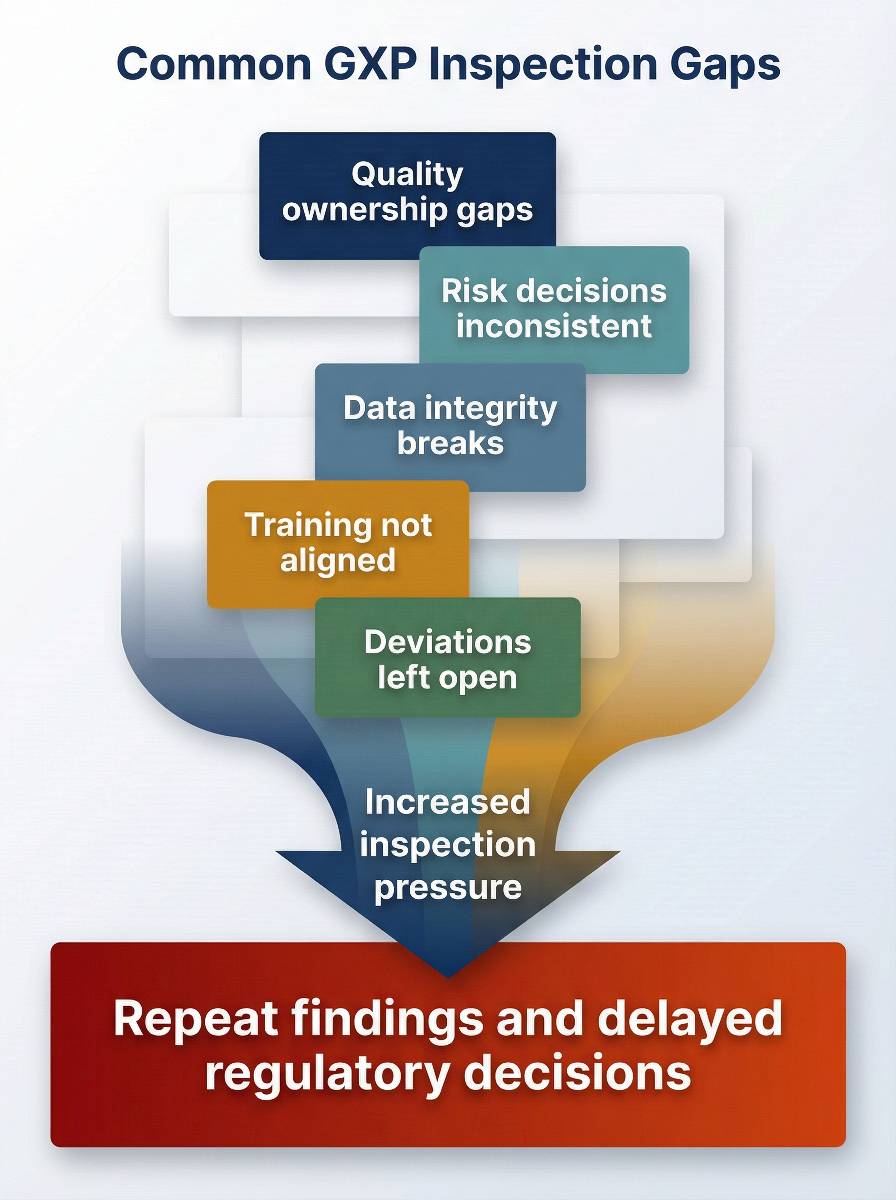
Common GxP Gaps Identified During Inspections

Recurring inspection findings consistently stem from a small set of unresolved system-level compliance gaps.

Common GxP Gaps
Common Inspection GxP Gaps

Recurring inspection findings reveal how regulatory failures develop across manufacturing sites.

Inspectors consistently report gaps related to operational control, documentation discipline, and environmental oversight when regulatory expectations are not fully integrated into daily execution.

Common GxP Gap and  inspectionimpact

Common GxP Gap Inspection Impact Systemic Concern
Fragmented quality ownership
Delayed corrective actions
Weak governance structure
Inconsistent risk assessments
Uncontrolled process changes
Superficial risk management
Data integrity lapses
Loss of record trust
System reliability questioned
Training not role-specific
Execution variability
Compliance dependent on individuals
Poor deviation closure
Repeat observations
Lifecycle control failure

These gaps persist when GxP is treated as a compliance obligation rather than an operational framework.

Practical Actions to Strengthen GxP Compliance

Strengthening GxP compliance requires reinforcing system behavior, not expanding documentation volume.

Inspection-aligned actions that reduce repeat findings include:

  • Clarifying quality governance and escalation ownership
  • Embedding risk management into change and deviation processes
  • Ensuring documentation reflects real execution, not ideal workflows
  • Aligning training with actual operational responsibilities
  • Reviewing system performance under routine conditions, not just audits

Consistent application of these actions improves inspection resilience and supports sustainable compliance maturity.

Final Word

Across recent international inspection programs, regulatory authorities issued market-impacting actions in roughly 20–25% of cases where systemic GxP weaknesses remained unresolved after initial audits. These outcomes demonstrate a clear regulatory expectation: GXP in pharma is enforced as an integrated control framework, not as a collection of compliant documents or isolated procedures.

Organizations that align governance, operations, data integrity, and training into a coherent system reduce compliance risk, protect regulatory timelines, and avoid prolonged inspection cycles. In most inspections, warning signs of systemic failure appear well before regulators arrive on site.

Micro-credibility insight: Sites facing enforcement actions often show early indicators such as repeated deviations, inconsistent risk decisions, and unclear quality ownership months before inspection outcomes escalate.

FAQs

1️⃣ What does GxP cover beyond individual GMP procedures?


GxP covers how quality systems, operational controls, data integrity, and governance work together across regulated activities.


Findings repeat when organizations correct documents but fail to align governance, risk management, and execution across systems under routine operating conditions.

3️⃣ How can organizations improve GxP inspection readiness without major system changes?


Clarifying quality ownership, strengthening risk-based decision-making, and aligning daily execution with documented controls significantly improves inspection readiness without large structural changes.

Picture of Mahtab Shardi

Mahtab Shardi

Mahtab is a pharmaceutical professional with a Master’s degree in Physical Chemistry and over five years of experience in laboratory and QC roles. Mahtab contributes reliable, well-structured pharmaceutical content to Pharmuni, helping turn complex scientific topics into clear, practical insights for industry professionals and students.

Wide view of a regulated pharmaceutical manufacturing facility during a quality inspection, illustrating pharmaceutical GxP compliance, GxP inspection readiness, quality risk management, data integrity expectations, and pharmaceutical governance systems.

GxP in pharma in 2026: How Inspectors Evaluate System Control

This article explains how GxP quality systems are assessed during inspections, why gaps in governance and execution lead to repeat audit findings, and how regulated pharma operations strengthen inspection readiness through risk management, data integrity, and lifecycle compliance controls.

Read More »

Share