


Features
Topics
Discover

Unlock the potential of your career in the Pharma industry with our online courses and qualifications.

Career Path

Pick a career path, follow its guided course roadmap, and secure industry-verified credentials in a few months.

Courses

Earn career credentials from industry leaders that demonstrate your expertise.

Revalidation In Pharma (2026 guide): Meaning, Triggers, Frequency, And Requalification Differences

Revalidation matters because delays, repeat testing, and failed batches raise cost and audit risk. WHO TRS 1019 Annex 3 (2019), sections 11.2–11.3, says Re-validation should follow identified need, risk management, and change control. This article covers meaning, types/severity, GMP grading, and a practical classification approach.

Good Manufacturing Practices (GMP) decisions affect recalls, remediation timelines, and inspection outcomes. PIC/S PI 040-1, effective 1 January 2019, is an 18-page guidance that supports risk-based classification and defines three categories: Critical, Major, and Other deficiencies, helping teams align severity ratings, prioritize actions, and defend compliance decisions consistently across inspectorates.

Table of Contents

What is Revalidation in Pharma?

Re-validation in pharma confirms a process still performs within approved limits over time for patients. Therefore, teams review changes, trends, and deviations before they continue routine production safely.

It protects product quality and reduces compliance surprises during inspections, audits, and complaints. It also supports faster decisions after supplier, equipment, or parameter changes in GMP systems.

  • A 10% drift in yield can trigger re-validation reviews early internally.

  • A 20% rise in deviations can increase delays, costs, and batch reviews.

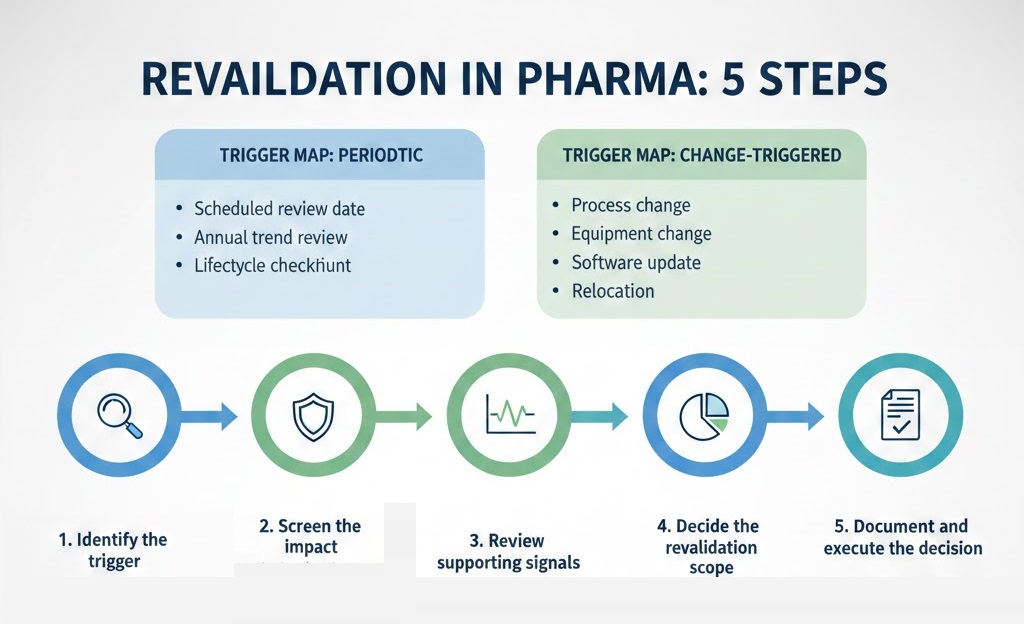
Re-validation In Pharma 5 Steps
Steps to Assess Triggers, Risk, and Scope for Re-validation

When Re-validation Is Required

Teams need re-validation when changes, deviations, or trend drift threaten process control. WHO TRS 1019 Annex 3 (2019), sections 11.1–11.4, links re-validation to reviews and changes. This problem increases batch delays, repeat testing, and investigation workload and costs during production. 

FDA’s 2011 guidance describes three lifecycle stages and ongoing process verification for manufacturers. Therefore, teams should trigger re-validation after impactful changes, recurring data signals, and complaints. This article explains timing, triggers, and documentation priorities for stronger compliance decisions. 

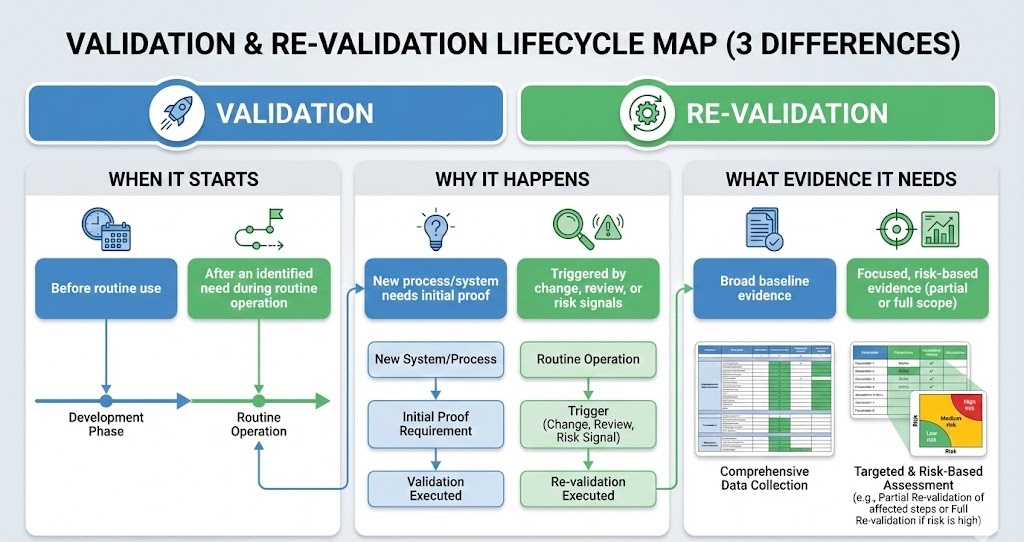
Lifecycle of Validation and Re-validation; Key Points

FDA’s 2011 guidance defines three lifecycle stages for process validation in pharma. However, teams often confuse stage work, records, and evidence, which delays reviews. 

WHO TRS 1019 Annex 3 (2019) links re-validation to periodic review and verification. Therefore, readers should care because weak lifecycle decisions increase deviations, repeat testing, and compliance risk. This section explains links between validation planning, re-validation triggers, and documented GMP decisions. Use it to align QA, production, and validation teams before audits and changes. 

  1. Point 1: Initial Validation Before Routine Use

  2. Point 2: Documentation Differences (Validation Report vs Re-validation Report)

  3. Point 3: Acceptance Criteria and Evidence Expectations

Validation starts it. Re-validation keeps control.
Different triggers, different evidence, same GMP goal

Point 1: Initial Validation Before Routine Use

Initial validation proves a process can make quality product before routine manufacturing starts. Teams run  planned studies, collect data, and confirm controls under protocol. It builds confidence for QA, production, and management decisions.

Therefore, early validation prevents batch failures, delays, and costly investigations later often. It also supports compliance readiness during audits and process transfer activities.

Point 2: Documentation Differences (Validation Report vs Re-validation Report)

FDA’s 2011 guidance defines 3 lifecycle stages for process validation. Initial validation starts before routine production and confirms consistent performance readiness. 

WHO TRS 1019 Annex 3, published 2019, lists protocols and reports in documentation. However, validation reports show baseline study design, data, and initial conclusions. Re-validation reports emphasize trigger rationale, impact assessment, updated evidence, and QA decision traceability. 

Point 3: Acceptance Criteria and Evidence Expectations

FDA’s 2011 guidance describes 3 process validation lifecycle stages for manufacturers. Teams must set acceptance criteria before testing and compare results consistently. 

However, WHO TRS 1019 Annex 3 (2019) requires protocols and reports. Strong evidence links data, deviations, and conclusions, which supports faster QA decisions. This reduces review delays, repeat testing, and weak audit explanations during inspections today. 

Acceptance Criteria and Evidence Expectations (Validation and Re-validation)

Element Validation (Initial) Re-validation
Objective & Scope
Define purpose and scope before execution.
Justify trigger, impact, and full/partial scope.
Acceptance Criteria
Predefine limits for CQAs, CPPs, and test results.
Confirm criteria still apply or justify updates.
Evidence Required
Protocol, test data, batch records, summaries.
Change control, impact assessment, updated data, trends.
Sampling Plan
Predefine sampling points, timing, and quantity.
Focus sampling on affected areas and risks.

Revalidation vs Requalification In Pharma

Revalidation checks whether a process still performs within approved limits after changes. Requalification checks equipment, utilities, or systems to confirm continued fitness and control.

Therefore, teams use 1 path for process performance and 2 paths for linked equipment checks. This distinction speeds decisions, targets evidence, and reduces unnecessary testing during GMP changes and reviews. It also helps QA document scope clearly and defend actions during inspections and audits.

Process Focus vs Equipment/System Focus

Process focus checks steps, parameters, and controls across the full manufacturing workflow. However, equipment/system focus checks machines, utilities, and software for fitness and reliability.

  • Use process focus when parameter drift affects yield, quality, or timing.

  • Use equipment/system focus after maintenance, relocation, calibration failure, or software updates.

  • This split reduces duplicate testing and improves evidence planning for QA.

  • It also speeds change decisions and supports clearer GMP documentation reviews.

Practical Examples In GMP Operations

Practical examples help teams choose the right GMP action during changes. A mixer speed change can affect blend uniformity and process performance. Teams also prevent delays, repeat testing, and weak audit explanations. Therefore, teams review impact, define scope, and collect targeted evidence quickly.

  • A reactor relocation needs equipment and utility checks before routine production resumes.

  • A supplier change may need process studies to confirm stable output and product quality.

How Often Revalidation Should Be Done In Pharma

No fixed schedule fits every process because risk and performance differ. Therefore, teams set timing through periodic review, change control, and trend monitoring.

WHO TRS 1019 and FDA lifecycle guidance support risk-based review decisions.

  • Use shorter intervals for complex processes, high variability, or repeated deviations.

  • Use longer intervals for stable trends, strong controls, and low-risk changes.

  • Document frequency rationale, supporting data, and QA approval in formal site procedures.

Final Word

Revalidation matters because GMP changes can raise patient and business risk if teams misclassify impact. Using ICH Q9(R1) quality risk management and ICH Q10 lifecycle oversight, this article explains meaning, types/severity, GMP grading, and a practical classification approach based on risk, regulatory basis, context, and recurrence potential. 

PIC/S PI 040-1  defines critical, major, and other deficiencies for risk-based consistency. FDA cites Q9(R1) , EMA report templates require criticality, and MHRA/GOV.UK also defines critical, major, and other findings, helping teams prioritize CAPA timelines, evidence depth, and responses.

FAQs

1️⃣ When is re-validation required in pharma?

Rev-alidation is usually required after significant changes, periodic review findings, or trend signals that show process drift. WHO TRS 1019 Annex 3 links re-validation need to identified changes and review outcomes.

2️⃣ How often should re-validation be done?

There is no single fixed interval for every process. Teams should use a risk-based decision using performance trends, deviations, change history, and site procedures. FDA lifecycle guidance supports ongoing monitoring and data-based decisions.

3️⃣ Why should QA teams care about classification and context?


 Poor classification can delay CAPA, increase audit risk, and weaken decisions. PIC/S PI 040-1 explains risk-based deficiency classification and notes that context and site quality history matter during classification.

Picture of Ershad Moradi

Ershad Moradi

Ershad Moradi, a Content Marketing Specialist at Zamann Pharma Support, brings 6 years of experience in the pharmaceutical industry. Specializing in pharmaceutical and medical technologies, Ershad is currently focused on expanding his knowledge in marketing and improving communication in the field. Outside of work, Ershad enjoys reading and attending industry related networks to stay up-to-date on the latest advancements. With a passion for continuous learning and growth, Ershad is always looking for new opportunities to enhance his skills and contribute to pharmaceutical industry. Connect with Ershad on Facebook for more information.

Share