


Features
Topics
Discover

Unlock the potential of your career in the Pharma industry with our online courses and qualifications.

Career Path

Pick a career path, follow its guided course roadmap, and secure industry-verified credentials in a few months.

Courses

Earn career credentials from industry leaders that demonstrate your expertise.

GMP Regulations in 2026: How Inspectors Assess Compliance and Control Systems

In recent inspection cycles, more than 35–45% of cited critical or major observations across regulated pharmaceutical manufacturing sites were linked to failures in executing GMP Regulations consistently during routine operations rather than to missing procedures or formal documentation gaps. These findings reflect increasing regulatory pressure on manufacturers to demonstrate operational control under real production conditions governed by Good Manufacturing Practices, not just theoretical compliance on paper.

This article explains how inspectors interpret regulatory requirements during on-site inspections, why compliance maturity directly shapes inspection outcomes, and which practical actions help organizations maintain control in regulated manufacturing environments.

Table of Contents

Why Regulatory Compliance Shapes Inspection Outcomes

GMP regulations define how pharmaceutical manufacturing must operate to ensure product quality, patient safety, and regulatory accountability.

From a regulatory standpoint, GMP regulations establish mandatory expectations for facility design, process control, documentation, personnel qualification, and quality system governance. Inspectors use these rules as an operational benchmark to evaluate whether manufacturing environments remain controlled during routine production, maintenance activities, and unplanned events.

Rather than reviewing isolated procedures, authorities assess how regulatory requirements translate into daily execution. Compliance is demonstrated through stable processes, traceable decisions, and systems that prevent contamination, mix-ups, and uncontrolled variability across the manufacturing lifecycle.

Why It Matters for GMP Compliance

Regulatory compliance determines inspection outcomes because inspectors treat GMP requirements as evidence of system reliability, not abstract rules.

During inspections, authorities assess whether regulatory expectations are embedded into operational behavior. Weak execution, inconsistent documentation control, or delayed responses signal loss of control, even when formal procedures exist. As a result, inspectors often escalate findings when regulatory gaps reveal systemic weaknesses rather than isolated errors.

Inspection history shows that sites with mature compliance systems resolve issues faster, avoid repeat observations, and maintain regulatory trust across inspection cycles.

How Inspectors Assess GMP Regulation Implementation

Regulatory compliance is evaluated through observable control, not documented intent.

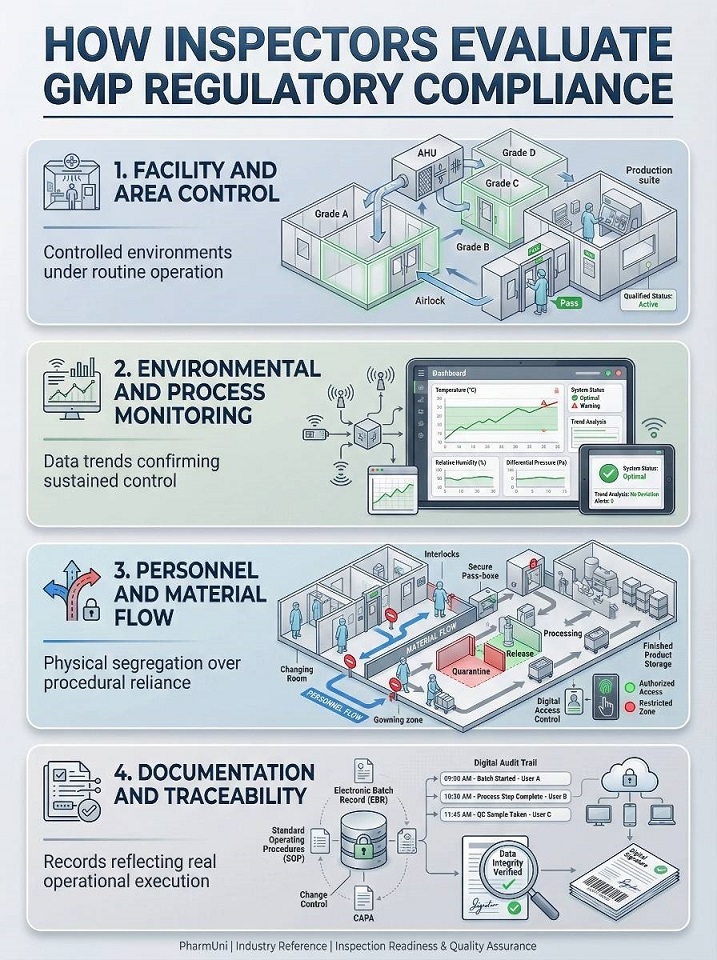
How Inspectors Evaluate GMP Regulatory Complance

Regulators evaluate GMP regulation implementation by observing how regulatory requirements translate into real operational behavior across facilities, personnel, equipment, and documentation during routine manufacturing activities rather than controlled audit scenarios.

This assessment typically focuses on the following operational areas:

  • Facility Design and Controlled Manufacturing Areas
  • Environmental Controls and Monitoring Expectations
  • Personnel and Material Flow Under GMP Rules
  • Documentation, SOPs, and Regulatory Traceability

Facility Design and Controlled Manufacturing Areas

Facility design must support regulatory requirements through defined zoning, controlled manufacturing areas, and risk-based layouts. Inspectors observe whether physical separation, pressure differentials, and access controls remain effective during routine operations.

In real inspections, layout limitations often surface during shift changes or maintenance activities, when controls are most stressed.

Environmental Controls and Monitoring Expectations

Environmental controls demonstrate whether manufacturing conditions remain stable under regulatory expectations. Inspectors review monitoring programs, alert limits, and response timelines to confirm that deviations trigger timely and proportionate action.

Monitoring data that lacks trend analysis or shows repeated excursions undermines confidence in environmental control maturity.

Personnel and Material Flow Under GMP Rules

Personnel movement and material flow remain frequent inspection focus areas. Inspectors observe gowning practices, transfer routes, and segregation logic to confirm that contamination risks are physically controlled rather than procedurally managed.

Sites that rely on operator judgment instead of enforced pathways face higher inspection scrutiny.

Documentation, SOPs, and Regulatory Traceability

Documentation provides regulatory traceability when it reflects real operations. Inspectors examine whether SOPs align with actual practices, deviations are investigated to root cause depth, and decisions remain traceable throughout the quality system.

Inconsistent records often indicate deeper execution gaps rather than administrative errors.

Common GMP Regulation Gaps Found During Inspections

Repeat inspection findings consistently originate from a limited set of unresolved regulatory control gaps.

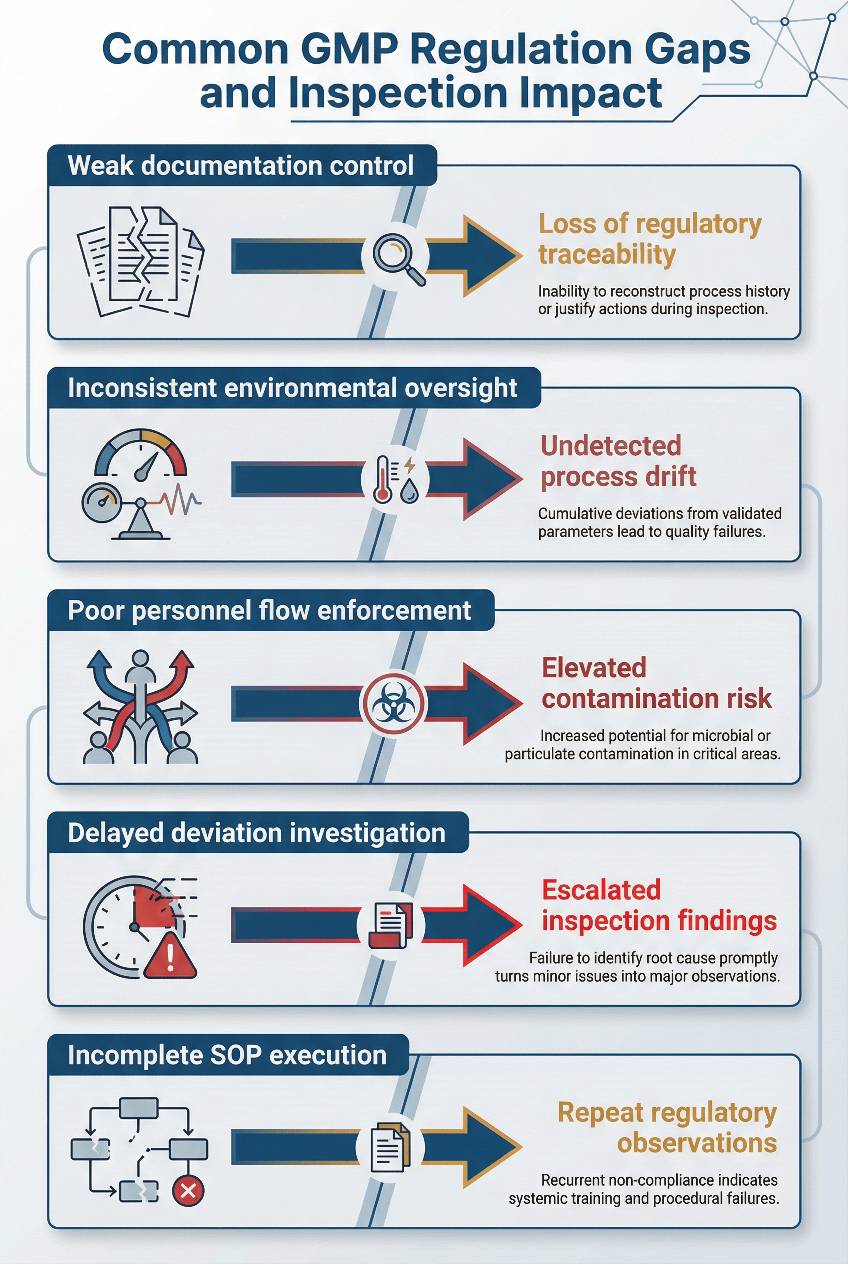
Common GMP Regulation Gaps and Inspection Impact

Recurring inspection findings reveal how regulatory failures develop across manufacturing sites.

Inspectors consistently report gaps related to operational control, documentation discipline, and environmental oversight when regulatory expectations are not fully integrated into daily execution.

Common Regulatory Gap and  inspectionimpact

Common Regulatory Gap Inspection Impact Regulatory Concern
Weak documentation control
Loss of traceability
Inability to defend decisions
Inconsistent environmental monitoring
Hidden contamination risk
Uncontrolled process drift
Poor personnel flow enforcement
Cross-contamination
Reliance on human behavior
Delayed deviation response
Escalating observations
Weak quality ownership
Incomplete SOP execution
Repeat findings
Compliance not sustained

These gaps persist when GMP regulations are treated as static requirements rather than dynamic operational controls.

Practical Steps to Strengthen GMP Regulatory Compliance

Effective compliance requires aligning regulatory expectations with operational reality. Organizations strengthen compliance maturity by reinforcing the following actions:

  • Integrate regulatory requirements into daily production decisions
  • Enforce physical controls over procedural reminders
  • Apply risk-based compliance measures to high-impact operations
  • Maintain documentation that reflects actual execution
  • Prepare facilities continuously, not only before audits

Consistent application of these steps reduces inspection friction and supports long-term regulatory confidence.

Final Word

In the 2023 European inspection cycle, regulators issued 7 formal non-compliance statements that temporarily blocked affected manufacturing sites from supplying regulated markets until critical deficiencies were resolved. These outcomes illustrate a clear regulatory message: failures tied to GMP Regulations are rarely viewed as isolated incidents, but as indicators of deeper weaknesses in operational control and quality system governance.

Organizations that embed regulatory expectations into everyday manufacturing decisions rather than expanding documentation alone maintain stronger inspection readiness, protect market access, and reduce the risk of prolonged regulatory disruption. In most inspections, the line between a manageable observation and a market-impacting outcome becomes visible long before inspectors arrive on site.

FAQs

1️⃣ What do inspectors focus on first when reviewing GMP regulations on site?


Inspectors first assess whether operational controls actually work during routine manufacturing, especially around contamination control, documentation traceability, and process consistency under normal production pressure.

2️⃣ Why do GMP regulatory findings often repeat even after corrective actions?


Findings repeat when corrective actions address documentation or procedures but fail to strengthen underlying operational control, risk management, and execution discipline within the quality system.

3️⃣ How can regulated manufacturing sites reduce inspection risk without major redesign?


Strengthening flow discipline, improving documentation accuracy, and applying risk-based compliance measures across daily operations significantly reduce inspection risk without requiring facility redesign.

Picture of Mahtab Shardi

Mahtab Shardi

Mahtab is a pharmaceutical professional with a Master’s degree in Physical Chemistry and over five years of experience in laboratory and QC roles. Mahtab contributes reliable, well-structured pharmaceutical content to Pharmuni, helping turn complex scientific topics into clear, practical insights for industry professionals and students.

Share