


Features
Topics
Discover

Unlock the potential of your career in the Pharma industry with our online courses and qualifications.

Career Path

Pick a career path, follow its guided course roadmap, and secure industry-verified credentials in a few months.

Courses

Earn career credentials from industry leaders that demonstrate your expertise.

WHO GMP in 2026: Inspection Readiness and Compliance Expectations

In recent inspection cycles, nearly 30–40% of inspected manufacturing sites faced additional regulatory actions after initial audits because operational controls failed to perform consistently under routine production conditions. In 2024, inspection data from multiple regulatory regions further showed that a significant share of critical and major findings were linked to gaps in operational control, contamination management, and facility readiness under WHO GMP expectations. Many of these findings did not arise from missing procedures but from weak execution on the manufacturing floor, leading to delayed approvals and repeat inspections across global supply chains governed by Good Manufacturing Practices.

This article shows how inspectors actually interpret WHO guidance during on-site inspections, why familiar compliance gaps continue to surface across audits, and what operational control looks like in facilities that remain inspection-ready year after year.

Table of Contents

What is WHO GMP in Pharmaceutical Operations )PDF)

WHO GMP defines the globally accepted baseline for controlling quality, safety, and consistency in pharmaceutical manufacturing, particularly for products supplied to international and WHO-supported markets. The core principles are formally documented in WHO Technical Report Series 986, Annex 2 (PDF – downloadable) which inspectors routinely reference when assessing quality systems, facility design, equipment qualification, and production controls.

During inspections, auditors evaluate whether these requirements function effectively under routine manufacturing conditions, not just during scheduled audits. Compliance is judged through observed operational behavior, data trends, and the ability of controls to prevent contamination, manage deviations, and maintain product integrity under normal production pressure.

Why It Matters for GMP Compliance

Inspection readiness emerges when environmental controls, operational discipline, and risk management function as a single system rather than isolated compliance elements.

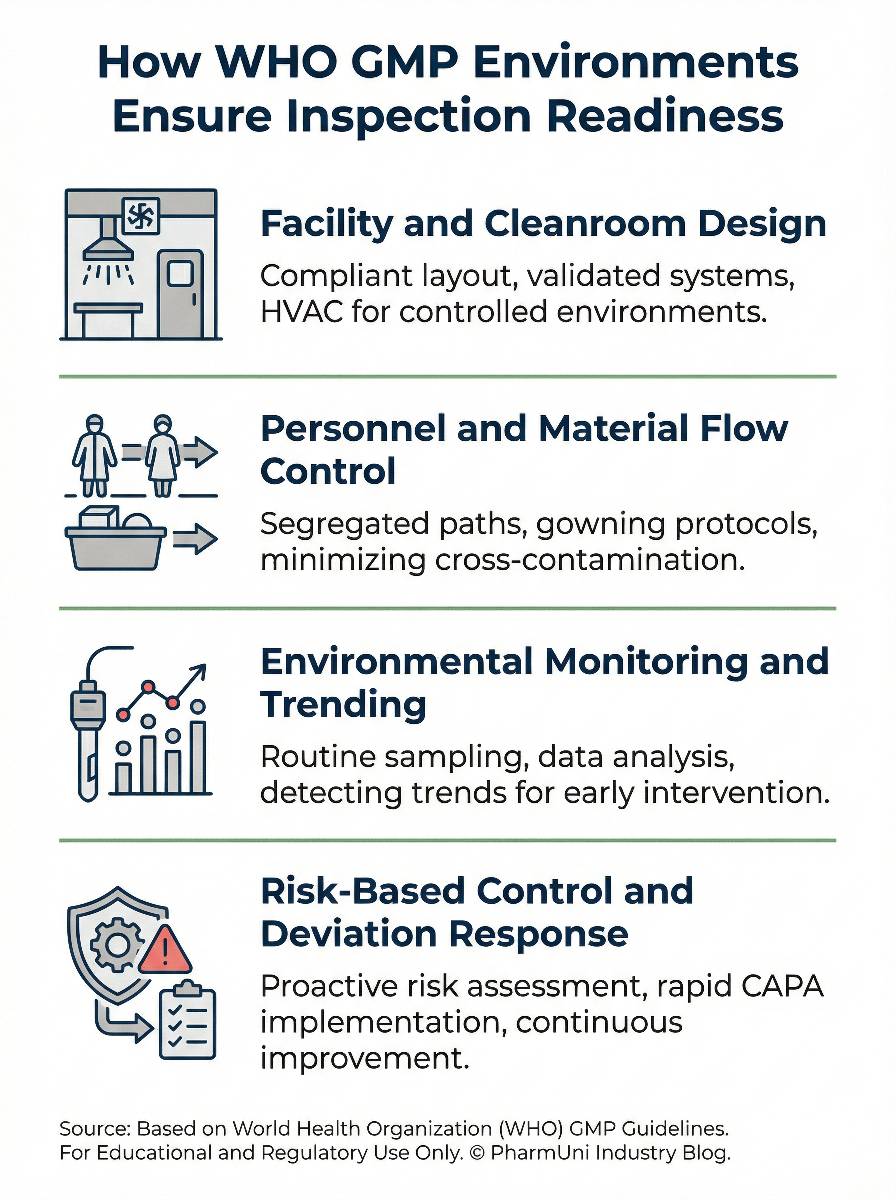
How WHO GMP Environments Ensure Inspection Readiness

Regulatory inspection readiness matters because it directly shapes how inspectors judge operational control and risk management during inspections.

Facilities aligned with WHO expectations demonstrate consistency across production, monitoring, and corrective actions. Inspectors look for evidence that contamination risks are anticipated, not merely documented, and that controls remain effective during routine manufacturing, maintenance, and shift changes.

Inspection trends show that deviations tied to environmental control or process execution often escalate when organizations rely on documentation alone. As a result, proactive control strategies carry more regulatory weight than extensive procedural libraries.

Core Inspection Framing

Inspectors assess compliance by examining how well contamination risks are controlled at critical operational interfaces within the GMP quality management system. Rather than reviewing individual procedures in isolation, they look for alignment between facility design, personnel behavior, equipment use, and monitoring outcomes during routine manufacturing. When these elements reinforce each other, inspection outcomes remain stable. When they do not, deviations surface quickly.

This section focuses on the operational controls inspectors prioritize when assessing regulatory inspection readiness:

  • Cleanroom Contamination Control with Environmental Monitoring
  • Material Flow and Personnel Movement Controls
  • Equipment Segregation with Validated Cleaning Procedures
  • Risk-Based Contamination Controls in GMP Compliance

Cleanroom Contamination Control with Environmental Monitoring

Effective contamination control relies on aligning cleanroom classification, airflow design, and environmental monitoring with actual process risk. Inspectors evaluate whether monitoring locations and frequencies reflect product exposure rather than legacy assumptions.

In practice, inspectors review trend data to confirm stability over time. Facilities that investigate excursions promptly and adjust controls based on data demonstrate stronger compliance maturity during inspections.

Material Flow and Personnel Movement Controls

Uncontrolled personnel and material movement remains a frequent inspection concern. Inspectors observe how operators move between areas, how materials enter and exit controlled zones, and whether segregation is enforced by design rather than memory.

Facilities that rely on informal practices or verbal instructions struggle to defend flow integrity under inspection scrutiny.

Equipment Segregation and Contamination Prevention

Equipment sharing introduces contamination and mix-up risk when segregation and cleaning validation are weak. Inspectors assess whether equipment use aligns with room classification and whether cleaning procedures are validated, documented, and consistently executed.

During inspections, repeated equipment-related findings often indicate systemic gaps rather than isolated errors.

Risk-Based Contamination Controls in GMP Compliance

Risk-based control focuses resources on operations with the highest potential impact on product quality. Inspectors expect facilities to justify control intensity using risk assessments rather than applying uniform rules.

Clear risk ownership during inspections becomes visible when daily decisions reflect process impact rather than procedural formality.

Common Inspection Findings in WHO GMP Facilities (PDF)

Inspectors consistently identify recurring deviations related to contamination control, environmental monitoring, material flow, and execution gaps across WHO-aligned manufacturing sites. Common inspection deviations are formally described in WHO Guidance on GMP: Inspection Report (PDF – downloadable)  which outlines how inspectors document observations and classify compliance gaps during GMP assessments. These findings show that repeat citations most often stem from weak operational control rather than missing procedures or incomplete documentation.

Common Inspection Gap Typical Inspection Concern Expected Corrective Focus
Inadequate environmental monitoring trending
Early loss of contamination control
Strengthen statistical trend review and escalation
Weak material and personnel segregation
Increased cross-contamination risk
Redesign physical flow and zoning controls
Incomplete cleaning validation
Residual carryover risk
Re-validate worst-case cleaning scenarios
Delayed deviation investigation
Loss of process control
Shorten response timelines and assign ownership
Inconsistent execution of procedures
Compliance not sustained in practice
Reinforce operational discipline and supervision

These inspection patterns demonstrate how findings tied to regulatory inspection readiness concentrate on execution under routine production conditions rather than isolated technical failures.

Practical Strategies for Inspection Readiness

Inspection-ready operations translate contamination risks into clear, enforceable control strategies that remain effective under routine manufacturing pressure.

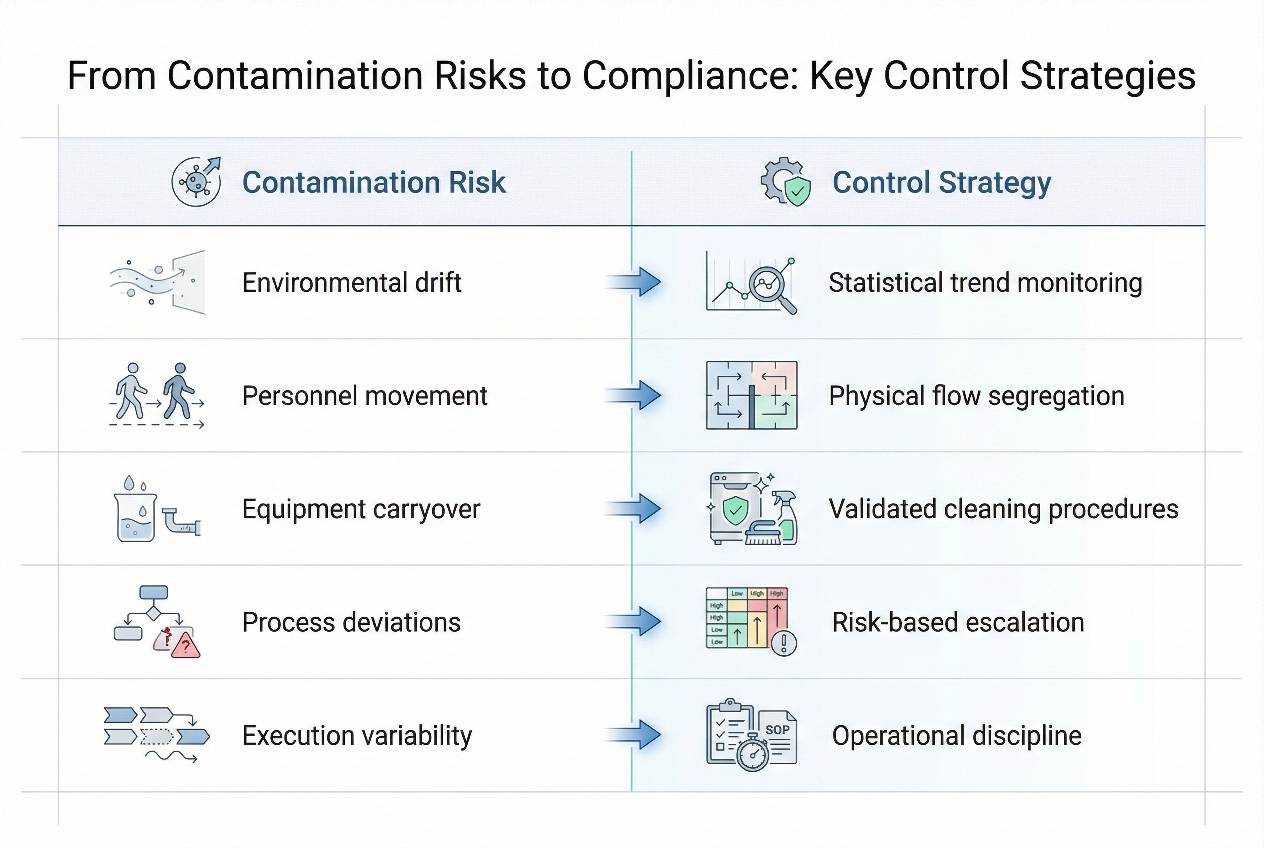
From Contamination Risk to Compliance: Key Control Strategies

Effective operations translate contamination risks into clear, enforceable control strategies that remain effective under routine manufacturing pressure.

Inspection-ready facilities translate standards into consistent operational behavior.

The following strategies help reduce contamination risk and support compliance:

  • Align monitoring programs with high-risk operations
  • Enforce physical flow controls instead of procedural reminders
  • Use trend analysis to trigger early corrective action
  • Integrate risk management into change control decisions

Consistent application of these strategies helps maintain control during routine production and regulatory inspections.

Final Word

In the 2023 GMP inspection cycle, European authorities issued 7 non-compliance statements following on-site inspections, temporarily preventing affected manufacturing sites from supplying products to regulated markets until critical deficiencies were resolved. This outcome underscores a recurring reality in regulatory practice: inspectors do not treat environmental or execution failures as isolated events, but as signals of deeper weaknesses in site governance and operational discipline.

For organizations operating under WHO GMP, inspection readiness depends less on expanding documentation and more on whether facility design, day-to-day behavior, and risk controls consistently reinforce each other under routine manufacturing conditions.

Operations that actively challenge their controls during normal production rather than preparing only for scheduled audits reduce the likelihood of repeat findings, protect market access, and avoid prolonged regulatory disruption. In most inspections, the difference between a manageable observation and a market-impacting outcome becomes visible well before inspectors arrive on site.

FAQs

1️⃣ What do global GMP expectations mean in daily pharmaceutical operations?

They mean teams must control quality through routine execution, not only written procedures. Inspectors check if controls work during normal production.

2️⃣ Why do GMP findings continue, even when SOPs exist?

Many sites write procedures but apply them inconsistently. Inspectors often find weak execution, delayed investigations, or poor control integration.

3️⃣ Why is contamination control central during pharmaceutical inspections?

Contamination risks can directly affect product quality and patient safety. Inspectors expect effective controls, monitoring, and fast escalation.

Picture of Mahtab Shardi

Mahtab Shardi

Mahtab is a pharmaceutical professional with a Master’s degree in Physical Chemistry and over five years of experience in laboratory and QC roles. Mahtab contributes reliable, well-structured pharmaceutical content to Pharmuni, helping turn complex scientific topics into clear, practical insights for industry professionals and students.

Share