


Features
Topics
Discover

Unlock the potential of your career in the Pharma industry with our online courses and qualifications.

Career Path

Pick a career path, follow its guided course roadmap, and secure industry-verified credentials in a few months.

Courses

Earn career credentials from industry leaders that demonstrate your expertise.

Audit Observation in Pharma (2026 guide): Meaning, Types, and GMP Classification

An Audit Observation is a documented issue noted during a pharma audit or inspection. In FDA’s Form 483 FAQ, Form 483 notifies management of objectionable conditions, explains the purpose of the observation, and encourages a written corrective-action response after the closeout discussion for site leadership. 

In Good Manufacturing Practices (GMP), WHO guidance highlights 2 broad production risks: cross-contamination/mix-ups and false labelling. FDA’s Inspectional Observations and Citations page adds a practical format: each observation starts with a law/regulation citation, then describes the specific condition observed, typically listed by risk significance on Form 483 during inspections. 

Table of Contents

What is an Audit Observation?

An audit observation is a documented issue an auditor finds during an audit review. It shows a gap between actual practice and written GMP requirements in operations.

However, one observation does not always mean immediate product harm or batch rejection. It signals a problem and starts investigation, correction, and prevention actions for teams.

  • 40% trend: weak documentation controls cause missing signatures, dates, and unclear records.

  • 25% trend: training gaps cause repeated errors, inconsistent steps, and delayed CAPA closure.

Different Types of Audit Findings

Audit Findings show gaps between daily practice and GMP requirements during audits. Auditors use them to flag risks, weak controls, and repeated errors. Therefore, teams review observations quickly and plan corrections before problems grow.

  1. Critical: serious product or patient risk.
  2. Major: significant control gap needs prompt action.
  3. Minor: limited issue still needs correction and tracking.
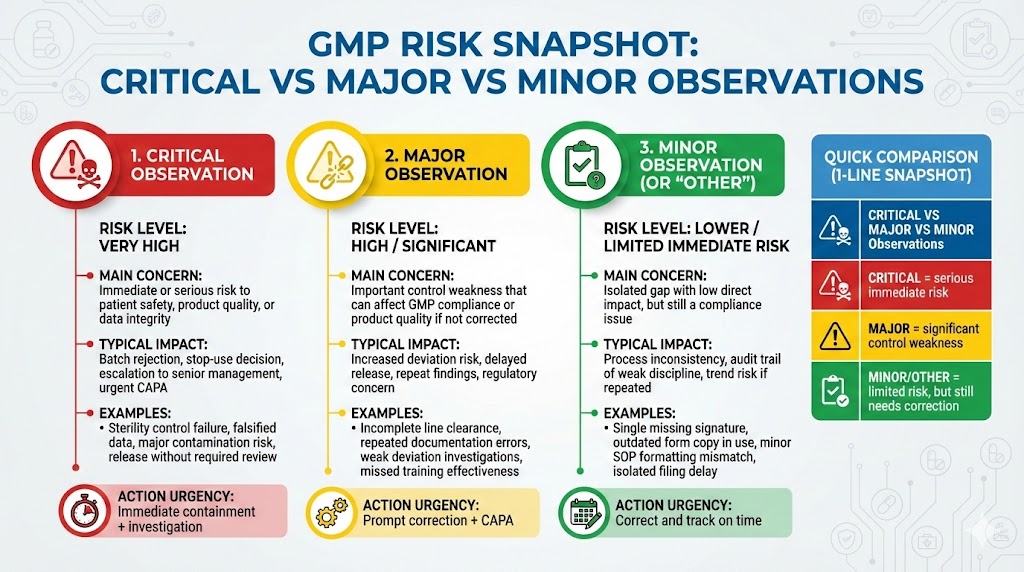
GMP Risk Snapshot

1- Critical Observation

A critical observation shows a serious GMP gap with immediate patient or product risk. Auditors flag it when controls fail and contamination, mix-up, or data risks rise.

Therefore, teams act at once and document containment before deeper investigation starts.

  • Stop affected operations immediately.

  • Quarantine impacted materials and records.

  • Open CAPA and assign ownership.

  • Verify effectiveness before full closure.

2- Major Observation

A major observation shows a significant GMP gap that can weaken control systems. It may not create immediate patient harm, but it needs prompt correction.

  • Fix control gaps fast.

  • Document actions and timelines.

However, teams must investigate the cause and prevent recurrence quickly. Example: An operator skips line clearance checks, and QA finds repeated documentation errors. This pattern increases deviation risk and can delay batch release decisions significantly.

3- Minor Observation

A minor observation shows a limited GMP gap with low immediate risk. It still needs correction and tracking to protect consistency.

However, repeated minor issues can signal weak discipline and future problems. Teams should close these findings on time and keep evidence clear internally.

  • Correct the issue quickly and update the record.

  • Coach the operator and confirm the correct step.

  • Monitor repeats during audits and trend recurring weaknesses.

Terminology and Scope of Inspection Observations

Teams often confuse  observations with final violations and delay strong responses. FDA says Form 483 observations are not final agency determinations. FDA lists observations by risk significance on Form 483.

However, scope improves when teams document citations, evidence, and observed conditions clearly. FDA uses a 2-part observation format: citation first, condition second. This structure supports classification.

  1. Audit Observation Meaning in Pharma
  2. Audit Finding Definition
  3. Why InspectionObservations Matter in GMP
  4. Who Issues Inspection Observations in Pharma Audits

Terminology Crosswalk: Inspection Observation vs Finding vs Deficiency vs CAPA

Term Meaning (Pharma/GMP) Used In CAPA Trigger?
Audit Observation
Documented audit issue showing a gap to a requirement or procedure
Audits / inspections
Sometimes
Finding
Broad audit result (gap, weakness, or improvement point)
Audit reports / closeout
Sometimes
Deficiency
Confirmed GMP shortfall against requirements or controls
Inspection / regulatory context
Usually Yes
CAPA
Process to investigate cause, fix issue, and prevent recurrence
Post-finding response
N/A

1- Inspection Observation Meaning in Pharma

An Inspection observation in pharma is a documented gap noted during an audit. FDA inspectors record observations on Form 483 when they identify objectionable conditions. They describe observed conditions and support inspection discussions with site management. 

However, FDA says Form 483 observations are not final agency determinations. Many firms submit responses within 15 business days to support corrections.

Teams should review 1) evidence, 2) risk significance, and 3) corrective actions quickly. 

2- Audit Finding Definition

Teams often confuse an audit finding with a final violation during EU audits. An audit finding records a documented GMP gap against requirements, controls, or procedures.

However, EMA says GMP/GDP Q&As add interpretation to EU guidelines. EMA also notes national authorities inspect EU sites and inspect many non-EU sites. This scope supports clear classification, risk ranking, and CAPA planning across teams. It improves consistency and speeds response drafting. 

3- Why Inspection Observations Matter in GMP

Inspection observations matter in GMP because they show control gaps before failures grow. They help teams protect product quality, patient safety, and data integrity. Therefore, teams can act early and reduce repeat deviations.

They also support audits, inspections, and management reviews with clear evidence.

  • Prioritize risks and assign CAPA owners faster.

  • Track patterns and improve training, procedures, and supervision.
    This focus strengthens compliance discipline across daily operations consistently.

4- Who Issues Observations in Pharma Audits

Internal QA auditors, supplier auditors, and client auditors issue observations during routine reviews. Regulatory inspectors also issue observations during GMP inspections at manufacturing and testing sites.

However, each issuer uses formats, severity terms, and reporting timelines. They should identify the source first, then align responses and plans.

Observation Grading GMP

Observation grading in GMP ranks findings by risk and urgency. Teams use grades to prioritize audit actions. PIC/S PI 040-1 supports consistent classification across inspectorates. It uses 3 categories: Critical, Major, and Other. 

However, WHO Annex 4 links outcomes to deficiency numbers. It shows acceptable compliance with other deficiencies only. It flags decisions after CAPAs for other plus few majors, for example under six.

Download both guidelines below.

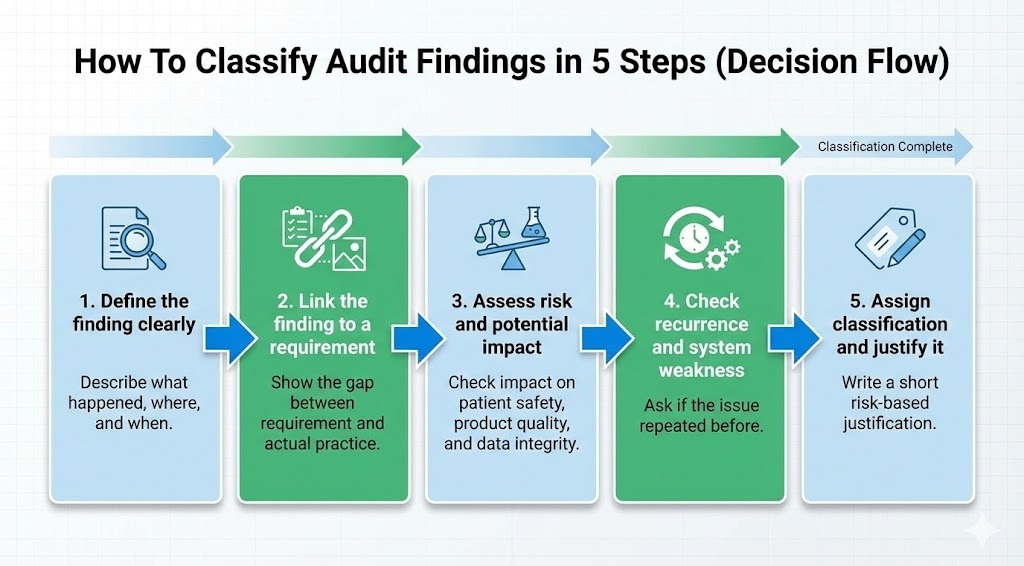
How To Classify Audit Findings

Classify audit findings with evidence, risk, and GMP requirements, not opinion alone. PIC/S PI 040-1 supports risk-based deficiency classification and consistency across inspectorates. It entered into force on 1 January 2019 and guides harmonized reporting.

However, teams should cite the exact requirement and documented condition first. PIC/S also aligns responses around 3 categories: Critical, Major, and Other. This structure improves classification, CAPA prioritization, and audit closeout decisions consistently

How To Classify Audit Findings in 5 Steps

Final Words

Audit Observation summarizes a documented gap, its evidence, and its risk context. This article separated observations, findings, deficiencies, and CAPA, then linked classification to response quality. It also stressed consistent terminology, clear evidence, and risk justification. ICH Q9(R1) supports risk-based decisions and reduces subjectivity in evaluations.

However, audit-readiness needs timely response tracking, ownership, and effectiveness checks after closure. Teams should document due dates, actions, and evidence updates consistently internally. ICH Q10 adds a clear pharmaceutical quality system model across lifecycle stages. It supports management review and sustained improvement after repeated observations in GMP inspections.

FAQs

1️⃣ Is an Inspection observation the same as a final regulatory violation?

No. An observation is not always a final regulatory decision. FDA states Form 483 observations do not represent a final agency determination.

2️⃣ How do teams classify audit findings in GMP?

Teams classify findings using evidence, regulatory requirements, and risk impact. PIC/S PI 040-1 supports a risk-based approach and consistency in GMP deficiency classification across inspectorates.

3️⃣ Why do audit matter in GMP operations?

They help teams detect control gaps early and prioritize actions. Correct classification improves CAPA prioritization, response quality, and inspection readiness. FDA also structures observations with citation + observed condition, which supports clearer documentation and follow-up.

References

Picture of Ershad Moradi
Ershad Moradi

Ershad Moradi, a Content Marketing Specialist at Zamann Pharma Support, brings 6 years of experience in the pharmaceutical industry. Specializing in pharmaceutical and medical technologies, Ershad is currently focused on expanding his knowledge in marketing and improving communication in the field. Outside of work, Ershad enjoys reading and attending industry related networks to stay up-to-date on the latest advancements. With a passion for continuous learning and growth, Ershad is always looking for new opportunities to enhance his skills and contribute to pharmaceutical industry. Connect with Ershad on Facebook for more information.

Share